
Best Hosting Platforms for Docker Containers (2026) – Top 12 Compared
The same Docker container can cost you USD 0 or USD 25 a month to run, and the gap comes down to who manages the server. Hetzner will rent you a 4 GB box for EUR 5.49 (about USD 6) and let you install Docker yourself. Render will take your Dockerfile, build it, and run it for free, as long as you don't mind it falling asleep after 15 idle minutes. Twelve platforms made this list, split between raw VPS hosts you control and managed platforms that deploy containers for you. This guide shows which fits your workload, with renewal prices and the 2026 free-tier cuts spelled out.
Last reviewed: June 2026. Prices and features verified.
Quick answer: For a one-click Docker box with no terminal work, pick Hostinger. For the most RAM and traffic per dollar on a real KVM server, pick Hetzner. To deploy a Dockerfile with zero server management, Render (free tier) or DigitalOcean App Platform win.
Jump to: Hostinger · Kamatera · Hostwinds · Hosting.com · Akamai (Linode) · DigitalOcean · ASPHostPortal · Vultr · Hetzner · Render · Railway · Fly.io
How We Selected These Providers
Three things got a provider cut before pricing even mattered. First, the virtualization had to support Docker. Any host running OpenVZ or shared-kernel containers was out, because Docker needs true KVM virtualization (where each server gets its own kernel) or a purpose-built container runtime. Second, the Docker path had to be real, not a marketing label. One provider here advertises "Docker hosting" that turns out to be Windows shared hosting, and we kept it in only to show you the difference. Third, we ignored any plan needing more than a 36-month prepay to hit its headline rate.
Weighting reflected the Docker angle, not generic hosting. We scored one-click or Dockerfile deployment, price per GB of RAM, included traffic and egress fees, KVM confirmation, and region count. Sources were official pricing pages (checked June 2026), recent provider docs, and user-review aggregators with 50-plus reviews. We did not run load tests or measure build times ourselves, and a couple of renewal rates (Hosting.com's VPS, ASPHostPortal's multi-year terms) could not be confirmed on the live product pages. Those are flagged in the sections below.
| Hosting Provider | Reviews | Overall Rating | Docker VPS Starts from |
|---|---|---|---|
1  Hostinger Hostinger
|
63.2k+ |

|
$4.99 / mo. 80% Off |
2  Kamatera Kamatera
|
320 |

|
$4.00 / mo. 30 Days free |
3  Hostwinds Hostwinds
|
1.5k+ |
|
$4.99 / mo. |
4  A2 Hosting A2 Hosting
|
3.4k+ |
|
$2.99 / mo. NOW -76% |
5  Linode Linode
|
242 |

|
No data / mo. |
6  Digital Ocean Digital Ocean
|
1.9k+ |

|
No data / mo. |
7  ASPHostPortal.com ASPHostPortal.com
|
510 |
|
No data / mo. |
8  Hetzner Online Hetzner Online
|
2.3k+ |
|
$4.28 / mo. |
1. Hostinger

 63.2k+
4.6
Positive
Positive
63.2k+
4.6
Positive
Positive









| Storage | Cpu | Ram | Price | |
|---|---|---|---|---|
| 50 GB | 1 core | 4 GB | $4.99 / mo. | View Plan |
| 100 GB | 2 cores | 8 GB | $5.99 / mo. | View Plan |
| 200 GB | 4 cores | 16 GB | $10.49 / mo. | View Plan |
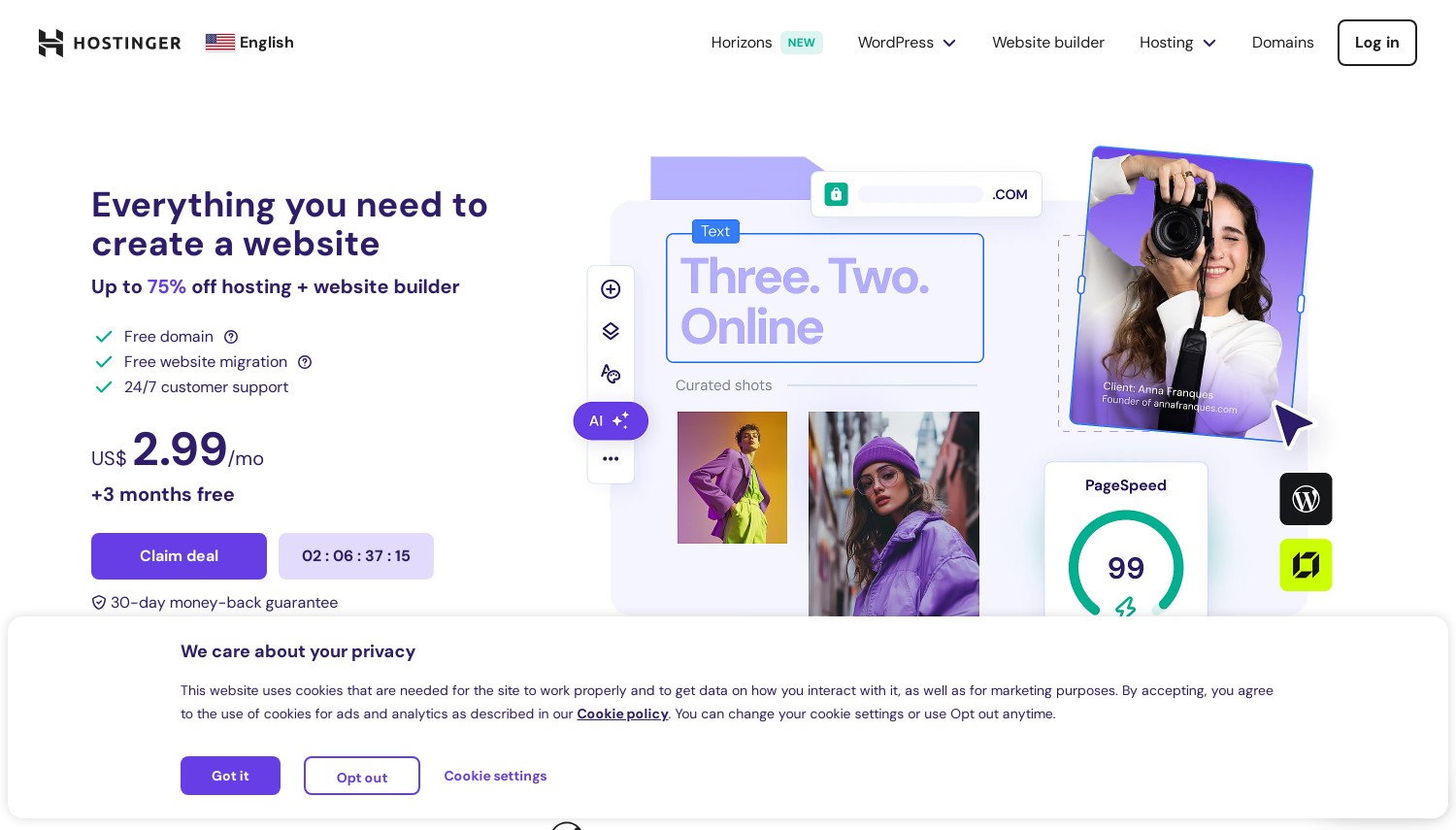
Hostinger – Best for one-click Docker without the terminal
From USD 4.99/mo on a 24-month term, renews at USD 11.99/mo. 1 vCPU, 4 GB RAM, 50 GB NVMe, 4 TB bandwidth, KVM. 30-day money-back.
Say you've never touched a Docker command and don't want to start now. Hostinger's KVM VPS plans ship with a Docker Manager built into hPanel, the control panel. You open a catalog, search for an app, click deploy, and the container runs. Docker Compose templates and Portainer (a visual container dashboard) install the same way, and Hostinger handles security updates on the one-click stacks. For people who want containers without a shell session, nothing else here is this hands-off.
The hardware backs it up. Hostinger's KVM 1 hands you 4 GB of RAM for USD 4.99; Kamatera's USD 4 Basic gives you 1 GB. Four times the memory for 99 cents more. That headroom matters because a single 1 GB box chokes once you stack three or four containers.
Now the trade-off. You prepay 24 months to get USD 4.99, and the price more than doubles at renewal. There's no hourly billing, so you can't spin a box up for an afternoon and kill it. And you pick your data center once, with no live migration later.
- Built-in Docker Manager with one-click app catalog, no CLI needed
- 4 GB RAM at the entry tier, ahead of most rivals here
- 50 GB NVMe storage and 4 TB bandwidth included
- Free SSL, weekly backups, and the Kodee AI helper
- Renewal jumps to USD 11.99/mo, roughly 2.4x the promo
- Term prepay only, no hourly or per-minute option
- Data center is fixed once the VPS is built
Pricing covers the VPS, panel, and backups. There are no separate Docker fees, which is rare. The thing to watch is the second-term bill, not the first.
Best for: beginners who want Docker running through a GUI. Skip if: you need hourly billing or hate renewal jumps.
Choose Hostinger if the one-click Docker Manager is the feature you're paying for and you'll commit two years. If you'd rather not prepay or you want flat lifetime pricing, Kamatera bills by the minute and Hetzner holds its rate forever at a similar spec.
2. Kamatera
 320
4.2
Positive
Positive
320
4.2
Positive
Positive





| Storage | Cpu | Ram | Price | |
|---|---|---|---|---|
| 20 GB | 1 x 2.6GHz | 1 GB | $4.00 / mo. | View Plan |
| 20 GB | 1 x 2.6GHz | 2 GB | $6.00 / mo. | View Plan |
| 30 GB | 2 x 2.65GHz | 2 GB | $12.00 / mo. | View Plan |
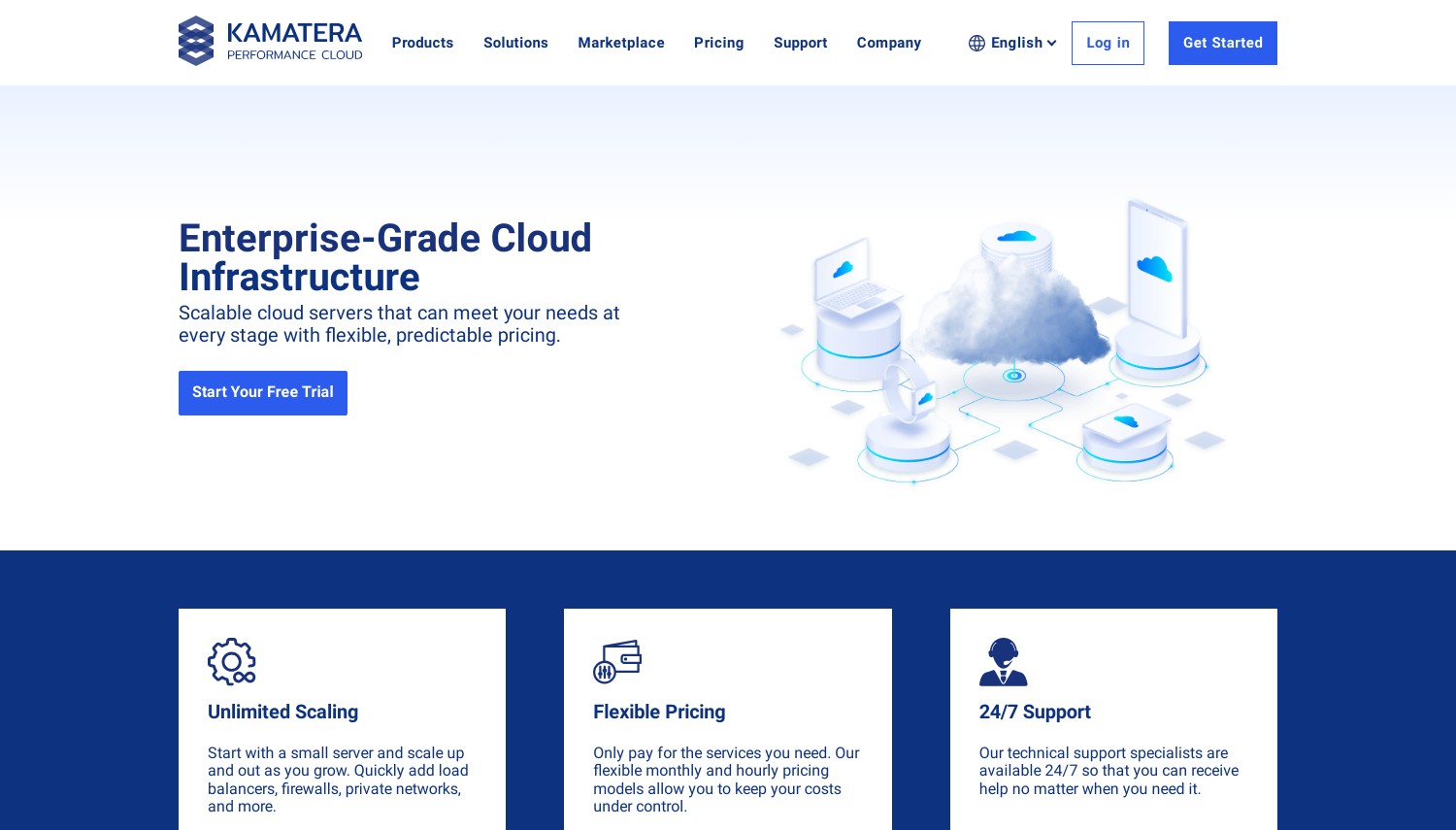
Kamatera – Best for hourly and burst Docker workloads
USD 0.014/hr or USD 4/mo. 1 vCPU, 1 GB RAM, 20 GB NVMe, 5 TB traffic, KVM. 30-day free trial with up to USD 100 credit, no card.
USD 0.014 an hour. That's the number that defines Kamatera for container work. You build a server in any of 18 regions, run your containers, then stop the machine and stop paying. For testing an image across regions, spinning up throwaway environments, or handling a traffic spike that lasts a weekend, per-minute billing beats a monthly commitment every time.
Everything is configurable. You dial in vCPU, RAM, and disk separately instead of picking a fixed tier, and dedicated-CPU options remove the noisy-neighbor problem (zero CPU steal). Kamatera documents Docker, Compose, and Kubernetes on its KVM servers, with full root access. The trial is generous too: 30 days and up to USD 100 in credit without a card, which is a real sandbox, not a teaser.
Where Hostinger gives you 4 GB at entry, Kamatera's USD 4 Basic starts at 1 GB and 20 GB of storage. Hetzner's CX23 quadruples that RAM for about USD 2 more. So Kamatera's value isn't the base spec, it's the billing model and the global reach.
- True per-minute billing, stop the server to stop charges
- 18 data center regions across 4 continents
- Fully custom CPU, RAM, and storage; dedicated-CPU option
- 30-day trial, up to USD 100 credit, no card required
- No one-click Docker template, you install it yourself
- 1 GB base RAM is thin for multi-container stacks
- No traditional money-back guarantee (trial instead)
Pricing is flat with no renewal markup, billed hourly or monthly. The 1 GB tier is fine for a single service; budget for 2 GB or 4 GB once you run a stack. Storage stays at 20 GB unless you add more.
Best for: CI runs, regional testing, short-lived containers. Skip if: you want a guided setup or a fat box for cheap.
Pick Kamatera when you spin containers up and tear them down, or need a region Hostinger and Hetzner don't have (Tokyo, Sydney, Tel Aviv). If you run one always-on container and want maximum RAM per dollar, Hetzner is the better buy. If you want a click-to-deploy panel, go Hostinger.
3. Hostwinds
 1.5k+
4.4
Positive
Positive
1.5k+
4.4
Positive
Positive
| Storage | Cpu | Ram | Price | |
|---|---|---|---|---|
| 30 GB | 1 core | 1 GB | $4.99 / mo. | View Plan |
| 30 GB | 1 core | 1 GB | $8.24 / mo. | View Plan |
| 50 GB | 1 core | 2 GB | $9.99 / mo. | View Plan |
Hostwinds – Best cheap unmanaged KVM for a single app
From USD 4.99/mo, flat pricing. 1 vCPU, 1 GB RAM, 30 GB SSD, 1 TB bandwidth, 1 Gbps port, KVM. 72-hour refund window.
Where Hosting.com's entry VPS renews near USD 9, Hostwinds holds USD 4.99 for the life of the account. That flat pricing is the reason to look here. It's an unmanaged Linux VPS on KVM, so Docker runs natively once you SSH in and install it. You also get an hourly cloud-billing option if you'd rather not commit monthly, plus nightly snapshots even on the unmanaged tier, which most budget hosts charge extra for.
At the same USD 4.99, Hostwinds gives 30 GB of SSD against Hosting.com's 20 GB NVMe, and it holds that price while Hosting.com climbs. The catch shows up on the map. Hostwinds runs only three data centers: Seattle, Dallas, and Amsterdam. No Asia, no Oceania, no South America. If your users sit in Singapore, latency will hurt, and Kamatera or Akamai will serve them far better.
The refund window is the other weak spot. You get 72 hours, the shortest on this list. Test fast or you're committed.
- Flat USD 4.99 with no renewal increase
- 30 GB SSD and a 1 Gbps port at entry
- Nightly snapshots included on unmanaged plans
- Monthly or hourly cloud billing
- Only 3 data centers, all US and EU
- 72-hour refund window is harsh
- No Docker tooling, pure DIY on the VPS
Pricing is honest: what you sign up for is what you renew at. The 1 GB RAM tier suits one container or a small Compose file. Step up to 2 GB if you plan to run a database alongside your app.
Best for: a budget single-container app served to US or EU users. Skip if: you need Asian regions or a long trial.
Hostwinds wins for a cheap, flat-priced KVM box when your audience is North American or European. If you need a region outside those three cities, Akamai's 41 locations or Kamatera's 18 leave it behind. If you want Docker pre-installed, Vultr's one-click image saves you the setup.
4. A2 Hosting
 3.4k+
4.5
Positive
Positive
3.4k+
4.5
Positive
Positive

| Storage | Cpu | Ram | Price | |
|---|---|---|---|---|
| 20 GB | 1 core | 1 GB | $2.99 / mo. | View Plan |
| 75 GB | 2 cores | 2 GB | $7.99 / mo. | View Plan |
| 150 GB | 4 cores | 4 GB | $9.99 / mo. | View Plan |
Hosting.com – Best AMD EPYC NVMe box, if you ignore the renewal
From USD 4.99/mo promo, renews around USD 9/mo. 1 vCPU, 1 GB RAM, 20 GB NVMe, AMD EPYC, KVM, full root. 8 data centers.
Start with the number that bites: the cheapest "Runway 1" unmanaged VPS launches at USD 4.99 and renews near USD 9, roughly an 80% jump. Worse, VPS plans here sit outside the money-back guarantee, so there's no refund safety net if you change your mind. This is the rebranded A2 Hosting (the change landed in April 2025), and the old reputation for steep renewals carried over.
So why include it? The hardware is good. You get AMD EPYC CPUs and NVMe storage with full root access on KVM, which runs Docker cleanly after a manual install. For a developer who wants a fast, no-frills box and reads the renewal terms before signing, it delivers.
Hosting.com's USD 4.99 becomes about USD 9 at renewal; Hetzner's EUR 5.49 (about USD 6) never moves, and it carries 4 GB of RAM to Hosting.com's 1 GB. On a pure cost-per-resource basis over two years, that's not close. Hosting.com's argument is the EPYC silicon and the in-house 24/7 support, not the price.
- AMD EPYC CPUs and NVMe storage at entry
- Full root on KVM, Docker installs cleanly
- Optional in-house 24/7 infrastructure support
- Renewal climbs roughly 80% to near USD 9
- VPS plans excluded from the money-back guarantee
- No one-click Docker, manual install only; 8 regions
The entry price is real but temporary. Calculate the second-term cost before you commit, because there's no refund to fall back on. Storage at 20 GB and 0.5 TB transfer is modest, so heavier workloads need a higher tier.
Best for: developers who want EPYC and NVMe and will eat the renewal. Skip if: you want a refund window or flat pricing.
Choose Hosting.com if the AMD EPYC hardware and 24/7 support justify the renewal for you. If you want the same KVM-plus-Docker setup without an 80% price climb, Hetzner and Hostwinds both hold their rates, and Vultr adds a one-click Docker image on top.
5. Linode
 242
3.0
Neutral
Neutral
242
3.0
Neutral
Neutral

Akamai Cloud (Linode) – Best global footprint and managed Kubernetes
USD 5/mo (USD 0.0075/hr, capped). 1 vCPU, 1 GB RAM, 25 GB SSD, 1 TB transfer, KVM. Pay-as-you-go, no renewal markup.
41 regions across 36 cities. Since Akamai bought Linode, the footprint went from 11 locations to one of the widest in cloud hosting, covering North America, Europe, APAC, South America, and India. If your containers need to sit close to users in several continents, this is the reach that delivers it, and the billing is flat hourly with a monthly cap, so no promo-to-renewal surprise.
For Docker, the Linode Marketplace offers a one-click Docker deploy (it provisions via StackScripts and Ansible and can set up Docker Compose on first boot). For orchestration, LKE (Linode Kubernetes Engine) gives you managed Kubernetes when a single host isn't enough. Both run on KVM Linux instances with full developer access. It's worth pairing with our broader cloud hosting comparison if multi-region is your priority.
Akamai's USD 5 Nanode doubles DigitalOcean's USD 4 Droplet on memory (1 GB versus 512 MB) for a dollar more, which makes it the better starter box of the two. One honest caveat: Akamai flags the Nanode shared-CPU line as older hardware aimed at dev and test, so production loads want a higher tier.
- 41 regions, among the widest reach here
- Marketplace one-click Docker plus managed Kubernetes (LKE)
- Flat hourly billing with a monthly price cap
- Mature docs and a large community
- Nanode uses legacy hardware for dev/test
- Unmanaged and developer-oriented, little hand-holding
- You handle OS and software updates yourself
Pricing is predictable: USD 5/mo or the hourly equivalent, no markup later. The 1 GB Nanode handles a couple of containers; move up a tier for anything serving real traffic. Egress past 1 TB is billed per GB.
Best for: multi-region apps and teams heading toward Kubernetes. Skip if: you want the cheapest possible box or managed hand-holding.
Akamai is the pick when geographic spread or a path to managed Kubernetes drives the decision. If you only serve one region and want more RAM per dollar, Hetzner wins outright. If you want a free managed Kubernetes control plane, Vultr's VKE costs nothing for the control layer.
6. Digital Ocean
 1.9k+
3.7
Neutral
Neutral
1.9k+
3.7
Neutral
Neutral
DigitalOcean – Best for deploying a Dockerfile without a server
Droplets from USD 4/mo (512 MB); App Platform containers from USD 5/mo. KVM, per-second billing, USD 200 credit for 60 days.
Picture a developer who has a Dockerfile and no interest in patching an OS. DigitalOcean's App Platform takes the container, builds it, and runs it from USD 5/mo, no server to manage. That's a different product from a raw VPS, and it's the cleanest no-ops path on this list short of Render. If you do want the box, the 1-Click Docker Droplet ships with Docker CE and Compose pre-installed.
The full container story runs three layers deep: a Marketplace Docker Droplet for DIY, App Platform for managed container deploys, and DOKS (DigitalOcean Kubernetes) for orchestration. All on KVM, all with the documentation DigitalOcean is known for. Billing went per-second on January 1, 2026, so you pay only for the minutes you run.
DigitalOcean's App Platform runs a container from USD 5/mo, two dollars under Render's USD 7 Starter, though Render's free tier undercuts both. The weak spot is the USD 4 Droplet: at 512 MB of RAM, it's too small for a real Docker workload, so plan on the USD 6 tier (1 GB) as your true starting point.
- App Platform deploys containers from a Dockerfile, no server ops
- 1-Click Docker Droplet with Compose pre-installed
- Managed Kubernetes (DOKS) for orchestration
- Per-second billing and USD 200 trial credit
- 512 MB entry Droplet too small for Docker; start at USD 6
- No money-back window, only the trial credit
- Bandwidth overages billed per GB
Droplets bill per second; App Platform is plan-based from USD 5. The headline USD 4 is a teaser for Docker purposes; treat USD 6 (1 GB) as the floor for a working container, more if you run a stack.
Best for: shipping a Dockerfile with zero server management. Skip if: you want the lowest raw-VPS price.
Go DigitalOcean when App Platform's no-ops deploy or the documented Droplet-to-Kubernetes path is what you need. If you want a free tier for the same Dockerfile flow, Render beats it. If you want raw RAM per dollar on a VPS, Hetzner is far cheaper.
7. ASPHostPortal.com
 510
4.6
Positive
Positive
510
4.6
Positive
Positive


ASPHostPortal – The "Docker hosting" that isn't a container VPS
"Host One" from USD 3.81/mo (5-year prepay). 5 GB SSD, 60 GB monthly bandwidth, Windows shared hosting with Plesk. 30-day money-back.
Here's the contrarian take: ASPHostPortal markets "Docker Hosting," but what you actually buy is Windows shared hosting (Server 2019/2022) with a Plesk Docker extension bolted on. It's not a Linux container VPS, and it's not KVM. The "single-click Docker" works through the Plesk panel, but a shared Windows plan doesn't give you root, a Linux kernel, or proper resource isolation, which is what real Docker workloads need.
We kept it on the list precisely to flag the difference. If you searched "Docker hosting" and landed on a cheap Windows shared plan, you'd want to know it can't do what a Hetzner or Vultr box does. ASPHostPortal's Host One gives you 5 GB of disk and 60 GB of monthly bandwidth; Hostwinds' USD 4.99 KVM gives 30 GB and 1 TB. Six times the storage, and it actually runs Linux Docker.
The footprint is broad (around 11 to 12 locations) and there's a 30-day money-back guarantee, which is fairer than Hosting.com's no-refund VPS policy. But the renewal rate past the 5-year promo isn't published, and the resource ceiling is too low for container work of any size.
- 30-day money-back guarantee
- Plesk GUI for users who fear the command line
- Broad data center footprint
- Windows shared hosting, not a Linux container VPS
- Only 5 GB disk and 60 GB monthly bandwidth
- Renewal pricing past the multi-year promo unpublished
The USD 3.81 rate needs a 5-year prepay, and what happens after that isn't on the page. For anything resembling a production container, this tier runs out of room immediately.
Best for: Plesk users on Windows who want a managed panel demo of Docker. Skip if: you actually need to run Linux containers, which is most people.
Honestly, almost everyone reading a Docker guide should skip this and take a real KVM VPS. If you want a one-click Docker panel done right, Hostinger's Docker Manager runs on proper Linux KVM. If you want cheap Linux Docker, Vultr or Hetzner cost about the same and do the job.
Vultr – Best balance of cheap KVM and free managed Kubernetes
USD 2.50/mo (IPv6-only) or USD 5/mo with IPv4. 512 MB to 1 GB RAM, 10 to 25 GB NVMe, KVM. 32+ regions, pay-as-you-go.
USD 2.50 a month is the headline, with one asterisk: that tier is IPv6-only. Add a public IPv4 address and you're at USD 5/mo for 1 GB of RAM and 25 GB of SSD. Vultr's USD 2.50 box matches DigitalOcean's 512 MB, but DigitalOcean charges USD 4 there; with IPv4, Vultr's USD 5 plan ties Akamai's Nanode while adding 32-plus regions on top.
For Docker, Vultr's Marketplace has a one-click Docker app (Ubuntu 24.04 with docker-ce ready to go), plus a k3s app for lightweight Kubernetes. The differentiator is VKE, Vultr Kubernetes Engine, whose control plane is free. Hyperscalers charge roughly USD 70 a month for the equivalent managed control layer, so if Kubernetes is on your roadmap, that's real money saved. Everything runs on full KVM virtualization with pay-as-you-go billing.
The 32-plus region count rivals Akamai's reach, and NVMe storage comes standard. The honest catches: the cheapest box drops IPv4, and 512 MB of RAM won't carry a multi-container stack, so budget for the USD 6 High Performance tier if you're running more than one service.
- One-click Docker image plus free VKE control plane
- 32-plus regions, NVMe storage standard
- From USD 2.50/mo, true pay-as-you-go
- k3s app for lightweight Kubernetes
- USD 2.50 tier is IPv6-only, no public IPv4
- 512 MB base RAM is tight for stacks
- Prepaid credit model, no refund guarantee
Billing is usage-based with no renewal markup. Read the IPv4 line before you buy: the real entry for a normal setup is USD 5/mo, not USD 2.50. NVMe and the free Kubernetes control plane are where the value sits.
Best for: cheap Docker now with a free path to managed Kubernetes later. Skip if: you need lots of RAM per dollar today.
Vultr is the smart middle ground: cheap KVM, one-click Docker, and free VKE when you scale up. If you want maximum RAM and traffic for the price right now, Hetzner beats it on raw specs. If you want zero server management, Render or DigitalOcean App Platform take the Dockerfile off your hands.
8. Hetzner Online
 2.3k+
3.1
Neutral
Neutral
2.3k+
3.1
Neutral
Neutral

| Storage | Cpu | Ram | Price | |
|---|---|---|---|---|
| 25 GB | 1 core | 1 GB | $4.28 / mo. | View Plan |
| 50 GB | 2 cores | 2 GB | $7.58 / mo. | View Plan |
| 100 GB | 2 cores | 4 GB | $13.06 / mo. | View Plan |
Hetzner – Best RAM and traffic per euro for real Docker
CX23 from about USD 6/mo (EUR 5.49); ARM CAX11 EUR 5.99. 2 vCPU, 4 GB RAM, 40 GB NVMe, 20 TB traffic, KVM. Hourly billing, capped.
Hetzner raised its cloud prices on June 15, 2026, pushing the cheapest CX23 from EUR 3.99 to EUR 5.49 and the ARM CAX11 from EUR 4.49 to EUR 5.99. Even after that rise, nothing here matches its cost per resource. Hetzner's CX23 carries 4 GB of RAM and 20 TB of traffic for about USD 6; Vultr's USD 5 IPv4 plan gives 1 GB and 1 TB. For Docker, where RAM is the wall you hit first, that's a different league.
Setup is easy. Hetzner Cloud offers a one-click "Docker CE" app that pre-installs Docker at server creation, and full cloud-init support automates the rest. It's all KVM, so containers run natively, and the 20 TB of included traffic means egress-heavy workloads (image pulls, API responses) won't surprise you on the bill. There's even an ARM option (CAX11) for cheap multi-architecture image builds.
The limits are honest. Hetzner runs only six data centers (Germany, Finland, Singapore, and two in the US), so global reach trails Akamai and Vultr. There's no managed Kubernetes control plane to match VKE either. And the June price rise means the old sub-EUR-4 deals you'll see quoted elsewhere are stale.
- 4 GB RAM, 20 TB traffic for about USD 6
- One-click Docker CE app plus cloud-init
- NVMe storage and KVM virtualization
- ARM (CAX11) option for multi-arch builds
- June 2026 price rise, up roughly 37%
- Only 6 data centers, no Asia beyond Singapore
- No managed Kubernetes control plane
Billing is hourly with a monthly cap and no renewal markup; existing servers keep their old rate unless rescaled. The 4 GB CX23 is enough for a genuine multi-container stack, which is why it reads as the value pick despite the increase.
Best for: one always-on box running several containers on a budget. Skip if: you need many global regions or managed Kubernetes.
Hetzner wins on raw RAM and traffic per euro, full stop. If your users span Asia, Oceania, or South America, Akamai's 41 regions serve them better. If you want managed Kubernetes without paying for the control plane, Vultr's free VKE is the move.
Render – Best free tier and zero-config Dockerfile deploys
Free web service (512 MB, 0.1 vCPU, 750 hrs/mo); Starter USD 7/mo always-on. Deploys from Dockerfile, 5 regions.
Render kept the thing almost everyone else cut: a real free tier. You point it at a repo, it auto-detects your Dockerfile, builds the image, and runs it for nothing, with 750 instance hours and 100 GB of bandwidth a month. The trade is that free web services spin down after 15 idle minutes and take about a minute to wake, so it's for side projects and demos, not production.
Deployment is the easy part. Render builds from a Dockerfile automatically or runs a prebuilt image from a registry, with no buildpack configuration to fuss over. To kill the cold starts, the Starter plan runs always-on at USD 7/mo. That USD 7 sits above DigitalOcean App Platform's USD 5 container tier, but Render still runs a container for free where Railway and Fly.io now charge from the first hour, so the cheapest always-on alternatives are Railway's USD 5 Hobby or Fly's roughly USD 2 machine.
Pricing is flat and plan-based, which makes it predictable, no usage metering on the basic tiers. The limits are the five-region footprint (Oregon, Ohio, Virginia, Frankfurt, Singapore) and the jump from Starter to the USD 25 Standard tier once you outgrow 512 MB.
- Genuine free tier with 750 hours a month
- Auto-detects and builds from a Dockerfile
- Flat, predictable pricing, no usage metering
- Managed databases and cron jobs alongside services
- Free services sleep after 15 minutes idle
- Only 5 regions
- Standard tier jumps to USD 25/mo
Free covers hobby use; USD 7 Starter buys always-on. The price climbs quickly above that, so map your RAM needs before committing to Render for production.
Best for: hobby projects and Dockerfile deploys you want free or cheap. Skip if: you need a box you control or sub-second cold starts.
Render is the free pick and the simplest Dockerfile-to-URL flow here. If you need always-on at the lowest price, Fly.io's per-second machines run cheaper. If you want full control of the underlying server, any KVM VPS (Hetzner, Vultr) gives you root that Render doesn't.
Railway – Best developer experience for Dockerfile deploys
Hobby USD 5/mo (includes USD 5 usage credit), then metered. Pro USD 20/mo per seat. Dockerfile or Railpack builds, NA/EU/APAC regions.
Where Render gives you a free tier that sleeps, Railway trades that away for polish. Its Hobby plan is USD 5/mo with USD 5 of usage baked in, and the developer experience is the best in this group: push to a branch and it deploys, with managed Postgres, MySQL, Redis, or Mongo wired in over private networking. It builds from a Dockerfile, or via Railpack, its own builder that became the default on March 4, 2026.
Railway runs on its own bare-metal fleet (Railway Metal) in Amsterdam, Singapore, Virginia, and California, bursting into the big clouds when needed. Railway's USD 5 Hobby lands two dollars under Render's USD 7 Starter, but the comparison isn't clean: Railway meters CPU, RAM, and egress on top of that USD 5, while Render's USD 7 is fixed. For steady workloads Railway can be cheaper; for spiky ones it can swing higher.
The honest change: Railway removed its permanent free tier. New users get a one-time USD 5 trial credit (no card, up to 30 days), then drop to a Free plan with about USD 1/month of credit, which barely runs anything. So budget the USD 5 Hobby as your real floor.
- Best-in-class deploy UX, Git push to ship
- Builds from Dockerfile or Railpack
- Managed databases with private networking
- Own bare-metal fleet across NA, EU, APAC
- No permanent free tier, trial credit only
- Usage metering makes spiky-workload bills unpredictable
- Pro plan adds USD 20 per seat
The USD 5 Hobby base plus metered usage is the model; there's no promo-to-renewal trick, just your actual consumption. Watch egress and always-on RAM if your costs need to stay flat.
Best for: developers who want the smoothest Dockerfile-to-production flow with managed databases. Skip if: you need a free tier or fixed monthly cost.
Railway earns its place on developer experience and the bundled databases. If you want a free tier for the same workflow, Render is the only one here that still offers it. If predictable flat billing matters more than UX, Render's USD 7 Starter or a fixed-price VPS won't surprise you at month-end.
Fly.io – Best for global edge containers as microVMs
Pay-as-you-go, per second. Smallest machine about USD 2.02/mo (256 MB); realistic app USD 8 to 25/mo. 18 regions, egress USD 0.02 to 0.12/GB.
About USD 2.02 a month for an always-on machine, the lowest entry here. Fly.io takes your Docker image and runs it as a Firecracker microVM (a hardware-isolated mini-VM), then distributes it across 18 regions, the widest spread of any managed platform on this list. For an app that needs to sit physically close to users worldwide, that edge distribution is the draw, and the per-second billing means you pay only for what runs.
The deployment model is unusual in a good way: your container literally becomes a VM, which gives stronger isolation than a shared container runtime. Fly's smallest always-on machine runs about USD 2.02/mo, less than half Railway's USD 5 Hobby floor. But egress fees (USD 0.02/GB in North America and Europe, up to USD 0.12/GB in Africa and India) can erase that gap quickly, and a realistic small app with restarts and traffic lands closer to USD 8 to 25/mo.
Like Railway, Fly.io ended its free allowances. New organizations get a short trial (a couple of VM-hours or seven days), then it's card-on-file pay-as-you-go. The per-second-plus-egress model is the least predictable here, so it rewards people who watch their metrics.
- Runs Docker images as Firecracker microVMs
- 18 regions, the widest edge reach of the PaaS group
- Cheapest entry, about USD 2.02/mo always-on
- Per-second billing, scale to zero possible
- No free tier, short trial only
- Metered egress, up to USD 0.12/GB in some regions
- Least predictable billing of the managed platforms
There are no fixed plans; you pay per second for compute plus per GB for egress. The USD 2.02 figure is real for a tiny idle-ish service, but model your traffic, because egress is where the bill grows.
Best for: globally distributed apps that need edge presence and strong isolation. Skip if: you want predictable flat bills or a free tier.
Fly.io is the choice when global edge distribution and microVM isolation are the point. If you want predictable monthly cost, Render's flat Starter or a fixed VPS beat it. If you need a free tier to start, only Render still has one.
How to Choose a Docker Host by Workload
Forget feature checklists. The right host depends on what your containers actually do. Here are the workloads that map cleanly to a pick.
One box, several containers: Budget under USD 7/mo? Hetzner CX23 at about USD 6/mo gives you 4 GB of RAM and 20 TB of traffic, enough for several containers plus a database. Skip Hostinger here unless you want the GUI, because its USD 11.99 renewal beats the purpose of going budget. Skip the USD 4 DigitalOcean Droplet too: 512 MB chokes a real stack.
Dockerfile, no server management: Render's free tier handles side projects (accept the 15-minute sleep), and its USD 7 Starter removes the cold starts. For always-on at a lower base, DigitalOcean App Platform starts at USD 5/mo. Choose Railway's USD 5 Hobby instead only if you want bundled managed databases and don't mind usage metering on top.
Short-lived or CI containers: For boxes you spin up and tear down, Kamatera's per-minute billing (USD 0.014/hr) and 30-day USD 100 trial make throwaway environments nearly free. Hetzner and Vultr also bill hourly, but Kamatera's 18 regions and no-card trial win for disposable test boxes. A fixed monthly VPS like Hostwinds wastes money on workloads that run two hours a day.
Heading toward Kubernetes: Vultr's VKE gives you a free control plane (versus roughly USD 70/mo at the hyperscalers), so you pay only for worker nodes. Akamai's LKE is the alternative if you want its 41-region reach. Don't reach for either until a single host genuinely can't hold your containers; managed Kubernetes adds complexity you don't need for three services.
Global edge presence: Fly.io runs your image as a microVM across 18 regions with per-second billing. If you'd rather control the servers yourself, pair Akamai or Vultr regions manually. Still weighing a plain server against a managed platform? Our general VPS hosting guide covers the control-versus-convenience trade in more depth.
Frequently Asked Questions
Do I need a VPS to run Docker, or can shared hosting do it?
For real Docker work, you need a VPS or a container platform, not shared hosting. Docker needs root access and a Linux kernel it can control, which a KVM VPS like Hetzner, Vultr, or Hostwinds provides. Some hosts advertise "Docker" on Windows shared plans (ASPHostPortal is one), but those lack the isolation and root access containers depend on. If you don't want to manage a server at all, a platform like Render or DigitalOcean App Platform runs your container for you.
Which Docker host has a real free tier in 2026?
Render is the only platform here that kept a genuine free tier, with 750 instance hours a month, though free services sleep after 15 idle minutes. Railway and Fly.io both ended their free allowances in 2024 to 2025; they now offer short trial credits only. For an always-on container on a budget, the cheapest paid options are Fly.io's roughly USD 2/mo machine or Railway's USD 5 Hobby plan.
Is a managed platform like Railway cheaper than a Hetzner VPS?
Usually not, once you're past hobby scale. Railway's Hobby plan starts at USD 5/mo and meters CPU, RAM, and egress on top, while Hetzner's CX23 is a flat EUR 5.49 (about USD 6) with 4 GB of RAM and 20 TB of traffic included. You pay Railway extra for the convenience of not managing a server. If your workload is steady and you're comfortable with SSH, the VPS is cheaper; if you value zero ops, the platform earns its premium.
Do I need Kubernetes to run Docker containers?
No. A single Docker host with Docker Compose runs multi-container apps fine, and most projects never outgrow that. Kubernetes earns its keep when you need automatic scaling, self-healing, and rolling deploys across many nodes. If you do reach that point, Vultr's VKE and Akamai's LKE offer managed control planes, and Vultr's control plane is free. Until then, a Compose file on one KVM box is simpler and cheaper.
Final Verdict
Most people overthink Docker hosting. If you want a container running today with no command line, Hostinger deploys one through its Docker Manager, just plan for the USD 11.99 renewal. If you'd rather own a real server and squeeze the most out of every dollar, Hetzner is the clear value winner: 4 GB of RAM and 20 TB of traffic for about USD 6, even after the June 2026 price rise.
For shipping a Dockerfile without touching a server, Render is the free starting point and DigitalOcean App Platform the cheapest always-on managed option. Need to spin containers up and down by the hour? Kamatera. Building toward Kubernetes? Vultr hands you a free control plane. Going global at the edge? Fly.io runs your image as a microVM across 18 regions. And steer clear of any "Docker hosting" that turns out to be Windows shared hosting; if it can't give you root on Linux, it can't really run your containers.
If you're still deciding between a managed platform and a server you control, read our container VPS guide and our roundup of Linux VPS hosting for the broader picture. Both go deeper on the virtualization and management questions that decide how smoothly Docker runs.