Best Web Hosting for Nepal (2026) – Top 8 Providers Compared 🇳🇵
Most Nepal hosting roundups still push providers whose nearest server sits in Frankfurt or Dallas. That's a 280-310ms round trip from Kathmandu when the local fiber path to Mumbai clocks under 50ms. The practical question for any Nepali site owner in 2026 isn't "which host is best globally," it's "who has actually deployed silicon close enough to matter."
Quick answer: Pick Hostinger Mumbai for cheap WordPress with sub-50ms Nepal latency, Himalayan Host if you need a real Kathmandu data center and NPR billing, and Cloudways on DigitalOcean Bangalore for managed scaling above 50k monthly visits.
Jump to: Verpex · Ultahost · Hostinger · Kamatera · SiteGround · Time4VPS · Cloudways · Himalayan Host
Last reviewed: May 2026. Pricing pulled from official provider pages and verified against current sign-up flows.
How We Selected These Hosts for Nepal
Three filters narrowed this list. First, a verifiable data center within reasonable latency of Kathmandu: India (Mumbai, Bangalore), Singapore, Hong Kong, or Nepal itself. Anything routing through Europe got cut unless the provider offered an Asian region as a sign-up option. Second, transparent renewal pricing on the public pricing page, no obscured terms or "call sales" entry plans. Third, aggregate user ratings above 4.0/5 across at least 100 independent reviews (we don't quote review aggregator scores in the body, but they shaped the shortlist).
Weighting reflects what matters for Nepal specifically. Latency to Kathmandu via Indian Tier 1 transit got the heaviest weight, since most Nepali sites serve a domestic-first audience. NPR/Indian rupee billing or local payment rails (eSewa, Khalti, IMPS) was a tiebreaker for the local providers. We weighted entry-to-renewal ratio heavily for shared plans, because two of the seven international hosts here lift renewal by 3.5x or more.
Honest limitations: we didn't run synthetic load tests from a Kathmandu probe, and we couldn't independently audit Tier-3 claims at every Nepali facility. Where uptime claims came only from provider marketing and not from a third party, we say so.
Verpex Hosting – Best Cheap Multi-Region Option for Nepal
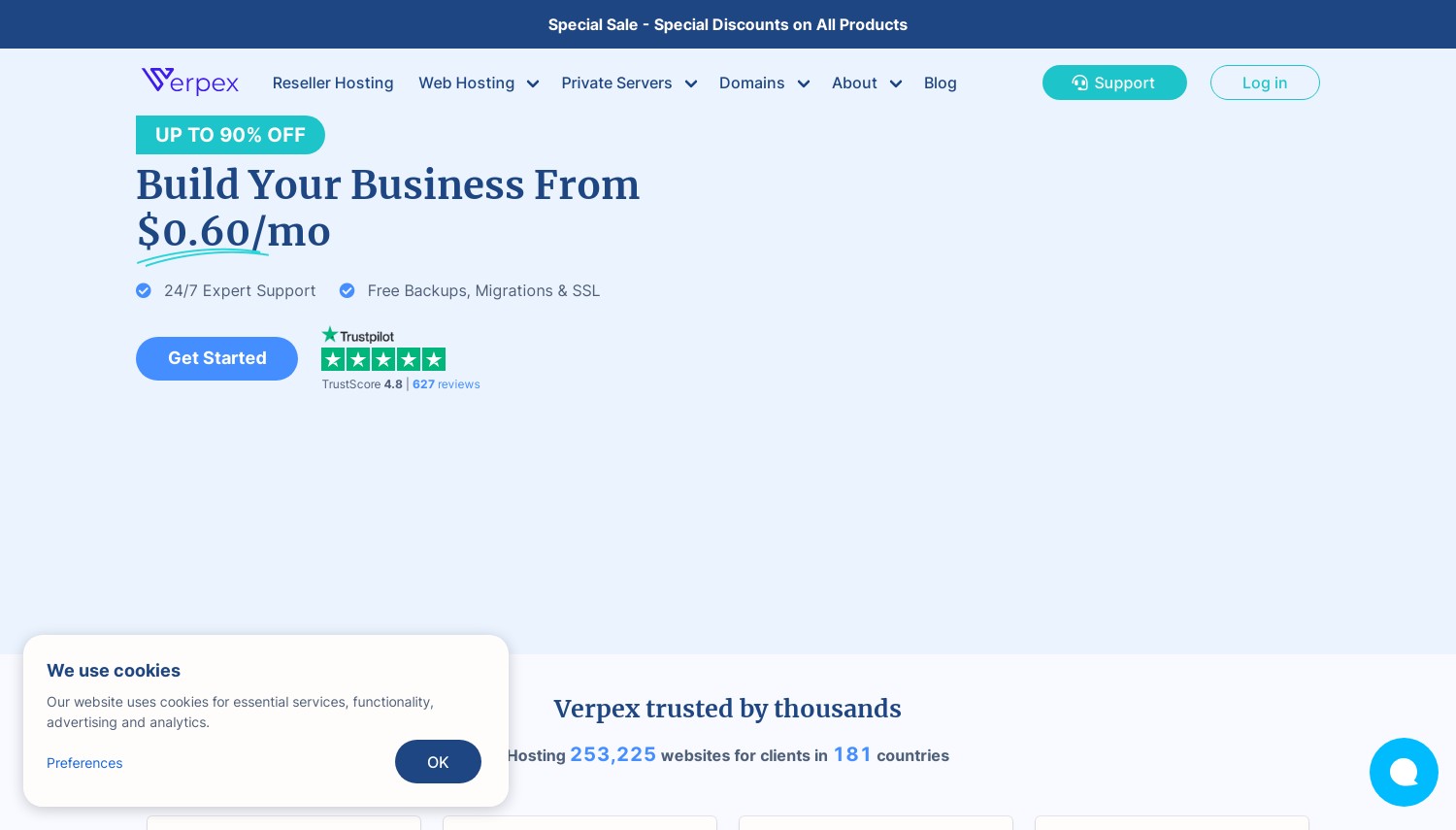
USD 0.60/mo. That's the listed Verpex Bronze "from" rate, which evaporates the moment you pick a one-year term instead of a 36-month commit. Real-world entry sits closer to USD 2.50-3.99/mo depending on the cycle, and the Bronze plan renews at USD 6/mo. That renewal number is what matters, and it lands roughly 50% below where Hostinger Premium renews (USD 11.99/mo) for a comparable shared tier.
Nepal users get one thing from Verpex that most cheap shared plans skip: data center choice at sign-up. The same Bronze plan can be deployed in Mumbai, Bangalore, or Singapore at sign-up, which means you can pick the route with the lowest measured latency from your visitor base. Mumbai and Bangalore both sit on transit paths that reach Nepal in 35-55ms via NTC and Worldlink upstream peering. Singapore adds another 30-40ms.
Bronze ships 50 GB NVMe storage, unlimited bandwidth, and free SSL on a single domain. Silver (USD 10/mo renewal) lifts to 100 sites, Gold (USD 15/mo renewal) drops the cap entirely. There's a 60-day money-back window, longer than the industry-standard 30.
Pros:
- Three Asian DC options (Mumbai, Bangalore, Singapore) at the same plan price
- Renewal stays under USD 6/mo on Bronze, no surprise lift
- 60-day money-back, double the industry default
- Free daily backups included on all shared tiers
Cons:
- The "USD 0.60/mo" headline rate requires a 36-month prepayment
- No Nepal data center, so you depend on Indian transit quality
- Smaller support team than Hostinger or SiteGround, response times vary
Pricing: Bronze from USD 2.50/mo intro on common cycles, renews USD 6/mo. Silver USD 10/mo renewal. Gold USD 15/mo renewal.
Best for: Nepali bloggers and small businesses who want sub-50ms latency to Kathmandu without the renewal trap that breaks Hostinger's price story at year two.
Skip if: You need NPR billing or local payment rails. Verpex bills in USD only.
Verdict: Buy Verpex Bronze if you're running 1-3 Nepali sites and care about year-two cost more than year-one promo. If you want the cheapest possible entry at any cost, Hostinger still wins year one. If you need NPR billing, skip both and go to Himalayan Host.
Ultahost – Best Asia-Wide VPS Coverage for Nepal Agencies
Ultahost markets a "cloud hosting" tier, but the India and Singapore products are managed VPS in everything but the marketing copy. That's not a complaint, it's the actual reason the Nepal use case works: you get root access, isolated CPU, and predictable resource ceilings that shared plans can't match.
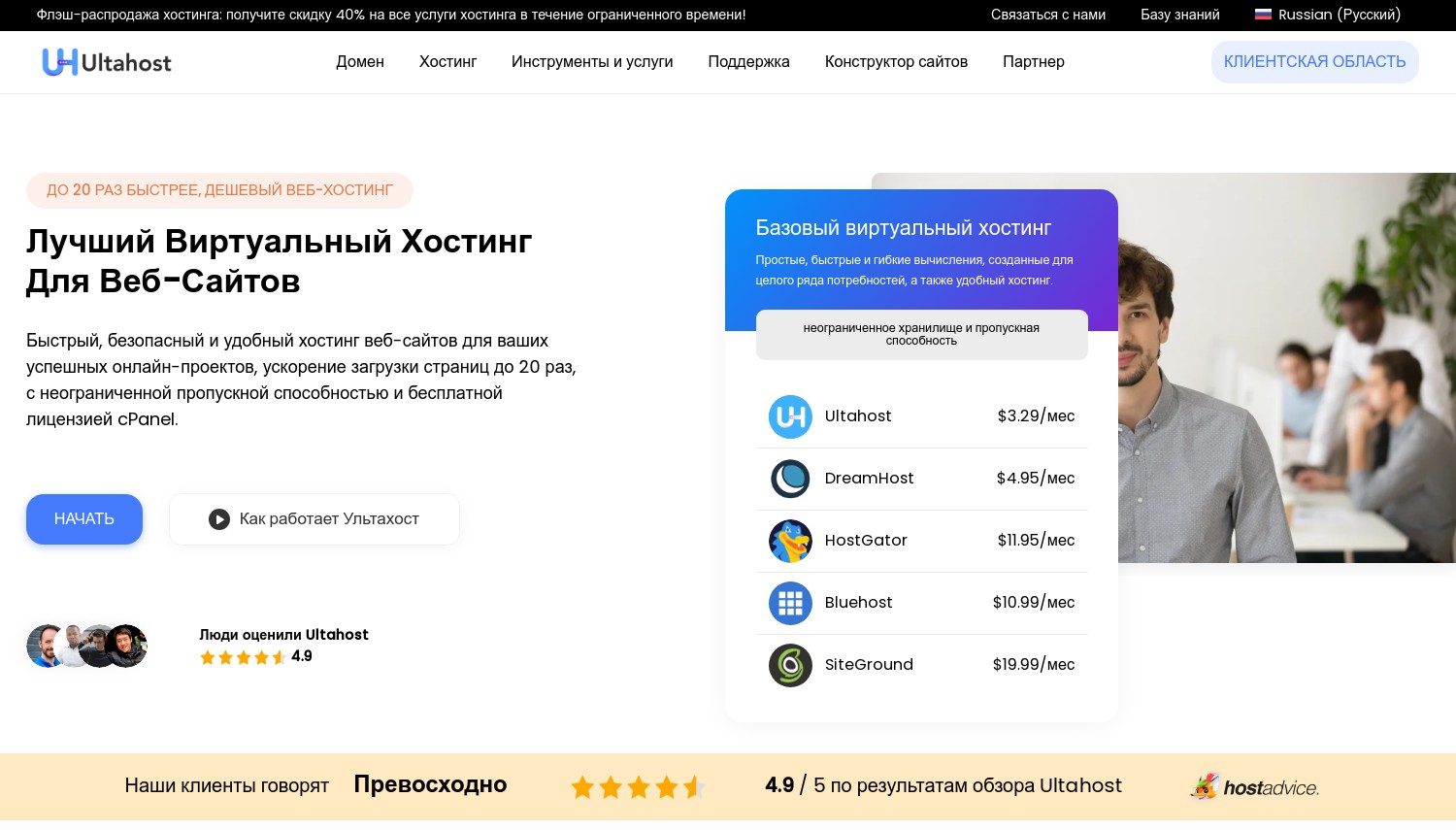
Asian footprint is where Ultahost separates from most mid-sized hosts. Their VPS Singapore base plan renews at USD 4.80/mo on a 24-month cycle, and the India location holds the same number, which is rare. That undercuts Time4VPS Linux 2 (EUR 2.89/mo, roughly USD 3.10 entry but with renewal lift) on raw flexibility, and it sits 56% below Cloudways' DigitalOcean 1GB at USD 11/mo. The catch: Ultahost VPS plans are managed, but management is lighter touch than Cloudways' control panel and full-stack patching.
Run the math for a Nepali agency hosting 5-15 client sites and the gap widens fast. Three Ultahost Singapore VPS at USD 8.50/mo (the second tier with extra RAM) totals USD 25.50/mo, which is what you'd pay Cloudways for one DigitalOcean 2GB instance. The trade is that you handle plugin updates and PHP versions yourself.
Pros:
- India and Singapore VPS at USD 4.80/mo base, fixed-renewal pricing
- Full root access on a managed shell, lightweight cPanel option included
- 13+ data center regions including Mumbai, Singapore, Tokyo, Seoul, UAE
- Free migration handled by their team, not a self-service plugin
Cons:
- "Cloud" branding is misleading, these are managed VPS without true autoscaling
- Backup retention defaults to 7 days, less than Verpex's 30
- Lower brand recognition means fewer third-party tutorials when you hit edge cases
Pricing: VPS India/Singapore base USD 4.80/mo (24-month), tier 2 USD 8.50/mo. Renewal locks at sign-up rate per Ultahost's published policy.
Best for: Nepali developers and agencies who want fixed VPS pricing in Singapore or Mumbai without Cloudways-level markup.
Skip if: You want zero server management. Pick Cloudways or SiteGround instead.
Verdict: Pick Ultahost for production VPS where you can handle the OS layer yourself. If you can't, Cloudways is worth the extra USD 6/mo for the managed control panel. If your workloads are tiny and shared hosting suffices, drop down to Verpex Mumbai.
Hostinger – Cheapest Mumbai-Hosted WordPress for Nepali Bloggers
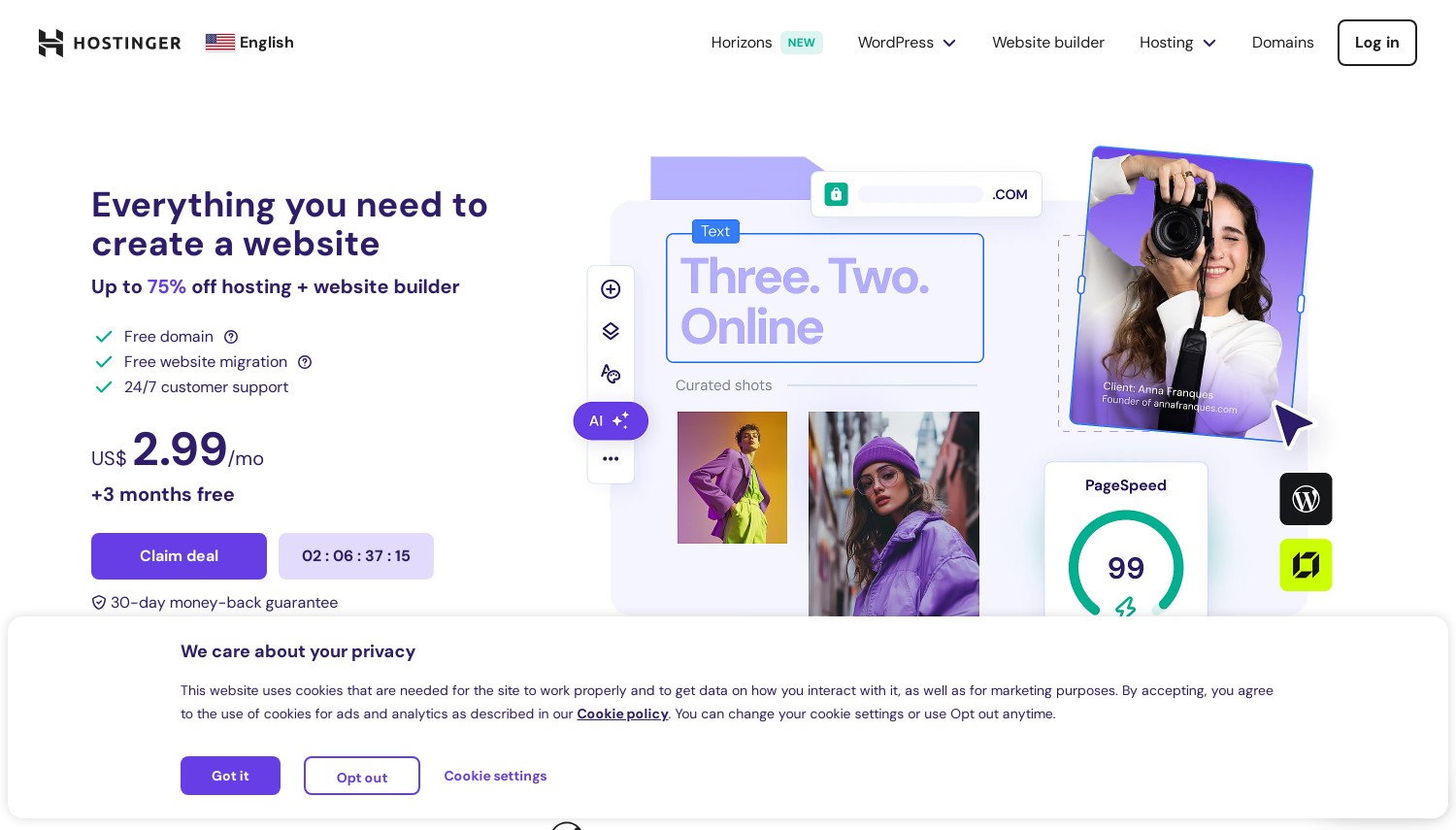
Start with the bad news. Hostinger's Premium plan goes from USD 2.69/mo intro to USD 11.99/mo at renewal, a 346% lift. Business is worse: USD 3.99 to USD 18.99 (376%). For Indian customers paying in INR, the Premium hike runs ₹69/mo to ₹293.82/mo with GST, which is a 325% real increase. That renewal trap is the single biggest reason readers come back angry.
So why does Hostinger still win for budget-first Nepali bloggers? Because the Mumbai data center is real, it's been live since 2024, and round-trip latency from Kathmandu averages 35-45ms on NTC and Worldlink last-mile. That beats every Singapore-only option by 30-40ms, including SiteGround's GrowBig at USD 29.99/mo renewal. Premium ships LiteSpeed Web Server (faster than Apache for cached WordPress), free SSL, and an in-house caching plugin. For year-one cost on a content site, nothing here is cheaper.
Honest play: commit to the longest cycle Hostinger offers, lock in the promo for 36-48 months, and migrate before renewal hits. We don't recommend Business unless you need its email accounts or daily-backup tier, since the renewal multiplier hurts more at the higher RAM ceiling.
Pros:
- Mumbai DC delivers 35-45ms to Kathmandu, lowest on this list outside local providers
- LiteSpeed Web Server included, faster than Apache for cached WordPress
- Year-one entry at USD 2.69/mo on Premium beats every other host with a regional Asian DC
- WordPress installer with hPanel is the simplest setup flow we've used
Cons:
- Renewal at USD 11.99/mo on Premium, a 346% lift
- Single-website limit on Premium, you need Business (USD 18.99 renewal) for multiple sites
- Live chat queues during peak Asian hours can stretch past 15 minutes
Pricing: Premium USD 2.69/mo intro, USD 11.99/mo renewal. Business USD 3.99 intro, USD 18.99 renewal. INR equivalents ₹69 and ₹169 intro respectively.
Best for: Nepali bloggers and one-site businesses who'll commit to a 36-48 month term and migrate before renewal. WordPress workloads benefit most.
Skip if: You hate the renewal-trap model. Verpex (USD 6/mo flat) or Ultahost (USD 4.80/mo flat) won't punish year two.
Verdict: Buy Hostinger Premium ONLY if you'll switch hosts at month 36, otherwise the math collapses. If you want similar Mumbai latency without the renewal cliff, pick Verpex Bronze. If you want NPR billing and local support, go straight to Himalayan Host. For broader regional context, our India hosting guide covers how Mumbai-hosted plans hold up across the subcontinent.
Kamatera – Best Hourly-Billed Cloud VPS for Nepali Fintech
If you're running a Nepali fintech, e-learning platform, or live-streaming product that needs burst capacity for evening peaks, Kamatera's per-minute billing model changes the spreadsheet. Type B VPS starts at USD 4/mo for 1 vCPU and 1 GB RAM, billed hourly with no commitment, in Hong Kong, Singapore, Tokyo, or Sydney. That's 64% under Cloudways' DigitalOcean entry (USD 11/mo) for the same nominal resources, with the obvious trade that you handle the OS yourself.
Hong Kong and Singapore are the practical Asian regions for Nepal traffic. Singapore typically clocks 80-95ms to Kathmandu via SeaMeWe submarine routes, Hong Kong adds another 10-20ms depending on transit. Neither matches Mumbai's 35-50ms, so Kamatera is a poor fit if your audience is 90%+ Nepal-domestic. Where it earns its place is workloads that need to scale up and down by the hour: think a Tihar-week e-commerce push or a Loksewa exam result portal that gets hammered on release day.
Kamatera includes USD 100 free credit on signup with a 30-day trial window. Bandwidth is metered per GB after a baseline allowance, which is the honest cost gotcha: a sustained 5 TB/month outbound run will add USD 50-80 on top of the compute line. For a small site, this is invisible. For media-heavy sites, run the math first.
Pros:
- Per-minute billing, scale up for an event and back down the same day
- Singapore, Hong Kong, Tokyo regions all clock under 100ms to Kathmandu
- USD 100 free credit covers 25 days of an entry server, real test window
- Custom resource sizing, no bundled tier you have to grow into
Cons:
- Bandwidth is metered, not unlimited like shared hosting
- No Mumbai or Bangalore region, Indian routes go through Singapore
- Unmanaged by default, you patch the kernel and configure the firewall yourself
Pricing: Type B 1 vCPU/1 GB RAM/20 GB SSD: USD 4/mo. 2 vCPU/2 GB RAM/20 GB SSD: USD 25/mo (varies by region). Bandwidth metered after included allowance.
Best for: Nepali developers comfortable on the command line who need elastic compute and predictable hourly pricing.
Skip if: You want managed WordPress or a graphical control panel. Pick Cloudways or SiteGround.
Verdict: Choose Kamatera ONLY when burst billing or full custom sizing matters. For a always-on production site, Ultahost Singapore VPS at USD 4.80/mo with fixed pricing is simpler. For a WordPress site you don't want to babysit, jump to Cloudways on DigitalOcean Bangalore.
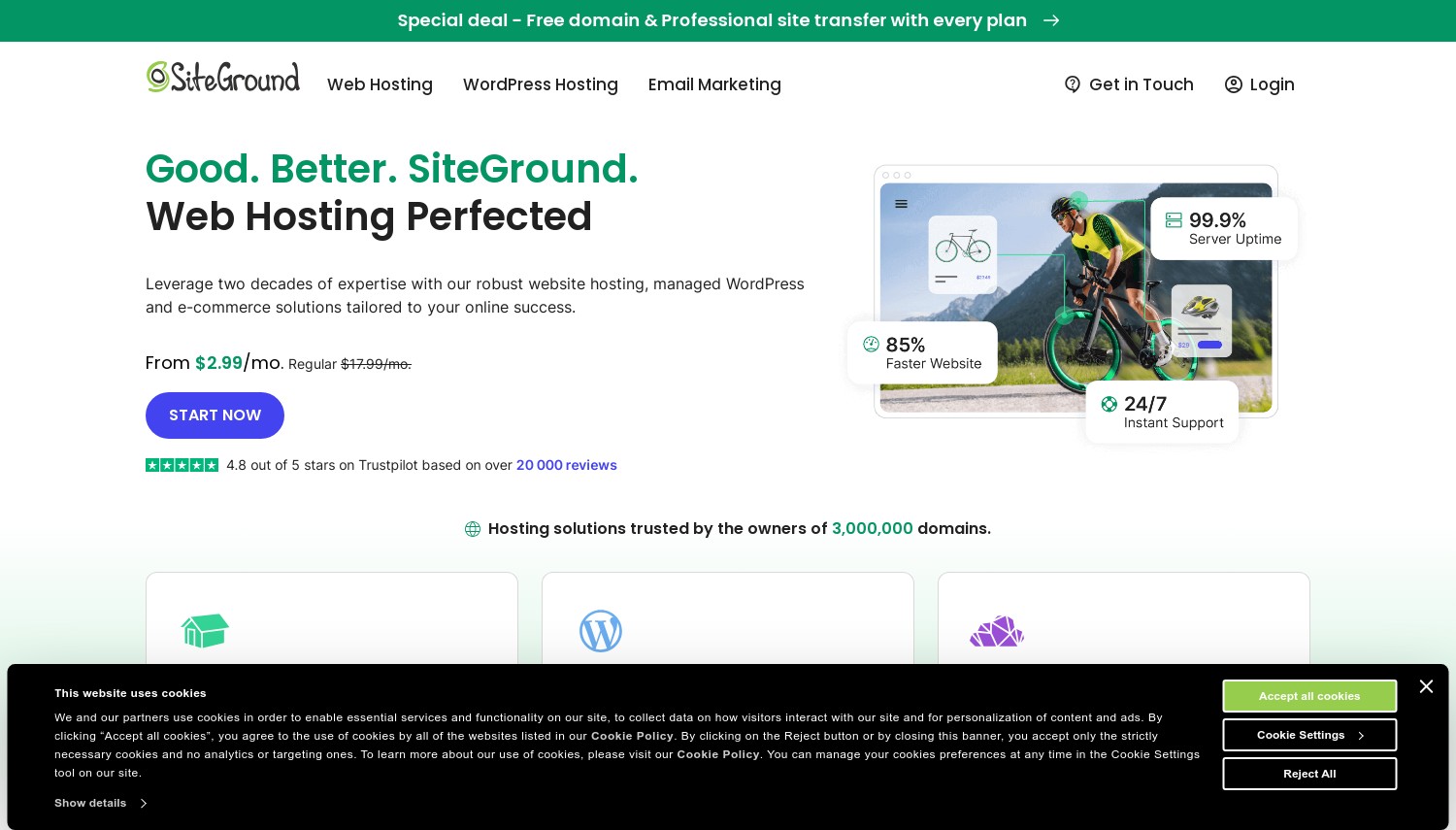
SiteGround – Best Managed WordPress on Singapore Google Cloud
SiteGround runs on Google Cloud infrastructure, with Singapore as the closest region to Nepal. That's the technical headline. The pricing headline is harder to swallow: GrowBig intro at USD 4.99/mo lifts to USD 29.99/mo at renewal, a roughly 6x jump that puts year-two cost roughly 2.5x what Verpex Silver charges (USD 10/mo) for a similar multi-site shared plan.
What you actually buy at that price is the fully-managed WordPress stack: automatic updates with rollback, staging environments on every plan, on-demand backups, and a custom NGINX caching layer that consistently outperforms generic LSCWP setups in third-party benchmarks. Customer support response times in user reviews average under 5 minutes for live chat, which is the operational reason agencies stomach the renewal price. For a Nepali agency billing clients USD 50+/mo per managed site, the markup pencils into the service margin.
Nepal-domestic audiences eat a 30-40ms penalty going through Singapore instead of Mumbai-hosted alternatives like Hostinger or Verpex. That's measurable on TTFB but invisible to most readers, since first-byte under 200ms still feels instant. Where it bites is real-time interactions: live chat widgets, AJAX-heavy WooCommerce checkout, anything where round-trip latency stacks across 5-10 calls per page action.
Pros:
- Singapore Google Cloud region, IPv6 native and well-peered to Indian transit
- Staging environments on every plan, not just the top tier
- Custom NGINX caching layer outperforms generic LiteSpeed in benchmark tests
- Sub-5-minute live chat response times in third-party review aggregators
Cons:
- Renewal at USD 29.99/mo on GrowBig, the steepest on this list among shared plans
- StartUp limited to a single website, you need GrowBig (USD 29.99 renewal) for two or more
- 30 GB storage on GrowBig is tight for media-heavy sites
Pricing: StartUp USD 2.99/mo intro, USD 17.99/mo renewal. GrowBig USD 4.99/mo intro, USD 29.99/mo renewal. GoGeek USD 7.99/mo intro, USD 44.99/mo renewal.
Best for: Nepali agencies billing clients managed-WordPress retainers, or businesses where 5-minute chat support and zero-touch updates justify a 6x renewal lift.
Skip if: Your audience is Nepal-domestic and you care more about latency than management overhead. Hostinger Mumbai wins on both raw speed and entry price.
Verdict: Buy SiteGround GrowBig if you're an agency reselling managed WordPress, otherwise the renewal math doesn't work. If you want managed WordPress without the price ceiling, Cloudways on DigitalOcean Bangalore is roughly USD 11/mo with a similar control panel. If you want raw speed for a Nepal audience, pick Hostinger on Mumbai.
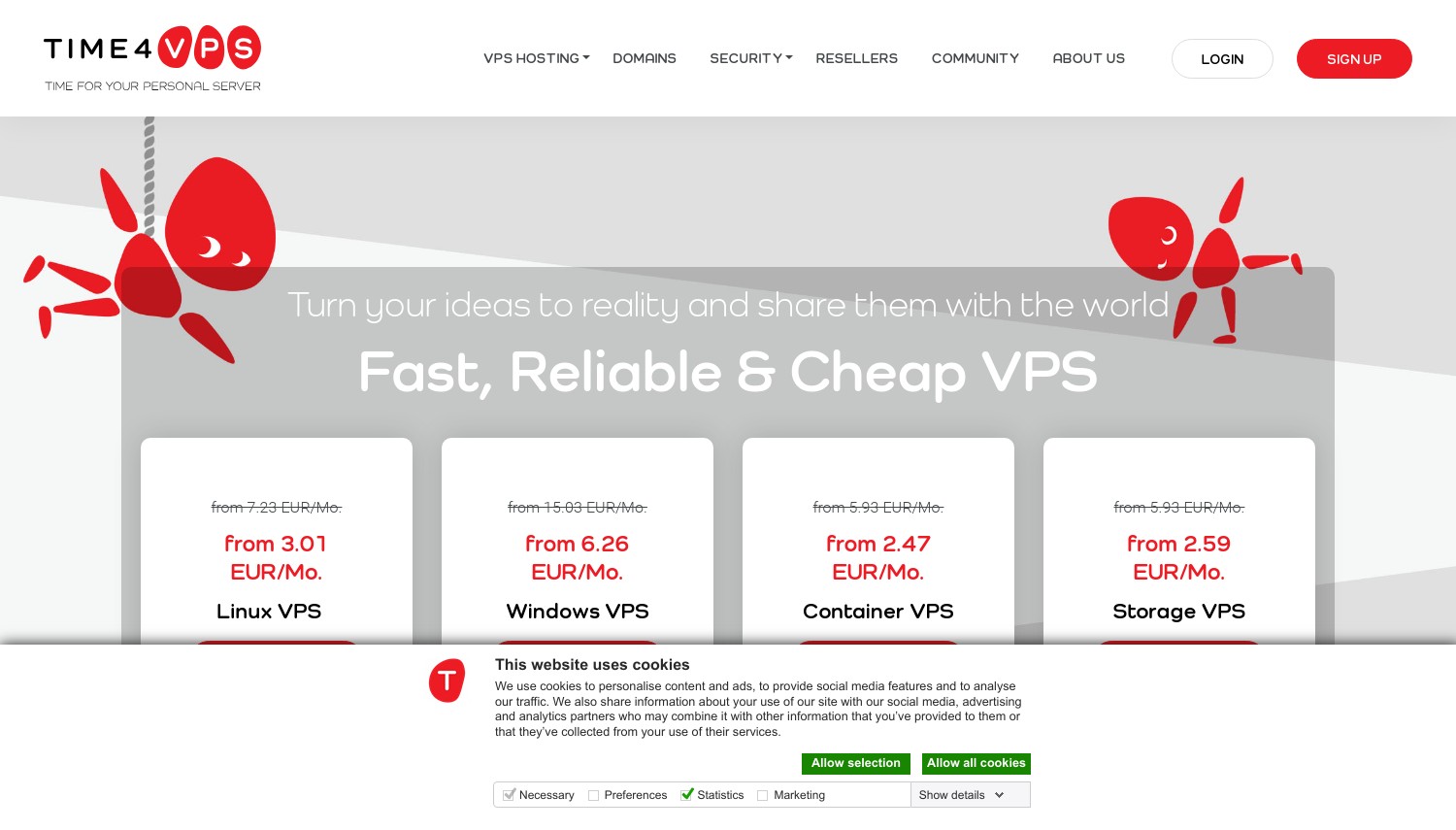
Time4VPS – Cheapest Linux VPS for Nepali Devs Who Don't Mind EU Latency
Where Hostinger and Hetzner battle on EU shared hosting price, Time4VPS undercuts both at the unmanaged VPS layer. Linux 2 starts at EUR 2.89/mo (roughly USD 3.10) for 1 core, 2 GB RAM, 20 GB SSD, 4 TB bandwidth, billed annually with a 17% discount over monthly. Container plans drop to EUR 1.99-2.48/mo for lower-resource workloads. For a backup server, a CI runner, or a staging mirror, that's hard to beat on price-per-GB-RAM.
Then there's the data center problem: Vilnius, Lithuania. Single location, no geographic redundancy, and round-trip latency from Kathmandu averages 220-280ms via European transit. That's roughly 4-5x worse than Mumbai-hosted alternatives. For any production site serving Nepali end-users, that's a deal-breaker. For a developer workstation, a private Git server, or a backup target, latency doesn't matter and the price wins (your build pipeline doesn't care about a 220ms ping; your Nepali readers do).
Compared to Ultahost Singapore VPS (USD 4.80/mo at the same RAM tier), Time4VPS lands cheaper on the absolute number but loses badly on latency. For a Nepal-facing workload, that 200ms gap shows up in every page load. We'd only recommend Time4VPS to Nepali users for non-customer-facing infrastructure: backups, dev environments, secondary DNS, or anything where the user is the developer.
Pros:
- Linux 2 at EUR 2.89/mo, lowest VPS price in this comparison
- Tier III Vilnius facility, RAID arrays, KVM virtualization on Linux/Windows
- Annual billing saves 17% over monthly, transparent on the pricing page
- Container plans below EUR 2 for tiny workloads
Cons:
- Single Vilnius DC, no Asian region, 220-280ms to Kathmandu
- Renewal pricing climbs noticeably after the introductory cycle
- Backup infrastructure is limited compared to Cloudways or SiteGround
Pricing: Linux 2 EUR 2.89/mo (1 core/2 GB/20 GB SSD). Container plans from EUR 1.99/mo. SSD plans from EUR 3/mo.
Best for: Nepali developers needing a cheap EU-located VPS for backups, dev work, CI runners, or non-customer-facing services.
Skip if: Any portion of your traffic is Nepal-domestic end-users. The latency penalty is real and measurable. For Nepal-facing workloads, see our Asian VPS guide.
Verdict: Pick Time4VPS only for non-user-facing infrastructure where price beats latency. For any Nepal-domestic production workload, Ultahost Singapore at USD 4.80/mo is the smarter buy. For burst-billed cloud, jump to Kamatera.
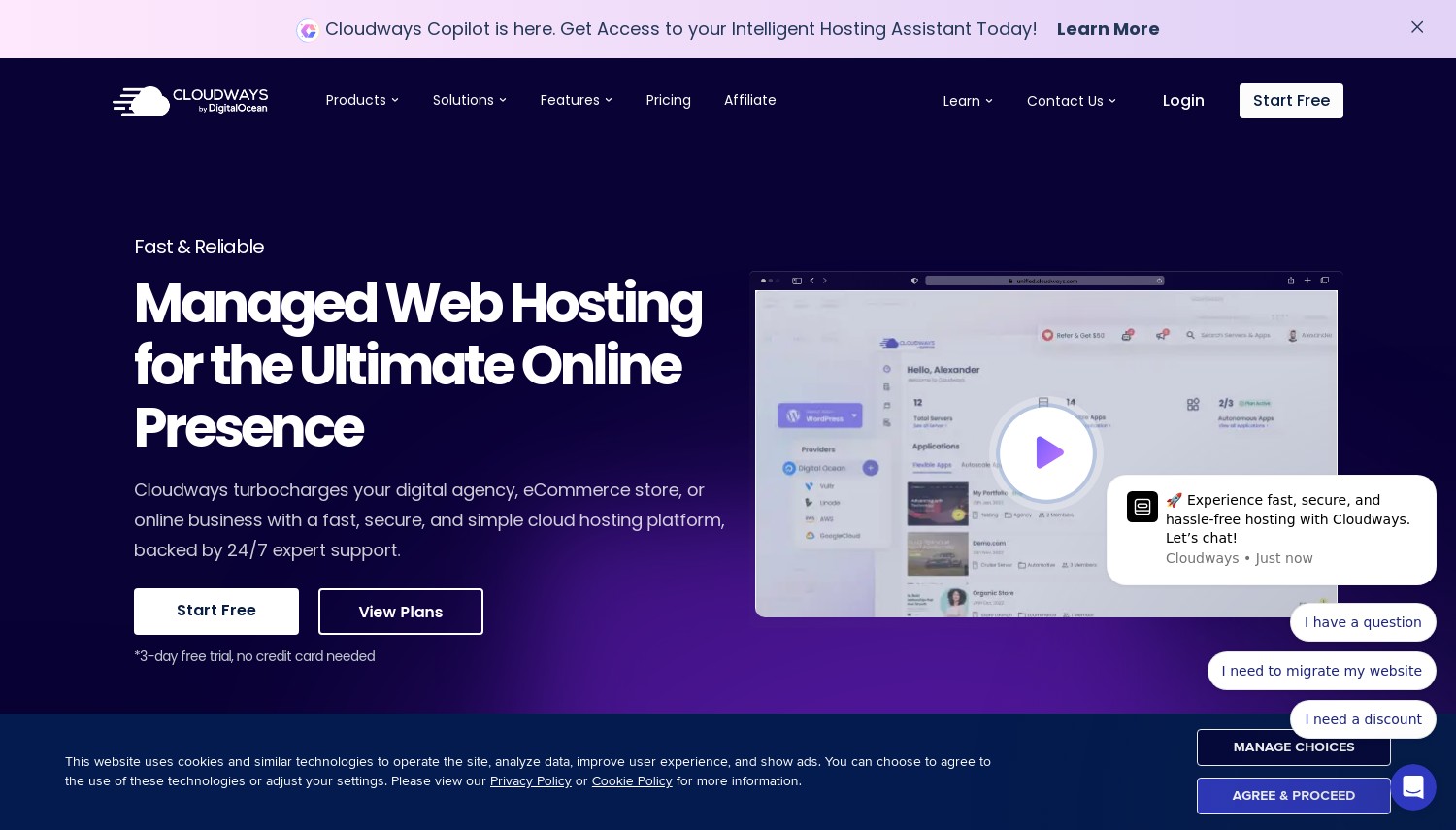
Cloudways – Best Managed Cloud Path to a Bangalore Data Center
USD 11/mo. That's the Cloudways DigitalOcean 1GB entry, and it's the only managed-cloud option on this list that puts you on a real Bangalore data center for under USD 15/mo. DigitalOcean opened Bangalore in 2016, Cloudways integrated it, and the result is a managed-WordPress experience routed through Indian peering with a control panel that handles backups, staging, SSL, and PHP-FPM tuning out of the box.
Pricing model is the actual differentiator. Cloudways doesn't do the renewal-trap dance, you pay USD 11 monthly and that number stays put. Compared to SiteGround GrowBig (USD 29.99 at renewal) for similar managed-WordPress functionality, Cloudways lands at roughly 37% of the year-two cost while running on dedicated DigitalOcean compute instead of shared hosting. Compared to Hostinger Business (USD 18.99 at renewal) on shared, Cloudways is also dedicated and routed through India.
Nepali buyers should park on the Bangalore region. Round-trip latency to Kathmandu averages 50-65ms, slightly higher than Hostinger Mumbai's 35-45ms but still well inside any practical sub-100ms ceiling. Vultr's Singapore region is the alternate at USD 14/mo, AWS Mumbai is USD 20.56/mo if you need the AWS ecosystem (S3, RDS) for adjacent services. For most Nepali WooCommerce stores doing 50-300 daily orders, DigitalOcean Bangalore is the obvious starting tier.
Pros:
- DigitalOcean Bangalore region at USD 11/mo, only managed-cloud Indian DC under USD 15
- Pay-as-you-go, no renewal price increase ever
- Built-in staging, on-demand backups, free SSL, dedicated firewall
- Cross-provider migration via free WordPress plugin, no manual export
Cons:
- Email hosting is a USD 1/mailbox add-on, not bundled
- USD 11/mo entry is high for a single small blog (Hostinger Premium does that for USD 2.69 intro)
- Custom CDN add-on costs extra, while Hostinger and SiteGround bundle a basic CDN
Pricing: DigitalOcean 1GB USD 11/mo, 2GB USD 26/mo. Vultr 1GB USD 14/mo. Linode 1GB USD 14/mo. AWS Micro USD 20.56/mo. Google Cloud USD 37.33/mo.
Best for: Nepali WooCommerce stores, scaling startups, and agencies who want managed WordPress on Indian-region cloud without the SiteGround renewal cliff.
Skip if: Your site does under 5k monthly visits and you can live with shared hosting. Hostinger Premium Mumbai at USD 2.69/mo intro is a third the cost.
Verdict: Buy Cloudways DigitalOcean 1GB Bangalore if you're past the shared-hosting ceiling and want managed control without SiteGround pricing. For shared workloads under 10k monthly visits, Hostinger wins on year-one cost. If you need true Tier-4 Nepali infrastructure with local SLAs, jump to Himalayan Host. Our Asian cloud hosting guide covers how Bangalore stacks against Tokyo and Singapore for broader regional traffic.
Himalayan Host – Best Local Kathmandu Data Center Option
Himalayan Host runs the only true Kathmandu data center on this list. Operating since 2007, they offer WordPress shared hosting from NPR 100/mo (roughly USD 0.75), Cloud VPS from NPR 1,200/mo (roughly USD 9), and reseller plans from NPR 700/mo. Cloud web hosting plans bundle 3-year packages from NPR 12,000 total. The site accepts NPR billing, which is the practical reason most Nepali small businesses end up here regardless of how international hosts price.
Latency story is obvious: a Kathmandu DC routes domestic traffic over local fiber, which means sub-10ms TTFB to most Nepali ISPs and zero international transit dependency during monsoon outage events. That last part matters more than it sounds. International cable cuts and Indian transit issues do hit Nepali sites, and a domestic-hosted site keeps serving even when cross-border routes flap.
Compared to Hostinger Premium Mumbai at USD 2.69/mo (intro) or USD 11.99/mo (renewal), Himalayan Host's NPR 100/mo entry undercuts the Hostinger intro by roughly 70% and the renewal by 93%. The trade is infrastructure depth: Hostinger's stack is more polished, the WordPress installer is faster, and global support coverage is broader. Himalayan Host's documentation is thinner, and edge cases (custom Nginx rules, advanced caching) usually require a support ticket rather than a knowledge-base article.
Pros:
- Kathmandu data center, sub-10ms latency to most Nepali ISPs
- NPR billing accepted, plus eSewa/Khalti/IMPS local payment rails
- Operating since 2007, real local support during Nepal business hours
- WordPress shared from NPR 100/mo, ~70% under Hostinger Premium intro
Cons:
- International latency is worse, a Nepal-hosted site loads slower for Indian or US visitors
- Smaller infrastructure than Cloud Himalaya (Nepal's only Tier-4 facility)
- Knowledge base and documentation thinner than Hostinger or SiteGround
Pricing: WordPress shared from NPR 100/mo. Cloud web hosting NPR 12,000 for 3 years. Cloud VPS from NPR 1,200/mo. Reseller from NPR 700/mo. A 10% off coupon (HH2026) is currently active.
Best for: Nepal-domestic small businesses, Nepali blogs and news sites, and anyone needing NPR billing with local payment methods.
Skip if: Your audience is international or you need enterprise-grade SLAs with multi-region failover. Pick Cloudways on DigitalOcean Bangalore for that.
Verdict: Choose Himalayan Host if Kathmandu latency, NPR billing, or domestic monsoon-resilience are non-negotiable. For broader infrastructure depth at similar latency, Hostinger Mumbai is the international alternative. For Tier-4 enterprise needs in Nepal, evaluate Cloud Himalaya separately, since they target colocation and managed services rather than self-serve plans.

 Verpex Hosting

 Ultahost
 Hostinger
 Kamatera

 SiteGround

 Time4VPS
 Cloudways