
Best Next.js Hosting (2026): 10 Providers for React Apps Compared
Next.js changed how developers build React applications. Server-side rendering, static generation, API routes, and edge functions all packaged together. But this flexibility creates a hosting problem: not every provider actually supports what Next.js can do. Some hosts only handle static exports. Others charge premium rates for serverless functions. And a few pretend to support Next.js while quietly breaking features you'll discover after deployment.

Quick answer: Vercel (the company behind Next.js) offers the smoothest deployment experience with a generous free tier, but costs can spike at scale. For budget-conscious projects, Hostinger's VPS at $4.99/mo gives you full control with auto-detection for Next.js. Developers comfortable with containers should consider Railway or DigitalOcean App Platform for usage-based pricing that scales sensibly. Below, we compare 10 providers with verified January 2026 pricing and honest capability assessments.
Jump to: FastComet | A2 Hosting | Hostinger | Liquid Web | IONOS | DigitalOcean | Netlify | Vercel | Railway | Render | How to Choose | FAQ
Last reviewed: January 2026. Prices and features verified.
Unlike generic hosting guides, this comparison specifically addresses Next.js deployment modes: static export, server-side rendering (SSR), and edge functions. We've noted which providers support each mode, because deploying a Next.js app that relies on SSR to a host that only handles static files creates frustration you don't need.
How We Selected These Providers
Next.js hosting requires specific capabilities beyond standard web hosting. We evaluated providers on Node.js runtime support (essential for SSR), serverless function limits, edge network coverage, and deployment workflow integration. Pricing was verified from official sources in January 2026, including both promotional and renewal rates where applicable. User ratings required minimum 4.0/5 from aggregated reviews, with preference given to providers demonstrating consistent Next.js support in community feedback.
| Hosting Provider | Reviews | Overall Rating | Next.js VPS from |
|---|---|---|---|
1  FastComet FastComet
|
3.5k+ |

|
$1.79 / mo. -80% OFF |
2  A2 Hosting A2 Hosting
|
3.4k+ |

|
$2.99 / mo. NOW -76% |
3  Hostinger Hostinger
|
63.2k+ |
|
$4.99 / mo. 80% Off |
4  Liquid Web Inc. Liquid Web Inc.
|
2.8k+ |
|
$5.00 / mo. up to -55% |
5  IONOS | ionos.com IONOS | ionos.com
|
38.1k+ |

|
$2.00 / mo. |
6  Digital Ocean Digital Ocean
|
1.9k+ |

|
No data / mo. |
7  Netlify Netlify
|
17 |
|
No data / mo. |
1. FastComet
 3.5k+
4.8
Positive
Positive
3.5k+
4.8
Positive
Positive










| Storage | Cpu | Ram | Price | |
|---|---|---|---|---|
| 10 GB | - | $1.79 / mo. | View Plan | |
| 50 GB | 1 x 2.5GHz | 2 GB | $46.16 / mo. | View Plan |
| 80 GB | 2 x 2.5GHz | 4 GB | $53.86 / mo. | View Plan |
FastComet: Budget Shared Hosting with Node.js Support
Starting at $1.79/mo (promo) | 10GB NVMe | 45-day money-back guarantee
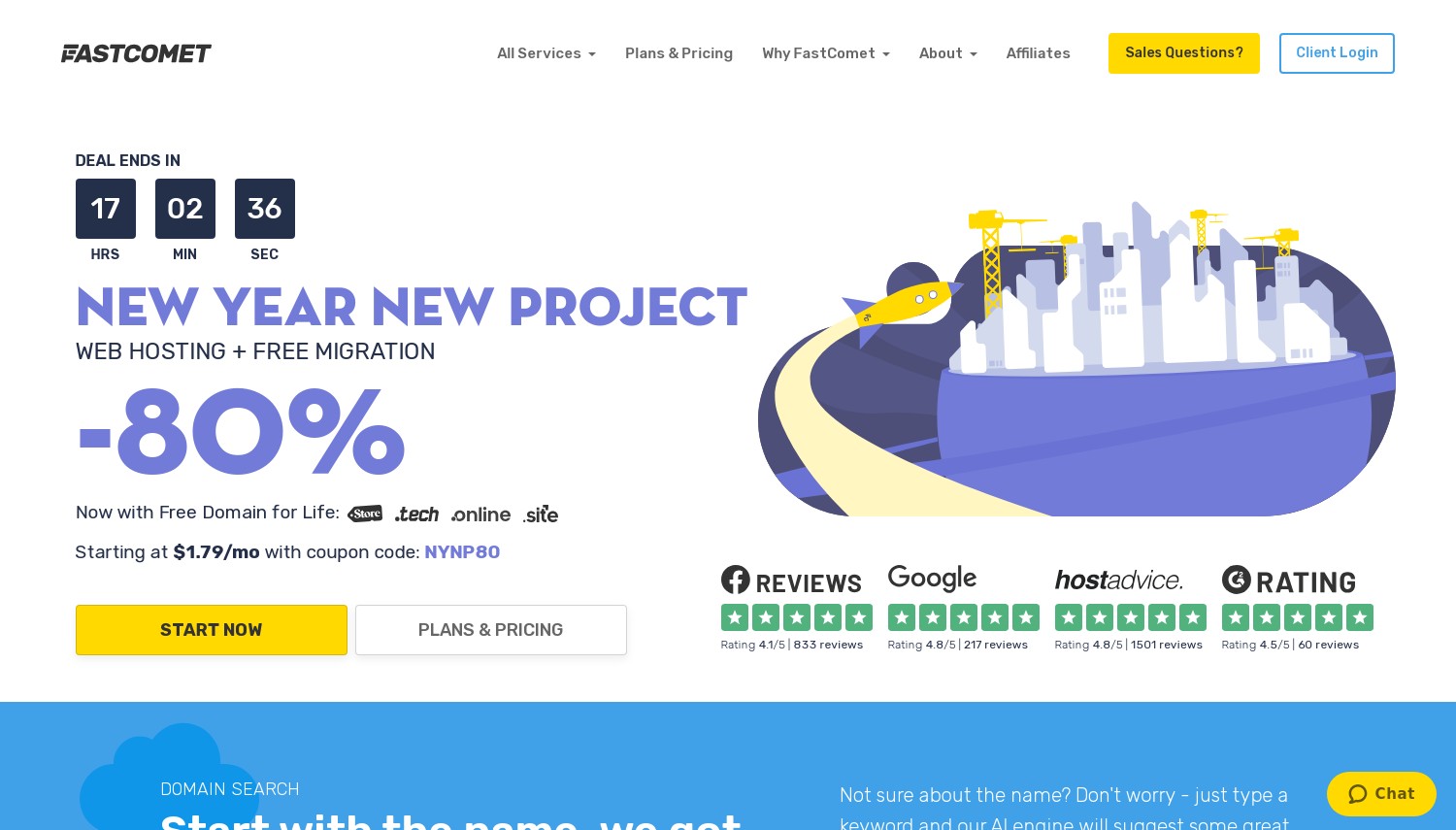
FastComet positions itself as an accessible entry point for developers who want to run Next.js without managing a full server. Their shared hosting plans include Node.js support through cPanel, allowing you to deploy Next.js applications using the static export approach. The 45-day money-back guarantee provides more testing runway than most competitors offer, giving you time to verify your deployment actually works before committing.
The technical reality requires some context. FastComet's shared hosting works well for Next.js projects exported as static sites. If your application requires server-side rendering or API routes, you'll hit limitations. The Node.js support handles basic setups, but true SSR demands more control than shared environments provide. For blogs, landing pages, or documentation sites built with Next.js, FastComet handles the job. For dynamic applications fetching data on each request, you'll need to look at their Cloud VPS options or other providers entirely.
Pricing deserves careful attention. That $1.79/mo rate applies only to the first term and requires multi-year commitment. Renewal jumps to $8.95/mo for the Starter plan, a 400% increase. The Plus plan at $3.59/mo renews at $17.95/mo. FastComet includes useful features at these prices: Cloudflare CDN (which helps static Next.js sites load faster globally), daily backups, and free SSL. Just calculate total multi-year cost before deciding.
Pros
- 45-day money-back guarantee provides genuine testing time
- Cloudflare CDN included for global static asset delivery
- cPanel with Softaculous for familiar management interface
- LiteSpeed caching improves static site performance
Cons
- Renewal pricing jumps to $8.95-$24.95/mo from promo rates
- Shared hosting limits SSR and API route functionality
- Node.js support is basic compared to dedicated platforms
Pricing: Starter at $1.79/mo (promo), $8.95/mo renewal. 1 website, 10GB NVMe. Essential at $2.39/mo promo, $11.95/mo renewal. 20GB NVMe. Plus at $3.59/mo promo, $17.95/mo renewal. Unlimited websites, 30GB NVMe. Extra at $4.99/mo promo, $24.95/mo renewal. 40GB NVMe. All plans include free SSL, daily backups, and Cloudflare CDN.
Best for: Static Next.js sites (blogs, documentation, landing pages) on a tight initial budget.
Skip if: Your application requires server-side rendering, API routes, or you need predictable long-term pricing.
FastComet works as a starting point for simple Next.js projects. The shared hosting limitations matter though. Export your app as static files, and FastComet delivers reasonable value. Need SSR or dynamic features, and you're looking at workarounds that defeat the purpose.
2. A2 Hosting
 3.4k+
4.5
Positive
Positive
3.4k+
4.5
Positive
Positive




| Storage | Cpu | Ram | Price | |
|---|---|---|---|---|
| 20 GB | 1 core | 1 GB | $2.99 / mo. | View Plan |
| 75 GB | 2 cores | 2 GB | $7.99 / mo. | View Plan |
| 150 GB | 4 cores | 4 GB | $9.99 / mo. | View Plan |
A2 Hosting: Turbo VPS for Performance-Focused Developers
Unmanaged VPS from $4.99/mo | Managed VPS from $25/mo | 30-day money-back guarantee
A2 Hosting (which rebranded to hosting.com in 2025) built their reputation on speed claims. Their Turbo servers promise up to 20X faster page loads compared to standard hosting. For Next.js applications, this translates to LiteSpeed web server integration, NVMe SSD storage, and optimized server configurations. The technical foundation supports full Next.js deployments including SSR, API routes, and custom server configurations.
The VPS tier makes the most sense for Next.js. Unmanaged plans starting at $4.99/mo give you 1 CPU core, 1GB RAM, and 150GB SSD with root access. You'll configure Node.js yourself, set up PM2 for process management, and handle your own updates. For developers comfortable with server administration, this provides complete control at reasonable cost. The Turbo Boost option adds their performance-optimized stack with faster hardware.
Managed VPS starting at $25/mo suits teams without dedicated DevOps. A2's team handles server configuration, security patches, and basic troubleshooting. You still get root access when needed, but the routine maintenance doesn't fall on you. Compared to Liquid Web in this list, A2's managed offering costs less but provides fewer proactive optimizations. The 30-day money-back guarantee applies to hosting only, not domain registrations.
Pros
- Turbo servers with LiteSpeed and NVMe for measurable speed gains
- Full root access on VPS for complete Next.js configuration control
- Choice of data centers across US, Europe, and Asia
- Both managed and unmanaged options available
Cons
- Promotional pricing requires long-term commitment
- Renewal rates increase substantially from promo pricing
- Unmanaged plans require server administration knowledge
Pricing: Unmanaged VPS: Runway at $4.99/mo (1 vCPU, 1GB RAM, 150GB SSD, 2TB bandwidth). Lift at $6.99/mo (2 vCPU, 2GB RAM). Takeoff at $14.99/mo (4 vCPU, 4GB RAM). Managed VPS: Entry at $25/mo with cPanel included. Pro-rated refunds available after 30-day guarantee period.
Best for: Developers who want VPS control with performance-optimized infrastructure for full Next.js capabilities.
Skip if: You prefer platform-as-a-service simplicity over server management.
A2 Hosting delivers when you need traditional VPS with genuine performance focus. The Turbo branding isn't just marketing; LiteSpeed and NVMe make measurable differences. Just factor in the management overhead if you choose unmanaged plans.
3. Hostinger
 63.2k+
4.6
Positive
Positive
63.2k+
4.6
Positive
Positive


| Storage | Cpu | Ram | Price | |
|---|---|---|---|---|
| 50 GB | 1 core | 4 GB | $4.99 / mo. | View Plan |
| 100 GB | 2 cores | 8 GB | $5.99 / mo. | View Plan |
| 200 GB | 4 cores | 16 GB | $10.49 / mo. | View Plan |
Hostinger: VPS with Auto-Detection for Modern Frameworks
VPS from $4.99/mo | 1 vCPU, 4GB RAM, 50GB NVMe | 30-day money-back guarantee
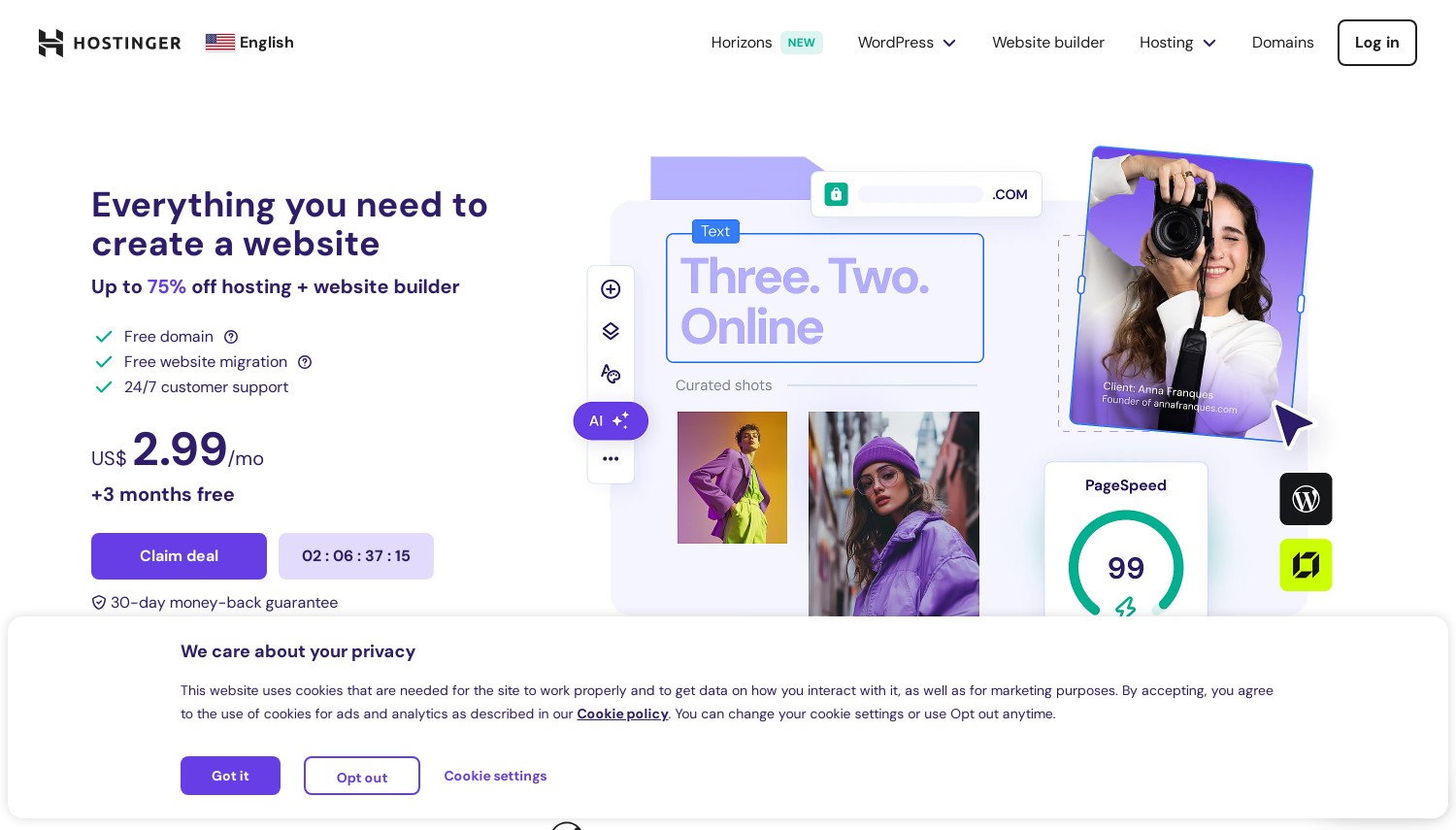
Hostinger's approach to Next.js hosting splits into two paths. Their VPS plans give you a Linux environment where you install and configure Node.js manually. Alternatively, their newer Web Apps hosting auto-detects frameworks including Next.js, React, Vue, and others. Connect your GitHub repository, and the platform identifies your stack and handles deployment. No YAML configurations, no manual build scripts. For developers who want deployment simplicity without Vercel's pricing at scale, this hits an interesting middle ground.
The VPS specs punch above typical budget pricing. The entry KVM 1 plan includes 4GB RAM and 50GB NVMe storage on AMD EPYC processors. Most competitors at this price tier offer 1-2GB RAM. The AI assistant Kodee helps troubleshoot common configuration issues without requiring you to parse Stack Overflow threads. Weekly backups come included (daily backups cost $6/mo extra). Server locations span North America, Europe, Asia, and South America.
Pricing follows the promotional playbook. That $4.99/mo rate requires a 48-month commitment paid upfront (about $240 total). Monthly billing runs $9.99/mo. Renewal hits $9.99/mo regardless of original commitment. For a 4-year comparison: the promo rate totals $240, while monthly billing totals $480. The managed Web Apps hosting for Node.js starts around $5.99/mo with similar commitment requirements. Against Railway or Render in this comparison, Hostinger offers more raw resources per dollar but requires more setup work.
Pros
- 4GB RAM on entry VPS plan, double most competitors
- Auto-detection for Next.js on Web Apps hosting (GitHub integration)
- AMD EPYC processors with NVMe storage standard
- AI assistant Kodee for troubleshooting common issues
Cons
- Promo pricing requires 48-month upfront payment
- Renewal doubles to $9.99/mo
- Daily backups cost additional $6/mo
Pricing: KVM 1 at $4.99/mo promo, $9.99/mo renewal. 1 vCPU, 4GB RAM, 50GB NVMe, 4TB bandwidth. KVM 2 at $6.99/mo promo (2 vCPU, 8GB RAM, 100GB NVMe). KVM 4 at $9.99/mo promo (4 vCPU, 16GB RAM, 200GB NVMe). All plans include weekly backups and Cloudflare-protected DNS.
Best for: Developers wanting generous VPS specs for Next.js with optional platform-like deployment simplicity.
Skip if: You need month-to-month flexibility or want to avoid renewal price increases.
Hostinger occupies useful middle ground. The VPS specs compete favorably, and the Web Apps auto-detection adds convenience. Calculate your 4-year cost before committing, because that renewal jump matters more than initial pricing suggests.
4. Liquid Web Inc.
 2.8k+
4.5
Positive
Positive
2.8k+
4.5
Positive
Positive
| Storage | Cpu | Ram | Price | |
|---|---|---|---|---|
| 30 GB | 1 core | 1 GB | $5.00 / mo. | View Plan |
| 540 GB | 6 cores | 24 GB | $33.00 / mo. | View Plan |
| 640 GB | 8 cores | 32 GB | $48.00 / mo. | View Plan |
Liquid Web: Enterprise-Grade Managed Infrastructure
Cloud VPS from $5/mo | Managed VPS from $33/mo | 99.999% uptime guarantee
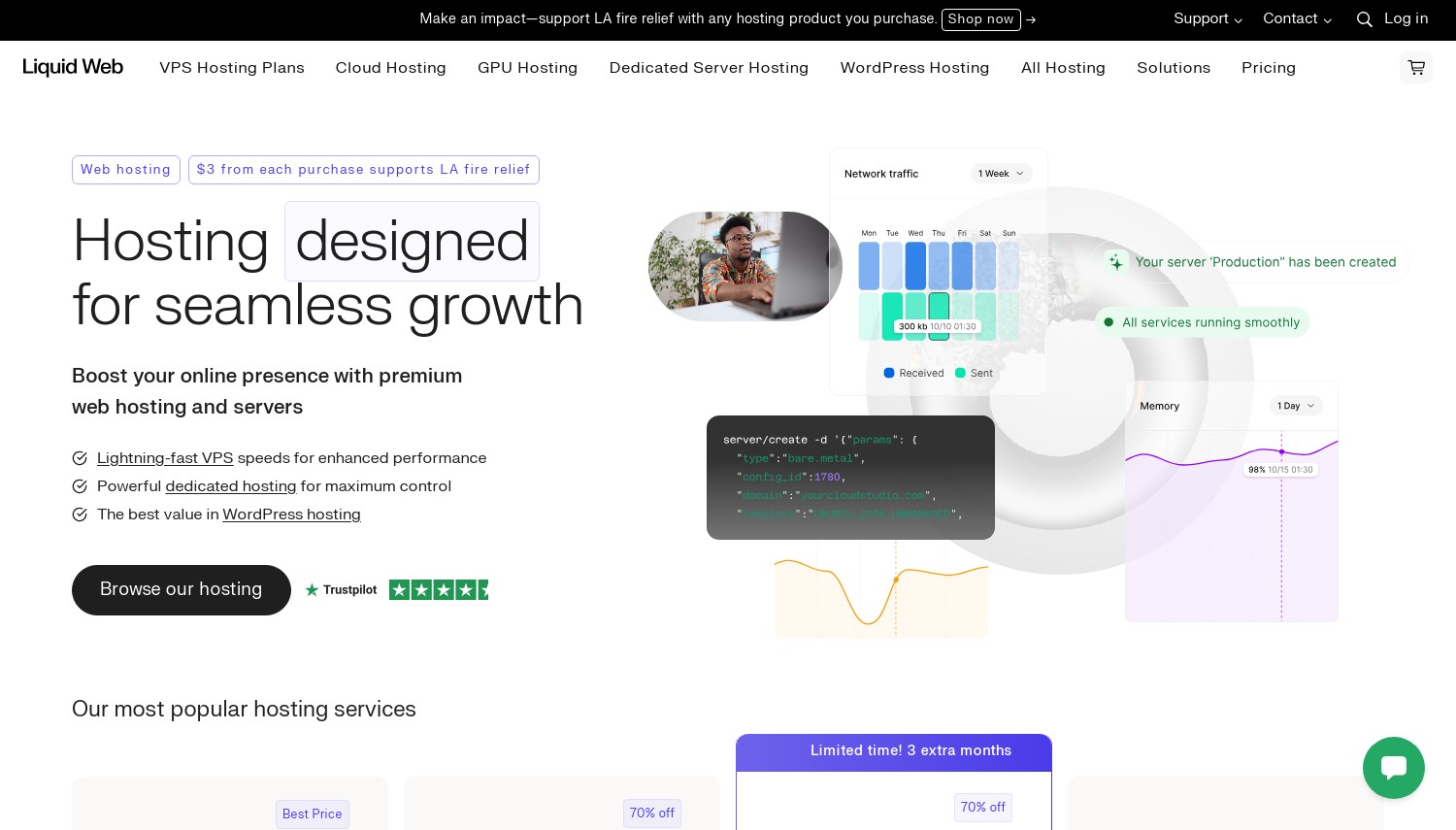
Liquid Web targets businesses where hosting problems translate directly to revenue loss. Their 99.999% uptime guarantee (under 5.26 minutes of downtime per year) backs this with actual SLA credits. For Next.js applications serving customers in production, this reliability focus matters more than saving a few dollars monthly. The infrastructure runs on their own data centers rather than reselling third-party capacity.
The Cloud VPS tier provides an entry point at $5/mo for basic workloads: 1 vCPU, 1GB RAM, 30GB SSD. This handles lightweight Next.js apps or development environments. Production applications need their Managed VPS starting at $33/mo, which includes proactive monitoring, security hardening, automatic updates, and 24/7 support from humans who can actually help with server issues. The Core-Managed level handles routine maintenance; upgrading to Fully Managed with cPanel or Plesk adds $28/mo.
Liquid Web costs more than most options in this comparison. That premium pays for genuine management: their team watches your server, responds to alerts, and handles issues before you notice them. Against Cloudways (which layers management over third-party infrastructure), Liquid Web owns the full stack. For agencies managing client Next.js applications or businesses where downtime means lost sales, the cost differential often justifies itself in incident response alone.
Pros
- 99.999% uptime SLA with actual credit compensation
- Proactive monitoring and security hardening included on managed plans
- 24/7 support from technical staff, not script-readers
- DDoS protection and CloudFlare CDN included
Cons
- Managed plans start at $33/mo, premium vs. budget alternatives
- Fully managed with cPanel adds $28/mo extra
- Overkill for hobby projects or development environments
Pricing: Cloud VPS: from $5/mo (1 vCPU, 1GB RAM, 30GB SSD, 10TB bandwidth). Pay-as-you-go with prorated billing. Managed VPS: Core-Managed from $33/mo. Fully Managed with cPanel from $61/mo. Cloud Dedicated from $52.50/mo. 30-day money-back guarantee on managed plans.
Best for: Businesses running production Next.js applications where uptime directly impacts revenue.
Skip if: You're building side projects, learning, or operating on startup budgets.
Liquid Web's value shows up during incidents. When something breaks at 3am, their team handles it while you sleep. That's worth the premium when your business depends on your application staying up.
5. IONOS | ionos.com
 38.1k+
4.3
Positive
Positive
38.1k+
4.3
Positive
Positive


| Storage | Cpu | Ram | Price | |
|---|---|---|---|---|
| 10 GB | 1 core | 1 GB | $2.00 / mo. | View Plan |
| 80 GB | 2 cores | 2 GB | $4.00 / mo. | View Plan |
| 160 GB | 2 cores | 4 GB | $6.00 / mo. | View Plan |
IONOS: Budget VPS with European Infrastructure
Cloud VPS from $2/mo | Unlimited traffic | 99.9% uptime guarantee
IONOS operates its own data centers in the US, Germany, Spain, and UK. This European heritage matters for Next.js applications serving EU audiences, both for latency reasons and GDPR compliance considerations. Their pricing undercuts most competitors: Cloud VPS starts at just $2/mo, though practical Next.js deployments need at least their $4/mo tier for adequate resources.
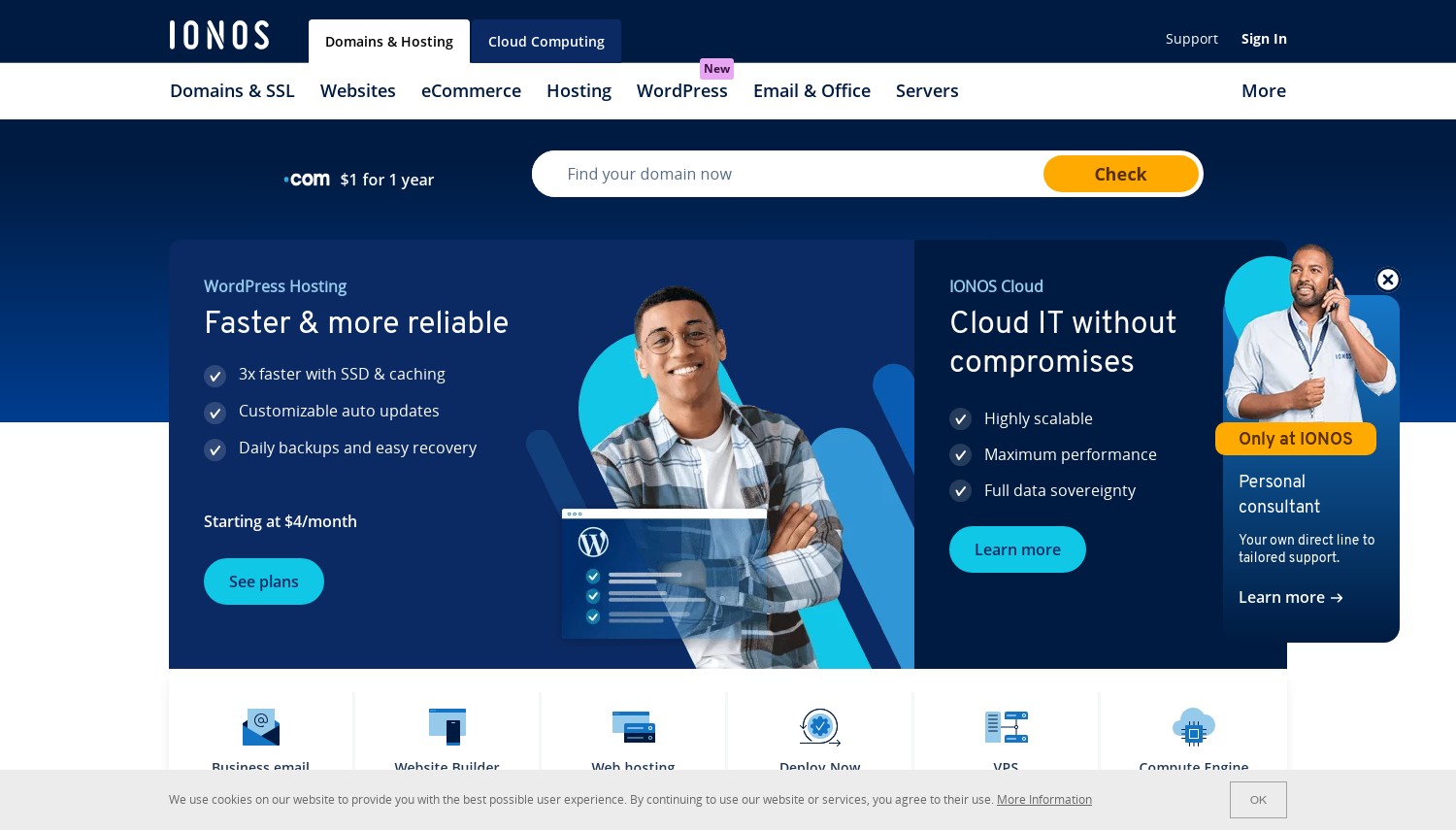
An important technical caveat applies here. IONOS offers a Deploy Now service for static sites that supports Next.js, but it only handles static export mode. There's no Node.js runtime on Deploy Now, which means SSR, API routes, and dynamic features won't work on that platform. For full Next.js functionality, you need their VPS plans where you manage the Node.js runtime yourself. This splits their offering: easy deployment for static sites, manual configuration for dynamic apps.
The VPS specs provide solid value. The Essential plan at $4/mo (first year, renews at $6/mo) includes adequate resources for small to medium Next.js applications. Unlimited traffic removes bandwidth anxiety that plagues some competitors. DDoS protection comes standard, along with Wildcard SSL certificates. The main gap is backup storage, which costs extra at $0.065 per GB/month. Against Hostinger's VPS in this list, IONOS costs less but requires more manual configuration and lacks the framework auto-detection features.
Pros
- Entry VPS at $2-4/mo, among the cheapest available
- Unlimited traffic included on Cloud VPS plans
- Own data centers in US and Europe for compliance flexibility
- DDoS protection and Wildcard SSL standard
Cons
- Deploy Now only supports static export (no SSR on that platform)
- Backups cost extra ($0.065/GB/month)
- VPS requires manual Node.js configuration for full Next.js
Pricing: Cloud VPS: Entry from $2/mo. Essential at $4/mo first year, $6/mo renewal. Starter at $6/mo. Linux options significantly cheaper than Windows. All include unlimited traffic and basic DDoS protection. Backup storage billed separately.
Best for: Cost-conscious developers comfortable with VPS configuration, especially those targeting European audiences.
Skip if: You want managed deployment or expect platform-like simplicity.
IONOS delivers infrastructure value, not convenience. The pricing is genuinely low for what you get. Expect to configure Node.js, PM2, and Nginx yourself. For developers who know their way around Linux, that's fine. For everyone else, platform options in this list require less work.
6. Digital Ocean
 1.9k+
3.7
Neutral
Neutral
1.9k+
3.7
Neutral
Neutral
DigitalOcean: App Platform for Containerized Next.js
App Platform from $5/mo | Free tier for static sites | $200 new user credit
DigitalOcean's App Platform handles Next.js deployment through container-based infrastructure. Connect your GitHub repository, and the platform builds and deploys your application. Static exports work on the free tier. Dynamic Next.js with SSR requires paid plans starting at $5/mo for basic resources. The cloud hosting infrastructure runs across 17 data centers globally, providing reasonable geographic coverage.
The platform's strength lies in its integrated ecosystem. Need a PostgreSQL database for your Next.js API routes? Managed Databases integrates directly. Want object storage for user uploads? Spaces provides S3-compatible storage at predictable rates. Background workers, cron jobs, and autoscaling (on dedicated CPU plans) round out the platform. This coherent approach contrasts with piecing together separate services from different providers.
New accounts receive $200 in credits valid for 60 days. That's substantial runway to test production workloads, not just spin up a demo. Billing granularity matters here: per-second billing (60-second minimum) suits Next.js deployments that spin up preview environments for each pull request. Against Vercel in this comparison, DigitalOcean offers more infrastructure flexibility at the cost of some deployment convenience. Against Railway, DigitalOcean provides more mature tooling but less focus on developer experience.
Pros
- $200 free credits for 60 days of serious testing
- Integrated platform: compute, databases, storage, Kubernetes
- Free tier handles static Next.js exports
- Per-second billing reduces waste on preview environments
Cons
- Dynamic Next.js at scale can get expensive ($5/mo minimum per component)
- Less Next.js-specific optimization compared to Vercel
- Platform learning curve for developers used to simpler hosts
Pricing: App Platform: Free for static sites. Basic Droplet from $5/mo (512MB RAM, 1 vCPU). Professional Droplet from $12/mo (1GB RAM, 1 vCPU). Components billed separately; total cost depends on architecture. Managed PostgreSQL from $15/mo. Spaces object storage at $5/mo for 250GB.
Best for: Teams wanting integrated cloud infrastructure with database and storage needs alongside Next.js.
Skip if: You want the simplest possible Next.js deployment or need to minimize costs on small projects.
DigitalOcean works when Next.js is part of a larger stack. The platform approach suits applications needing databases, background processing, or object storage. For simple Next.js sites, simpler options exist.
7. Netlify

 17
3.7
Neutral
Negative
17
3.7
Neutral
Negative
Netlify: Jamstack Pioneer with Next.js Runtime
Free tier available | Pro from $19/user/month | Static and hybrid modes
Netlify pioneered the Jamstack approach: build static HTML at deploy time, enhance with serverless functions when needed. Their free tier includes 100GB bandwidth and 300 build minutes monthly, enough for most hobby projects and small production sites. For shared hosting refugees wanting modern deployment workflows, Netlify's git-based deploys and automatic preview branches feel transformative.
Next.js support comes with a choice. You can export your application as static files for maximum compatibility and lowest cost. Alternatively, Netlify's Next.js Runtime enables SSR and API routes through their serverless infrastructure. The runtime approach adds complexity and cost, but handles dynamic features that static export can't. For hybrid sites (some pages static, some dynamic), Netlify's Edge Functions distribute rendering closer to users.
Pricing changed significantly in September 2025 to a credit-based model that makes costs harder to predict. Free tier remains genuinely free with stated limits. Paid plans start at $19/user/month, but actual costs depend on bandwidth, build minutes, and function invocations. Older accounts keep legacy pricing if they haven't upgraded. Against Vercel, Netlify costs slightly less for teams but offers less Next.js-specific optimization. The platform handles basic Next.js projects well but requires extra configuration for full SSR.
Pros
- Generous free tier (100GB bandwidth, 300 build minutes)
- Git-based deployments with automatic preview branches
- Edge Functions for hybrid rendering modes
- Excellent documentation and community support
Cons
- Credit-based pricing (Sept 2025+) makes costs less predictable
- Full SSR needs Next.js Runtime configuration
- Best for static and hybrid apps, not heavily dynamic sites
Pricing: Free: 100GB bandwidth, 300 build minutes, 1 concurrent build. Pro: $19/user/month with increased limits. Team: $19/user/month with collaboration features. Enterprise: Custom pricing. Overages billed beyond plan limits; sites pause on Free tier if limits exceeded.
Best for: Content-heavy sites, blogs, and hybrid Next.js applications leveraging static generation primarily.
Skip if: Your application requires heavy SSR or you need fully predictable billing.
Netlify shines for Jamstack-style Next.js projects. Static pages, incremental static regeneration, and occasional serverless functions work smoothly. Push your entire application to SSR, and you'll find other platforms handle that pattern better.
Vercel: The Official Next.js Platform
Free (Hobby) | Pro $20/user/month | Enterprise custom pricing
Vercel created Next.js. This matters beyond marketing. Every Next.js feature works on Vercel immediately because the same company builds both. Image optimization, ISR, middleware, App Router features, server actions, edge functions: Vercel supports everything without configuration hacks or compatibility delays. When the Next.js team releases a new feature, Vercel's platform supports it on the same day. For developers who want to use Next.js at its full potential without fighting infrastructure, nothing else compares.
The Hobby tier provides genuine value for personal projects: 100GB bandwidth, 1 million edge requests, and 4 hours of function compute monthly. That handles most portfolios, blogs, and side projects. Git integration deploys on every push with preview URLs for each branch. The developer experience sets industry standards: instant rollbacks, real-time logs, analytics baked in. Teams at companies like Hashicorp, Washington Post, and Tripadvisor run production Next.js on Vercel.
The cost conversation requires honesty. Hobby is non-commercial only. Pro at $20/user/month unlocks commercial use with 1TB included bandwidth. Overages hit: $0.15/GB beyond bandwidth limits, $0.60 per million function invocations. At scale, costs climb faster than infrastructure-level providers like DigitalOcean or VPS hosting. The convenience premium makes sense when developer time costs more than hosting bills. For budget-constrained projects with high traffic, self-hosting Next.js on cheaper infrastructure can make financial sense despite the operational overhead.
Pros
- Native Next.js support from the team that builds it
- Every feature works immediately, no compatibility delays
- Excellent developer experience with preview deployments
- Generous Hobby tier for personal projects
Cons
- Hobby tier restricted to non-commercial use
- Costs can spike at scale ($0.15/GB bandwidth overages)
- Vendor lock-in concerns for edge-specific features
Pricing: Hobby: Free, non-commercial. Includes 100GB bandwidth, 1M edge requests, 4 hours active CPU. Pro: $20/user/month. 1TB bandwidth, 10M edge requests included. Additional bandwidth at $0.15/GB. Enterprise: Custom pricing with 99.99% SLA, SSO, advanced security.
Best for: Developers who want every Next.js feature working perfectly with minimal configuration.
Skip if: You need commercial hosting on a tight budget or prefer infrastructure-level control.
Vercel is the default answer for Next.js hosting, and for good reason. The platform removes friction that other hosts create. The tradeoff is cost at scale and some vendor lock-in for edge-specific patterns. For most projects, the developer experience justifies the premium.
Railway: Usage-Based Billing for Full-Stack Next.js
Free trial ($5 credit) | Hobby $5/mo | Pro $20/mo | Usage-based pricing
Railway approaches hosting differently than traditional providers. Instead of fixed plans with wasted headroom, you pay for actual resource consumption: CPU seconds, memory hours, and storage. For Next.js applications with variable traffic, staging environments, or batch processing needs, this model can cost less than fixed-tier alternatives. The platform handles databases natively, making it particularly suited for full-stack Next.js with API routes connecting to PostgreSQL or Redis.
Deployment simplicity matches Vercel's developer experience. Connect GitHub, and Railway detects your Next.js project, builds it, and deploys. Preview environments spin up for each pull request. The template marketplace offers one-click setups for Next.js with PostgreSQL, Redis, or other common stacks. Private networking between services keeps database connections secure without public exposure. Scale-to-zero capability (services pause when unused) suits development and staging environments where 24/7 uptime isn't needed.
The billing model requires understanding. Hobby at $5/mo includes $5 worth of usage, which covers most small projects entirely. Pro at $20/mo includes $20 of usage. You pay per vCPU-second, per GB-second of memory, and per GB of storage. An idle Next.js app with modest traffic might cost $5-10/mo. Heavy traffic or always-on services cost more. Against Vercel, Railway typically costs less for similar workloads while offering more flexibility. The tradeoff is less Next.js-specific optimization and a younger platform with fewer enterprise features.
Pros
- Usage-based billing charges only for actual consumption
- Native database support (PostgreSQL, MySQL, MongoDB, Redis)
- Scale-to-zero reduces costs for development environments
- Simple deployment with GitHub integration
Cons
- Billing can be unpredictable for variable workloads
- Younger platform with fewer enterprise features than established providers
- Less Next.js-specific optimization compared to Vercel
Pricing: Trial: Free, $5 credit for 30 days. Hobby: $5/mo minimum, includes $5 usage. Pro: $20/mo minimum, includes $20 usage. Usage rates: Memory at $0.00000386/GB-second, CPU at $0.00000772/vCPU-second, Egress at $0.05/GB. Most hobby projects stay within $5/mo.
Best for: Full-stack Next.js applications needing integrated databases with pay-for-what-you-use economics.
Skip if: You need predictable fixed billing or enterprise compliance certifications.
Railway makes economic sense for Next.js applications that don't run 24/7 at full capacity. Development environments, staging servers, and applications with off-peak quiet hours benefit most from usage-based pricing. Production sites with consistent high traffic might find fixed-price alternatives simpler to budget.
Render: Heroku Alternative with Modern Infrastructure
Free tier available | Web services from $7/mo | PostgreSQL included
Heroku's pricing changes sent developers searching for alternatives. Render absorbed much of that migration by offering similar developer experience on modern infrastructure. For Next.js, Render provides both static site hosting (free) and web service hosting ($7/mo+) with Node.js runtime. The platform handles build and deployment from Git, automatic SSL, and managed PostgreSQL databases. If you remember Heroku's developer-friendly approach before it became expensive, Render recaptures that feeling.
The free tier provides genuine utility. Static sites deploy free with global CDN distribution. Web service hosting includes 750 free instance hours monthly, enough for development and small production sites. Free PostgreSQL databases come with limitations (90-day expiration, 1GB storage) but work for testing. Background workers, cron jobs, and Docker containers round out the platform for applications needing more than just Next.js frontend.
Compared to more Next.js-specialized platforms, Render requires understanding container deployment. Your Next.js app builds into a Docker image and runs as a persistent service. This differs from Vercel's serverless approach or Netlify's function-based model. For applications needing long-running connections, websockets, or server state, Render's model works better. For purely request-response workloads at scale, serverless platforms might cost less. Against Node.js hosting alternatives, Render offers more integrated services but less raw pricing competitiveness.
Pros
- Free tier for static sites and 750 web service hours
- Managed PostgreSQL databases included
- Background workers, cron jobs, and Docker support
- Modern Heroku alternative with better pricing
Cons
- Web services start at $7/mo for always-on instances
- Free databases expire after 90 days
- Less Next.js-specific than Vercel or Netlify
Pricing: Static Sites: Free with global CDN. Web Services: Free tier (750 hours/mo, services sleep after inactivity), Starter at $7/mo. PostgreSQL: Free (1GB, 90-day expiration), Starter at $7/mo. Redis, background workers, and cron jobs available at additional cost. Autoscaling on Pro plans.
Best for: Full-stack Next.js applications needing persistent processes, databases, and Heroku-like simplicity.
Skip if: You want serverless scaling or need long-term free database hosting.
Render fits Next.js applications that outgrow simple static hosting but don't need Vercel's serverless-first approach. The Heroku heritage shows in the developer experience: git push deploys, managed databases, straightforward pricing. For full-stack projects with backend needs, Render provides a coherent platform.
How to Choose Next.js Hosting
Your Next.js deployment mode determines which hosts make sense. Here's how to match your application type to the right platform:
For Static Export (next export)
If your Next.js site exports to static HTML, nearly every host works. FastComet, IONOS, Netlify's free tier, and Render's free tier all handle static files competently. Choose based on pricing and CDN coverage. Cloudflare Pages (not covered here but worth mentioning) offers generous free limits for static Next.js.
For Server-Side Rendering (SSR)
SSR requires a Node.js runtime. Your options narrow to: VPS providers (Hostinger, A2 Hosting, IONOS, Liquid Web) where you configure Node.js yourself, or platform providers (Vercel, Railway, Render, DigitalOcean App Platform) that handle the runtime. Vercel provides the smoothest SSR experience since they build Next.js. Railway and Render offer more flexibility for full-stack needs.
For Edge and Middleware
Next.js middleware and edge functions need specific runtime support. Vercel handles this natively. Netlify and Cloudflare offer edge runtimes but may require configuration. Traditional VPS and most platform providers don't support edge natively.
Budget Considerations
Static sites: Netlify free, Render free, or IONOS VPS at $2/mo.
Small SSR projects: Hostinger VPS at $4.99/mo, Railway Hobby at $5/mo.
Production applications: Vercel Pro at $20/mo, Render at $7/mo+, or DigitalOcean App Platform.
Enterprise: Liquid Web managed, Vercel Enterprise, or self-hosted on dedicated infrastructure.
Full-Stack Requirements
If your Next.js app needs PostgreSQL, Redis, background workers, or cron jobs, consider Railway, Render, or DigitalOcean. These platforms provide integrated databases and additional services. Vercel focuses on frontend deployment; you'll need separate database hosting.
Frequently Asked Questions
Can I host Next.js on shared hosting?
Only if you export to static HTML. Shared hosting environments like FastComet don't provide the Node.js runtime needed for SSR, API routes, or dynamic features. For static blogs or documentation sites built with Next.js, shared hosting works. For anything using getServerSideProps or API routes, you need VPS or platform hosting.
Which is cheaper: Vercel or self-hosting Next.js?
Self-hosting costs less in raw infrastructure. A $5/mo VPS can run Next.js with SSR. But self-hosting requires configuration, updates, monitoring, and troubleshooting time. Vercel's free tier handles small projects with zero operational overhead. For high-traffic production sites, the cost comparison depends on whether your time costs more than Vercel's bandwidth overages.
Do I need VPS or can I use platform hosting for Next.js?
Platform hosting (Vercel, Railway, Render, Netlify) provides simpler deployment at the cost of less control and sometimes higher pricing. VPS gives you complete control and typically lower costs, but you're responsible for configuration and maintenance. Most Next.js developers start with platform hosting and move to VPS only when they hit specific limitations or cost thresholds.
What's the difference between Vercel and Netlify for Next.js?
Vercel builds Next.js, so every feature works immediately. Netlify supports Next.js through their runtime adapter, which may lag behind new features. For static and hybrid sites, both work well. For heavy SSR or cutting-edge Next.js features, Vercel provides smoother support. Netlify costs slightly less for teams and has excellent documentation.
Final Verdict
The best Next.js hosting depends on what you're building. For straightforward deployments where you want everything to work without configuration: Vercel remains the obvious choice. The platform that builds Next.js handles it best. The free tier works for personal projects; Pro at $20/month handles most production needs.
For full-stack applications needing databases alongside Next.js: Railway or Render provide integrated platforms. Railway's usage-based pricing suits variable workloads; Render's Heroku-like simplicity appeals to developers familiar with that model.
For budget-conscious deployments: Hostinger VPS at $4.99/mo (48-month term) provides 4GB RAM and NVMe storage. You'll configure Node.js yourself, but the raw value beats most alternatives. IONOS undercuts even that at $2-4/mo for capable VPS infrastructure.
For enterprise reliability: Liquid Web managed hosting eliminates operational concerns with their 99.999% uptime guarantee and proactive support. The premium pricing pays for peace of mind when downtime costs matter.
If you're targeting European audiences or need VPS hosting beyond Next.js, we have dedicated comparisons. For simpler static sites without Next.js complexity, our shared hosting guide covers budget options.