Best Django Hosting Providers (2026) – Top 11 Managed VPS and Cloud Compared
Salesforce moved Heroku to "sustaining engineering" in February 2026. PythonAnywhere killed its USD 5/mo Hacker tier the same quarter. DigitalOcean repriced managed Postgres to USD 15.15/mo, pushing their Django stack from USD 12 to USD 20/mo. The default Django hosting playbook from three years ago doesn't match what's actually on offer in 2026, and most comparison lists haven't caught up.
Quick answer: For most Django projects, Render offers the smoothest deployment experience with native Git-based workflows and managed PostgreSQL. If you want raw power at a lower price, DigitalOcean gives you both a developer-friendly App Platform and affordable Droplets with a 1-click Django image. And if you're just learning Django, PythonAnywhere gets you from sign-up to a live app in under five minutes.
Jump to: Hostinger · DreamHost · A2 Hosting (Hosting.com) · Liquid Web · Cloudways · DigitalOcean · Linode (Akamai) · AWS · Render · PythonAnywhere · Heroku
Last reviewed: April 2026. Prices and features verified.
How We Selected These Providers
Most "best Django hosting" lists include providers that technically support Python but don't actually document any Django-specific deployment path. We filtered that out. Every provider on this list either publishes Django deployment documentation, ships a working Django Marketplace/1-click image, or offers Django as a first-class buildpack. Hosts requiring you to manually piece together Gunicorn, Nginx, and a systemd service without provider guidance got downgraded or excluded.
Selection weighted four factors. First, verified Django support from the provider's own documentation, not third-party tutorials. Second, price-to-resource ratio at the entry tier, because Django's minimum RAM floor (1 GB for a realistic production app with Postgres) makes "starts at USD 4/mo" misleading when that tier only ships 512 MB RAM. Third, renewal pricing transparency, since some providers quadruple rates after the promotional term ends. Fourth, Python-relevant features: pre-installed Python versions, WSGI/ASGI server support, managed Postgres availability, and background worker support for Celery.
We did not run synthetic benchmarks against Django apps ourselves. We cross-referenced provider-published specs against VPSBenchmarks aggregated data, StackShare user comments from Django engineering teams, and Django community discussion on r/django and Django Forum. We could not verify current Hosting.com renewal pricing because the mid-rebrand website returned 404s on the relevant page in April 2026, and we flag that honestly in the section. Providers with unclear Python support or no Django community traction got excluded even when pricing looked aggressive.
Hostinger – Best Budget VPS for Django
From USD 6.49/mo · 4 GB RAM · 99.9% uptime · 30-day money-back
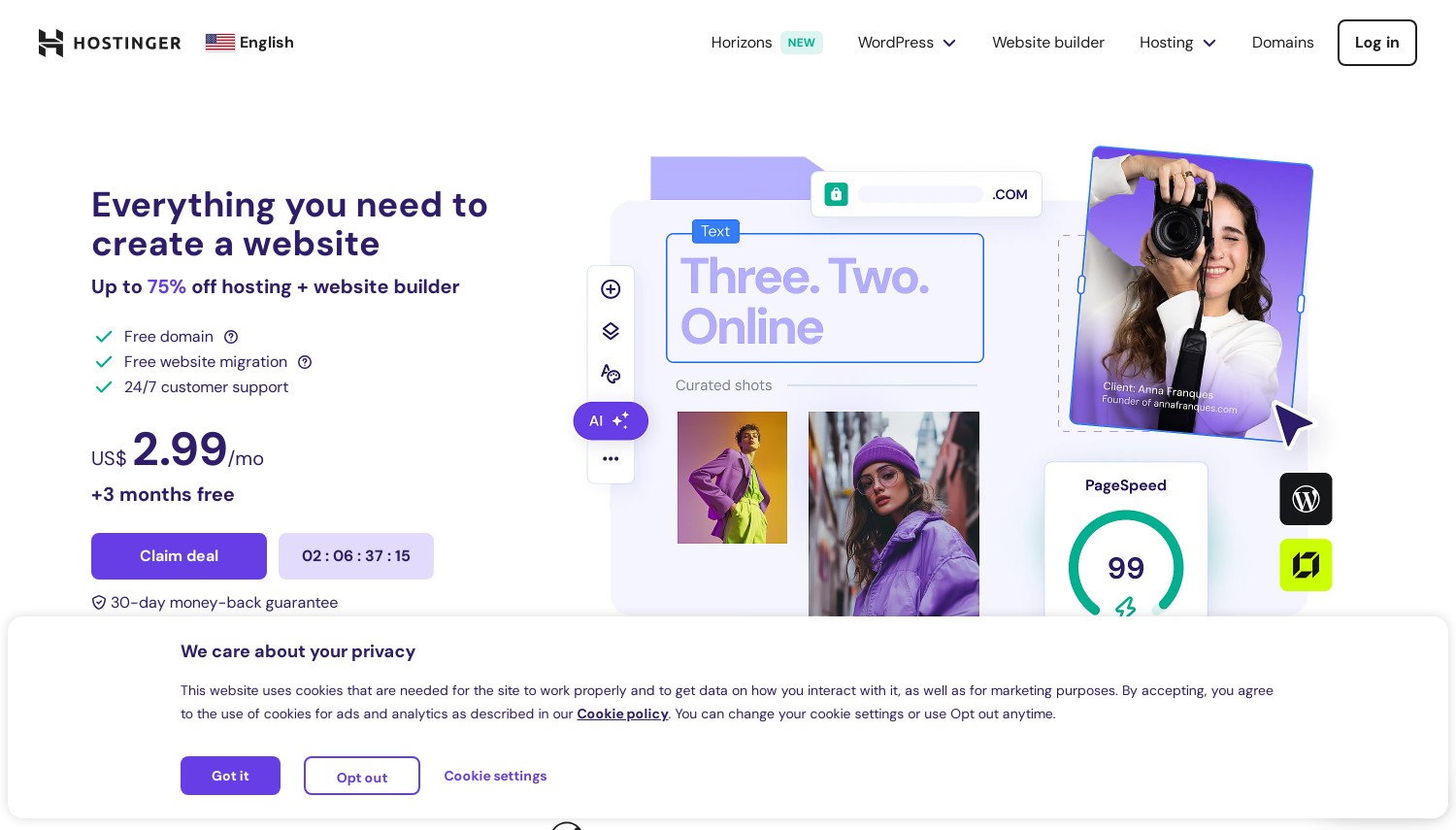
Hostinger's KVM 1 plan packs 4 GB of RAM and 50 GB of NVMe storage for USD 6.49/mo on a 24-month commitment. That's more memory than most entry-level VPS plans at this price point, which matters for Django apps running Gunicorn with multiple workers. You get full root access on Ubuntu, so installing Python, pip, and your preferred WSGI server takes minimal effort.
The catch? There's no Django-specific template or one-click installer. You'll need to SSH in and configure everything manually: Python environment, Gunicorn or uWSGI, Nginx reverse proxy, and your database. Hostinger does include an AI assistant called Kodee that can help with basic server configuration, but don't expect it to debug your Django settings.py file.
Server coverage is solid for a budget provider. VPS nodes sit in Lithuania, the US (Phoenix and Boston), France, the UK, Germany, Brazil, India, Indonesia, and Malaysia. The best VPS hosting roundup covers more about what to expect from KVM-based plans like these.
Compared to DigitalOcean's USD 4/mo Droplet (which only gives you 512 MB RAM), Hostinger's USD 6.49/mo entry plan delivers 8x the RAM for about USD 2.50/mo more. But DigitalOcean's App Platform handles Django deployment automatically, while Hostinger leaves all the server management to you.
- Pros:
- 4 GB RAM on the entry plan, more than most competitors at this price
- NVMe storage and 1 Gbps network speed
- 9 VPS server locations across 4 continents
- Full root access with KVM isolation
- Cons:
- No Django one-click installer or managed Python support
- Renewal jumps to USD 11.99/mo
- Support can be inconsistent for advanced VPS issues
Pricing: KVM 1 starts at USD 6.49/mo (24-month commitment), renewing at USD 11.99/mo. KVM 2 (2 vCPU, 8 GB RAM, 100 GB) runs about USD 8-10/mo promotional. 30-day refund window.
Best for: Developers comfortable with Linux who want maximum RAM per dollar for their Django project.
Skip if: You want managed Django deployment without touching the command line.
Verdict: Pick Hostinger if you're a terminal-comfortable developer who wants 4 GB RAM at USD 6.49/mo and will configure Gunicorn/Nginx yourself. If you want managed Django deployment from a Git push, Render at USD 13/mo gives you that for about USD 1/mo above your Hostinger renewal. If you want a 1-click Django installer on a cloud VPS, DigitalOcean or Linode skip the manual setup entirely at USD 5/mo entry.
DreamHost – Best for Python-Friendly Shared and VPS Hosting
From USD 10.00/mo · 2 GB RAM · 100% uptime guarantee · 97-day money-back
DreamHost stands apart with a genuine 100% uptime guarantee and an industry-leading 97-day money-back period on shared plans. Their VPS offering supports Python through Passenger WSGI, which means you can run Django without configuring Gunicorn or uWSGI separately. That's one less moving part in your deployment stack.
The VPS Business plan starts at USD 10.00/mo on a 3-year term, giving you 2 GB RAM and 60 GB of NVMe storage. It's not the cheapest entry point, and the renewal price of USD 24.99/mo represents a steep 150% increase. You'll want to lock in a longer term if DreamHost fits your needs.
DreamHost's server locations are limited to the US (Ashburn, VA and Hillsboro, OR). If your Django app serves users primarily in Europe or Asia, latency could be a concern. For those audiences, DigitalOcean or Linode offer more geographic flexibility.
What DreamHost does well is developer tooling. SSH access comes standard, you get full control over your Python environment with pip and virtualenv, and the Passenger integration simplifies WSGI configuration compared to a raw VPS setup.
- Pros:
- 100% uptime guarantee with downtime credits
- Passenger WSGI support simplifies Django deployment
- 97-day money-back period (shared), generous refund window
- Full SSH and Python environment control
- Cons:
- US-only server locations
- Renewal price jumps to USD 24.99/mo (150% increase)
- No managed Django-specific features
Pricing: VPS Business starts at USD 10.00/mo (3-year term), renewing at USD 24.99/mo. VPS Professional at USD 20.00/mo, renewing at USD 46.99/mo.
Best for: US-based Django projects that value uptime guarantees and a longer trial period.
Skip if: Your users are outside North America, or you need more than 2 GB RAM without paying USD 20+/mo.
Verdict: Pick DreamHost for US-audience Django projects where Passenger WSGI simplification and the 100% uptime guarantee outweigh the US-only data center limitation. If your users are in Europe or Asia, DigitalOcean's 14-region footprint or Linode's 20+ regions beat DreamHost on latency. If budget matters more than uptime guarantees, Hostinger's USD 6.49/mo delivers 2x the RAM at about a third of the price.
A2 Hosting (Hosting.com) – Best for Speed-Focused Django VPS
From USD 4.99/mo · 1 GB RAM · 99.9% uptime · Prorated refunds
A2 Hosting rebranded to Hosting.com in April 2025 after being acquired by World Host Group. The name changed, but the infrastructure stayed. Their unmanaged Runway 1 VPS starts at USD 4.99/mo with 1 vCPU, 1 GB RAM, and 150 GB SSD storage.
The big selling point has always been their Turbo servers, which use NVMe SSDs and LiteSpeed for faster page loads. For Django specifically, the Turbo advantage matters less since you'll be running Gunicorn or uWSGI behind Nginx rather than LiteSpeed's PHP-optimized stack. Still, the NVMe storage and overall server quality benefit any application.
With 13 data centers through World Host Group (including Michigan, Arizona, Amsterdam, and Singapore), geographic coverage is broader than most traditional hosts. The managed VPS option starts at USD 39.99/mo, which includes cPanel and proactive server monitoring. But for Django, unmanaged with root access is typically the better path.
One concern: the rebranding is still in progress. Some hosting.com product pages return 404 errors, and the renewal pricing page is currently broken. This transition period could affect support quality and documentation availability.
- Pros:
- 150 GB SSD on the entry plan, triple most competitors
- 13 data centers via World Host Group
- Prorated refunds (cancel anytime, no fixed window)
- Full root access and SSH on all VPS plans
- Cons:
- Only 1 GB RAM on entry plan (tight for Django + database)
- Rebranding to Hosting.com still incomplete, some pages broken
- Renewal pricing currently unavailable (website issues)
Pricing: Unmanaged Runway 1 from USD 4.99/mo (1 vCPU, 1 GB RAM, 150 GB SSD). Managed Lift 4 from USD 39.99/mo. Renewal rates not currently published due to website migration.
Best for: Developers who want generous storage and flexible cancellation terms.
Skip if: You need reliable documentation and support during the brand transition, or your Django app needs more than 1 GB RAM on a budget.
Verdict: Pick A2 Hosting (Hosting.com) if 150 GB SSD on a USD 4.99/mo VPS is the decisive factor AND you can tolerate the rebrand-period documentation gaps. If you want less operational uncertainty at similar pricing, Linode's transparent pay-as-you-go on a Nanode is the safer bet. If storage isn't the constraint and you want a confirmed-stable VPS host, Hostinger gives you more RAM (4 GB vs 1 GB) at the same entry price.
Liquid Web – Best Managed VPS with Premium Support
From USD 5.00/mo (self-managed) · 1 GB RAM · 100% uptime SLA · 30-day money-back
Liquid Web is the provider you pick when downtime isn't an option. Their 100% uptime SLA backs that claim with 10x credits for any downtime, one of the most aggressive compensation policies in the industry. Their "Heroic Support" team guarantees under 1-minute response on phone and chat, and under 30 minutes on tickets.
For Django, there's a split worth understanding. The self-managed VPS at USD 5.00/mo gives you 1 vCPU, 1 GB RAM, and 30 GB SSD with full root access. You handle everything, including Python and Django setup. The Core-Managed tier jumps to USD 14.75/mo (24-month term) and adds infrastructure management, security patches, and 24/7 support, but still expects you to manage your application stack. Fully Managed (with cPanel) adds another USD 28.00/mo on top.
Liquid Web doesn't advertise any Django-specific tooling. Their managed services focus heavily on PHP-based CMS platforms like WordPress and Magento. Python developers are an afterthought in their marketing, though the server infrastructure itself handles Django perfectly well once configured.
With 18 data centers including locations in Michigan, Phoenix, and Amsterdam, geographic reach is decent for a mid-market provider. The AMD EPYC processors powering their managed VPS line deliver strong single-thread performance, which benefits Django's synchronous request handling.
- Pros:
- 100% uptime SLA with 10x downtime credits
- Under 1-minute phone/chat response guarantee
- AMD EPYC processors on managed plans
- Free migrations on managed tiers
- Cons:
- No Django or Python-specific managed support
- Managed VPS renewal jumps to USD 59.00/mo
- Self-managed plan has only 30 GB storage
Pricing: Self-managed from USD 5.00/mo. Core-Managed from USD 14.75/mo (24-month), renewing at USD 59.00/mo. Fully Managed adds USD 28.00/mo for cPanel/Plesk.
Best for: Production Django apps where uptime and support response time matter more than price.
Skip if: You're on a budget, or you want managed Python/Django support rather than just managed infrastructure.
Verdict: Pick Liquid Web for business-critical Django apps where sub-1-minute support response and 100% uptime with 10x credits justify the USD 14.75/mo Core-Managed entry and the jump to USD 59/mo at renewal. If the priority is Django-native platform expertise rather than infrastructure SLAs, Render delivers the deployment workflow at USD 13/mo total. For similar managed cloud management at lower cost, Cloudways from USD 11/mo handles the OS layer without the premium support tier.
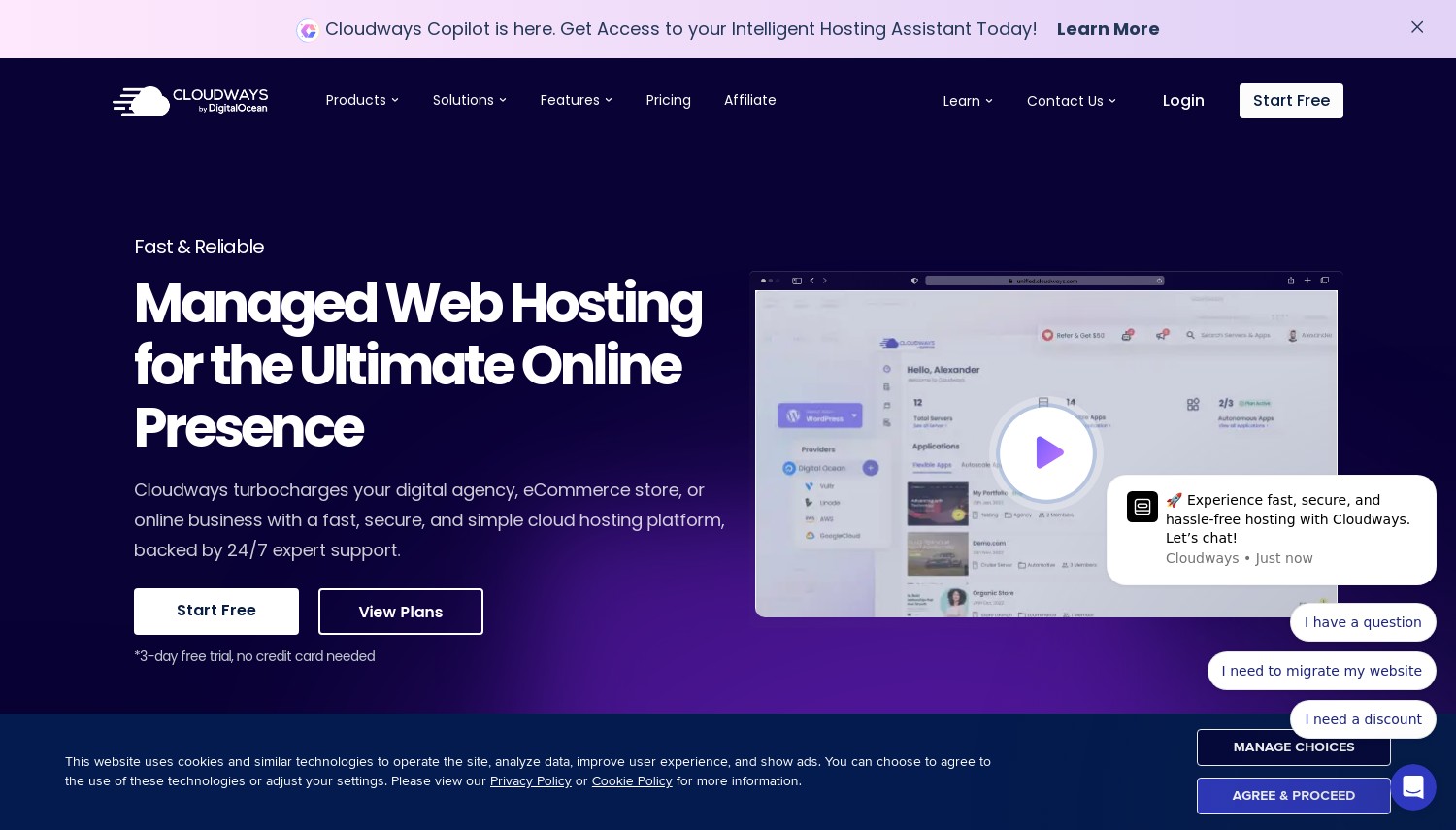
Cloudways – Best Managed Cloud with Multiple Infrastructure Providers
From USD 11.00/mo · Pay-as-you-go · 99.9% uptime · 3-day free trial
Here's the thing about Cloudways: it's a management layer on top of five cloud providers (DigitalOcean, AWS, Google Cloud, Vultr, and Linode). You pick the underlying infrastructure, and Cloudways handles server setup, security patches, backups, and monitoring. No long-term contracts. Cancel anytime.
The Django caveat is significant, though. Cloudways is built primarily for PHP applications like WordPress, Laravel, and Magento. There's no pre-configured Django environment, no Python buildpack, and no automated Django deployment. You'll need SSH access to manually install Python, set up your virtual environment, configure Gunicorn, and manage your own WSGI setup. Cloudways support can assist via live chat (averaging about 90-second response times), but Python troubleshooting isn't their core strength.
The entry point on DigitalOcean infrastructure starts at USD 11.00/mo. AWS-backed servers begin at USD 38.56/mo. Real-world uptime monitoring shows 99.981% over 12 months on Vultr infrastructure, which is solid. Independent reviews rate them among the top managed hosting providers for SMBs.
If you're already comfortable with Django server administration and just want someone else handling the OS-level maintenance, Cloudways could save you time. But if you want a platform that understands Django deployments natively, Render or PythonAnywhere are better fits.
- Pros:
- Choice of 5 cloud providers (pick based on location and budget)
- Pay-as-you-go billing, no lock-in contracts
- 24/7 live chat with ~90-second response time
- Automated backups and security patches at the OS level
- Cons:
- No native Django or Python support (PHP-first platform)
- Manual Django setup required via SSH
- Premium over raw cloud pricing for the management layer
Pricing: From USD 11.00/mo (DigitalOcean), USD 38.56/mo (AWS), USD 37.45/mo (Google Cloud). Pay-as-you-go with hourly billing from USD 0.0139/hr. 3-day free trial, no credit card needed.
Best for: Django developers who want managed infrastructure without managing the OS, and who don't mind handling the application layer themselves.
Skip if: You want a platform that natively supports Django deployment. Use Render or DigitalOcean's App Platform instead.
Verdict: Pick Cloudways only if you already have Django deployment scripts and just want someone else handling OS patches and security hardening across DigitalOcean, Vultr, or AWS infrastructure. If you want native Django deployment from a Git repo, Render at USD 13/mo does that without the SSH-first setup. If you want the underlying cloud infrastructure directly, DigitalOcean's App Platform starts at USD 5/mo plus USD 15.15/mo for managed Postgres after the 2026 reprice.
DigitalOcean – Best Developer Experience for Django
From USD 4.00/mo (Droplet) · 99.99% uptime SLA · USD 200 free credit
DigitalOcean gives you two paths to Django hosting, and both are good. The traditional route: spin up a Droplet (their term for a VPS) starting at USD 4.00/mo for 1 vCPU, 512 MB RAM, and 10 GB SSD. There's even a 1-click Django image in the Marketplace that pre-configures Python, Django, Gunicorn, and Nginx on Ubuntu.
The modern route: use App Platform, their PaaS that auto-deploys Django from a GitHub or GitLab repo. Connect your repository, and DigitalOcean detects the Django project, builds it, and deploys. Paid App Platform plans start at USD 5.00/mo for a shared instance. Managed PostgreSQL now starts at USD 15.15/mo (1 vCPU, 1 GiB RAM, 10 GiB storage) after DigitalOcean repriced the database tier in 2026, putting a production Django stack around USD 20/mo with zero server management.
What sets DigitalOcean apart is documentation quality. Their Django tutorials are among the best available, walking through everything from initial deployment to production hardening with Nginx and Let's Encrypt. For developers who learn by reading, this matters. If you're also exploring other frameworks, their Next.js hosting support follows a similar developer-friendly pattern.
With 14 data centers across New York, San Francisco, Atlanta, Toronto, Amsterdam, London, Frankfurt, Singapore, Bangalore, and Sydney, you can place your Django app close to your users. The 99.99% uptime SLA on Droplets is among the highest in the industry. New accounts get USD 200 in credits for the first 60 days.
- Pros:
- 1-click Django Droplet image AND managed App Platform
- 99.99% uptime SLA on compute instances
- Per-second billing (minimum 60 seconds)
- Excellent Django documentation and tutorials
- Cons:
- Entry Droplet (USD 4/mo) has only 512 MB RAM
- App Platform free tier limited to static sites
- Support responsiveness flagged in some reviews
Pricing: Droplets from USD 4.00/mo. App Platform from USD 5.00/mo (shared). Managed PostgreSQL from USD 15.15/mo (repriced in 2026). Per-second billing with monthly cap. USD 200 free credit for new accounts (60 days).
Best for: Developers who want both flexibility (Droplets) and convenience (App Platform) for Django projects.
Skip if: You need phone support or enterprise-grade SLAs beyond compute uptime.
Verdict: Pick DigitalOcean when you want the flexibility to switch between managed (App Platform at ~USD 20/mo with Postgres after the 2026 reprice) and unmanaged (Droplet + 1-click Django from USD 4/mo) within one provider. For the cleanest Django PaaS experience at USD 13/mo total, Render now undercuts App Platform by a wider margin than it did pre-reprice. For more global regions and better documentation on advanced scaling, AWS is the enterprise step up.
Linode (Akamai) – Best Value Cloud VPS for Django
From USD 5.00/mo · 99.99% uptime SLA · USD 100 free credit
Linode, now operating under the Akamai umbrella, offers one of the better Django quick-start options among traditional cloud providers. Their Marketplace includes a dedicated Django app that installs a working Django project with all dependencies in 2-5 minutes. There's also an OpenLiteSpeed Django template with HTTP/3 support and multi-app capability.
The Nanode plan at USD 5.00/mo gives you 1 shared vCPU, 1 GB RAM, and 25 GB SSD with 1 TB transfer. Pricing is straightforward (pay-as-you-go with hourly billing at USD 0.0075/hr) and, unlike Hostinger or DreamHost, there's no renewal price increase. What you see is what you keep paying.
Data center coverage expanded significantly after the Akamai acquisition. Beyond the original 11 locations (including Newark, Dallas, London, Frankfurt, Tokyo, and Singapore), they've added Chicago, Washington DC, Paris, Seattle, Los Angeles, Amsterdam, Jakarta, Osaka, Sao Paulo, Milan, and Stockholm. That's over 20 regions for placing your Django app close to your audience. For location-specific hosting, you can compare options in our cloud hosting guide.
The branding situation is messy. Some pages say "Linode," others say "Akamai Cloud Computing." Documentation references both names inconsistently. Functionally, nothing has changed for end users, but don't be confused when linode.com redirects you to akamai.com for some pages.
- Pros:
- Django Marketplace app with 2-5 minute deployment
- No renewal price increases (pay-as-you-go)
- 20+ data center locations worldwide
- 99.99% compute uptime SLA
- Cons:
- Entry plan limited to 1 GB RAM
- Inconsistent Linode/Akamai branding creates confusion
- Some users report price increases without notification post-acquisition
Pricing: Nanode from USD 5.00/mo (1 GB RAM, 25 GB SSD). Linode 2 GB at USD 12.00/mo. Dedicated 4 GB at USD 43.20/mo. Hourly billing available. USD 100 free credit for new accounts (60 days).
Best for: Django developers who want a quick Marketplace deployment on a global cloud network without renewal surprises.
Skip if: You need more than 1 GB RAM at the entry level, or inconsistent branding bothers you.
Verdict: Pick Linode (Akamai) when you want a global cloud VPS with a working Django Marketplace app and no renewal-price surprises at USD 5/mo flat. If you want the 1-click image bundled with the option to flip to a PaaS later, DigitalOcean matches price with more deployment paths. If your Django app needs Akamai's edge network across APAC, Linode is the unique pick; otherwise Render at USD 13/mo skips the VPS layer entirely.
AWS – Best for Enterprise-Scale Django Applications
From USD 3.50/mo (Lightsail) · 99.99% uptime (multi-AZ) · 12-month free tier
AWS is the obvious choice for Django apps that need to scale to millions of requests, and the wrong choice for a personal blog. The platform offers at least three ways to host Django, each with different complexity and cost trade-offs.
Simplest option: Lightsail starts at USD 3.50/mo (IPv6-only) or USD 5.00/mo (with IPv4). You get a fixed-price VPS with predictable billing, plus 3 months free on select plans. Think of it as AWS's answer to DigitalOcean Droplets.
Middle ground: Elastic Beanstalk handles Django deployment automatically. Push your code, and EB provisions EC2 instances, configures load balancing, and manages auto-scaling. The service itself is free; you pay for the underlying EC2 instances (t4g.micro at about USD 6.13/mo, t4g.small at USD 12.26/mo).
Full stack approach: raw EC2 instances with RDS for PostgreSQL, S3 for static files, CloudFront for CDN, and Route 53 for DNS. Powerful, but the billing complexity can be overwhelming. One unexpected traffic spike and your bill could surprise you.
AWS operates 39 regions with 100+ Availability Zones, dwarfing every other provider on this list. The 12-month free tier includes 750 hours/mo of t2.micro or t3.micro instances (enough to run one Django app 24/7). The t4g.small free trial has been extended through the end of 2026. Support starts free for billing issues only; actual technical support requires the Business tier at USD 29/mo minimum.
- Pros:
- 39 regions, 100+ availability zones worldwide
- Elastic Beanstalk automates Django deployment and scaling
- 12-month free tier covers a small Django project
- Lightsail offers simple, predictable pricing from USD 3.50/mo
- Cons:
- Complex, unpredictable pricing on most services
- Technical support requires USD 29/mo minimum (Business tier)
- Steep learning curve compared to PaaS alternatives
Pricing: Lightsail from USD 3.50/mo (IPv6) or USD 5.00/mo (IPv4). EC2 t4g.micro ~USD 6.13/mo. Elastic Beanstalk free (pay for resources). Free tier: 750 hrs/mo t2/t3.micro for 12 months.
Best for: Enterprise Django applications that need global reach, auto-scaling, and deep AWS ecosystem integration.
Skip if: You're running a small-to-medium Django project and don't want to learn AWS's billing model.
Verdict: Pick AWS when your Django app needs multi-region auto-scaling, deep ecosystem integration (RDS, S3, CloudFront, SQS), or compliance certifications other providers can't match. If you just want a predictable VPS without learning AWS's billing model, Linode or DigitalOcean deliver comparable compute at a fraction of the cognitive overhead. If Django deployment automation is the actual goal, Render handles it at USD 13/mo without Elastic Beanstalk's configuration depth.
Render – Best Modern PaaS for Django Deployment
From USD 7.00/mo · Native Django support · Free tier available
Render is what Heroku used to be: a developer-first platform where deploying Django feels natural rather than forced. Connect your GitHub or GitLab repo, and Render detects your Django project, installs dependencies, runs collectstatic, applies migrations, and deploys. Your render.yaml file defines the entire infrastructure as code.
Fair warning: the free tier works for experimentation but not production. Web services get 0.1 CPU and 512 MB RAM, and they spin down after inactivity. The PostgreSQL database expires after 30 days on the free plan. For a real Django project, the Starter web service at USD 7.00/mo plus a Basic PostgreSQL instance at USD 6.00/mo gives you an always-on stack for USD 13.00/mo total.
Django-specific features are genuinely useful here. Gunicorn and Uvicorn (ASGI) work out of the box. WhiteNoise with Brotli compression handles static files. Environment variables like DATABASE_URL are auto-configured. Shell access lets you run management commands like createsuperuser. Zero-downtime deploys mean your app stays live during updates.
Where it falls short: only 5 server regions (3 in the US, plus Frankfurt and Singapore). No published uptime SLA outside the Enterprise plan. Email-only support on lower tiers. If you need the managed hosting comparison for broader cloud options, our managed cloud hosting guide covers more providers.
- Pros:
- Native Django deployment from Git repos (auto-detect, build, deploy)
- Managed PostgreSQL with auto-configured DATABASE_URL
- Zero-downtime deploys and infrastructure-as-code via render.yaml
- Free tier for development and testing
- Cons:
- Only 5 server regions
- Free PostgreSQL expires after 30 days
- No published uptime SLA on non-Enterprise plans
Pricing: Free tier available (limited). Starter web service USD 7.00/mo (0.5 CPU, 512 MB). Standard USD 25.00/mo (1 CPU, 2 GB). PostgreSQL from USD 6.00/mo. Minimum production Django stack: USD 13.00/mo.
Best for: Developers who want the fastest path from a Django Git repo to a live production app.
Skip if: You need data centers in Asia-Pacific beyond Singapore, or require a contractual uptime guarantee.
Verdict: Pick Render for new Django projects where Git-based deployment, managed Postgres, and zero-downtime deploys at USD 13/mo total outweigh the 5-region limit. If your audience is primarily APAC beyond Singapore, DigitalOcean's 14 regions or Linode's 20+ regions cover the geography Render doesn't. If you need a contractual uptime SLA, Liquid Web's 100% uptime with 10x credits is the only roster option that commits in writing.
PythonAnywhere – Best for Django Beginners
From USD 0 (free tier) · Django pre-installed · Browser-based IDE
PythonAnywhere, owned by Anaconda since 2022, does one thing and does it well: Python hosting. Django comes pre-installed on every server. Sign up, click "Add a new web app," answer two questions, and you've got a live Django app. Five minutes, no terminal required. No other provider on this list matches that simplicity for getting started.
Unlike most "free tiers," this one is legitimately usable for learning. You get one web app on a subdomain (username.pythonanywhere.com), 512 MB storage, and 100 CPU-seconds per day. That's enough for a tutorial project or a personal portfolio. The big limitations: no custom domains, restricted outbound internet access (whitelist only), and no SSH.
Paid plans start at USD 10.00/mo (Developer tier) with a custom domain, 5 GB storage, 5,000 CPU-seconds per day, and 3 always-on worker processes. Custom plans scale up to USD 500/mo with 200 GB storage and 200,000 CPU-seconds. All paid plans include a 30-day money-back guarantee and monthly billing with no annual commitment.
Having a browser-based editor and Bash consoles means you can develop, deploy, and manage your Django app from any computer with a web browser. For students and beginners following Django tutorials, this removes the "install Python on your machine" barrier entirely.
Where PythonAnywhere falls short: it's not traditional hosting. There's no Nginx configuration, no load balancing, no CDN. You can't install arbitrary system packages. Server locations aren't disclosed (believed to be AWS-based). For production apps with serious traffic, you'll outgrow it.
- Pros:
- Django pre-installed, live app in under 5 minutes
- Free tier actually works for learning and small projects
- Browser-based IDE and Bash consoles (no local setup needed)
- Monthly billing, 30-day money-back, no lock-in
- Cons:
- Free tier: restricted outbound internet, no custom domains, no SSH
- Server locations not disclosed
- Not suitable for high-traffic production apps
Pricing: Free Beginner tier (1 app, 512 MB, 100 CPU-sec/day). Developer USD 10.00/mo (custom domain, 5 GB, 5,000 CPU-sec/day). Custom plans USD 10-500/mo. Monthly billing, cancel anytime.
Best for: Students, beginners, and developers who want Django running in minutes with zero server configuration.
Skip if: You need production-grade performance, geographic control over server location, or system-level access.
Verdict: Pick PythonAnywhere for students, tutorial projects, and first Django deployments where the free tier and browser-based workflow remove the local-install barrier. Once you need custom domains, outbound internet, or SSH, upgrade to Render's USD 13/mo production stack rather than scaling PythonAnywhere. If your project is already past "tutorial" stage, skip straight to Render or DigitalOcean App Platform; you'll migrate anyway.
Heroku – Best Established PaaS Ecosystem for Django
From USD 5.00/mo (Eco) · Native Python buildpack · Owned by Salesforce
Heroku practically invented the "git push to deploy" workflow that Render and others now replicate. The Python buildpack supports Django natively, and the deployment process is well-documented after over a decade of Django community use. Heroku Postgres integrates via the DATABASE_URL environment variable, and the add-on ecosystem covers everything from Redis caching to email delivery.
But here's what you need to know in 2026: Salesforce moved Heroku into "sustaining engineering" mode in February 2026. That means stability and security updates continue, but no major new features are coming. The free tier was removed in November 2022. Eco dynos at USD 5.00/mo share 1,000 compute hours across your account and sleep after 30 minutes of inactivity. Basic dynos at USD 7.00/mo stay always-on.
A minimal production Django setup on Heroku costs about USD 12.00/mo: one Basic dyno (USD 7.00) plus an Essential-0 Postgres database (USD 5.00). Standard-1X dynos at USD 25.00/mo give you 512 MB RAM with horizontal scaling capability.
Reliability is a concern. A 15-hour 45-minute outage in June 2025 wasn't a one-off. Heroku offers no uptime SLA on standard plans, and premium support costs USD 1,000/mo with a 3-month commitment. Server locations are limited to US (Virginia) and EU (Dublin) on the Common Runtime.
Thousands of Django tutorials still reference Heroku, and the deployment workflow remains smooth. But with Render offering similar functionality, better pricing, and active development, Heroku's position as the default Django PaaS has eroded.
- Pros:
- Mature Django deployment workflow with native Python buildpack
- Large add-on ecosystem (Postgres, Redis, monitoring, email)
- Extensive documentation and community tutorials
- PgBouncer buildpack for connection pooling
- Cons:
- Sustaining engineering mode since February 2026 (no new features)
- No free tier, Eco dynos sleep after 30 min inactivity
- No uptime SLA on standard plans; 15+ hour outage in June 2025
- Premium support costs USD 1,000/mo
Pricing: Eco dynos USD 5.00/mo (shared hours, sleeps). Basic dynos USD 7.00/mo (always-on). Standard-1X USD 25.00/mo (512 MB RAM, scalable). Essential-0 Postgres USD 5.00/mo. Minimum production stack: ~USD 12.00/mo.
Best for: Existing Heroku users or teams with workflows built around Heroku's add-on ecosystem.
Skip if: You're starting a new Django project. Render offers a similar experience with active development and better pricing.
Verdict: Pick Heroku only if you have existing Django apps on Heroku add-ons and migration cost exceeds the platform-risk cost. For any new Django project, Render delivers the same Git-push workflow at comparable pricing on actively-developed infrastructure. If add-on ecosystem depth is the decisive factor, AWS with managed services (RDS, ElastiCache, SES) replicates what Heroku add-ons do at scale.
HowToHosting.Guide Selected Hostinger Reviews

Trustpilot User
from India

Published on: 24/07/2025
"Easy to build websites on Hostinger."
Trustpilot User
from Brazil

Published on: 29/01/2025
"Desde que eu utilizo os serviços da Hostinger, foi o melhor atendimento que tive, se possível gostaria de ser sempre atendido pelo mesmo profissional Caio, ou que tenha o mesmo nível de preparo."
Trustpilot User
from United Kingdom

Published on: 05/01/2025
"When it comes to the back end of the servers, I always have a terrible temper with them! Nothing ever seems to work. Devi at Hostinger just sent me a few images, and the instructions on how to load an existing website were made clear. So I calmed down!! Problem solved thankfully!"

 Hostinger

 DreamHost
 A2 Hosting
 Liquid Web Inc.
 Cloudways
 Digital Ocean

 Linode

 Amazon Web Services (AWS)