
Best SMTP Hosting Services (2026) – Top 12 Compared
Gmail and Yahoo began rejecting bulk senders in February 2024 unless every message passed SPF, DKIM, and DMARC checks (the three standards that prove an email really comes from you). That one change turned "which SMTP server should I use" into a deliverability question, not a hosting one. Most shared hosts cap outbound mail at a few hundred emails an hour and quietly drop anything past it, so a password reset or order receipt can fail with no warning. SMTP hosting (the service that sends your outgoing mail) really splits into two camps: the throttled SMTP bundled with your web host, and dedicated relay services built to land transactional and bulk email in the inbox. This guide covers both, with verified sending limits, per-volume pricing, and renewal costs.
Last reviewed: June 2026. Prices and sending limits verified against provider pages.
Quick answer: For reliable delivery without babysitting IP reputation, SMTP2GO wins on a tested 95.5% inbox placement and plug-and-play setup. Sending high volume and comfortable in a console? Amazon SES runs USD 0.10 per 1,000 emails. Want the best transactional inbox rates regardless of price, go Postmark. Need marketing and transactional under one login, Brevo. Tightest budget, Zoho ZeptoMail at USD 2.50 per 10,000.
Jump to: SiteGround · Hosting.com (A2) · GreenGeeks · InMotion · Amazon SES · SMTP2GO · Brevo · Twilio SendGrid · Mailgun · Postmark · Mailjet · Zoho ZeptoMail
How We Selected These SMTP Services
Two questions shaped every call here: how many emails can you actually push per hour, and where do they land once they leave? We split the field into bundled-host SMTP (the four web hosts, fine for low-volume site mail) and dedicated relay services (built for transactional and bulk sending). Relays had to publish per-volume pricing, automate SPF and DKIM, and offer either a free tier or a real trial; we excluded anything that hid its sending rates behind a sales call. Where independent 2026 inbox-placement data existed, we weighted it heavily, leaning on EmailTooltester's multi-round transactional tests and InboxEagle's placement grades. For the web hosts, the deciding number was the outbound cap in their own knowledge-base docs, not their marketing copy. We also checked renewal pricing, because the four hosts all jump hard after year one.
Honest limits: we did not run live send tests against each relay's IP reputation, and inbox-placement scores were not publicly available for every provider (SendGrid, Mailgun, Mailjet, and ZeptoMail lacked a current independent figure, so we say so in those sections rather than guess). If you need full mailboxes rather than sending, our email hosting guide covers that side.
| Hosting Provider | Reviews | Overall Rating | Starts from |
|---|---|---|---|
1  SiteGround SiteGround
|
29.1k+ |

|
$3.41 / mo. NOW -81% |
2  A2 Hosting A2 Hosting
|
3.4k+ |

|
$1.95 / mo. NOW -76% |
3  GreenGeeks Web Hosting GreenGeeks Web Hosting
|
753 |

|
$2.49 / mo. |
4  InMotion Hosting InMotion Hosting
|
2.8k+ |
|
$0.99 / mo. -75% |
5  Amazon Web Services (AWS) Amazon Web Services (AWS)
|
200 |

|
$5.83 / mo. |
1. SiteGround
 29.1k+
4.8
Positive
Positive
29.1k+
4.8
Positive
Positive








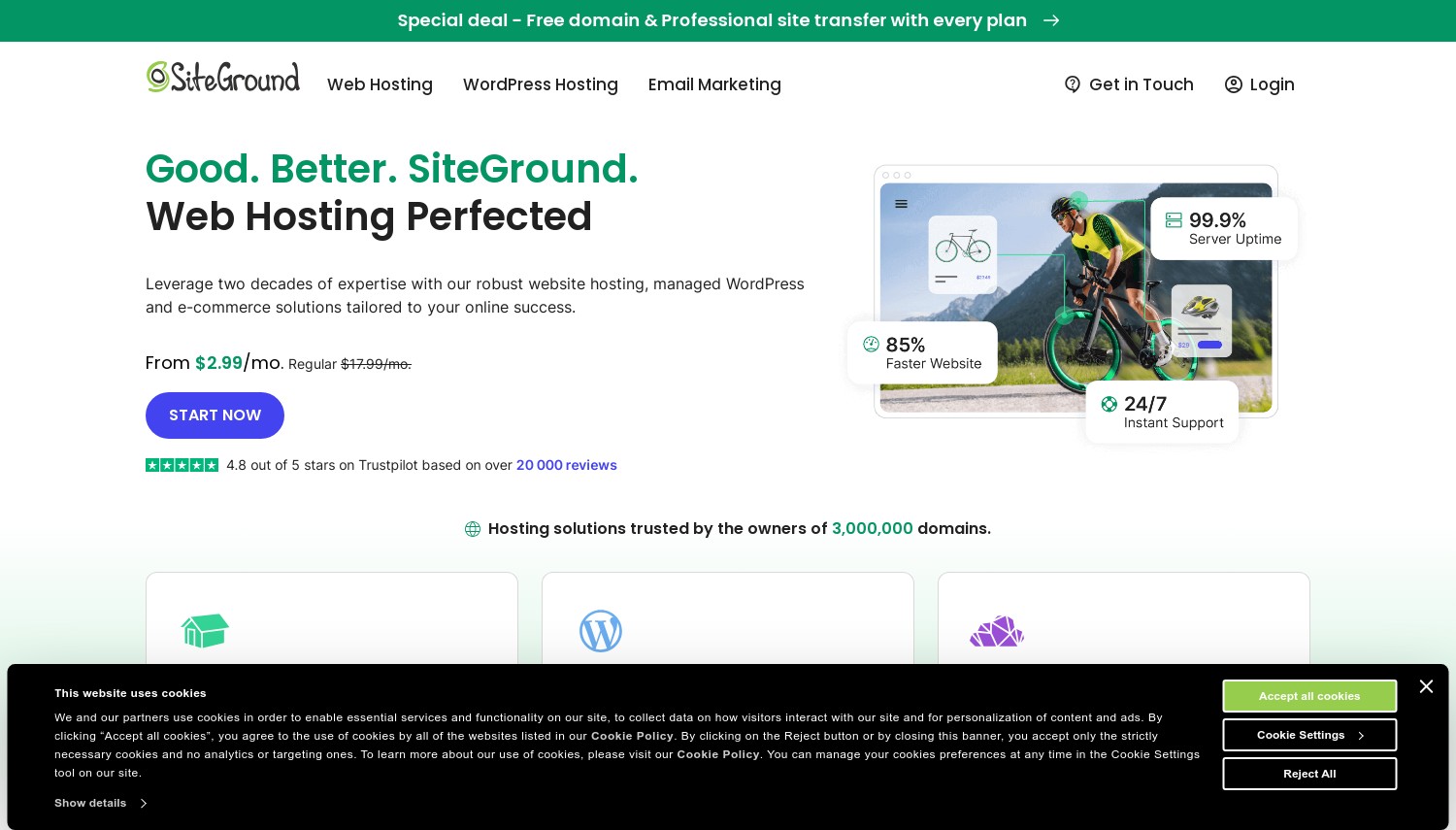
SiteGround – Best bundled SMTP for small sites
Entry: USD 2.99/mo. Renewal: USD 17.99/mo. Outbound cap: 400 emails/hour (StartUp).
Four hundred emails an hour. That is the StartUp ceiling, and it tells you exactly who SiteGround's bundled mail is for: contact forms, order notices, the occasional newsletter to a short list. Move up to GoGeek and the cap doubles to 800 an hour. You can put up to 80 recipients on a single message, but each one counts against that hourly quota. One big send eats it fast. SiteGround runs this on Google Cloud, and its own acceptable-use docs are blunt that the mail service is for "standard communication," not campaigns. Push real marketing volume and you get steered to its separate paid Email Marketing add-on.
For sending headroom, that 400/hour floor is 60% more than InMotion's 250/hour and roughly four times GreenGeeks' 100/hour. It still trails any dedicated relay by a mile: SMTP2GO's free tier alone clears transactional bursts a shared host would throttle. The renewal is the part that bites. You sign at USD 2.99 and re-up at USD 17.99 a month, so treat the first-year price as a trial rate. The web-host context here is covered more fully in our shared hosting roundup if you want plan-by-plan detail.
- Scales sending by plan: 400 to 800 emails/hour
- Google Cloud infrastructure with SPF and DKIM in Site Tools
- 30-day money-back window
- Four data center regions (US, UK, Netherlands, Singapore)
- Renewal jumps to USD 17.99/mo from USD 2.99
- Every recipient counts toward the hourly cap
- Bulk and marketing email pushed to a separate paid product
Best for: a brochure or small WordPress site that sends a few hundred emails a day. Skip if: you send transactional email at any real scale, where a relay like ZeptoMail or SMTP2GO belongs.
Verdict: Choose SiteGround when email is a side feature of your hosting and you value the 24/7 support. If sending is the actual job, do not use bundled host mail at all; SMTP2GO handles deliverability for you, and ZeptoMail does the volume for a fraction of the renewal.
2. A2 Hosting
 3.4k+
4.5
Positive
Positive
3.4k+
4.5
Positive
Positive




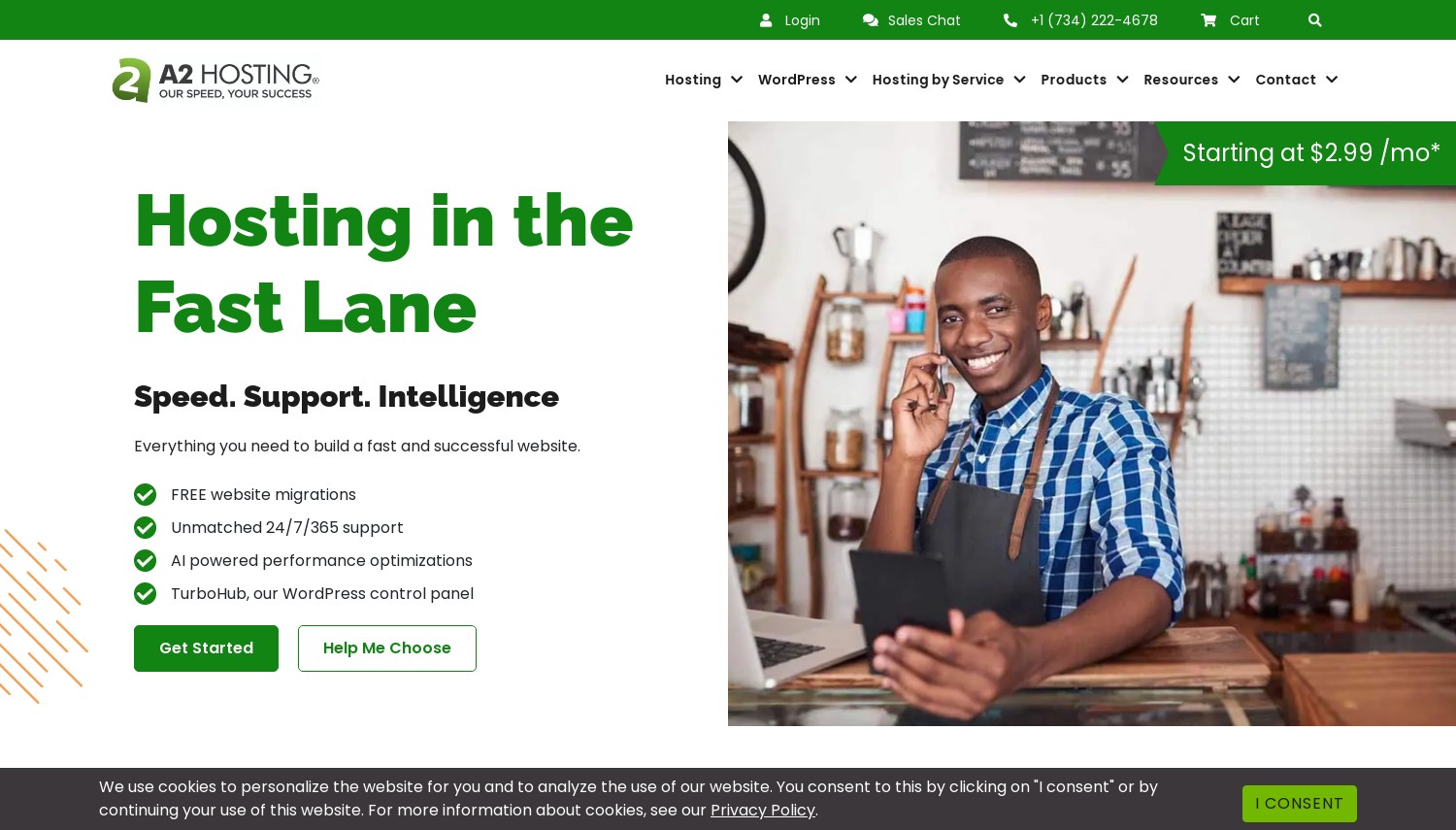
Hosting.com (formerly A2 Hosting) – Best for speed-first sites that send lightly
Entry: USD 2.99/mo. Renewal: USD 10.99/mo (Startup). No bulk sending allowed.
A2 Hosting rebranded to Hosting.com in April 2025, and the rename muddied which email policy applies. What is clear: bulk and marketing email are off the table. The host explicitly tells you to use a third-party service for campaigns, and accounts that cross roughly 1,000 emails a day risk suspension. Published hourly limits conflict by source, landing somewhere between 100 and 500 emails an hour, enforced per email account rather than per domain, so more mailboxes raises your effective ceiling.
Put numbers on it: Hosting.com suspends above about 1,000 emails a day, where InMotion tolerates roughly 6,000 a day before its 250/hour cap bites. The renewal is gentler than most of this group, though. Startup re-ups at USD 10.99 a month against SiteGround's USD 17.99, and the speed stack (LiteSpeed, NVMe) is real. None of that changes the verdict for sending: this is a fast web host that happens to relay light mail, not a sending platform.
- Per-account limits, so extra mailboxes add headroom
- Gentler renewal: USD 10.99/mo on Startup
- Nine data center regions across four continents
- SPF and DKIM via cPanel deliverability tools
- Bulk and marketing sending banned outright
- Suspension risk above 1,000 emails/day
- Conflicting published hourly caps post-rebrand
Best for: a performance-focused site that sends transactional mail in the low hundreds per day. Skip if: you need predictable bulk capacity, where Mailgun or SMTP2GO won't suspend you for hitting volume.
Verdict: Pick Hosting.com if page speed is your priority and email is incidental. Anyone whose product depends on email reaching the inbox should pair it with a relay; Brevo's free 9,000 a month covers more than this host's daily cap without the suspension risk.
3. GreenGeeks Web Hosting
 753
4.2
Positive
Positive
753
4.2
Positive
Positive


GreenGeeks – Best "named" SMTP product among shared hosts
Entry: USD 2.95/mo. Renewal: USD 13.95/mo (Lite). Outbound cap: ~100 emails/hour.
Here is the twist: GreenGeeks is the only host in this group that markets a product literally called "SMTP Hosting," complete with one-click setup, a choice of US or EU sending server, and built-in SPF, DKIM, and DomainKeys. It sounds like a relay. It is still shared-hosting mail underneath, throttled to about 100 emails an hour with a 50 MB message size cap and open-relay detection that blocks anything resembling a campaign.
That 100/hour rate is a quarter of SiteGround's 400/hour floor and 40% of InMotion's 250/hour, so the branding oversells the throughput. What the product does get right is authentication: SPF, DKIM, and DomainKeys configured for you, plus a sending server near your contacts, which helps a small site's mail actually arrive. Renewal on the Lite plan sits at USD 13.95 a month, between Hosting.com's USD 10.99 and SiteGround's USD 17.99. For deliverability at volume, a dedicated relay still wins; for a green-minded small site that wants clean authentication out of the box, this is a tidy option.
- Named SMTP product with one-click setup
- SPF, DKIM, and DomainKeys preconfigured
- US or EU sending server, user-selectable
- 30-day money-back window
- Effective cap around 100 emails/hour
- Open-relay detection blocks bulk campaigns
- "SMTP Hosting" name implies more throughput than it delivers
Best for: a low-volume site that wants authentication handled without touching DNS records. Skip if: you read "SMTP Hosting" and expected relay-grade volume, where SMTP2GO or Mailjet is the real thing.
Verdict: Choose GreenGeeks if you want bundled mail with deliverability basics done for you on a small site. If the word "SMTP" in the plan name is why you're here, buy an actual relay instead; Mailjet's free 6,000 a month sends more than this plan allows in a day.
4. InMotion Hosting
 2.8k+
4.0
Positive
2.8k+
4.0
Positive
 Neutral
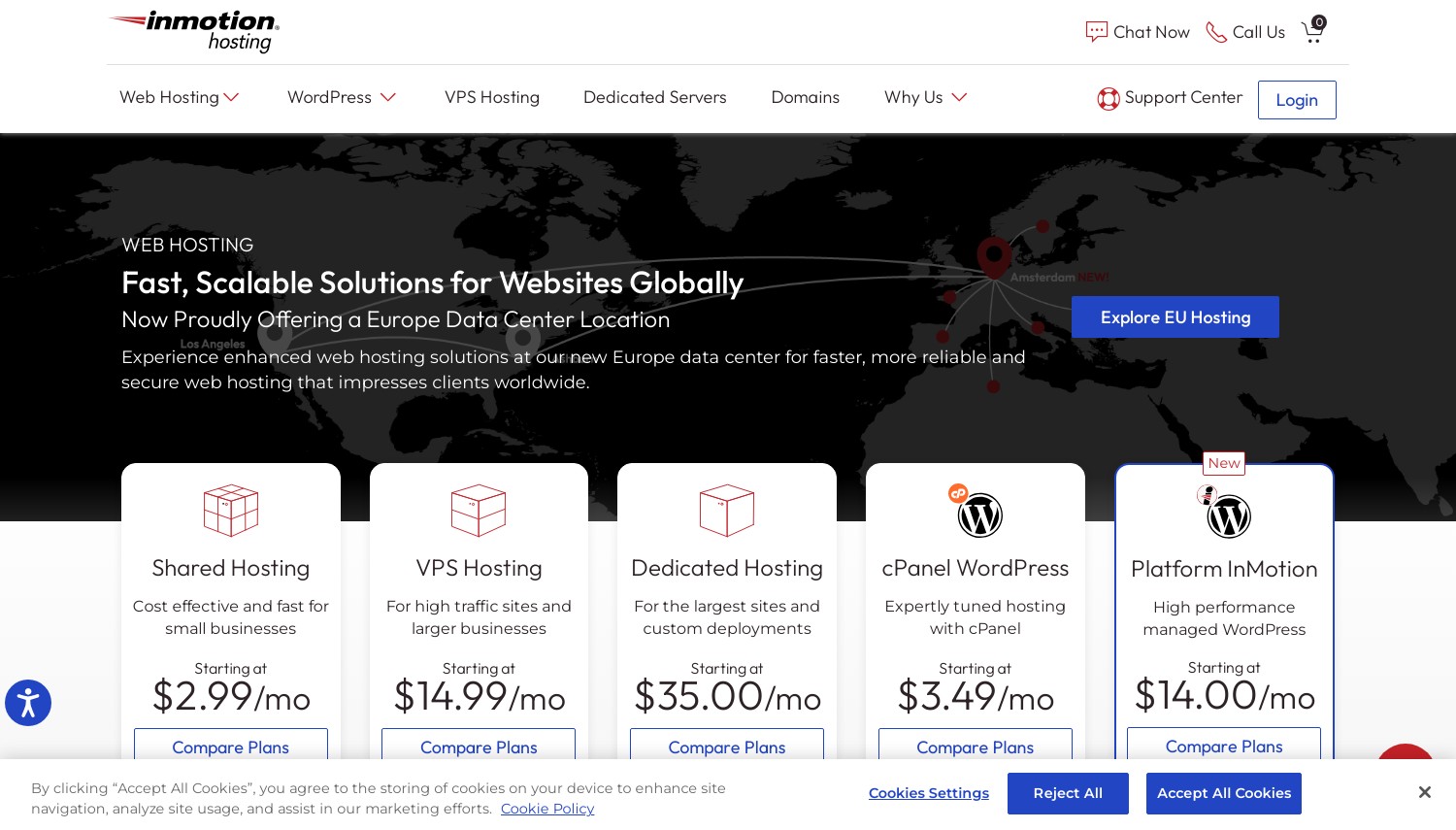
InMotion Hosting – Best refund safety net
Entry: USD 4.99/mo. Renewal: USD 13.99/mo (Launch). Outbound cap: 250 emails/hour.
Picture a small membership site sending welcome emails, renewal notices, and the odd announcement. That is InMotion's email comfort zone: 250 emails an hour, about 6,000 a day, with a 50-recipient limit per message on shared servers. Need more? You file an exception request through their AMP panel, or move to a VPS plan where the shared cap disappears. Outbound runs through MailChannels filtering, which keeps the shared IPs cleaner than a typical cPanel host.
The standout number isn't about sending, it's the refund. InMotion's 90-day money-back guarantee triples the 30 days you get from SiteGround and GreenGeeks, so you can test deliverability for your own audience risk-free. On capacity, its 250/hour sits below SiteGround's 400 but above GreenGeeks' 100. Launch renews at USD 13.99 a month, a gentle 2.8x on the USD 4.99 intro, and an Amsterdam data center gives EU senders a GDPR-friendly home.
- 90-day money-back, longest in this group
- MailChannels outbound filtering on shared plans
- EU data center option (Amsterdam)
- VPS upgrade removes the hourly cap
- Shared cap of 250 emails/hour
- Bulk sending needs a manual exception request
- No independent inbox-placement track record
Best for: a cautious buyer who wants three months to confirm mail reaches their audience before committing. Skip if: you already know you need bulk capacity today, where SES or Mailgun starts sending in minutes.
Verdict: Pick InMotion when the long refund and a managed cPanel experience matter more than raw sending volume. Outgrow 6,000 emails a day and the answer isn't an exception ticket, it's a relay; Amazon SES costs USD 10 for the next 100,000 and never throttles by the hour.
5. Amazon Web Services (AWS)

 200
2.1
Neutral
200
2.1
Neutral
 Negative



Amazon SES – Best price at high volume
Free: 3,000 emails/month for 12 months. Then USD 0.10 per 1,000. Setup: technical.
USD 0.10 per 1,000 emails. Nothing else here comes close on raw price, which is why SES anchors the budget end of any serious sending stack. A million emails a month costs about USD 100, and new AWS accounts get 3,000 free a month for their first year plus up to USD 200 in starter credits. The trade is that SES hands you an engine, not a dashboard: domain verification, sandbox removal, IAM permissions, and IP warmup are all on you.
The price gap is the headline. SES bills USD 10 for 100,000 emails where SMTP2GO charges USD 75 and Postmark lands near USD 126 for the same volume. You pay for that with deliverability legwork. InboxEagle's 2026 test graded SES at roughly 19% primary-inbox placement with a Grade B, because raw IP reputation is the sender's responsibility, not Amazon's. SES added inbox-placement metrics and blocklist monitoring in May 2026, which helps, but you still drive. If you already live in AWS, our cloud hosting comparison shows where SES fits a wider stack.
- Cheapest at scale: USD 0.10 per 1,000
- SMTP relay plus HTTPS API and deep event hooks
- Dedicated IP from USD 24.95/mo (standard)
- New 2026 inbox-placement and blocklist monitoring
- You manage IP warmup and reputation yourself
- Weak out-of-box placement: ~19% primary inbox (InboxEagle)
- AWS console, sandbox limits, and IAM learning curve
Best for: a developer or ops team sending high volume that can warm an IP and wants the lowest per-email cost. Skip if: you want delivery handled for you, where SMTP2GO trades price for a managed 95.5% inbox rate.
Verdict: Choose Amazon SES when volume is high, budget is tight, and someone on the team owns deliverability. If nobody wants to babysit IP reputation, pay the premium: SMTP2GO or Postmark will land more mail with none of the warmup work.
SMTP2GO – Best overall for managed deliverability
Free: 1,000 emails/month. 100k/month: USD 75 with dedicated IP. Inbox placement: 95.5%.
SMTP2GO's pitch is the thing most teams actually want: point your app at it and stop thinking about deliverability. EmailTooltester's four-round 2026 test measured 95.5% average inbox placement, the second-highest result in their field, and named it the best free SMTP server three years running. Setup is point-and-send, with DKIM and SPF applied automatically and bounce handling, retries, and suppression managed behind the scenes.
Where SES makes you the deliverability engineer, SMTP2GO is the opposite trade. Its Professional plan runs USD 75 a month for 100,000 emails with a dedicated IP included, against SES's USD 10 for the same volume where you supply the reputation. It also undercuts Postmark's roughly USD 126 at 100k while landing a near-identical inbox score. The free tier (1,000 a month, 200 a day) is tighter than Brevo's 9,000, and reporting retention is only five days on free, but the paid experience is the smoothest here. Real-time analytics, sub-accounts, and webhooks round it out.
- Tested 95.5% inbox placement (EmailTooltester 2026)
- Automatic DKIM and SPF, managed bounce handling
- Dedicated IP included from the Professional tier
- Sub-accounts, webhooks, and live analytics
- Pricier at volume: USD 75 per 100k vs SES's USD 10
- Free tier capped at 200/day
- Five-day report retention on the free plan
Best for: a business that wants transactional and light bulk mail to just arrive, without managing IPs. Skip if: you have an engineer who'll warm an IP for SES and pocket the savings at scale.
Verdict: Pick SMTP2GO when deliverability matters more than the per-email rate and you'd rather not touch IP reputation. If you're sending millions and have the talent to manage a sender domain, SES does the same job for a tenth of the cost; if you only need a few hundred transactional mails, ZeptoMail is cheaper still.
Brevo – Best all-in-one (marketing plus transactional)
Free: 300/day (9,000/month). 100k/month: USD 69. Inbox placement: ~94%.
Say you run both order receipts and a monthly newsletter and you'd rather not stitch two tools together. Brevo (formerly Sendinblue) puts SMTP relay, an API, drag-and-drop campaigns, automation, and a light CRM under one login, with transactional and marketing drawing from the same send allowance. Its free tier gives 300 emails a day forever, which is more generous than every dedicated relay here except by raw monthly count.
On price and delivery it holds up against the pure relays. Brevo's USD 69 for 100,000 emails undercuts SMTP2GO's USD 75 and SendGrid Pro's USD 89.95, and its EmailTooltester 2026 placement of about 94% topped that round's range. Free, it sends 9,000 a month against SendGrid's zero. The trade-offs: that 300/day free cap throttles bursts, a dedicated IP is a roughly USD 21/mo add-on rather than included, and per-volume pricing gets less sharp than ZeptoMail or SES once you climb past six figures.
- Marketing, automation, and SMTP in one tool
- Forever-free 300 emails/day
- Strong tested placement: ~94% (EmailTooltester 2026)
- USD 69 per 100k undercuts SMTP2GO and SendGrid
- Free plan throttles at 300/day
- Dedicated IP is a paid add-on (~USD 21/mo)
- Less competitive cost above ~500k/month
Best for: a small business that wants campaigns and transactional email from a single dashboard. Skip if: you only send transactional mail and want the lowest rate, where ZeptoMail is far cheaper.
Verdict: Choose Brevo when one tool for marketing and transactional beats best-in-class at either. If you never run campaigns, you're overpaying for features you won't open; Postmark delivers transactional better, and ZeptoMail does it for a fifth of the price.
Twilio SendGrid – Best developer API at scale
No free plan (60-day trial). 50k/month: USD 19.95. 100k: USD 89.95 with dedicated IP.
Start with the bad news: SendGrid killed its permanent free plan on May 27, 2025. New accounts now get a 60-day trial at 100 emails a day, then it's pay or leave. What you're buying instead is the most battle-tested email API in the category, Twilio-backed, with deep SDKs, an event webhook system, subuser management, and a separate Marketing Campaigns product when you need it.
For developers the math can still work. Essentials starts at USD 19.95 a month for 50,000 emails, which beats Mailgun's USD 35 for the same volume. Step up to Pro at USD 89.95 for 100,000 and a dedicated IP comes included, near-identical to Mailgun Scale's USD 90 and a touch above Brevo's USD 69. The weak spots: no current independent inbox-placement score was available for 2026, shared-IP delivery on Essentials can be uneven, and account-deactivation complaints are common enough to plan around.
- Deepest API and SDK ecosystem here
- Essentials USD 19.95 for 50k, under Mailgun
- Pro at USD 89.95 includes a dedicated IP
- Separate marketing-campaigns product
- No permanent free plan since May 2025
- Shared-IP placement can be inconsistent on Essentials
- Reports of abrupt account deactivations
Best for: an engineering team that wants a mature API and integrations at scale. Skip if: you want a free tier to start small, where Brevo and Mailgun still give you one.
Verdict: Pick SendGrid when API depth and proven scale outweigh the lost free plan. If you're a hobbyist or just testing, start on Brevo or Mailgun's free tier instead; if you want measured deliverability over tooling, Postmark and SMTP2GO publish the scores SendGrid doesn't.
Mailgun – Best deliverability toolkit for developers
Free: 100/day. 50k/month: USD 35. 100k: USD 90 with dedicated IP.
Mailgun (owned by Sinch) leans hardest into the engineering side of sending. Beyond the SMTP relay and a strong API, you get inbound email routing and parsing, an email-validation service, send-time optimization, and a deliverability suite (Mailgun Optimize) with inbox-placement testing and guided IP warmup. For a team that treats email as part of the product, that toolkit is the draw.
Pricing sits mid-pack and climbs. Foundation is USD 35 a month for 50,000 emails, 75% more than SendGrid Essentials at USD 19.95 for the same count. Scale runs USD 90 for 100,000 with one dedicated IP included, effectively tied with SendGrid Pro's USD 89.95, while extra dedicated IPs cost USD 59 each per month. No standalone independent 2026 inbox score was available, so judge it on tooling and your own setup rather than a published number. Log retention is short on lower tiers, and overages stack up fast above plan.
- Inbound routing and parsing, rare at this tier
- Email validation and guided IP warmup
- Scale at USD 90/100k includes a dedicated IP
- Deliverability suite built for engineers
- Foundation USD 35 for 50k, above SendGrid
- Extra dedicated IPs at USD 59/mo each
- Short log retention and stacking overages
Best for: developers who want inbound routing, validation, and deliverability tooling in one API. Skip if: you just need cheap outbound volume, where SES or ZeptoMail costs far less per email.
Verdict: Choose Mailgun when its inbound and validation tooling earns its keep in your product. If you only send outbound transactional mail, you're paying for features you won't call; ZeptoMail handles the sending at a quarter of the cost, and SES wins outright on price at volume.
Postmark – Best transactional inbox placement
Free: 100/month. 50k/month: ~USD 68.50. Inbox placement: 93.8%.
Postmark will reject your marketing blast on purpose, and that is the whole point. By policing what customers send and keeping transactional and broadcast traffic on fully separate Message Streams, it protects the reputation that makes receipts and password resets actually arrive. EmailTooltester's 2026 test put it at 93.8% average inbox placement, with three of four rounds at 95 to 97% (one Microsoft-specific dip pulled the average down). Owned by ActiveCampaign, it pairs clean docs with a fast SMTP and API setup.
You pay for that discipline. At 100,000 emails Postmark lands near USD 126 a month, about 68% more than SMTP2GO's USD 75 and roughly five times ZeptoMail's USD 25. The free tier is a token 100 emails a month, and a dedicated IP (USD 50/mo) needs 300,000+ monthly volume to unlock. None of that matters if your transactional mail must hit the inbox, which is the one job Postmark does better than anything else here.
- Top transactional placement: 93.8% (EmailTooltester 2026)
- Separate Message Streams shield transactional reputation
- 45-day detailed activity history
- Fast, well-documented API and SMTP
- Premium pricing: ~USD 126 per 100k
- Token free tier of 100/month
- Dedicated IP gated behind 300k/month
Best for: a SaaS or store where a failed receipt or reset costs real money. Skip if: you send marketing volume or watch every cent, where Brevo or ZeptoMail fits better.
Verdict: Pick Postmark when transactional deliverability is non-negotiable and price is secondary. If you also send campaigns, it'll refuse them, so go Brevo; if you want similar placement for less, SMTP2GO lands 95.5% at USD 75 against Postmark's USD 126.
Mailjet – Best EU-based all-in-one on a budget
Free: 6,000/month (200/day). Essential: USD 17/mo for 15k. EU data residency.
Mailjet (also under Sinch) covers similar ground to Brevo, transactional plus marketing in one platform, with a strong pull for European teams: EU data residency baked in for GDPR comfort. Its free tier sends 6,000 a month (capped at 200 a day, with Mailjet branding on each message), which is six times SMTP2GO's 1,000-a-month free allowance. Both an SMTP relay and API are included from the free plan up.
Paid pricing is friendly at the entry. Essential is USD 17 a month for 15,000 emails and removes the branding, and a dedicated IP arrives with the Premium tier from USD 27 a month, far below Postmark's USD 50 IP or Mailgun's USD 59. The honest gap is deliverability: no current independent inbox-placement figure was available for Mailjet in 2026, and it historically lands mid-pack, below Postmark and Brevo. Treat it as the value all-in-one, not the delivery champion.
- Generous free tier: 6,000/month
- EU data residency for GDPR
- Dedicated IP from USD 27/mo (Premium)
- Transactional and marketing in one UI
- No verified 2026 inbox-placement score
- Free-plan emails carry Mailjet branding
- Historically mid-pack on deliverability
Best for: an EU team wanting marketing and transactional in one tool with data kept in Europe. Skip if: inbox placement is your top metric, where Postmark and SMTP2GO post the numbers Mailjet doesn't.
Verdict: Choose Mailjet for EU data residency and a cheap all-in-one with a roomy free tier. If you'd trade EU hosting for proven delivery, Brevo tested at ~94% for a comparable feature set; if you only send transactional, ZeptoMail is cheaper and more focused.
Zoho ZeptoMail – Best price for transactional-only sending
Free: 10,000-email trial credit. Then USD 2.50 per 10,000. Transactional only.
USD 2.50 per 10,000 emails. Zoho's ZeptoMail prices transactional sending as pay-as-you-go credits with no monthly subscription, and the credits stay valid for six months. There is no marketing module by design: send a campaign and it gets rejected, which keeps the shared IP pools clean and reputation high. For receipts, OTPs, and notifications, it's the cheapest credible option in this guide.
The cost gap is dramatic. At 100,000 emails ZeptoMail runs about USD 25, a fifth of Postmark's USD 126 and roughly a third of Brevo's USD 69. A dedicated IP is USD 30 a month (billed annually) in select regions, and data centers span the US, EU, India, and Australia. Two honest caveats: independent inbox-placement benchmarks for ZeptoMail are scarce, so it lacks the tested scores Postmark and SMTP2GO carry, and Zoho has flagged updated pricing for new sign-ups from July 1, 2026, so confirm the current rate when you register.
- Cheapest credible rate: USD 2.50 per 10,000
- Credit-based, no monthly commitment
- Transactional-only keeps reputation clean
- Data centers in US, EU, India, Australia
- No marketing or broadcast sending allowed
- Scarce independent deliverability data
- New-account pricing changes from July 1, 2026
Best for: a cost-conscious startup or developer sending receipts and OTPs at low cost. Skip if: you need marketing campaigns or a published inbox-placement score, where Brevo or Postmark answers that.
Verdict: Pick ZeptoMail when you send transactional mail only and price drives the decision. If you need campaigns too, it'll reject them, so use Brevo; if you want a tested inbox rate behind your receipts, SMTP2GO's 95.5% is worth the step up from USD 25 to USD 75 at 100k.
How to Choose an SMTP Service for Your Volume
Pick by how much you send and whether delivery is mission-critical, not by feature lists. Five scenarios cover most buyers:
- Under 300 transactional emails a day (small site, password resets, receipts): Brevo's free 9,000 a month or ZeptoMail's trial credit. Skip SendGrid here. With no free plan, you'd pay USD 19.95 a month for capacity you won't touch.
- WooCommerce store sending 30k to 80k a month, wants it to just work: SMTP2GO (USD 10 Starter scaling to USD 75 at 100k) for managed delivery, or ZeptoMail at USD 2.50/10k if you'll handle DNS yourself. Store owners weighing the whole stack should read our eCommerce hosting guide too. Skip Postmark unless a failed receipt genuinely costs you sales.
- Developer sending 1M+ a month, comfortable in a console: Amazon SES at USD 0.10 per 1,000 (about USD 100/month) beats every managed relay, as long as you warm your own IP. Don't want to own reputation? Pay up for SMTP2GO or Mailgun Scale.
- Marketing plus transactional, ~50k a month: Brevo or Mailjet. Brevo tested higher (~94% vs Mailjet mid-pack); choose Mailjet only if EU data residency is a hard requirement.
- Just a contact form on a brochure site (a few hundred a month): don't buy a relay at all. SiteGround's 400/hour bundled mail covers it. Switch to a relay the day a transactional email silently lands in spam.
One rule cuts across all five: authenticate before you scale. Set SPF, DKIM, and DMARC on day one, because Gmail and Yahoo now require all three from anyone sending 5,000+ a day. If your volume is climbing past what shared mail allows, the move is usually a relay plus a stronger host; our VPS hosting roundup covers where to land the site itself.
Frequently Asked Questions
Is Amazon SES better than SendGrid for transactional email?
It depends on who's sending. SES is far cheaper (about USD 10 per 100,000 emails versus SendGrid Pro's USD 89.95) and scales to millions, but you verify domains, warm IPs, and manage reputation yourself. SendGrid gives you a friendlier API, subuser management, and a dedicated IP on Pro out of the box. Pick SES if you have engineering time and high volume; pick SendGrid if you want the tooling and don't mind paying for it.
What's the cheapest SMTP service for sending bulk email?
Amazon SES at USD 0.10 per 1,000 emails is the lowest raw rate, but it's technical and you own deliverability. Zoho ZeptoMail is the cheapest managed option at USD 2.50 per 10,000 (about USD 25 for 100,000), though it's transactional-only and won't send marketing campaigns. For bulk marketing specifically, Brevo at USD 69 per 100,000 bundles the campaign tools you'd otherwise need separately.
Do I need a dedicated SMTP service if my web host already sends email?
Once you cross your host's hourly cap, yes. Shared hosts throttle outbound mail hard, roughly 100/hour on GreenGeeks, 250 on InMotion, up to 800 on SiteGround GoGeek, and they discourage or ban bulk sending. A relay like SMTP2GO or ZeptoMail removes the cap, automates SPF and DKIM, and posts inbox-placement scores a shared host never will. If you only send a few hundred a day, bundled host mail is fine.
How many emails can I send before Gmail flags me as spam?
There's no fixed number, but the threshold that changed everything is 5,000 a day. Since February 2024, Gmail and Yahoo require senders above that volume to pass SPF, DKIM, and DMARC and to keep spam complaints under 0.3%. Below 5,000 a day you still need SPF and DKIM, just not enforced DMARC. A dedicated relay handles this authentication for you, which is why deliverability climbs the moment you leave shared-host mail.
Final Verdict
For most senders, SMTP2GO is the safest call: a tested 95.5% inbox rate, plug-and-play setup, and a dedicated IP from USD 75 at 100,000 emails. If you live in a console and send at scale, Amazon SES is unbeatable on price at USD 0.10 per 1,000, provided you own IP warmup. When a dropped receipt costs real money, Postmark earns its premium with separated Message Streams and 93.8% placement. Want one tool for campaigns and transactional, pick Brevo at ~94% and USD 69 per 100k. On the tightest budget for transactional-only sending, nothing beats Zoho ZeptoMail at USD 2.50 per 10,000. The four web hosts, SiteGround, Hosting.com, GreenGeeks, and InMotion, are for site mail in the low hundreds a day, not real sending.
If you're still mapping the wider stack, the four bundled hosts here are covered plan-by-plan in our best shared hosting guide, and teams outgrowing shared sending limits will want a stronger box from the VPS comparison linked above. Pair the right host with the right relay and your transactional mail stops landing in spam.