
Best High Storage VPS Hosting (2026): 10 Providers With Massive Disk Space Compared
Media servers, backup repositories, and file archives need disk space that standard VPS plans don't provide. Most entry-level VPS allocates 30-50GB, barely enough for an operating system and basic applications. When your project demands 500GB, a terabyte, or more, the math changes completely.
Quick answer: Contabo's Storage VPS delivers the best raw capacity per dollar, offering 1TB of SSD storage for just $15/mo with no renewal price increases. InterServer provides the cheapest path to massive storage using SATA drives at $12/mo for 1TB. For block storage that scales on demand, Vultr and DigitalOcean both price additional NVMe at $0.10/GB/month. Below, we compare 10 providers verified for February 2026 with honest assessments of storage value versus performance tradeoffs.
Last reviewed: February 2026. Prices and features verified.
Jump to: Contabo | InterServer | Hetzner | AlphaVPS | Time4VPS | HOSTKEY | Hostinger | Vultr | DigitalOcean | Kamatera | How to Choose | FAQ
This comparison focuses specifically on providers offering large storage allocations, either through dedicated storage VPS products or generous block storage add-ons. We've separated providers optimizing for capacity (HDD/SATA-based) from those prioritizing speed (NVMe), since these serve different use cases.
How We Selected These Providers
We prioritized providers with either dedicated storage VPS products or block storage offerings exceeding 500GB at competitive per-gigabyte pricing. Selection criteria included transparent pricing (no hidden fees for bandwidth or backups), user ratings above 4.0/5 from aggregated reviews, and verified uptime records. Research combined official pricing pages, independent benchmark data from January 2026, and user feedback from hosting communities.
| Hosting Provider | Reviews | Overall Rating | VPS Starts from |
|---|---|---|---|
1  Contabo Contabo
|
9.1k+ |

|
$4.73 / mo. No Setup Fee |
2  InterServer InterServer
|
2.3k+ |

|
$3.00 / mo. NOW 65% off |
3  Hetzner Online Hetzner Online
|
2.3k+ |

|
$4.28 / mo. |
4  AlphaVPS AlphaVPS
|
102 |

|
$5.27 / mo. |
5  Time4VPS Time4VPS
|
1.3k+ |
|
$2.52 / mo. from 1.04E |
6  Hostkey Hostkey
|
289 |
|
$5.49 / mo. |
7  Hostinger Hostinger
|
63.2k+ |
|
$4.99 / mo. 80% Off |
8  Digital Ocean Digital Ocean
|
1.9k+ |

|
No data / mo. |
9  Kamatera Kamatera
|
320 |
|
$4.00 / mo. 30 Days free |
1. Contabo
 9.1k+
4.0
Positive
Positive
9.1k+
4.0
Positive
Positive




| Storage | Cpu | Ram | Price | |
|---|---|---|---|---|
| 400 GB | 4 cores | 6 GB | $4.73 / mo. | View Plan |
| 800 GB | 4 cores | 8 GB | $9.98 / mo. | View Plan |
| 2.3 TB | 6 cores | 12 GB | $14.71 / mo. | View Plan |
Contabo: Best Overall Storage Value
Starting at $4.86/mo (€4.50) | Up to 1.4TB SSD | Unlimited traffic
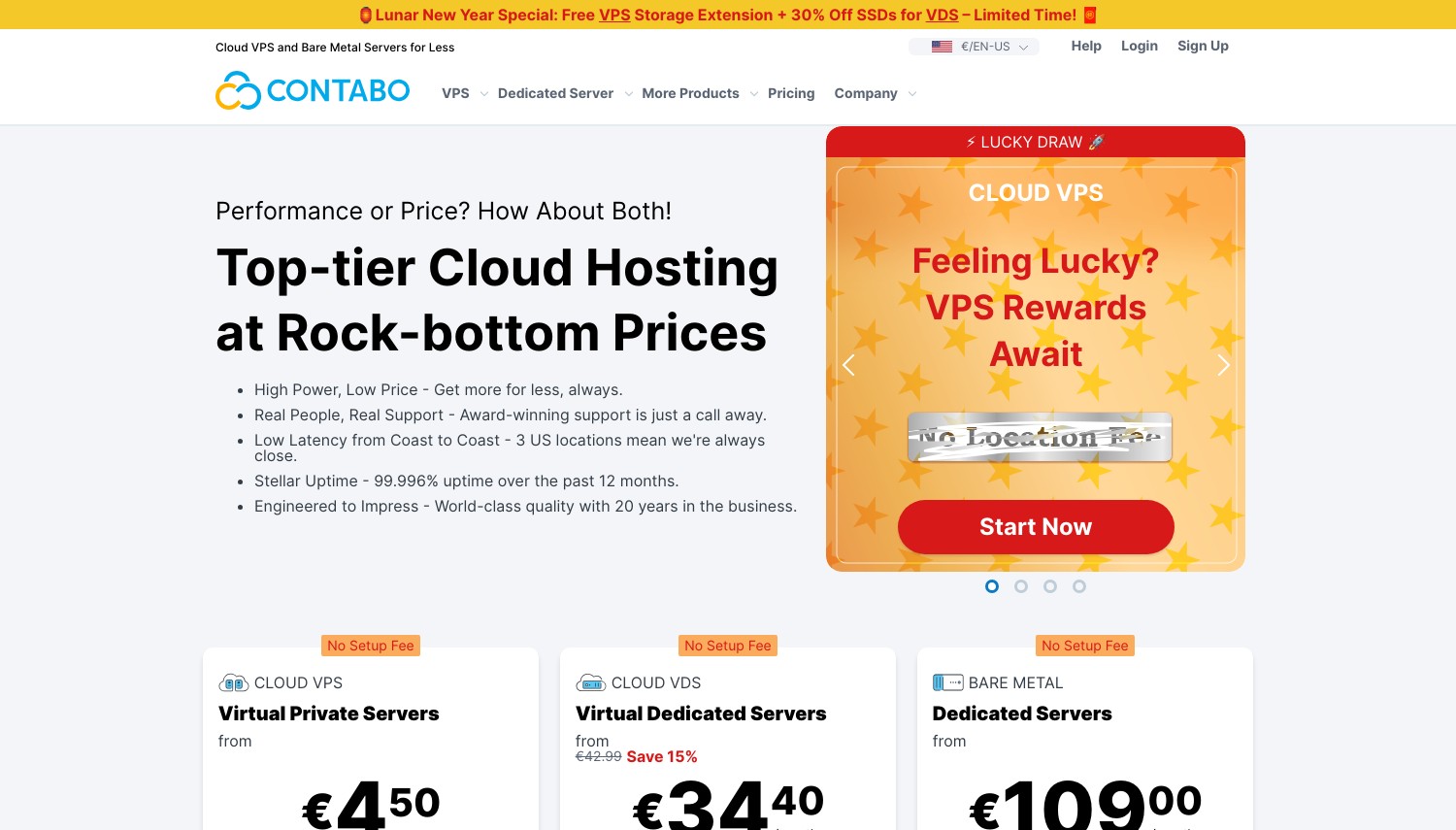
Contabo built an entire product line around storage-hungry workloads. Their Storage VPS tier prioritizes disk capacity over raw compute power, which is exactly what backup servers, media libraries, and archive projects need. The entry Storage VPS 10 delivers 300GB of SSD storage for under $5/mo. Scale up and you're looking at 1TB for $15.12/mo or 1.4TB for $39.96/mo. No other provider in this comparison matches that capacity-to-price ratio on SSD storage.
The infrastructure runs SSD-only across the storage lineup. Earlier Contabo products offered HDD options, but the current Storage VPS line has standardized on solid-state drives for better reliability and access speeds. Unlimited inbound and outbound traffic removes bandwidth anxiety when transferring large files. Data centers span 11 global locations including US (St. Louis, Seattle, New York), Europe (Germany, UK), and Asia (Singapore, Japan). The price-lock guarantee means your renewal rate matches your signup rate, eliminating the renewal trap common with competitors.
Performance expectations need calibration. Storage VPS optimizes for capacity, not I/O throughput. Database-heavy applications wanting maximum IOPS should look at Contabo's standard Cloud VPS line instead. The 200-1000 Mbit/s port speeds (varying by plan) suit file transfers but won't win speed benchmarks. Support operates adequately but won't hold your hand through complex configurations. Against Hetzner in this comparison, Contabo offers similar value with broader geographic reach but less sophisticated tooling.
Pros
- 1TB SSD for $15.12/mo, unmatched capacity pricing
- Price-lock guarantee prevents renewal increases
- Unlimited traffic on all Storage VPS plans
- 11 global data center locations
Cons
- Storage VPS optimized for capacity, not I/O speed
- Port speeds limited to 200-1000 Mbit/s depending on tier
- Support adequate but not hand-holding
Pricing: Storage VPS 10 at $4.86/mo (€4.50): 2 vCPU, 4GB RAM, 300GB SSD, 200 Mbit/s. Storage VPS 20 at $7.56/mo (€7.00): 3 vCPU, 8GB RAM, 400GB SSD, 300 Mbit/s. Storage VPS 30 at $15.12/mo (€14.00): 6 vCPU, 18GB RAM, 1TB SSD, 600 Mbit/s. Storage VPS 40 at $27/mo (€25.00): 8 vCPU, 30GB RAM, 1.2TB SSD, 800 Mbit/s. Storage VPS 50 at $39.96/mo (€37.00): 14 vCPU, 50GB RAM, 1.4TB SSD, 1 Gbit/s.
Best for: Backup servers, media archives, and file storage projects prioritizing capacity over speed.
Skip if: You need maximum I/O performance for databases or high-traffic applications.
Contabo redefined what storage VPS should cost. The combination of SSD capacity, price stability, and global infrastructure creates genuine value for anyone storing substantial data without demanding enterprise-grade throughput.
2. InterServer
 2.3k+
4.4
Positive
Positive
2.3k+
4.4
Positive
Positive








| Storage | Cpu | Ram | Price | |
|---|---|---|---|---|
| 15 GB | 1 core | 1 GB | $3.00 / mo. | View Plan |
| 30 GB | 1 core | 2 GB | $5.00 / mo. | View Plan |
| 30 GB | 1 core | 2 GB | $6.00 / mo. | View Plan |
InterServer: Best for Bulk SATA Storage
Starting at $6/mo | Up to 20TB SATA | Price-lock guarantee
When raw capacity matters more than storage speed, spinning disks still make economic sense. InterServer's Storage VPS uses SATA hard drives instead of SSDs, delivering vastly more gigabytes per dollar. Their slice-based system starts at $6/mo for 500GB of SATA storage. Double that to $12/mo and you hit 1TB. Max out at 20 slices and you're looking at 20TB of storage with 10 CPU cores and 40GB RAM.
The pricing model deserves attention. InterServer charges $6/slice, with each slice including CPU, RAM, and storage proportionally. Unlike competitors hiding renewal increases in fine print, InterServer's price-lock guarantee means your rate never changes. Sign up at $6/slice, renew at $6/slice. This transparency suits long-term projects where cost predictability matters. KVM or Hyper-V virtualization options accommodate both Linux and Windows workloads. Full root access comes standard.
SATA drives create obvious tradeoffs. Sequential reads and writes perform adequately for backups and media streaming, but random I/O lags badly compared to SSD-based alternatives. Don't deploy databases or applications with heavy disk access patterns here. The interface feels dated, and documentation targets experienced administrators. Compared to Contabo's SSD-based Storage VPS, InterServer offers more raw capacity at the cost of significantly slower access speeds. The US-based data centers (New Jersey) limit geographic options.
Pros
- 1TB SATA for $12/mo, cheapest bulk storage option
- Price-lock guarantee matches Contabo's renewal stability
- Scales to 20TB with predictable slice pricing
- Full root access with KVM or Hyper-V options
Cons
- SATA drives significantly slower than SSD alternatives
- US data centers only (New Jersey)
- Interface and documentation feel dated
Pricing: Storage VPS 1 Slice at $6/mo: 1 core, 1GB RAM, 500GB SATA, 1TB transfer. Storage VPS 2 Slices at $12/mo: 1 core, 2GB RAM, 1TB SATA, 2TB transfer. Storage VPS 4 Slices at $24/mo: 2 cores, 4GB RAM, 2TB SATA, 4TB transfer. Scales linearly to 20 slices. Windows adds $10/mo. Promotional deals occasionally drop pricing to $2.40/slice.
Best for: Cold storage, backup archives, and media libraries where access speed matters less than raw capacity.
Skip if: You need SSD performance or data centers outside the United States.
InterServer targets a specific audience: projects needing maximum storage at minimum cost, where SATA speeds are acceptable. The honest pricing and predictable scaling make budgeting straightforward. Just understand what spinning disks mean for your workload.
3. Hetzner Online
 2.3k+
3.1
Neutral
Neutral
2.3k+
3.1
Neutral
Neutral

| Storage | Cpu | Ram | Price | |
|---|---|---|---|---|
| 25 GB | 1 core | 1 GB | $4.28 / mo. | View Plan |
| 50 GB | 2 cores | 2 GB | $7.58 / mo. | View Plan |
| 100 GB | 2 cores | 4 GB | $13.06 / mo. | View Plan |
Hetzner: Best European Storage Infrastructure
Starting at $3.77/mo (€3.49) for VPS | Storage Boxes from $3.24/mo (€2.99) | 20TB traffic included
German engineering meets aggressive pricing. Hetzner operates their own data centers in Germany and Finland, which translates to infrastructure control that resellers can't match. Their approach separates compute (Cloud VPS) from bulk storage (Storage Boxes), letting you architect systems matching actual requirements. A Cloud VPS handles application logic while attached Storage Boxes provide the capacity. This modularity avoids paying for compute resources you don't need just to get disk space.
Storage Boxes function as network-attached storage accessible via FTP, SFTP, SCP, rsync, Samba/CIFS, HTTPS, and WebDAV. The BX11 plan provides 1TB for approximately $3.78/mo (€3.49). Scale to BX31 and you're at 10TB for $22.46/mo (€20.80) with 10 concurrent connections, 30 snapshots, and unlimited traffic. For VPS-integrated storage, block volumes cost $0.048/GB/month (€0.044), making 500GB of additional VPS storage around $24/mo.
Hetzner requires comfort with European business practices. VAT applies to EU customers (adding 19-27% depending on country). Support operates business hours CET, and documentation assumes technical competence. The Cloud Console and API work well but lack the polish of DigitalOcean or Vultr. Geographic options limit to Germany and Finland for Storage Boxes, though Cloud VPS extends to US (Ashburn, Hillsboro) and Singapore. Against Contabo, Hetzner offers similar value with better tooling but less global presence.
Pros
- Storage Boxes provide 10TB for ~$22.46/mo
- Multiple access protocols (FTP, rsync, Samba, WebDAV)
- 20TB traffic included on Cloud VPS plans
- Own data centers mean infrastructure control
Cons
- VAT adds 19-27% for EU customers
- Support hours favor European time zones
- Storage Boxes limited to Germany/Finland locations
Pricing: Cloud VPS CX22 at $3.77/mo (€3.49): 2 vCPU, 4GB RAM, 40GB NVMe, 20TB traffic. Block storage at $0.048/GB/mo. Storage Box BX11 at $3.78/mo (€3.49): 1TB, 5 connections, unlimited traffic. Storage Box BX21 at $11.34/mo (€10.49): 5TB, 10 connections, 20 snapshots. Storage Box BX31 at $22.46/mo (€20.80): 10TB, 10 connections, 30 snapshots.
Best for: European users wanting separated compute and storage with multiple access protocols.
Skip if: You need Asian or South American data centers or prefer integrated VPS storage.
Hetzner's modular approach suits sophisticated architectures. Separate your application servers from your storage layer, scale each independently, and pay only for resources actually used. The German data center reputation for reliability doesn't hurt either.
4. AlphaVPS

 102
4.9
Positive
Positive
102
4.9
Positive
Positive

| Storage | Cpu | Ram | Price |
|---|---|---|---|
| 30 GB | 4 cores | 4 GB | $5.27 / mo. |
| 60 GB | 4 cores | 8 GB | $10.53 / mo. |
| 90 GB | 4 cores | 12 GB | $15.80 / mo. |
AlphaVPS: Best Budget KVM Storage
Starting at $6/mo | 1TB to 16TB storage | KVM virtualization
Bulgarian hosting competes on pure value. AlphaVPS built their storage VPS around KVM virtualization with RAID60 arrays, delivering both capacity and data protection. The entry tier provides 1TB of storage for $6/mo, scaling up to 16TB for larger requirements. Unlike OpenVZ-based competitors, KVM allows custom kernels, disk encryption, and full OS flexibility. This matters for backup solutions requiring specific filesystem configurations.
The security angle deserves mention. AlphaVPS explicitly supports Full Disk Encryption (FDE), letting you encrypt storage at rest without third-party workarounds. The RAID60 configuration combines striping with dual parity, meaning two drive failures per array don't destroy data. Hardware RAID controllers handle the complexity, avoiding software RAID performance overhead. Data centers in Bulgaria, Germany, UK, Los Angeles, and New York provide reasonable geographic coverage for a budget provider.
The budget positioning creates tradeoffs. The interface functions but lacks polish. Documentation exists but won't guide beginners through complex setups. Support responds reasonably but won't configure your backup scripts for you. The 14-day money-back guarantee is shorter than competitors offering 30-45 days. Compared to Time4VPS in this comparison, AlphaVPS offers KVM flexibility versus Time4VPS's container efficiency. The 500+ Gbps network capacity handles transfer-heavy workloads adequately.
Pros
- 1TB storage from $6/mo with KVM virtualization
- Full Disk Encryption support built-in
- RAID60 arrays with hardware controllers
- 5 data center locations across 3 continents
Cons
- 14-day refund window shorter than most competitors
- Interface and documentation basic
- Support adequate but not extensive
Pricing: Storage VPS plans scale from 1TB at $6/mo to 16TB at higher tiers. All include KVM virtualization, full root access, instant deployment, and choice of Ubuntu, Debian, or CentOS. 99.9% uptime SLA. Newsletter signup provides 10% discount on first invoice.
Best for: Technical users wanting KVM flexibility with encryption support at budget pricing.
Skip if: You need extensive documentation or longer refund windows.
AlphaVPS fills a specific niche: real KVM virtualization with substantial storage at prices typically associated with inferior container-based hosting. The encryption support and RAID60 architecture add value that budget competitors rarely match.
5. Time4VPS
 1.3k+
4.6
Positive
Positive
1.3k+
4.6
Positive
Positive




| Storage | Cpu | Ram | Price | |
|---|---|---|---|---|
| 20 GB | 1 x 2.4GHz | 2 GB | $2.52 / mo. | View Plan |
| 512 GB | 1 x 1.7GHz | 1 GB | $2.76 / mo. | View Plan |
| 40 GB | 2 x 2.4GHz | 4 GB | $3.08 / mo. | View Plan |
Time4VPS: Cheapest Storage VPS Option
Starting at $2.15/mo (€1.99) | OpenVZ containers | Lithuanian data center
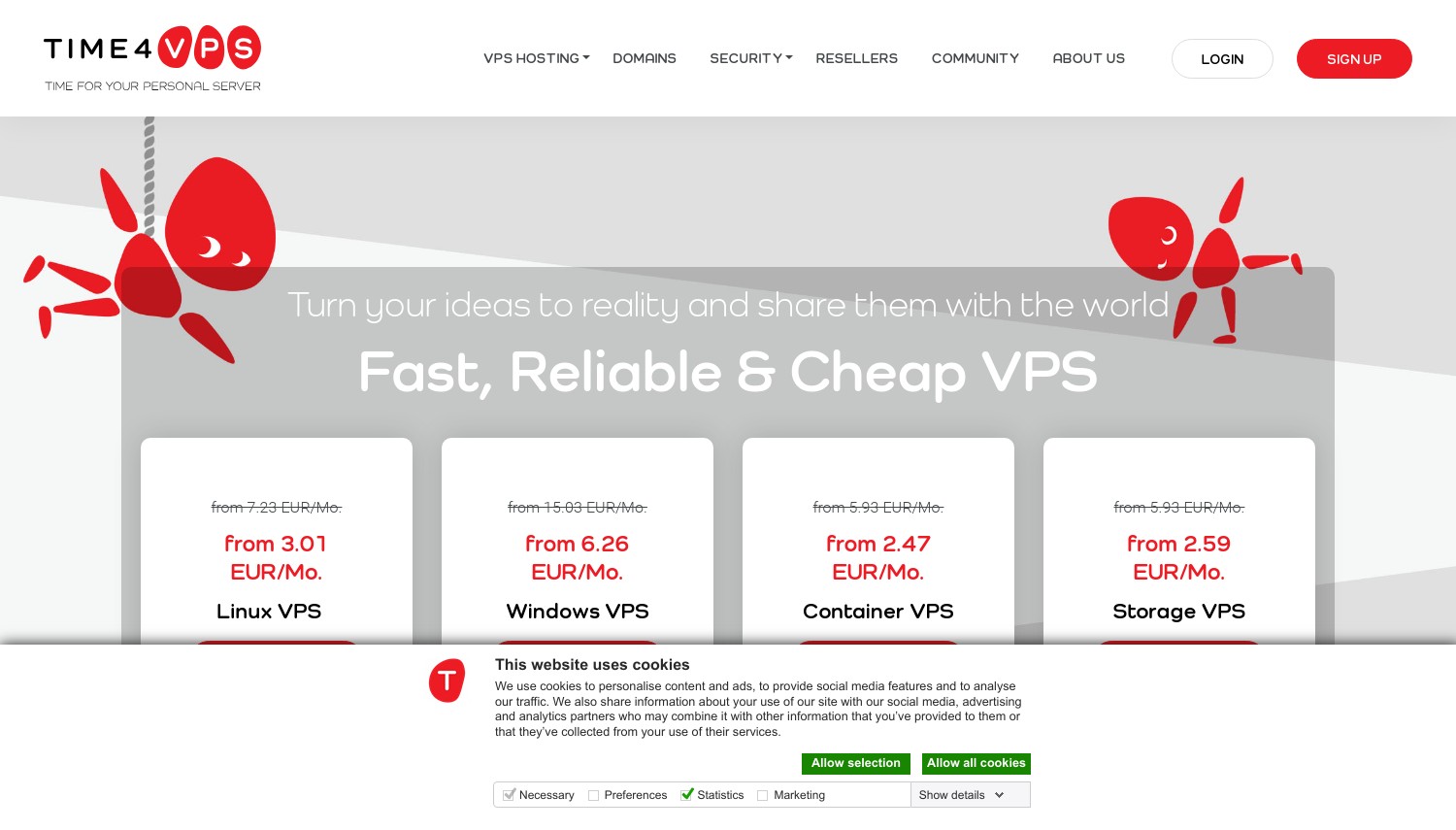
Price wars have a winner. Time4VPS pushes storage VPS pricing to levels that seem almost suspicious until you understand their model. Container-based virtualization (OpenVZ) shares resources more efficiently than KVM, passing savings to customers. The entry storage tier costs approximately $2.15/mo (€1.99) after discounts, making it the cheapest option in this comparison by a significant margin.
Lithuanian infrastructure provides European presence with Baltic networking advantages. The Tier III data center delivers 99.98% uptime SLA with 100 Gbps connectivity. Storage VPS includes full root access within the container environment, supporting FTP, RSYNC, SAMBA, NFS, and custom configurations. The 30-day money-back guarantee provides adequate testing time. Miss Group acquired Time4VPS in 2020, adding corporate backing while maintaining the aggressive pricing that built the brand.
Container limitations matter for certain workloads. OpenVZ shares the host kernel, preventing custom kernel modules or certain security tools that require kernel access. You can't run Docker containers within these containers without workarounds. Disk I/O depends heavily on neighbors' activity, which budget hosting attracts more than premium providers. The Lithuania-only data center limits geographic options. Against AlphaVPS, Time4VPS trades KVM flexibility for lower pricing. Understand what OpenVZ means before choosing.
Pros
- Entry pricing at ~$2.15/mo, cheapest in comparison
- Tier III data center with 99.98% uptime SLA
- 30-day money-back guarantee
- Multiple protocol support (FTP, rsync, Samba, NFS)
Cons
- OpenVZ containers limit kernel customization
- Lithuania only, no other data center locations
- I/O performance affected by neighbor activity
Pricing: Storage VPS from €1.99/mo (~$2.15). Prices shown often reflect promotional discounts. Linux VPS, Windows VPS, and Container VPS also available. All storage plans include full root access and major Linux distribution support. 30-day money-back guarantee applies to new customers.
Best for: Budget-conscious projects where container limitations are acceptable.
Skip if: You need KVM, custom kernels, or data centers outside Lithuania.
Time4VPS proves that storage VPS can cost almost nothing. The tradeoffs are real, but for backup destinations, file archives, or development environments, the price point enables projects that couldn't exist otherwise.
6. Hostkey
 289
4.0
Positive
Positive
289
4.0
Positive
Positive
| Storage | Cpu | Ram | Price |
|---|---|---|---|
| 20 GB | 1 x 2.60GHz | 2 GB | $5.49 / mo. |
| 20 GB | 1 x 2.90GHz | 2 GB | $7.68 / mo. |
| 40 GB | 2 x 2.60GHz | 4 GB | $10.98 / mo. |
HOSTKEY: Best for Massive HDD Storage
Starting at ~$3/mo | Up to 4TB HDD | European data centers
When terabytes matter more than milliseconds, HOSTKEY's HDD-focused storage VPS delivers. Their product line explicitly targets bulk storage use cases: backup repositories, archive systems, and disaster recovery infrastructure. With up to 4TB of HDD storage and deployment options across Europe, US, and Turkey, HOSTKEY provides capacity-first infrastructure that spinning disk economics make affordable.
The dual-storage approach offers flexibility. HDD configurations maximize capacity per dollar for archival workloads. SSD options (up to 160GB NVMe) handle cases needing faster access. Traffic allocations reach 10TB per month with unlimited available on request. The 1-10 Gbps uplink speeds suit large file transfers. Data centers in Netherlands, USA, Turkey plus presence across Germany, Finland, France, Iceland, UK, Spain, Italy, Poland, and Switzerland provide European-focused coverage with global reach.
HOSTKEY operates differently from consumer-focused providers. Pricing often requires configurator calculations or sales consultation rather than simple plan grids. The technical documentation targets infrastructure professionals rather than first-time VPS users. Support handles infrastructure issues competently but won't walk beginners through basic setups. Against InterServer, HOSTKEY offers more geographic options but less transparent pricing. The European focus suits compliance requirements that US-only alternatives can't address.
Pros
- Up to 4TB HDD storage per VPS
- 10+ European data center locations
- 10TB traffic included, unlimited on request
- Both HDD and NVMe options available
Cons
- Pricing requires configurator or sales contact
- Documentation targets experienced administrators
- Less transparent than simpler providers
Pricing: Storage VPS starting around €3/mo. HDD configurations up to 4TB. NVMe options up to 160GB. Traffic up to 10TB monthly included. 1-10 Gbps uplinks. Exact pricing via online configurator at hostkey.com or sales consultation. Volume discounts available for regular customers.
Best for: European compliance requirements, backup infrastructure, and archive systems needing multi-terabyte capacity.
Skip if: You want simple transparent pricing or US-only infrastructure.
HOSTKEY serves organizations that know exactly what they need from storage infrastructure. The European data center network and massive HDD options suit enterprise backup strategies that consumer-focused providers can't address effectively.
7. Hostinger
 63.2k+
4.6
Positive
Positive
63.2k+
4.6
Positive
Positive

| Storage | Cpu | Ram | Price | |
|---|---|---|---|---|
| 50 GB | 1 core | 4 GB | $4.99 / mo. | View Plan |
| 100 GB | 2 cores | 8 GB | $5.99 / mo. | View Plan |
| 200 GB | 4 cores | 16 GB | $10.49 / mo. | View Plan |
Hostinger: Best Mainstream VPS Storage
Starting at $4.99/mo | Up to 400GB NVMe | 30-day money-back guarantee
Not everyone needs specialized storage VPS. Hostinger's standard VPS hosting includes NVMe storage that satisfies most projects without diving into niche providers. The KVM 8 plan tops out at 400GB of NVMe storage, more than many dedicated storage products from smaller providers. AMD EPYC processors and genuine NVMe drives mean this storage actually performs, not just exists on paper.
The user experience sets Hostinger apart from technical-focused alternatives. Their visual control panel handles OS installation, firewall configuration, and backup scheduling without terminal commands. The AI assistant troubleshoots common issues. Weekly backups come included on all plans (daily backups cost $6/mo extra). For users upgrading from shared hosting who need more storage alongside VPS capabilities, Hostinger provides a gentler learning curve than infrastructure-focused providers.
Pricing mechanics need understanding. The $4.99/mo rate requires 48-month prepayment. Monthly billing runs $9.99/mo. Renewal doubles to $9.99/mo regardless of term length. Against Contabo's price-locked 1TB for $15/mo, Hostinger's 400GB maximum at higher effective rates costs more per gigabyte. The value proposition centers on usability rather than raw storage economics. For projects needing 200-400GB with beginner-friendly management, Hostinger makes sense. For pure storage maximization, specialized providers win.
Pros
- 400GB NVMe on highest tier, genuine performance
- Visual panel removes terminal command requirements
- AMD EPYC processors with included weekly backups
- AI assistant helps troubleshoot issues
Cons
- Best pricing requires 48-month prepayment
- Renewal at $9.99/mo doubles promotional rate
- Maximum 400GB, less than storage-focused providers
Pricing: KVM 1 at $4.99/mo promo, $9.99/mo renewal: 1 vCPU, 4GB RAM, 50GB NVMe, 4TB bandwidth. KVM 2 at $6.99/mo promo: 2 vCPU, 8GB RAM, 100GB NVMe, 8TB. KVM 4 at $9.99/mo promo: 4 vCPU, 16GB RAM, 200GB NVMe, 16TB. KVM 8 at $19.99/mo promo: 8 vCPU, 32GB RAM, 400GB NVMe, 32TB.
Best for: Users wanting VPS with substantial storage and beginner-friendly management.
Skip if: You need more than 400GB or want to maximize storage per dollar spent.
Hostinger works when VPS capabilities matter alongside storage requirements. The management layer adds genuine value for non-technical users. Just run the math on total costs before committing to ensure the usability premium fits your budget.
Vultr: Best Scalable Block Storage
Starting at $2.50/mo for VPS | Block storage at $0.10/GB/month | 32 data centers
Sometimes you don't know how much storage you'll need. Vultr's block storage volumes solve this by letting you provision NVMe capacity separately from compute. Start with a minimal VPS, attach a 100GB volume ($10/mo), and expand to 16TB maximum per volume as requirements grow. The per-second billing means you pay only for capacity actually used, not capacity reserved "just in case."
The infrastructure backs up the flexibility. 32 data center locations across 19 countries let you position storage near any global audience. NVMe-based volumes deliver up to 350 MB/s sustained throughput with burst support for demanding workloads. Volumes persist independently of compute instances, meaning you can destroy a VPS, attach the volume to a new one, and continue without data loss. Built-in encryption (LUKS) protects data at rest without third-party tools.
Block storage creates architecture requirements. Volumes attach to one instance at a time (not shared storage). The $0.10/GB pricing adds up at scale: 1TB costs $100/mo, making Contabo's 1TB for $15/mo dramatically cheaper for bulk capacity. Vultr targets use cases needing flexibility over raw economics. The interface works well, and documentation helps experienced users, but beginners will struggle without development backgrounds. Against DigitalOcean in this comparison, Vultr offers more global presence at similar pricing with slightly less polished tooling.
Pros
- 32 global data centers, most in this comparison
- Block volumes scale to 16TB per volume
- NVMe with LUKS encryption included
- Per-second billing for cost optimization
Cons
- Block storage at $0.10/GB expensive at scale
- Volumes attach to single instance only
- Unmanaged infrastructure requires technical skills
Pricing: Regular VPS from $2.50/mo (512MB RAM, 10GB SSD). High Frequency from $6/mo (1GB RAM, 32GB NVMe). Block storage at $0.10/GB/month, 10GB minimum ($1/mo) to 16TB maximum. Per-second billing with 60-second minimum. 2TB/mo pooled egress included, overage at $0.01/GB.
Best for: Developers needing flexible, scalable storage across global data centers.
Skip if: You need cost-effective bulk storage at terabyte scale.
Vultr's value is flexibility, not bulk economics. When storage requirements change unpredictably or you need presence across multiple continents, the block storage model and global footprint justify the premium over capacity-focused providers.
8. Digital Ocean
 1.9k+
3.7
Neutral
Neutral
1.9k+
3.7
Neutral
Neutral
DigitalOcean: Best Developer-Friendly Storage
Starting at $4/mo for Droplets | Block storage at $0.10/GB/month | $200 free credits
DigitalOcean earned its developer reputation through documentation and interface quality. Their block storage (Volumes) connects directly to Droplets, offering NVMe-based expansion from 1GB to 16TB per volume. The control panel makes provisioning, resizing, and snapshot management genuinely simple. If you've struggled with AWS's labyrinthine console or found budget providers confusing, DigitalOcean's approach feels refreshingly direct.
Recent platform improvements strengthen the storage proposition. Per-second billing (60-second minimum) suits short-lived workloads. Volume attach limits increased to 15 volumes per Droplet, up from the previous 7-volume cap. NVMe now spans all regions, eliminating the performance lottery of earlier geographic variations. The $200 free credit for new users provides genuine runway to test storage-intensive projects before commitment. Kubernetes integration means volumes work natively with container orchestration.
Block storage pricing matches Vultr at $0.10/GB/month, creating the same scale economics challenge. 1TB costs $100/mo versus Contabo's $15/mo for integrated storage. DigitalOcean targets developers who value tooling and documentation over raw cost optimization. The App Platform and managed databases add ecosystem value that pure IaaS providers lack. Against Vultr, DigitalOcean offers better documentation and interface with fewer global locations (14 data centers versus 32). Both charge identical block storage rates.
Pros
- Interface and documentation best-in-class for IaaS
- $200 free credits for new users
- Volumes up to 16TB, 15 volumes per Droplet
- Per-second billing with Kubernetes integration
Cons
- Block storage at $0.10/GB expensive for bulk needs
- 14 data centers versus Vultr's 32
- Unmanaged infrastructure requires technical capability
Pricing: Basic Droplets from $4/mo (512MB RAM, 10GB SSD). Regular Droplets from $6/mo (1GB RAM, 25GB SSD). Block Volumes at $0.10/GB/month (billed hourly at $0.00015/GB). Snapshots at $0.06/GB/month. Object storage (Spaces) at $5/mo for 250GB. Per-second billing effective January 2026.
Best for: Developers prioritizing tooling quality and documentation over raw storage economics.
Skip if: You need maximum storage per dollar or extensive global data center presence.
DigitalOcean works when developer experience matters more than cost minimization. The documentation alone saves hours compared to struggling through lesser providers. For projects where development velocity outweighs storage costs, that tradeoff pays off.
9. Kamatera
 320
4.2
Positive
Positive
320
4.2
Positive
Positive


| Storage | Cpu | Ram | Price | |
|---|---|---|---|---|
| 20 GB | 1 x 2.6GHz | 1 GB | $4.00 / mo. | View Plan |
| 20 GB | 1 x 2.6GHz | 2 GB | $6.00 / mo. | View Plan |
| 30 GB | 2 x 2.65GHz | 2 GB | $12.00 / mo. | View Plan |
Kamatera: Best for Custom Storage Configurations
Starting at $4/mo | Storage at $0.05/GB/month | 30-day free trial with $100 credit
Fixed plans force awkward decisions. Need 500GB storage but only 2GB RAM? Most providers make you buy 8GB RAM plans to get that storage. Kamatera eliminates this through granular configuration: specify exact CPU, RAM, and storage allocations, pay only for what you configure. Storage pricing at $0.05/GB/month cuts Vultr and DigitalOcean's rates in half. A 1TB configuration costs approximately $50/mo in storage alone, plus compute resources.
The 30-day free trial with $100 credit provides real testing capacity. Most competitors offer 3-day trials or require immediate payment. Kamatera lets you deploy storage-intensive configurations, run actual workloads, and validate performance before financial commitment. The 24 data centers across four continents (8 US locations alone) provide geographic flexibility. Intel Ice Lake processors and NVMe storage deliver credible performance, not just capacity.
Kamatera assumes technical competence. The interface works but lacks modern polish. Documentation exists but targets experienced administrators. Support handles infrastructure issues without hand-holding through application configuration. The $0.05/GB pricing beats Vultr and DigitalOcean but still costs more than Contabo's integrated storage at scale. The custom approach suits projects with specific resource ratios that don't match standard tiers. For basic storage needs, simpler providers work better.
Pros
- Storage at $0.05/GB/month, half of Vultr/DO pricing
- 30-day trial with $100 credit for real testing
- 24 data centers including 8 US locations
- Fully customizable CPU/RAM/storage ratios
Cons
- Interface dated compared to DigitalOcean
- Unmanaged requires server administration skills
- Custom pricing requires configuration calculations
Pricing: Entry at $4/mo (1 vCPU, 1GB RAM, 20GB SSD). Additional storage at $0.05/GB/month. Additional bandwidth at $0.01/GB. Custom configuration examples: 4 vCPU, 8GB RAM, 500GB SSD runs approximately $55-65/mo. Hourly billing available with per-minute granularity.
Best for: Projects needing specific resource ratios that don't match standard VPS tiers.
Skip if: You want simple pricing or need extensive documentation and support.
Kamatera's value emerges when standard plans waste resources. If you need unusual RAM-to-storage ratios, the configurator optimizes costs that fixed tiers can't match. The generous trial period validates configurations before commitment.
How to Choose High Storage VPS
Storage requirements split into distinct categories that different providers serve better:
Maximum capacity at minimum cost: InterServer's SATA-based Storage VPS provides the cheapest path to multi-terabyte storage. Contabo's Storage VPS delivers better SSD performance at slightly higher per-gigabyte pricing. Both lock renewal rates, eliminating surprise cost increases.
European compliance and presence: Hetzner's German infrastructure and Storage Boxes suit GDPR requirements and European audience targeting. HOSTKEY adds broader European data center options for organizations needing specific geographic placement.
Scalable block storage: Vultr and DigitalOcean offer identical $0.10/GB block storage with different geographic and tooling tradeoffs. Kamatera cuts that rate to $0.05/GB for custom configurations. These suit projects with unpredictable storage growth.
Mainstream VPS with decent storage: Hostinger's 400GB NVMe maximum works when you need VPS capabilities alongside storage, with beginner-friendly management. The storage-per-dollar efficiency loses to specialized providers.
Budget constraints: Time4VPS offers the absolute lowest pricing, though OpenVZ limitations constrain certain use cases. AlphaVPS provides KVM flexibility at only slightly higher cost.
Frequently Asked Questions
What's the difference between Storage VPS and adding block storage?
Storage VPS products (Contabo, InterServer, Time4VPS) include large disk allocations in the base plan, optimizing for capacity-first workloads. Block storage (Vultr, DigitalOcean, Kamatera) lets you attach additional volumes to standard VPS instances, providing flexibility but typically at higher per-gigabyte costs. Storage VPS suits predictable capacity needs; block storage suits variable or unpredictable requirements.
Should I choose HDD or SSD for large storage?
HDD (InterServer, HOSTKEY) provides the cheapest per-terabyte pricing for archival workloads where access speed matters less than capacity. SSD (Contabo, AlphaVPS) costs more per gigabyte but delivers dramatically faster read/write performance for active data. Backup destinations and cold archives work fine on HDD. Databases and frequently-accessed files need SSD or NVMe.
How much storage VPS capacity do I actually need?
Calculate current data size plus 12-18 months of growth. Backup servers should accommodate 2-3 full backup copies plus incrementals. Media servers need raw file sizes plus transcoding workspace. Development environments typically need less than you think, 100-200GB handles most projects. Production databases vary wildly based on application type and retention requirements.
Can I use storage VPS for website hosting?
Yes, but storage-optimized VPS typically deprioritizes compute resources for disk capacity. Web hosting needs balanced CPU, RAM, and storage. Consider standard cloud hosting with block storage expansion instead, which provides better resource balance for dynamic websites while allowing storage scaling.
Final Verdict
Contabo wins for most storage-focused projects. Their 1TB SSD at $15/mo with price-lock guarantees sets the value benchmark that specialized alternatives struggle to match. InterServer takes the crown for absolute bulk storage, delivering 1TB SATA at $12/mo for workloads where spinning disk speeds are acceptable.
Hetzner deserves consideration for European projects needing separated compute and storage with multiple access protocols. Vultr and DigitalOcean serve developers wanting scalable block storage across global infrastructure, though the $0.10/GB pricing limits bulk economics. Hostinger makes sense when you need managed VPS with decent storage rather than pure capacity maximization.
For exploring beyond storage-specific options, our VPS hosting comparison covers general-purpose providers, while the dedicated server guide addresses projects that have outgrown virtualized infrastructure entirely.