
Cheap Hosting With DDoS Protection (Oct. 2026): 10 Providers Compared
DDoS attacks hit 21.3 million per day globally in Q4 2025, according to Cloudflare's threat report. The largest recorded attack reached 31.4 Tbps. If you think your small business site isn't a target, consider this: automated botnets don't discriminate by website size. They scan for vulnerable infrastructure and attack whatever they find. DDoS protection isn't optional anymore. The question is whether you need to pay extra for it.
Quick answer: You don't. Cloudflare offers free, unmetered DDoS protection backed by 477 Tbps of network capacity that you can layer in front of any host. For all-in-one hosting with built-in protection, OVHcloud includes 17 Tbps DDoS filtering on every plan starting at USD 1.04/mo. Budget buyers wanting managed shared hosting with DDoS should look at FastComet (USD 1.79/mo, always-on ML-based filtering) or HostArmada (USD 1.99/mo, Imunify360). Below, we compare 10 providers with verified April 2026 pricing.
Jump to: FastComet | HostArmada | Cloudflare | Ultahost | Hostinger |OVHcloud | Hetzner | IONOS | A2 Hosting | Contabo | How to Choose | FAQ
Last reviewed: Oct. 2026. Prices and features verified.
Most "DDoS-protected hosting" guides list providers without specifying what their protection actually covers. We verified mitigation capacities where published, distinguished between L3/L4 network-layer and L7 application-layer protection, and flagged providers whose "DDoS protection" amounts to basic IP null-routing that takes your site offline during an attack. We also dropped one commonly recommended provider (ScalaHosting) whose SShield tool handles malware, not DDoS.
How We Selected These Providers
Selection required always-on DDoS protection included at no extra cost, with verified infrastructure details where available. We prioritized providers that publish mitigation capacities or name their DDoS technology partners (Cloudflare, OVHcloud, Hetzner/Nokia, A2 Hosting/Corero, Ultahost/BitNinja) over those making vague "protected" claims. Pricing was confirmed against official sources in April 2026. Hosting types range from free CDN proxies to shared hosting, VPS, and dedicated servers.
| Hosting Provider | Reviews | Overall Rating | Cheapest Plans from |
|---|---|---|---|
1  FastComet FastComet
|
3.5k+ |

|
$1.79 / mo. -80% OFF |
2  HostArmada HostArmada
|
1.1k+ |
|
$1.49 / mo. -85% NOW |
3  Ultahost Ultahost
|
854 |

|
$3.80 / mo. Flash Sale -40% |
4  Hostinger Hostinger
|
63.2k+ |
|
$1.95 / mo. 80% Off |
5  OVHcloud OVHcloud
|
6.7k+ |

|
$1.04 / mo. |
6  Hetzner Online Hetzner Online
|
2.3k+ |

|
$1.75 / mo. |
7  IONOS | ionos.com IONOS | ionos.com
|
38.1k+ |

|
$1.00 / mo. |
8  A2 Hosting A2 Hosting
|
3.4k+ |
|
$1.95 / mo. NOW -76% |
9  Contabo Contabo
|
9.1k+ |
|
No data / mo. No Setup Fee |
1. FastComet
 3.5k+
4.8
Positive
Positive
3.5k+
4.8
Positive
Positive










| Storage | Bandwidth | Panel | Price | |
|---|---|---|---|---|
| 10 GB | Unlimited | cPanel | $1.79 / mo. | View Plan |
| 20 GB | Unlimited | cPanel | $2.39 / mo. | View Plan |
| 30 GB | Unlimited | cPanel | $3.59 / mo. | View Plan |
FastComet: Best Always-On ML Protection for Shared Hosting
Starting at USD 1.79/mo | Machine learning-based | Always-on | All plans included
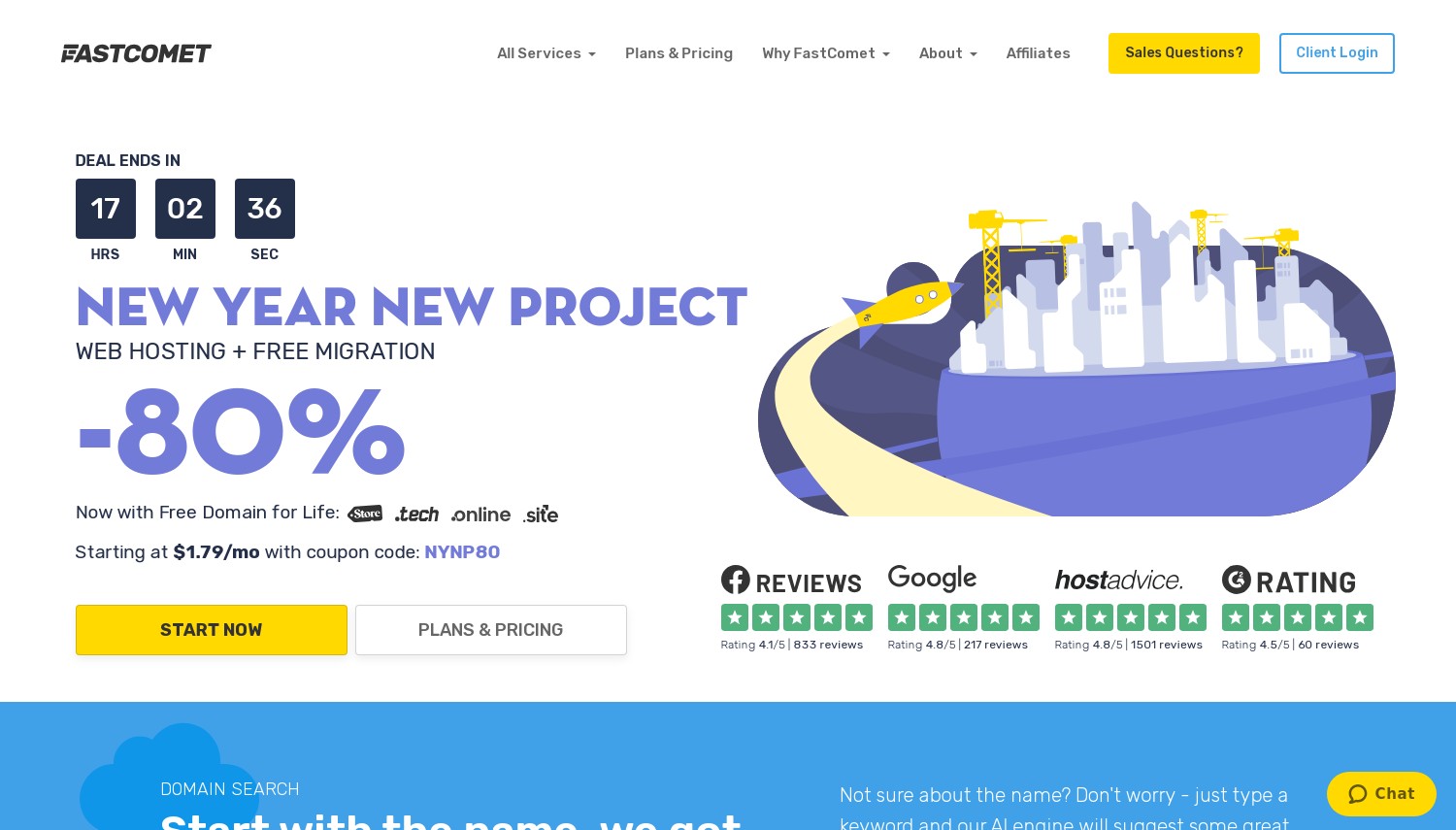
FastComet's DDoS protection runs machine learning algorithms trained on traffic patterns across their global network. The system identifies and blocks UDP floods, SYN floods, and HTTP floods inline, meaning malicious traffic gets filtered without routing to third-party scrubbing centers. That inline approach avoids the latency penalty that external mitigation adds during attacks. Protection covers all plans: shared, VPS, and dedicated.
The Starter shared plan at USD 1.79/mo includes this protection alongside Imunify360 server security, a WAF, brute-force defense, malware scanning, and account isolation via CageFS. Daily backups with 7-30 day retention (depending on plan) add another safety layer. The security stack is genuinely thorough for a host charging under USD 2/mo.
FastComet doesn't publish a specific Gbps or Tbps mitigation capacity. They claim the system "scales from personal blogs to large enterprises" but without numbers, that's marketing rather than specification. Renewal pricing jumps from USD 1.79 to USD 8.95/mo on the Starter plan, roughly a 5x increase. Compared to HostArmada below (similar pricing, Imunify360 security), FastComet's ML-based DDoS approach is technically different but neither provider publishes comparable capacity figures for shared hosting.
Pros
- Always-on ML-based DDoS protection on all plans
- Inline filtering (no third-party routing delay)
- Imunify360, WAF, malware scanning, and daily backups included
- 30-day money-back guarantee
Cons
- DDoS capacity not published
- Renewal jumps to USD 8.95/mo (5x entry price)
- Entry plan storage limited to 15GB
Pricing: Starter at USD 1.79/mo promo, USD 8.95 renewal. Essential at USD 2.39/mo, USD 11.95 renewal. Plus at USD 3.59/mo, USD 17.95 renewal. Extra at USD 4.99/mo, USD 24.95 renewal. All include DDoS protection, Imunify360, daily backups.
Best for: Small business owners wanting full-stack security (DDoS + WAF + malware) at budget shared hosting prices.
Skip if: You need verifiable DDoS capacity numbers or predictable long-term pricing.
FastComet bundles more security features into their cheapest plan than most providers include on premium tiers. The DDoS protection is real, even if the capacity is unquantified.
2. HostArmada
 1.1k+
4.9
Positive
Positive
1.1k+
4.9
Positive
Positive



| Storage | Bandwidth | Panel | Price | |
|---|---|---|---|---|
| 15 GB | Unlimited | cPanel | $1.49 / mo. | View Plan |
| 30 GB | Unlimited | cPanel | $2.47 / mo. | View Plan |
| 40 GB | Unlimited | cPanel | $2.96 / mo. | View Plan |
HostArmada: Best VPS DDoS Capacity on a Budget
Starting at USD 1.99/mo (shared) | 17 Tbit/s VPS filtering | Imunify360 | 45-day money-back
HostArmada publishes a specific number for their VPS DDoS protection: 17 Tbit/s of filtering capacity. That's the same figure OVHcloud claims for their entire global network, applied specifically to HostArmada's VPS infrastructure. For VPS users needing quantifiable DDoS protection at budget prices, this makes HostArmada's Spark plan (USD 3.69/mo annual) one of the best documented options available.
Shared hosting gets different protection. Instead of the 17 Tbit/s network filter, shared plans use Imunify360 with ModSecurity WAF, per-IP bandwidth throttling, SSL renegotiation protection, and reCAPTCHA challenges. It's effective against common attacks but lacks the published bandwidth capacity of the VPS line. The Start Dock shared plan at USD 1.99/mo includes this alongside daily backups, free SSL, and account isolation. The 45-day money-back guarantee on shared hosting is the longest in this comparison.
The VPS money-back drops to just 7 days. Shared hosting renewal doubles from USD 1.99 to USD 9.95/mo. VPS renewal similarly doubles from USD 3.69 to USD 8.20/mo. The reCAPTCHA challenge system on shared hosting can flag legitimate visitors, creating friction for real users during active attacks. Compared to general VPS hosting options, HostArmada's DDoS figures position their VPS competitively against providers costing 3-5x more.
Pros
- 17 Tbit/s published DDoS filtering on VPS plans
- Imunify360 security suite on shared hosting
- 45-day money-back on shared plans (longest here)
- Daily backups included on all plans
Cons
- 17 Tbit/s applies to VPS only, not shared hosting
- VPS money-back only 7 days
- Renewal doubles to USD 9.95/mo on shared
Pricing: Shared Start Dock at USD 1.99/mo promo, USD 9.95 renewal. VPS Spark at USD 3.69/mo annual (1 vCPU, 1GB, 40GB NVMe), renews ~USD 8.20/mo. VPS Flux at USD 5.18/mo (2 vCPU, 4GB, 80GB NVMe). Managed VPS Web Shuttle at USD 29.95/mo.
Best for: VPS users wanting published DDoS capacity figures at budget pricing.
Skip if: You need the same level of DDoS protection on shared hosting or want longer VPS trial periods.
HostArmada earns points for publishing actual numbers. In an industry where most hosts say "DDoS protected" without specifying what that means, 17 Tbit/s on VPS is a concrete, verifiable claim.
Cloudflare: Best Free DDoS Protection for Any Host
Free plan available | 477 Tbps network capacity | L3/L4/L7 protection | 330+ global PoPs
Cloudflare isn't a traditional hosting provider. It's a reverse proxy that sits between your visitors and your server, filtering traffic through 477 Tbps of network capacity before it reaches your origin. That's 23 times larger than the biggest DDoS attack ever recorded. Every plan, including the free tier, gets unmetered DDoS protection across L3, L4, and L7 layers. No traffic caps, no bandwidth limits on mitigation, no extra fees during an attack.
You can add Cloudflare to any existing host in about 10 minutes by changing your domain's nameservers. Your hosting provider doesn't need to support Cloudflare specifically. The free plan includes a basic WAF (Web Application Firewall), universal SSL, and always-on DDoS mitigation that handles most attacks automatically in under 3 seconds. The Pro plan at USD 20/mo adds enhanced WAF rules, and the Business plan at USD 200/mo includes 100 custom WAF rules plus PCI compliance.
The trade-off: all traffic routes through Cloudflare's network, which adds a proxy hop. For most sites this actually improves performance (CDN caching), but it means Cloudflare sees your traffic. You also can't use Cloudflare's registrar without their nameservers. Support on the free plan is community-forum only. Cloudflare doesn't host your site, it only protects and accelerates it. You still need a separate hosting provider. Compared to OVHcloud's built-in protection below, Cloudflare requires more setup but provides dramatically larger mitigation capacity at zero cost.
Pros
- 477 Tbps network, largest DDoS mitigation capacity available
- Free plan with unmetered L3/L4/L7 protection
- Works with any hosting provider, no migration needed
- Mitigated a 31.4 Tbps attack in Q4 2025
Cons
- Not a hosting provider (protection layer only)
- Free plan support is community forum only
- All traffic routes through Cloudflare's network
Pricing: Free plan: USD 0 (unmetered DDoS, basic WAF, SSL). Pro: USD 20/mo (enhanced WAF, 20 custom rules). Business: USD 200/mo (100 WAF rules, PCI compliance). Enterprise: custom pricing. DDoS protection identical across all tiers.
Best for: Any website owner who wants enterprise-grade DDoS protection without changing hosts.
Skip if: You want all-in-one hosting + protection from a single provider.
Cloudflare is the answer to "I already have hosting but need DDoS protection." Point your DNS, wait 10 minutes, and your site is behind the world's largest DDoS mitigation network. Free.
3. Ultahost
 854
4.6
Positive
Positive
854
4.6
Positive
Positive

| Storage | Bandwidth | Panel | Price | |
|---|---|---|---|---|
| 30 GB | Unlimited | cPanel | $3.80 / mo. | View Plan |
| 60 GB | Unlimited | cPanel | $4.80 / mo. | View Plan |
| 80 GB | Unlimited | cPanel | $8.80 / mo. | View Plan |
Ultahost: Highest Published DDoS Capacity for Budget Hosting
Starting at USD 2.50/mo (shared) | BitNinja, 3,500+ Gbps | Always-on | Fixed renewal pricing
Ultahost publishes the highest DDoS mitigation capacity of any budget hosting provider in this comparison: 3,500+ Gbps (3.5 Tbps) on their VPS and DDoS-protected VPS products. That's a concrete number backed by BitNinja's ML-powered defense system, which combines WAF protection, network monitoring, honeypots, and adaptive algorithms that learn new attack patterns. The system claims to filter 99% of known attack signatures.
All hosting types get BitNinja protection: shared, VPS, dedicated servers, and game servers. The shared Starter plan at USD 2.50/mo includes it alongside free SSL, daily backups, and NVMe storage. And here's what sets Ultahost apart from most competitors: renewal prices stay flat. What you pay on signup is what you pay next year. In a comparison where most providers double or triple their pricing at renewal, that predictability has real value.
The shared Starter plan limits you to 1 website and 30GB storage. Dedicated servers are capped at 150 Gbps DDoS protection, lower than the VPS figure. Some user reviews note inconsistent support quality. The 3,500+ Gbps figure applies specifically to VPS products, not necessarily shared hosting (where BitNinja operates at the server level rather than the network edge). Against FastComet, Ultahost wins on published capacity and renewal pricing stability, though FastComet includes more granular security features like CageFS isolation.
Pros
- 3,500+ Gbps published DDoS capacity (VPS)
- Fixed renewal pricing (no promo-to-renewal jump)
- BitNinja WAF + malware scanning on all plans
- 99.99% uptime guarantee
Cons
- Shared Starter limited to 1 website, 30GB
- Dedicated server DDoS capped at 150 Gbps
- Some user reports of inconsistent support quality
Pricing: Shared Starter at USD 2.50/mo (fixed, no renewal increase). Basic at ~USD 3.80/mo. Business at ~USD 7.50/mo. DDoS-protected VPS from USD 4.80/mo. All include BitNinja DDoS protection. 30-day money-back on shared hosting.
Best for: Users wanting the highest documented DDoS capacity at budget hosting prices with predictable renewals.
Skip if: You need more than 1 website on the cheapest plan or want phone-based support.
Ultahost combines two rare things in budget hosting: a published DDoS capacity number and flat renewal pricing. Most competitors offer neither.
4. Hostinger
 63.2k+
4.6
Positive
Positive
63.2k+
4.6
Positive
Positive


| Storage | Bandwidth | Panel | Price | |
|---|---|---|---|---|
| 100 GB | Unlimited | cPanel | $1.95 / mo. | View Plan |
| 200 GB | Unlimited | cPanel | $2.95 / mo. | View Plan |
| 200 GB | Unlimited | cPanel | $3.49 / mo. | View Plan |
Hostinger: Most Popular Budget Host with Tiered Protection
Starting at USD 1.99/mo | Wanguard/RTBH filtering | Enhanced on Business+ | 30-day money-back
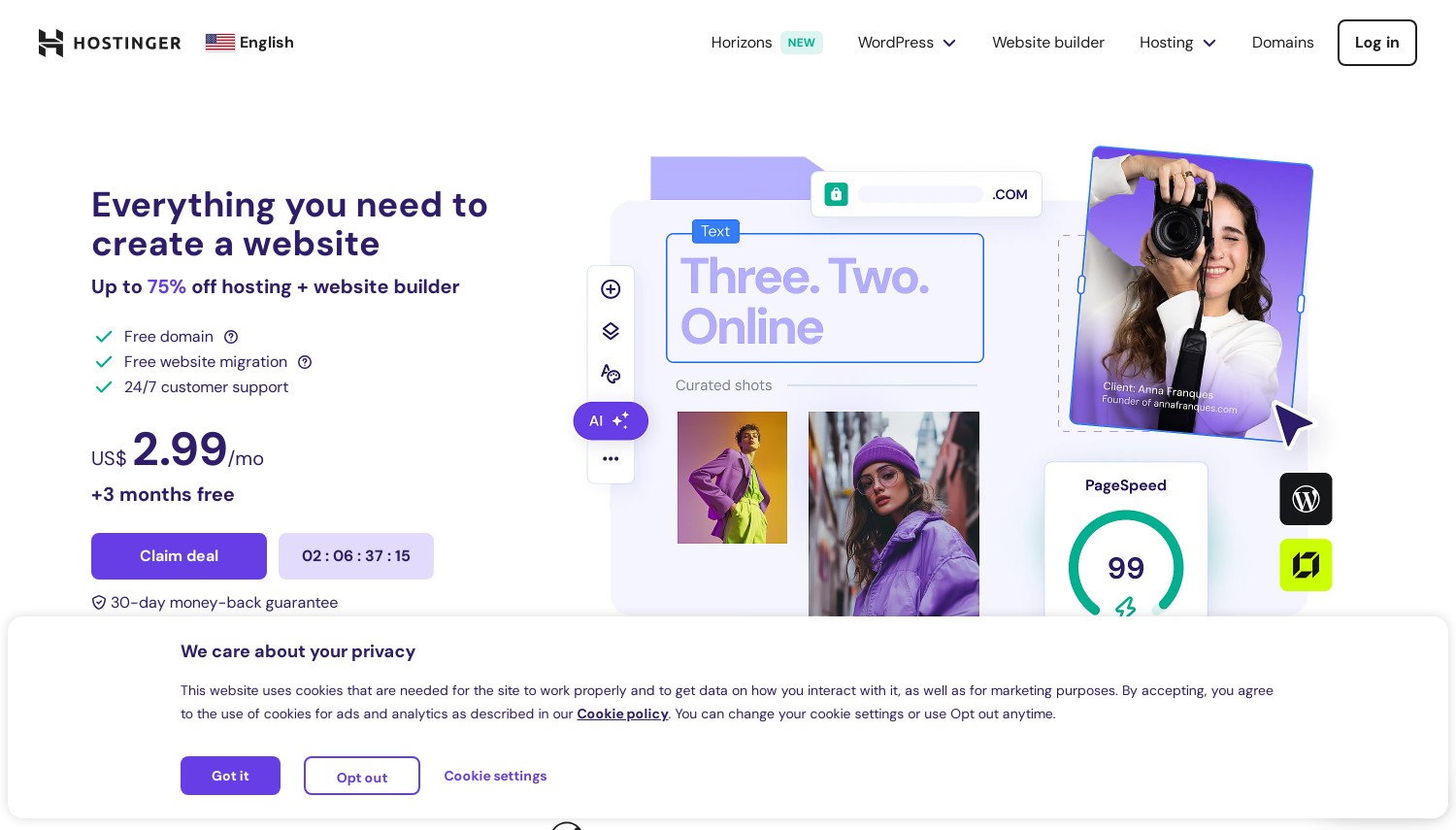
Hostinger includes basic DDoS protection on all hosting plans, but the implementation varies by tier. Entry shared plans get hardware firewall protection. The Business plan (USD 2.99/mo) and above unlock enhanced features: Hostinger CDN and "Under Attack Mode," which adds an extra verification layer during active attacks. VPS plans include Wanguard DDoS filtering on all tiers.
Two mitigation approaches work together. Traffic filtering through Wanguard targets malicious packets while preserving legitimate connections. For massive attacks that threaten to saturate network links, RTBH (Remotely Triggered Black Hole) routing kicks in. Hostinger has demonstrated handling attacks of approximately 8 Gbps and 1.5 million packets per second. The detection-to-mitigation window runs 20-50 seconds, which is honest but slower than providers claiming instant mitigation.
That RTBH fallback is worth understanding. During very large attacks, it null-routes your IP address, which stops the attack but also takes your site offline for all visitors temporarily. It's like stopping a fire by sealing the room. Effective but disruptive. Renewal on the Premium plan jumps from USD 1.99 to USD 10.99/mo. No specific Tbps capacity is published. Against HostArmada, Hostinger is cheaper at entry but offers less transparent DDoS specifications. For most budget shared hosting use cases, the protection handles common attack patterns adequately.
Pros
- DDoS protection on all plans (enhanced on Business+)
- Demonstrated 8 Gbps attack handling capacity
- VPS includes Wanguard filtering at no extra cost
- 30-day money-back guarantee
Cons
- RTBH can take site offline during large attacks
- 20-50 second detection-to-mitigation lag
- Enhanced protection requires Business plan (USD 2.99/mo)
Pricing: Premium Shared at USD 1.99/mo (48-month), renews USD 10.99/mo. Business Shared at USD 2.99/mo (enhanced DDoS/CDN), renews USD 16.99/mo. VPS KVM 1 at USD 4.99/mo (Wanguard included). 30-day money-back.
Best for: Beginners who want affordable hosting from a major provider with reasonable DDoS baseline protection.
Skip if: Your site can't tolerate any downtime during attacks or you need enterprise-grade mitigation.
Hostinger's DDoS protection works for the threat level most small websites actually face. If you're running a personal blog or small business site, the basic filtering catches common attacks. If you're running e-commerce or gaming servers, look at OVHcloud or layer Cloudflare on top.
5. OVHcloud
 6.7k+
2.3
Neutral
Neutral
6.7k+
2.3
Neutral
Neutral


| Storage | Bandwidth | Panel | Price |
|---|---|---|---|
| 1 GB | Unlimited | cPanel | $1.04 / mo. |
| 100 GB | Unlimited | cPanel | $4.39 / mo. |
| 250 GB | Unlimited | cPanel | $7.69 / mo. |
OVHcloud: Best Infrastructure-Grade Protection Included
Starting at USD 1.04/mo (shared) | 17 Tbps global filtering | L3/L4/L7 | All products included
OVHcloud bakes DDoS protection into every product they sell. Shared hosting, VPS, dedicated servers, public cloud: all get the same always-on mitigation powered by their proprietary VAC (Vacuum) scrubbing system. The network handles over 17 Tbps of filtering capacity with up to 1.3 Tbps per individual attack. No traffic limits, no time limits during attacks, no extra fees regardless of attack volume.
The VAC system combines an Edge Network Firewall with Armor scrubbing components. Traffic analysis happens at the network edge, filtering malicious packets before they reach your server. A Network Security Dashboard provides traffic monitoring and scrubbing logs with one-year retention. For game server hosting, OVHcloud offers an additional Game Shield layer purpose-built for gaming workloads that face targeted attacks.
OVHcloud shared hosting starts at just USD 1.04/mo for their Starter plan. VPS pricing begins at USD 6.46/mo with 4 vCores and 8GB RAM, which includes the same DDoS protection as their enterprise dedicated servers. The catch: everything is unmanaged. OVHcloud provides infrastructure, not hand-holding. Support response times vary, and no money-back guarantee exists for North American customers (EU customers get 14 days by law). Compared to Cloudflare, OVHcloud's 17 Tbps is smaller but it's genuine all-in-one hosting with DDoS, not a separate proxy layer.
Pros
- 17 Tbps global DDoS filtering on every product
- No traffic limits or time limits during attacks
- Shared hosting from USD 1.04/mo with full protection
- Game Shield available for gaming workloads
Cons
- Entirely unmanaged, all administration on you
- No money-back guarantee for North American customers
- Mixed support reputation with variable response times
Pricing: Shared Starter at USD 1.04/mo. Personal at USD 4.39/mo. VPS-1 at USD 6.46/mo (4 vCores, 8GB, 75GB SSD). VPS-2 at USD 9.99/mo (6 vCores, 12GB, 100GB NVMe). All plans include identical DDoS protection. 99.9% uptime SLA on VPS.
Best for: Technical users wanting cheap hosting with verifiable, large-capacity DDoS protection included.
Skip if: You need managed hosting or responsive customer support.
OVHcloud operates the infrastructure that many smaller hosts resell. You're getting the source, not the middleman. The DDoS protection is the same system that guards Fortune 500 workloads on their dedicated servers.
6. Hetzner Online
 2.3k+
3.1
Neutral
2.3k+
3.1
Neutral
 Neutral

| Storage | Bandwidth | Price | |
|---|---|---|---|
| 2 GB | 10.24 GB | $1.75 / mo. | View Plan |
| 10 GB | Unlimited | $4.52 / mo. | View Plan |
| 25 GB | Unlimited | $9.13 / mo. | View Plan |
Hetzner: Best European Value with AI-Powered Protection
Starting at ~USD 1.47/mo (shared) | Nokia Deepfield Defender | Always-on | German data centers
Hetzner deployed Nokia's Deepfield Defender across their European data centers in March 2026, upgrading from their previous Arbor/Juniper setup. The system uses AI and machine learning to detect attack patterns, with edge-based mitigation on Juniper routers that filters DDoS traffic before it enters the network. Complex application-layer attacks get redirected to Nokia's 7750 Defender Mitigation System for deep packet scrubbing.
Every Hetzner product gets this protection at no extra cost: shared hosting, cloud VPS (from EUR 4.99/mo), and dedicated servers. The shared Webhosting S plan starts at approximately USD 1.47/mo with no promotional-to-renewal price increase. That flat pricing model extends across all products. The DDoS system handles three layers: automated pattern recognition, traffic filtering for known attack signatures (DNS reflection, NTP reflection, UDP floods), and challenge-response filtering for SYN floods and DNS floods.
Hetzner doesn't publish their mitigation capacity, citing security policy. That means you can't compare their Tbps figures against OVHcloud or Cloudflare. No money-back guarantee exists, though monthly billing with no long-term contracts limits your risk. European data centers only (Germany and Finland) for shared hosting, so North American latency is a factor. Support runs on tickets only, no phone or chat. Compared to OVHcloud, Hetzner offers similar flat pricing with arguably newer DDoS technology (Nokia AI vs OVHcloud's proprietary VAC), but without OVHcloud's published capacity figures.
Pros
- Nokia Deepfield Defender AI-powered detection (March 2026)
- Flat pricing, no promotional-to-renewal increases
- Edge-based mitigation filters traffic before entering the network
- ISO 27001 certified data centers
Cons
- DDoS capacity not publicly disclosed
- European data centers only (Germany, Finland)
- No money-back guarantee, ticket-only support
Pricing: Webhosting S at ~USD 1.47/mo (EUR pricing, flat rate). Cloud VPS CX23 at EUR 4.99/mo (2 vCPU, 4GB RAM, 40GB SSD, 20TB traffic). Dedicated from EUR 47.30/mo. All include DDoS protection. No promotional pricing, prices recently adjusted April 1, 2026.
Best for: European-focused sites wanting modern AI-powered DDoS protection at flat, honest pricing.
Skip if: You need North American servers or want published mitigation capacity numbers.
Hetzner's investment in Nokia's AI-powered defense signals they're taking DDoS seriously at the infrastructure level. The lack of published capacity figures is frustrating for comparison purposes, but the technology itself is cutting-edge.
7. IONOS | ionos.com
 38.1k+
4.3
Positive
Positive
38.1k+
4.3
Positive
Positive



| Storage | Bandwidth | Panel | Price | |
|---|---|---|---|---|
| Unlimited | Unlimited | cPanel | $1.00 / mo. | View Plan |
| 10 GB | Unlimited | cPanel | $4.00 / mo. | View Plan |
| 100 GB | Unlimited | cPanel | $6.00 / mo. | View Plan |
IONOS: Most Affordable Entry with Split Protection
Starting at USD 1/mo (promo) | WebShield (L7 shared) + GSP (L3/L4 VPS) | 30-day money-back
IONOS takes an unusual approach: different DDoS technologies for different product types. Shared hosting gets WebShield, which protects the application layer (L7) against HTTP floods and similar attacks. VPS and dedicated servers get the Global Scrubbing Platform (GSP), handling network-layer (L3/L4) volumetric attacks. Both systems are always-on and included at no extra cost.
The USD 1/mo first-year promo on shared hosting makes IONOS the cheapest entry point with DDoS protection in this list. Renewal at USD 6/mo is also competitive. Every customer gets a dedicated personal consultant, a unique touch that most budget hosts skip. Free Wildcard SSL covers all subdomains, and daily backups come included. VPS starts at USD 2/mo with GSP protection.
Neither system covers all layers by default. Shared hosting lacks L3/L4 network scrubbing (only L7 WebShield). VPS lacks L7 application protection (only L3/L4 GSP). Getting both layers requires adding Cloudflare or a separate CDN service. IONOS also explicitly states they "cannot guarantee 100% protection against all threats." Capacity figures aren't published. Renewal from USD 1 to USD 6/mo is a 6x increase, though the absolute dollar amount remains low. Compared to OVHcloud, IONOS provides cheaper entry pricing but less complete per-product DDoS coverage.
Pros
- USD 1/mo first-year promo, cheapest entry here
- Dedicated personal consultant for every account
- Free Wildcard SSL (covers all subdomains)
- 30-day money-back guarantee
Cons
- Shared gets L7 only, VPS gets L3/L4 only
- No single product covers both network and application layers
- Renewal at USD 6/mo (6x promo price)
Pricing: Shared Start at USD 1/mo promo (12-month), renews at USD 6/mo. VPS Linux XS at USD 2/mo. All include respective DDoS protection tier. Domain Guard add-on USD 1-2.50/mo. 30-day money-back.
Best for: Budget buyers who want the absolute cheapest DDoS-protected hosting to start with.
Skip if: You need both L3/L4 and L7 protection from a single product.
IONOS delivers DDoS protection at prices other providers charge for unprotected hosting. The split-layer approach is a genuine limitation, but for most small websites facing basic attacks, WebShield on shared hosting handles the common threats.
8. A2 Hosting
 3.4k+
4.5
Positive
Positive
3.4k+
4.5
Positive
Positive

| Storage | Bandwidth | Panel | Price | |
|---|---|---|---|---|
| 10 GB | Unlimited | cPanel | $1.95 / mo. | View Plan |
| Unlimited | Unlimited | cPanel | $3.95 / mo. | View Plan |
| Unlimited | Unlimited | cPanel | $4.95 / mo. | View Plan |
A2 Hosting (Hosting.com): Best Hybrid Protection Architecture
Starting at USD 2.99/mo | Corero SmartWall + cloud scrubbing | L3/L4/L7 | 30-day money-back
A2 Hosting (rebranded as Hosting.com in April 2025 after acquisition by World Host Group) uses a hybrid DDoS approach that combines on-premises and cloud mitigation. Corero SmartWall hardware sits at the network edge for immediate local filtering. When attacks threaten to overwhelm local capacity, traffic automatically redirects to multi-terabit cloud scrubbing centers. This two-tier system means small attacks get handled locally (faster) while large attacks scale to cloud capacity (bigger).
Every A2 Hosting plan includes this protection: shared, VPS, and dedicated. The Startup shared plan at USD 2.99/mo bundles it alongside Imunify360 for application-layer security, free SSL, and malware scanning. The "Anytime Money-Back Guarantee" provides a full refund within 30 days and prorated refunds after that. Turbo plans with LiteSpeed servers start at USD 6.99/mo for performance-focused sites.
Renewal pricing jumps from USD 2.99 to USD 10.99/mo on the Startup plan. Specific on-premises Gbps capacity isn't published, only that cloud scrubbing reaches "multi-terabit" levels. The rebranding from A2 Hosting to Hosting.com may confuse users looking for the original brand. L7 protection relies on Imunify360 rather than dedicated application-layer scrubbing. Compared to OVHcloud's fully integrated approach, A2's hybrid model adds complexity but provides the flexibility of both local and cloud mitigation.
Pros
- Corero SmartWall on-premises + cloud scrubbing hybrid
- L3/L4 network filtering plus L7 via Imunify360
- Anytime money-back (prorated after 30 days)
- Protection on all hosting types
Cons
- Renewal at USD 10.99/mo (3.7x entry price)
- On-premises capacity not published
- Brand confusion from A2 Hosting to Hosting.com rebrand
Pricing: Startup Shared at USD 2.99/mo promo, USD 10.99 renewal. Drive at USD 5.99/mo, USD 12.99 renewal. Turbo Boost at USD 6.99/mo, USD 15.99 renewal. All include Corero DDoS protection and Imunify360. 30-day full refund, prorated after.
Best for: Users wanting a named DDoS technology partner (Corero) with documented hybrid architecture.
Skip if: Brand stability matters to you or you want published capacity numbers.
A2's Corero partnership adds credibility that generic "DDoS protected" claims lack. Corero is an established network security company, not a checkbox on a feature list. The hybrid approach covers different attack scales intelligently.
9. Contabo
 9.1k+
4.0
Positive
Positive
9.1k+
4.0
Positive
Positive
Contabo: Best Specs with Basic DDoS Included
Starting at ~USD 4.95/mo (VPS) | Network-level filtering | Always-on | All plans included
Contabo includes DDoS protection on everything they sell: VPS, storage VPS, virtual dedicated servers, and bare metal. It's always-on, automatic, and costs nothing extra. For a provider whose primary appeal is cramming 4 vCPU and 8GB RAM into a USD 4.95/mo VPS, the DDoS inclusion is a practical bonus rather than a headline feature.
The protection works at the network level, automatically detecting attack patterns and filtering malicious traffic before it reaches your server. All Contabo plans include unlimited bandwidth (fair use), so you don't face overage charges from attack traffic. The same protection covers their storage-focused VPS line and dedicated servers.
Contabo is honest about limitations. They explicitly state their "protection system cannot provide a guarantee that every conceivable DDoS attack will be repelled." No Gbps capacity is published. Community feedback suggests the protection handles common volumetric attacks but may fall short against sustained, sophisticated campaigns. No money-back guarantee is confirmed. Contabo doesn't offer traditional shared hosting, so their cheapest entry is VPS at ~USD 4.95/mo. For users whose primary need is raw server power and who want basic DDoS protection as a baseline, Contabo delivers. For users whose primary need is DDoS defense, providers like OVHcloud or Cloudflare offer stronger documented protection.
Pros
- 4 vCPU + 8GB RAM from ~USD 4.95/mo with DDoS included
- Always-on protection on all products
- Unlimited bandwidth (no attack traffic overage fees)
- Flat pricing with no promotional-to-renewal jump
Cons
- DDoS capacity not published
- Protection openly described as not all-encompassing
- No traditional shared hosting (VPS is entry product)
Pricing: Cloud VPS S at ~USD 4.95/mo (EUR 4.50, 4 vCPU, 8GB RAM, 75GB NVMe). Cloud VPS M at ~USD 7.60/mo (6 vCPU, 12GB, 100GB NVMe). All include always-on DDoS protection. Unlimited bandwidth. Flat pricing.
Best for: Users who need high-spec VPS with basic DDoS protection as a baseline rather than a primary feature.
Skip if: DDoS protection is your top priority or you want published mitigation capacity.
Contabo's DDoS protection is a floor, not a ceiling. It catches common attacks. For anything beyond that, pair it with Cloudflare's free tier and you've got enterprise-grade protection on a USD 5/mo server.
How to Choose Hosting with DDoS Protection
First, understand the layers. L3/L4 protection stops volumetric floods (UDP, SYN, DNS amplification), the type of attacks that overwhelm bandwidth. L7 protection stops application-layer attacks (HTTP floods, Slowloris), which target your web server directly with seemingly legitimate requests. Ideally, you want both. OVHcloud and Cloudflare cover all layers. IONOS splits them by product type. Most shared hosts cover L7 through WAFs and rely on upstream network filtering for L3/L4.
Check if capacity is published. OVHcloud (17 Tbps), Cloudflare (477 Tbps), HostArmada VPS (17 Tbit/s), and Ultahost (3,500+ Gbps) publish numbers. Hetzner, Hostinger, FastComet, and Contabo don't. Published numbers aren't a guarantee, but they signal that the provider has invested in quantifiable infrastructure rather than checking a marketing box.
Consider the Cloudflare combination strategy. Pair any cheap host (Contabo, Hetzner, OVHcloud) with Cloudflare's free plan and you get 477 Tbps of DDoS protection in front of your budget server. This is often the best value approach: buy hosting for specs and price, add Cloudflare for security. The best cloud hosting providers generally include some DDoS protection, but combining with Cloudflare adds defense in depth.
Match protection to your risk profile. A personal blog faces different threats than an e-commerce store or a game server. Basic shared hosting DDoS handles script-kiddie attacks. Online stores handling payments need L7 protection at minimum. Gaming servers need both layers plus low-latency filtering. Scale your protection investment to your actual risk.
Frequently Asked Questions
What types of DDoS attacks does hosting protection cover?
DDoS attacks fall into three categories: volumetric (L3/L4), which flood your network bandwidth with massive traffic; protocol attacks (L3/L4), which exhaust server connection capacity through malformed packets; and application-layer attacks (L7), which target web server resources with seemingly legitimate HTTP requests. Most hosting providers cover L3/L4 through network-level filtering. L7 protection typically comes through WAFs (Web Application Firewalls) like Imunify360, ModSecurity, or Cloudflare's WAF. OVHcloud and Cloudflare explicitly cover all three types. Budget shared hosts generally handle L3/L4 at the network level and L7 through application firewalls.
Is free DDoS protection enough for most websites?
For personal blogs, portfolios, and small business sites, yes. The DDoS protection included with providers like OVHcloud, Hetzner, FastComet, and Hostinger handles the automated attacks that make up the vast majority of DDoS incidents. Most attacks are under 1 Gbps and last less than 15 minutes. Free Cloudflare adds enterprise-grade defense on top of any host. You'd only need paid premium DDoS services if you're a specific target (political sites, gaming platforms, crypto exchanges) or handling sensitive financial transactions where even brief downtime has direct revenue impact.
Can I add Cloudflare DDoS protection to any hosting provider?
Yes. Cloudflare works as a reverse proxy. You change your domain's nameservers to Cloudflare, and all traffic routes through their network before reaching your origin server. It works with shared hosting, VPS, dedicated servers, and any provider that lets you control your DNS settings. Setup takes about 10 minutes. The free plan includes unmetered DDoS protection with no traffic limits. You can combine Cloudflare with any host in this list for layered defense, though pairing it with a host that already includes DDoS (like OVHcloud or Hetzner) creates redundant protection at the network level.
What happens to my site during a DDoS attack if I have protection?
With proper protection, legitimate visitors see no difference. Malicious traffic gets filtered at the network edge before reaching your server. Your site stays online and responsive. Without protection, or when attacks exceed your provider's capacity, your server becomes unreachable for everyone. Some hosts use RTBH (null-routing) during large attacks, which stops the attack by taking your IP offline entirely. Hostinger acknowledges using this approach for overwhelming attacks. OVHcloud and Cloudflare are designed to absorb attacks without null-routing, keeping your site accessible throughout. The difference matters: filtered protection keeps you online, null-routing stops the attack but takes you down temporarily.
Final Verdict
Here's the smartest approach for most users: pick your host based on price and features, then add Cloudflare's free plan for 477 Tbps of DDoS protection. Done. A Contabo VPS at USD 4.95/mo behind Cloudflare gives you enterprise-grade DDoS defense on a budget server.
For all-in-one hosting with strong built-in protection, OVHcloud leads with 17 Tbps filtering from USD 1.04/mo. Hetzner matches with Nokia's AI-powered defense at flat pricing from ~USD 1.47/mo. Both are unmanaged, so pair with FastComet (USD 1.79/mo) or HostArmada (USD 1.99/mo) if you need managed shared hosting with included protection.
Ultahost stands out for publishing the highest capacity number (3,500+ Gbps) at budget prices with fixed renewals. A2 Hosting earns credibility through its named Corero SmartWall partnership. IONOS offers the cheapest entry at USD 1/mo, though its split-layer protection means no single product covers all attack types.
Skip Contabo if DDoS is your primary concern. Its protection is basic and openly acknowledged as limited. But if you want maximum specs and add Cloudflare free, it becomes one of the best protected setups per dollar.