
eCommerce Website Builders (2026): Top 9 for Building an Online Store Compared
Shopify pushed its Plus tier to USD 2,300 per month this year. BigCommerce added a fee on payments run through outside gateways on June 1. Ecwid quietly retired the free plan it was known for. Ecommerce builders aren't getting cheaper or simpler in 2026, they're getting more conditional, and the fees now hide in a different spot on every platform. This guide maps where each of nine builders actually charges you, from the entry price to the renewal to the fees buried underneath, so you can choose before the surprise lands.
Quick answer: Shopify is the strongest builder for stores meant to scale, though you pay for it (from USD 29/mo on annual billing). Hostinger runs a real store for USD 3.99/mo with zero transaction fees, if you can stomach the renewal. Squarespace wins on design at USD 23/mo. Want to own everything outright? WooCommerce stays free to license. Pick by where you sell and how fast you plan to grow, not by the headline price.
Jump to: Shopify · Hostinger · Wix · Squarespace · GoDaddy · BigCommerce · WooCommerce · Square Online · Ecwid · Real Cost · How to Choose · FAQ
Last reviewed: July 2026. Pricing verified on official provider pages.
Two things most ecommerce builder roundups skip: renewal pricing (Hostinger and GoDaddy both jump hard after year one) and the fee changes that landed in 2026. We flag both. If you're still deciding between a hosted builder and self-hosted WordPress, our WordPress vs website builders breakdown covers that fork. This guide assumes you've picked "builder" and want the best store for your situation.
How We Selected These Ecommerce Builders
Price was the easy part. The hard part was separating what a builder advertises from what selling actually costs once fees, renewals, and product caps come into play. We started with platforms that can run a real checkout: list a product, take a card, ship an order. Then we kept one exception, Ecwid, because embedding a store into a site you already own is something nothing else here does.
Every price below came off the official pricing page on 2026-07-06, entry rate and renewal where the provider publishes it. We weighted four things for this angle: transaction-fee structure (the number that eats into your margin), renewal-to-entry jump, product and sales caps that force an upgrade, and the breadth of built-in payment methods. Design polish and AI tooling counted, but less than the money math. Sources included official pricing pages, published payment-processor fee schedules, store-tracking datasets for market share, and user review aggregates for real-world complaints.
Honest limits: we didn't build nine stores and process live orders through each. Some renewal rates (GoDaddy, most notably) aren't published by the provider and come from current third-party pricing reviews. Where a figure couldn't be pinned down, we left it out rather than guess.
| Hosting Provider | Reviews | Overall Rating | Cheap Plan Starts |
|---|---|---|---|
1  Shopify Shopify
|
4.2k+ |

|
$29.00 / mo. $1/month |
2  Hostinger Hostinger
|
63.2k+ |

|
$1.95 / mo. 80% Off |
3  Wix Hosting Wix Hosting
|
25.1k+ |

|
No data / mo. |
4  Squarespace Squarespace
|
2.3k+ |

|
$16.00 / mo. |
5  GoDaddy GoDaddy
|
126k+ |
|
$5.99 / mo. WB Free Trial |
1. Shopify

 4.2k+
1.4
Negative
Negative
4.2k+
1.4
Negative
Negative


| Storage | Bandwidth | Panel | Price | |
|---|---|---|---|---|
| Unlimited | Unlimited | cPanel | $29.00 / mo. | View Plan |
| Unlimited | Unlimited | cPanel | $79.00 / mo. | View Plan |
| Unlimited | Unlimited | cPanel | $299.00 / mo. | View Plan |
Shopify – Best for stores built to scale
From USD 29/mo (annual) | non-Payments fee 2% on Basic | 3-day trial, then USD 1/mo for 3 months
Shopify is the platform you graduate into, not out of. Basic runs USD 29/mo on annual billing (USD 39 month-to-month), Grow (the tier formerly just called "Shopify") is USD 79/mo annual, and Advanced is USD 299/mo. Above that sits Plus, which climbed to USD 2,300/mo in 2026 from the roughly USD 2,000 it held for years. Unlimited products, real inventory tracking, and true multichannel selling work out of the box, which is why independent 2026 testing keeps ranking it first for sales features.
Here's the trap buyers walk into. Route payments through anything other than Shopify Payments (PayPal-only setups, or regions where Shopify Payments isn't offered) and Basic tacks on a 2% penalty per order, on top of that gateway's own cut. Wix Core charges nothing extra on the same sale. The penalty drops to 1% on Grow and 0.5% on Advanced, so the more you sell, the less it stings, but on a starter store it stacks fast. Shopify's other soft costs are apps (subscriptions, advanced reviews, upsells often mean paid third-party add-ons at USD 10 to 50 each) and a blog engine too thin for content-led SEO.
The 2026 headline feature is Agentic Storefronts: AI shopping agents can buy directly from a Shopify store, included free on paid plans, plus a new USD 0 "Agentic" entry plan. Sidekick, its built-in AI assistant, ships on every tier.
- Unlimited products and multichannel selling on every paid plan
- Card rates from 2.9% + 30c (Basic) down to 2.5% (Advanced) with Shopify Payments
- Largest app ecosystem of any builder here
- New agentic checkout that competitors haven't matched
- The 2% non-Payments penalty on Basic punishes outside gateways
- Core features often need paid apps, so real monthly cost creeps up
- Weak native blog for SEO content
Pricing: USD 29/mo Basic (annual), USD 79 Grow, USD 299 Advanced, before app add-ons. No free plan for a full storefront, though the USD 5 Starter sells via links and social. Trial is 3 days, then USD 1/mo for the first three months.
Best for: stores expecting real growth, multichannel sellers, anyone using Shopify Payments. Skip if: you're launching a tiny catalog on a tight budget, or you must use an outside payment gateway.
Choose Shopify if you're building past a few hundred orders a month and will use Shopify Payments. If budget is the priority and you'll sell under 50 products, Hostinger does the job for a fraction of the cost. If you refuse to be tied to one payment processor, BigCommerce is the better scaler.
2. Hostinger
 63.2k+
4.6
Positive
Positive
63.2k+
4.6
Positive
Positive








| Storage | Bandwidth | Panel | Price | |
|---|---|---|---|---|
| 100 GB | Unlimited | cPanel | $1.95 / mo. | View Plan |
| 200 GB | Unlimited | cPanel | $2.95 / mo. | View Plan |
| 200 GB | Unlimited | cPanel | $3.49 / mo. | View Plan |
Hostinger – Best for launching a store on a budget
USD 3.99/mo entry | renews at USD 16.99/mo | zero transaction fees
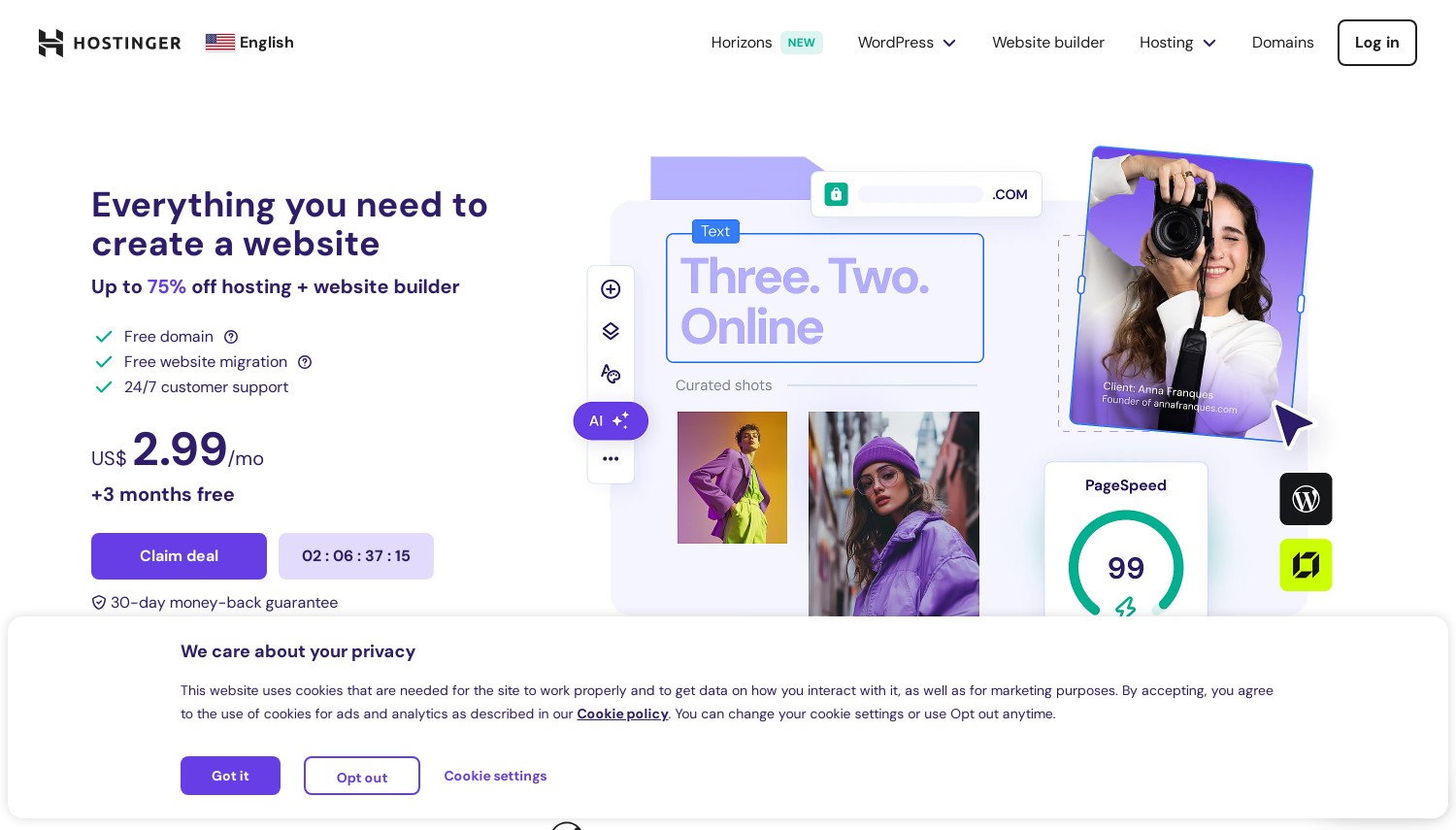
Where Shopify charges USD 29/mo before you sell a thing, Hostinger opens a real store at USD 3.99/mo on its Business Website Builder plan, roughly one-seventh the price. That gets you up to 1,000 products, more than 100 payment methods, and, the part that matters most at this tier, 0% transaction fees. You keep the whole sale minus your processor's cut. For a first store or a side project, that combination is hard to argue with, and it's why Hostinger keeps showing up as the budget pick in independent 2026 reviews.
Now the honest part. That USD 3.99 requires a 48-month prepay, and it renews at USD 16.99/mo, a 4.26x jump. Even renewed, it still undercuts Wix Core (USD 29) by more than USD 12 a month, so the value holds. But budget the year-two number, not the promo. Note too that ecommerce lives on the Business plan and up; the cheaper Premium plan can't sell. If you want the wider budget picture, our cheapest website builder guide breaks down renewal traps across the category.
Hostinger leans hard on AI: an AI site generator, an AI product-description writer that works from a photo, plus logo and SEO helpers. It's a lightweight store engine, though. There's a 1,000-product ceiling, and no subscriptions, product bundles, or POS (point-of-sale) tools. This is a builder for a focused catalog, not a growing empire.
- Zero transaction fees at a price no competitor here matches
- Over 100 payment methods built in
- AI tools that actually cut setup time (product copy from a photo)
- 30-day money-back guarantee
- Renewal jumps to USD 16.99/mo (4.26x)
- Hard 1,000-product cap, no subscriptions or POS
- Cheapest price needs a 4-year commitment
Pricing: USD 3.99/mo entry (48-month term), renews USD 16.99/mo. Ecommerce needs the Business tier. 30-day refund window.
Best for: first-time sellers, small catalogs, budget-first launches that still want zero fees. Skip if: you'll pass 1,000 products or need subscriptions.
Pick Hostinger if you want a genuine store for the price of a coffee and can live with a capped catalog. If you expect to sell subscriptions or scale past a thousand products, Shopify or BigCommerce is the right home. If design is your whole pitch, Squarespace looks more premium for USD 19 more.
3. Wix Hosting
 25.1k+
4.1
Positive
Positive
25.1k+
4.1
Positive
Positive
Wix – Best for design freedom on small-to-mid catalogs
USD 29/mo (Core, annual) | up to 50,000 products | no added Wix fees
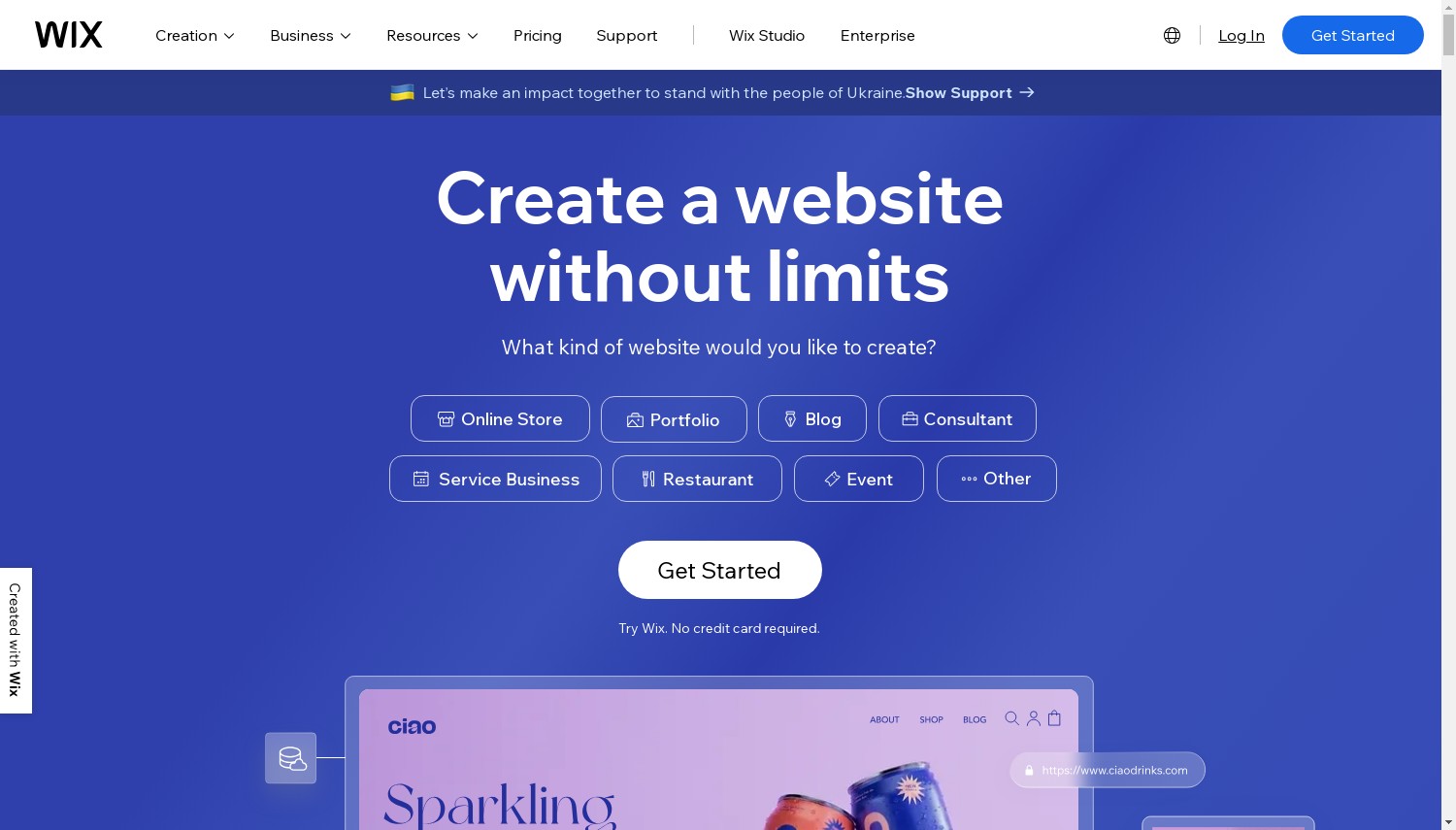
Say you're a maker with 40 products and strong opinions about how each page looks. That's the Wix buyer. Ecommerce starts on the Core plan at USD 29/mo (billed annually), which matches Shopify Basic to the dollar, but the two spend that money differently. Wix hands you a free-form drag-and-drop canvas where you place any element anywhere. It also runs a 2026 AI builder (Wix Harmony, on its "Aria" engine) that can generate a full store, product pages included, from a few prompts. The cheaper Light plan at USD 17/mo can't sell, so Core is the real entry point.
On fees, Wix has a quiet advantage. It adds no transaction fee of its own on paid plans; you pay only the processor's ~2.9% + 30c. That's the same spot where Shopify's Basic plan would charge you an extra 2% on a non-Shopify-Payments order. Catalog headroom is large, too: up to 50,000 products, versus Hostinger's 1,000 cap, so Wix scales further than most people expect from a design-first tool. Abandoned-cart recovery and automated sales tax kick in on Business (USD 39/mo).
The real limitation isn't fees, it's flexibility after launch. Wix won't let you switch templates once a site is published; changing your whole look means rebuilding on a new site and moving the plan across. Decide on the design before you go live. Costs also spike at the top, with Business Elite at USD 159/mo. Weighing Wix against the other design darling? Our Wix vs Squarespace comparison goes deeper on that matchup.
- True drag-anywhere editor, most creative freedom in this list
- No added Wix transaction fees on paid plans
- Up to 50,000 products and dropshipping via Modalist
- Strong 2026 AI site generator
- Can't change template after publishing
- Ecommerce needs Core (USD 29); Light and free can't sell
- Top tier jumps to USD 159/mo
Pricing: USD 29/mo Core, USD 39 Business, USD 159 Business Elite (annual billing). Free plan exists but can't sell. 14-day money-back guarantee.
Best for: design-led sellers with catalogs up to a few thousand items who want layout control. Skip if: you change your mind about design a lot, or you're on a rock-bottom budget.
Go with Wix if visual control matters more than commerce depth and you'll commit to one design. If you want the same look for USD 6 less per month, Squarespace Core is USD 23. If you need heavy inventory logic and multichannel, Shopify earns its higher effective cost.
4. Squarespace
 2.3k+
1.8
Negative
Negative
2.3k+
1.8
Negative
Negative
| Storage | Bandwidth | Panel | Price | |
|---|---|---|---|---|
| Unlimited | Unlimited | cPanel | $16.00 / mo. | View Plan |
| Unlimited | Unlimited | cPanel | $23.00 / mo. | View Plan |
| Unlimited | Unlimited | cPanel | $27.00 / mo. | View Plan |
Squarespace – Best for visual brands and creators
USD 23/mo (Core, annual) | 0% store fee from Core | 14-day trial
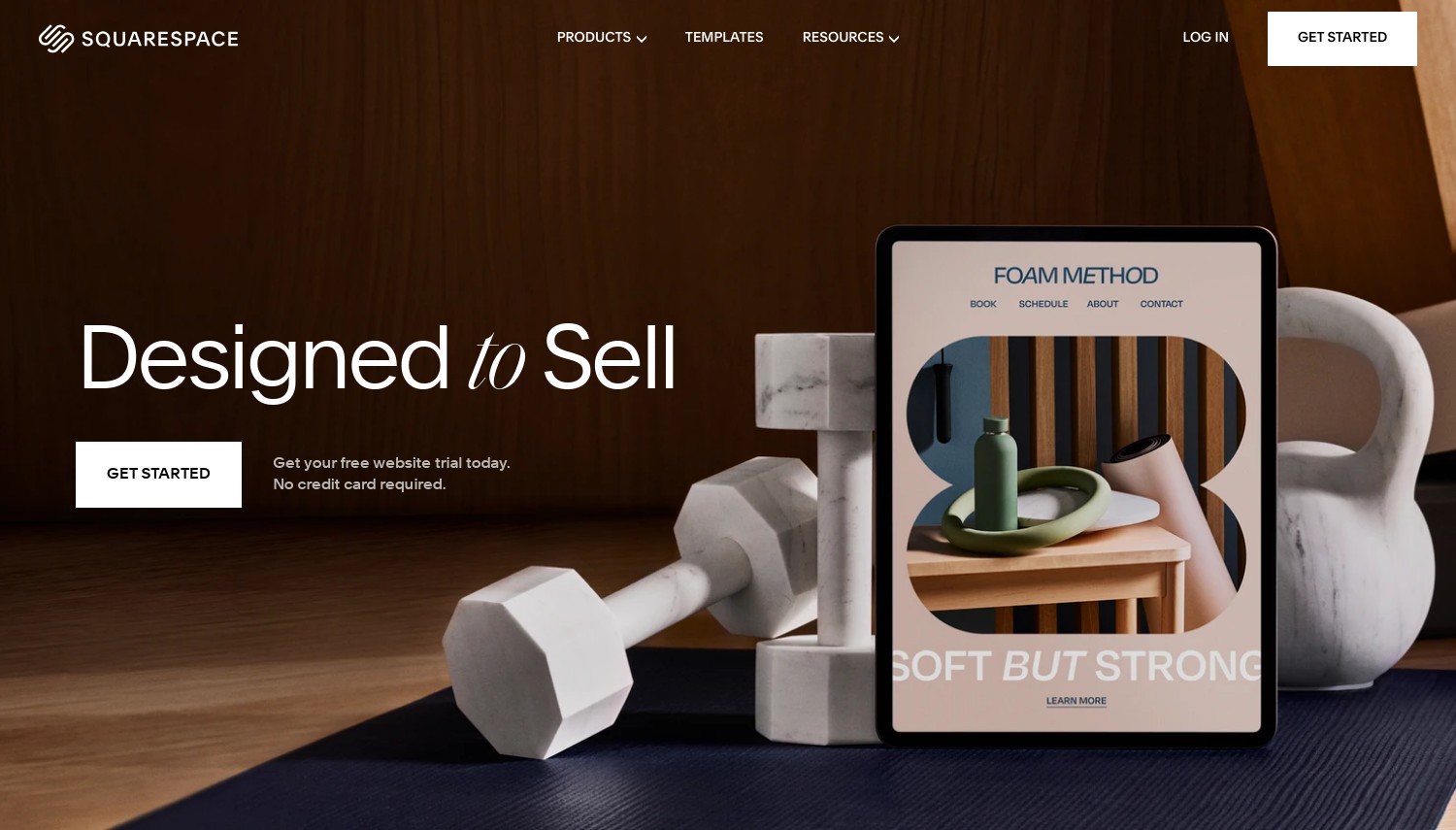
Squarespace's best plan for selling is not its cheapest one, and missing that costs people money. The entry Basic plan at USD 16/mo looks tempting until you read the fee grid: it charges a 2% store fee on physical products and a brutal 7% on digital goods. Step up to Core at USD 23/mo and the store fee drops to 0%. So Core, not Basic, is where Squarespace ecommerce actually begins, and at USD 23 it still undercuts both Wix Core and Shopify Basic (USD 29 each) by USD 6.
What you're paying for is design. Squarespace's templates are the most polished in the category, and its Blueprint AI can generate a coordinated, on-brand site quickly. For photographers, designers, and product brands where the storefront is the marketing, that matters. The plans climb to Plus (USD 39/mo) and Advanced (USD 99/mo), which is where you unlock the serious commerce tools.
Two limits keep it honest. The app and integration library is far smaller than Shopify's, so complex or scaling stores hit a ceiling. And the features that make selling efficient, abandoned-cart recovery and low digital-goods fees, live on Plus and up. If you sell digital downloads or memberships, Basic's 7% digital fee eats USD 7 of every USD 100, while Plus cuts that to 1%. Note the plans were renamed in late 2025 (the old Personal/Business/Commerce structure is gone), so older reviews list tiers that no longer exist.
- Best-in-class templates and design polish
- 0% store fee from Core (USD 23/mo)
- Blueprint AI for fast on-brand builds
- Strong memberships, subscriptions, and digital-product tools
- Basic's 2% store / 7% digital fees make it a poor sell tier
- Far fewer apps than Shopify
- Abandoned cart only on Plus (USD 39)
Pricing: USD 16 Basic, USD 23 Core, USD 39 Plus, USD 99 Advanced (annual billing). Card processing 2.9% + 30c (2.5% on Advanced). 14-day free trial.
Best for: brands, creators, and boutique catalogs where visual quality drives sales. Skip if: you need a big app ecosystem or sell mostly digital goods on a budget.
Choose Squarespace if the storefront is the sales pitch and you'll start on Core or higher. If you sell digital downloads and want low fees without paying USD 39 for Plus, Hostinger's flat 0% is cheaper. If you need integrations and scale, Shopify is the safer long-term bet.
5. GoDaddy
 126k+
4.5
Positive
Positive
126k+
4.5
Positive
Positive
| Storage | Bandwidth | Panel | Price | |
|---|---|---|---|---|
| 25 GB | Unlimited | cPanel | $5.99 / mo. | View Plan |
| 100 GB | Unlimited | Plesk | $6.99 / mo. | View Plan |
| 50 GB | Unlimited | cPanel | $7.99 / mo. | View Plan |
GoDaddy – Best for selling across marketplaces fast
USD 20.99/mo entry (Commerce) | renews at USD 34.99/mo | 2.7% + 30c fee
Start with the weak spot, because it decides who should skip GoDaddy: it's built for small catalogs, full stop. Reviewers are blunt that its ecommerce tools suit small stores and little else, and design flexibility trails Wix and Squarespace. If you're planning a large or fast-growing inventory, look elsewhere first.
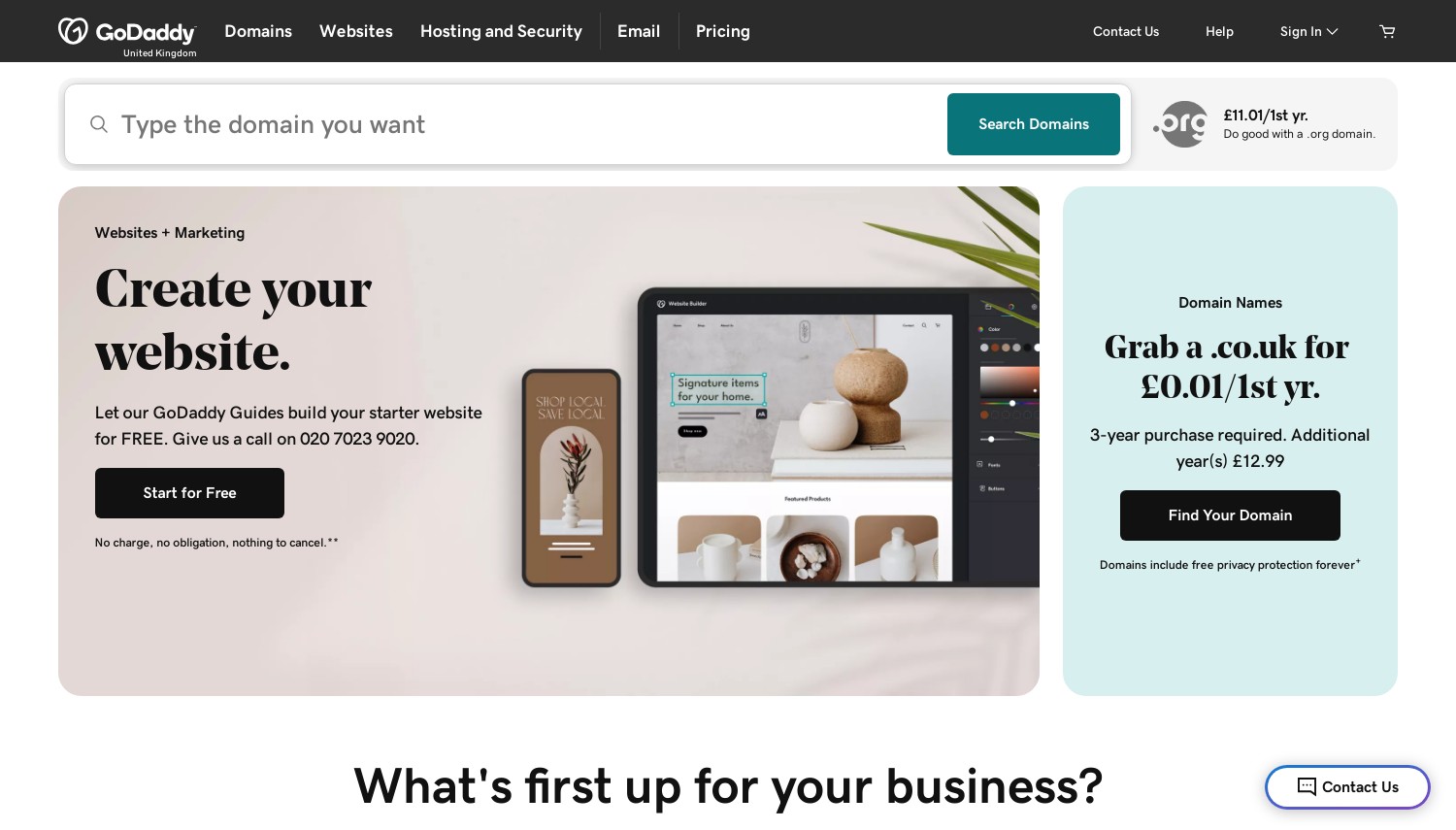
What GoDaddy does well is speed and reach. Its Websites + Marketing builder, powered by the GoDaddy Airo AI, can spin up a store, logo, product descriptions, and email campaigns in one guided flow. That's why beginners rate it highly for ease. The real hook is marketplace selling: list to Amazon, eBay, Etsy, and Walmart with inventory syncing across all of them from one dashboard. If your plan is "be everywhere shoppers already are," that's a strong pitch.
Ecommerce needs the Commerce plan at USD 20.99/mo entry, which undercuts Shopify Basic's USD 29. But GoDaddy doesn't publish renewals on its own pages, and third-party 2026 pricing puts the Commerce renewal at USD 34.99/mo, a 1.67x jump that lands USD 6 above Shopify's flat USD 29 annual rate. Payment processing runs 2.7% + 30c online through GoDaddy Payments, with a USD 99 card reader for in-person sales at 2.3%. Airo Plus, premium email, and other extras are steady upsells on top.
- Fastest AI-guided setup for total beginners
- Native selling on Amazon, eBay, Etsy, Walmart with synced inventory
- Abandoned cart, gift cards, automatic tax
- Integrated POS for in-person sales
- Commerce renews around USD 34.99/mo (unpublished by GoDaddy)
- Suited to small catalogs only
- Upsell-heavy; design flexibility trails rivals
Pricing: USD 20.99/mo Commerce entry, renews ~USD 34.99/mo. Transaction fee 2.7% + 30c. (We could not verify a free-trial length on the current page, so we're not quoting one.)
Best for: beginners who want to sell across marketplaces quickly with a small catalog. Skip if: you're scaling, or you hate creeping upsells.
Pick GoDaddy if multichannel marketplace listing and fast setup outrank everything else. If you want the same speed with a genuinely free store engine, Square Online starts at USD 0. If you'll outgrow a small catalog, Shopify or BigCommerce won't box you in.
BigCommerce – Best for growing catalogs without payment lock-in
USD 29/mo (Core, annual) | no forced payment processor | new open-payment fee
June 1, 2026 reshuffled BigCommerce, and most articles still describe the old version. The plans were renamed (Standard/Plus/Pro became Core/Growth/Scale), and a new fee appeared. Core is USD 29/mo on annual billing, matching Shopify Basic exactly, then Growth is USD 79 and Scale is USD 299. Here's the difference that matters: where Shopify locks you into Shopify Payments or charges a 2% penalty, BigCommerce lets you run any approved gateway at a 0% platform fee. No processor lock-in has always been its signature.
That signature just got an asterisk. As of the June update, orders pushed through a non-approved gateway now carry an Open Payment Provider Fee: 2% on Core, 1% on Growth, 0.6% on Scale. Stay on an approved provider and you still pay nothing to BigCommerce, so the old "no transaction fees" pitch survives with a condition attached. Flagging that condition is exactly the kind of detail competitors' stale pages miss.
The other thing to watch is sales caps. BigCommerce meters annual revenue, and the June change lowered the thresholds. Core now tops out at USD 30,000 a year in sales before it auto-upgrades you to Growth (which allows up to USD 100,000). Hit USD 30K, which a modest store does quickly, and your USD 29 plan becomes a USD 79 plan whether you planned for it or not. In exchange you get proper SaaS scalability, strong built-in features without add-on sprawl, and no server maintenance.
- No payment-processor lock-in on approved gateways
- Deep built-in features, less reliance on paid apps than Shopify
- Genuine SaaS scalability for growing catalogs
- Transparent card rates via your own processor
- New open-payment fee (2% Core) on outside gateways
- USD 30K/yr sales cap on Core forces an upgrade
- Editor is less beginner-friendly than Wix or GoDaddy
Pricing: USD 29/mo Core, USD 79 Growth, USD 299 Scale (annual billing). Open-payment fee applies only to non-approved gateways.
Best for: growing stores that want to keep their own payment processor and avoid app bloat. Skip if: you're a tiny store, or you want the simplest possible editor.
Choose BigCommerce if you're scaling and refuse payment lock-in, and you'll stay on an approved gateway to keep fees at zero. If you want the biggest app ecosystem instead, Shopify Advanced wins at similar money. If you're a beginner with 20 products, GoDaddy or Hostinger is far gentler.
WooCommerce – Best for owning your store outright
Free to license | real cost = hosting + extensions | no platform fee
WooCommerce isn't a website builder, and pretending otherwise sets you up to be disappointed. It's an open-source plugin that turns a WordPress site into a store, which means there's no signup screen and no monthly platform bill. By raw count it's the most-used ecommerce software on the web, powering roughly a third of all online stores. One honest caveat: among the largest one million stores, Shopify actually leads (about 28.8% to WooCommerce's 18.2%), so "most popular" depends on whether you count by volume or by size.
The appeal is ownership. You control every file, every extension, and your own checkout, and WooCommerce itself charges no transaction fee, you pay only your gateway (Stripe, PayPal, whatever you choose). Compare that to Shopify Basic's 2% penalty on non-Payments orders and the math favors WooCommerce for anyone routing sales through their own processor. The ecosystem is enormous: tens of thousands of WordPress plugins and over a thousand official extensions.
"Free" needs an asterisk, though. Your real cost is WordPress hosting plus any paid extensions, and you own the work that a hosted builder handles for you: updates, security, backups, and configuration. A capable managed setup runs around USD 10 to 30/mo, still under Shopify Basic's USD 29, but with your time as the hidden line item. If you go this route, matching it to the right host matters, so see our WordPress ecommerce hosting guide.
- Free, open-source, no platform transaction fee
- Full ownership of code, data, and checkout
- Largest extension ecosystem of any option here
- Uses any payment gateway you like
- Fully DIY: you manage hosting, security, updates
- No built-in support line to call
- "Free" plus real costs (hosting + extensions)
Pricing: plugin free; budget USD 10 to 30/mo for capable hosting, plus extensions as needed. No refund concept (it's software you install).
Best for: owners who want full control and no platform lock-in, and don't mind managing the stack. Skip if: you want someone else to handle updates and support.
Pick WooCommerce if ownership and zero platform fees outweigh convenience, and you're comfortable running WordPress. If you'd rather never touch a server, Shopify or BigCommerce removes that burden for a monthly fee. If you want WordPress-style flexibility with AI assembling it for you, look at an AI WordPress builder instead.
Square Online – Best for retail shops going online
Free plan (USD 0/mo) | 3.3% + 30c online on free | native Square POS sync
Picture a cafe or a boutique that already rings up sales on Square registers and now wants a website that shares the same inventory. That's precisely who Square Online is built for. Its free plan beats Wix's free plan on the one thing that counts: you can actually sell. Wix makes you pay USD 29/mo for Core before it processes a single payment, while Square takes orders at USD 0/mo, charging 3.3% + 30c per online sale. Paid tiers (Plus at USD 49/mo, Premium at USD 149/mo, per location) drop that online rate to 2.9% + 30c.
The real magic is omnichannel. Your online store, your in-person register, and your inventory are one system, so a sale in the shop updates the website automatically and vice versa. For brick-and-mortar sellers, that unification is worth more than any template. Payments, POS hardware, and the online store all speak the same language out of the box.
Two honest limits. The free plan carries a Square-branded subdomain and that higher 3.3% processing rate, so it's a place to start, not to stay. And Square Online mainly shines if you're already in, or planning to join, the Square ecosystem. As a pure website builder for a business with no shopfront, Wix or Squarespace gives you more design range. Think of it as the online arm of a retail operation, not a standalone web studio.
- Genuinely free plan that can take real orders
- Native sync with Square POS and hardware
- Best omnichannel setup here for physical retail
- Paid tiers cut online rate to 2.9% + 30c
- Free plan uses a Square subdomain and 3.3% rate
- Best value only if you use Square's POS
- Weaker design range than Wix or Squarespace
Pricing: USD 0 Free, USD 49/mo Plus, USD 149/mo Premium (per location). Online processing 3.3% + 30c (Free) or 2.9% + 30c (paid).
Best for: retail and food businesses already using Square that want a synced online store. Skip if: you're online-only and design-led.
Choose Square Online if you run a physical shop and want one system for register and web. If you're online-only and want a beautiful storefront, Squarespace or Wix is the better tool. If you want the cheapest full-featured store without POS baggage, Hostinger's USD 3.99 plan wins on price.
Ecwid – Best for adding a store to a site you already have
From USD 5/mo (Starter) | no transaction fees | embeds into any site
Ecwid isn't a website builder either, and that's the whole point of it. Instead of making you rebuild on a new platform, Ecwid (now part of Lightspeed) drops a working store into a site you already own, whether that's WordPress, Wix, Squarespace, or plain HTML. If you've spent months on a site you like and just need a checkout bolted on, nothing else in this list does that job as cleanly.
One correction, because plenty of 2026 articles get it wrong: Ecwid's famous free plan is gone. It was retired in favor of the paid Starter tier, so the real entry point is now USD 5/mo, not USD 0. At that price you get 10 products and no Ecwid transaction fees on any plan. Starter costs USD 24 less than Wix Core (USD 29), but caps you at 10 products where Wix Core allows up to 50,000, so the trade is obvious: cheaper and embeddable, but small. Venture (USD 35/mo) lifts you to 100 products, Business (USD 65) to 2,500, and Unlimited (USD 149) removes caps and adds in-person POS.
The limitation is baked into the concept. Ecwid is a bolt-on widget, not a standalone builder, so your store is only ever as good as the site hosting it. There's no design system to speak of because design isn't its job. Treat it as ecommerce plumbing for an existing site, and it's excellent; expect it to build you a storefront from scratch, and you'll be let down.
- Embeds into any existing website
- No transaction fees on any plan
- Cheapest paid entry here at USD 5/mo
- Scales to POS on the Unlimited tier
- Free plan discontinued; entry now USD 5/mo
- Starter caps at 10 products
- Not a standalone builder (needs a host site)
Pricing: USD 5 Starter, USD 35 Venture, USD 65 Business, USD 149 Unlimited (per month). No Ecwid transaction fees.
Best for: people with an existing website who just want to add a store. Skip if: you're starting from nothing and need the site built too.
Choose Ecwid if you already have a site you're happy with and only need checkout added. If you're building from scratch, a standalone tool like Wix or Hostinger gives you the whole site plus the store. If you want that embed approach but sell mostly in person, Square Online covers both sides better.
What Selling USD 5,000 a Month Really Costs
Subscription price is the number you see. Fees are the number you feel. So here's the effective monthly cost of a store doing USD 5,000 in sales, counting the plan price plus any platform surcharge unique to that plan. Card processing (~2.9% + 30c) is close to universal, so leave it out and the real gaps come into focus.
- Hostinger Business: USD 16.99 renewed, no platform fee. The cheapest real total in the group.
- Squarespace Core: USD 23, 0% store fee.
- Wix Core and BigCommerce Core: USD 29, both 0% on their own or approved payments.
- Shopify Basic: USD 29 on Shopify Payments. Route sales through an outside gateway and the 2% penalty adds USD 100 on USD 5,000, so the real number becomes about USD 129.
- GoDaddy Commerce: USD 34.99 renewed, no extra platform fee beyond standard processing.
- WooCommerce: USD 10 to 30 in hosting, no platform fee, plus your own time to run it.
- Ecwid: USD 5 to 65 by catalog size, no platform fee.
- Square Online: USD 0 plan, but its 3.3% online rate runs roughly USD 20/mo above a 2.9% platform, so "free" still costs about that in extra processing.
Two lessons fall out of this. First, at this volume the plan prices barely separate the field: a USD 18 spread from Hostinger to GoDaddy. Second, the fee structure moves far more money than the subscription does. A Shopify store on an outside gateway costs more than seven times a like-for-like Hostinger store, and Square's "free" plan isn't the cheapest once processing is counted. If you take one habit from this guide, price your store at year-two rates and at your own payment setup, not at the signup screen.
How to Choose an Ecommerce Website Builder
Forget "which is best overall." The right builder depends on how much you sell, where you sell, and how much you'll manage yourself. So which one should you actually pay for? Match your situation to one of these.
Budget under USD 10/mo, fewer than 50 products, want zero fees → Hostinger Business (USD 3.99/mo, renews USD 16.99). Skip Shopify Basic here; at USD 29/mo plus a 2% penalty on non-Shopify-Payments orders, you'd pay roughly seven times more before your first sale, for scale you don't need yet.
Projected sales of USD 30K to 100K a year, want to keep your own payment processor → BigCommerce Growth (USD 79/mo). Its 0% platform fee on approved gateways beats Shopify Grow, which sits at the same USD 79 but still adds 1% on orders through an outside gateway. Skip Shopify here unless you specifically need its deeper app catalog.
You already run a physical shop on Square registers → Square Online free tier (USD 0/mo). You already own the POS sync, so paying USD 20.99/mo for GoDaddy Commerce would buy you a second, disconnected system. Start free, upgrade to Plus (USD 49) only when the 3.3% online rate outweighs the subscription.
You have a site you love and just need checkout → Ecwid Starter (USD 5/mo) embeds into it. Don't migrate to Shopify and rebuild everything for a USD 29/mo plan; add the store where your site already lives.
Creator selling digital downloads and memberships → Squarespace Plus (USD 39/mo) for its 1% digital fee and abandoned-cart recovery. Skip Squarespace Basic, whose 7% digital fee quietly takes USD 7 out of every USD 100 you earn.
Frequently Asked Questions
Which ecommerce website builder is cheapest to start an online store?
Hostinger's Business plan is the cheapest full store at USD 3.99/mo (renewing at USD 16.99), with no transaction fees and up to 1,000 products. If you already have a website, Ecwid embeds a store for USD 5/mo. And Square Online is technically free at USD 0/mo, though its 3.3% online processing rate makes it cheap to start but not cheapest to run at volume.
Do you need Shopify to sell online, or can cheaper builders handle it?
You don't need Shopify. For small catalogs, Hostinger (USD 3.99/mo) and Wix Core (USD 29/mo) run complete stores, and WooCommerce does it with no platform fee at all. Shopify earns its higher cost once you're scaling past a few hundred orders a month or selling across many channels, but a first store rarely needs that muscle on day one.
Which ecommerce builder has the lowest transaction fees?
Several charge no platform fee of their own: Hostinger, WooCommerce, Ecwid, and Wix all add nothing beyond your payment processor's rate (typically ~2.9% + 30c). BigCommerce is 0% on approved gateways, though a new 2026 fee applies to outside ones. Shopify is the outlier, adding up to 2% on Basic if you don't use Shopify Payments, while Squarespace Core and above drop their store fee to 0%.
Is Shopify or Wix better for a small online store?
For a small store, Wix is often the better value. Wix Core and Shopify Basic both cost USD 29/mo. The difference is fees: Wix adds nothing extra, while Shopify can tack on 2% if you use an outside payment gateway. Choose Shopify anyway if you plan to scale fast or sell across many channels; choose Wix if design control and predictable fees matter more right now.
Can you build an online store for free?
Yes, but with strings attached. Square Online is the only builder here with a free plan that actually takes orders, at USD 0/mo, a 3.3% online rate, and a Square-branded subdomain. Wix and Squarespace have free plans too, though neither lets you sell a thing. WooCommerce is free to license, but you still pay for WordPress hosting. And note that Ecwid's old free tier ended in 2025, so its real entry point is now USD 5/mo.
Final Verdict
There's no single winner, because these nine builders don't solve the same problem. Shopify is the scaler's choice, worth its premium once you're moving real volume through Shopify Payments. Hostinger is the budget champion, a real zero-fee store for USD 3.99/mo if you accept the USD 16.99 renewal. Wix and Squarespace split the design crowd, Wix for layout freedom, Squarespace for polish at USD 23. GoDaddy wins on fast marketplace selling, BigCommerce on scaling without payment lock-in, and WooCommerce on outright ownership. Square Online is the pick for physical shops, and Ecwid for bolting a store onto a site you already have.
The pattern across 2026 is that the fees moved, they didn't disappear. Read the renewal line and the transaction-fee line before the monthly price, and you'll avoid the surprise that catches most first-time sellers.
Building a store is one decision; the platform under it is another. If two of the design-forward names here are your finalists, our Hostinger vs Squarespace comparison settles that head-to-head. And if you expect heavy traffic from launch day, our VPS hosting for ecommerce guide covers the point where a store outgrows entry-level infrastructure. Whichever builder wins, price it at year two and at your real sales volume, not at the signup discount. That's the habit that separates a store that stays cheap from one that stings later.