
On This Page: [hide]
Is Shopify worth it in 2026? Short answer: for most online sellers, yes. For everyone, no. Shopify dominates ecommerce for good reasons. It’s genuinely easy to use, scales well, and integrates with practically everything. But it’s also more expensive than it looks, and the app-dependent model can drain your budget fast.
This review analyzes over 11,000 verified business reviews from major platforms, plus unfiltered community feedback from Reddit and forums. Unlike affiliate-heavy reviews, we show both promotional AND renewal pricing, and we include the complaints that others conveniently skip. If Shopify has a weakness, you’ll find it here.
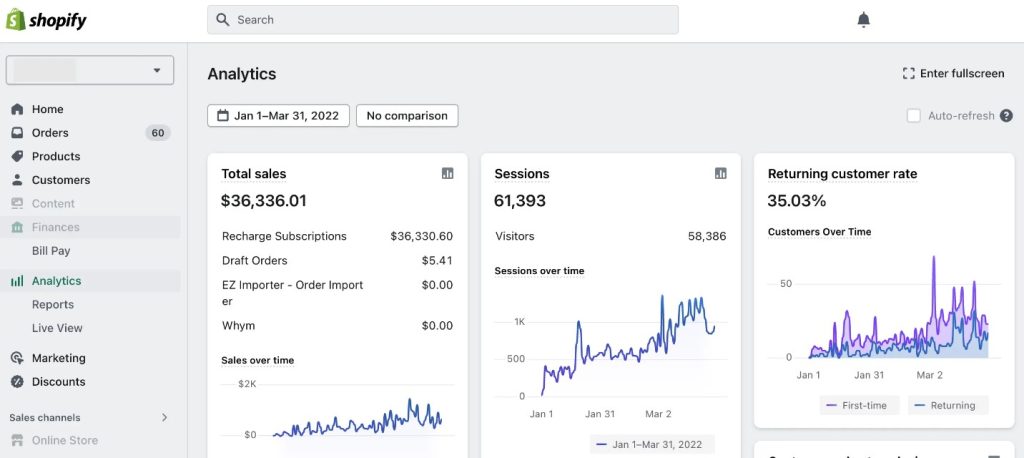
Overall assessment: Shopify scores 4.4-4.5/5 across major business review platforms based on 11,000+ reviews. Users praise the beginner-friendly interface and extensive app ecosystem. The most common complaints involve hidden costs from app dependencies, limited built-in SEO, and support quality that varies wildly. Best suited for small-to-medium businesses wanting a hands-off technical experience. Not ideal for budget-conscious sellers or those needing advanced customization without ongoing fees.
 Visit Site
| Name | Shopify |
| Total Reviews | 4289 |
| Average Score | 1.4 |
| Website | https://shopify.com |
| Server Locations |  United States United States |
Number of Reviews
Avg. Review Score
Customer Support
Features and Services
Shopify is a fully-hosted ecommerce platform. You don’t manage servers, install updates, or worry about security patches. Everything runs on Shopify’s infrastructure, which is both its biggest advantage and its main limitation.
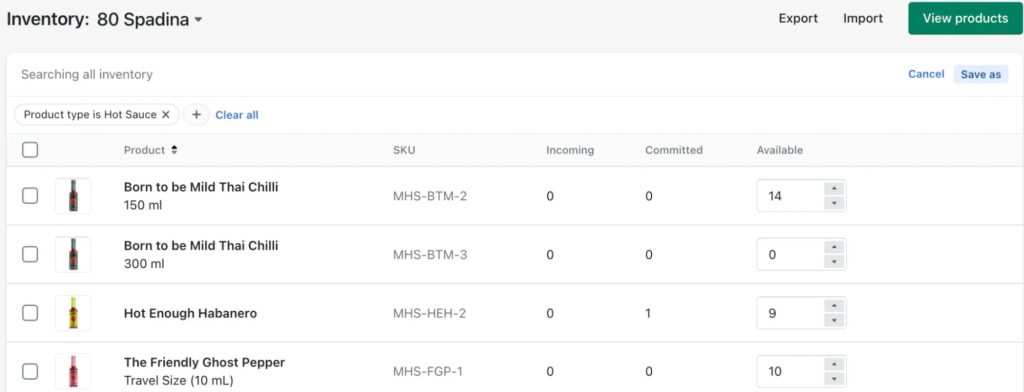
What Shopify Includes
Every Shopify plan covers the essentials:
- Unlimited products: List as many items as you want, no caps
- Unlimited bandwidth: No overage charges regardless of traffic
- Free SSL certificate: Secure checkout without extra configuration
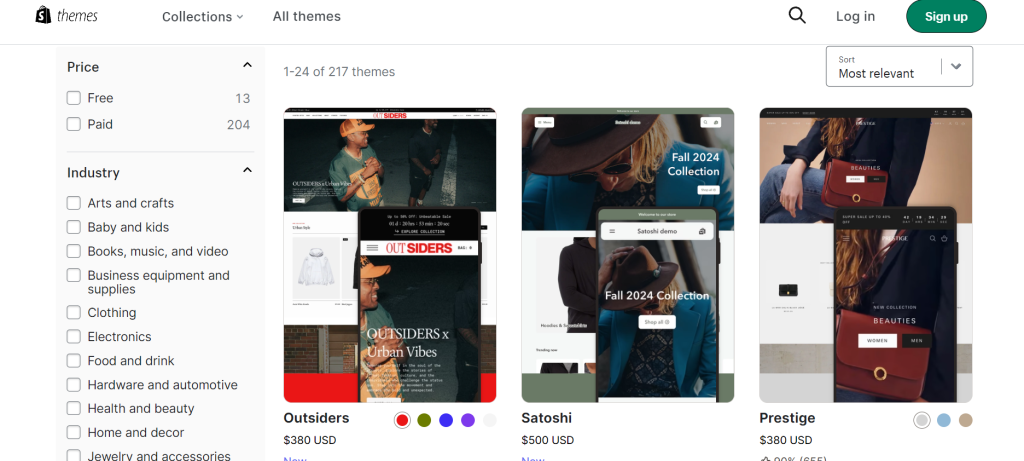
- 90+ themes: Including 12 free options, all mobile-responsive
- Abandoned cart recovery: Available on all plans, not locked behind premium tiers
- Shopify Email: 10,000 free marketing emails monthly
- Basic reports: Sales and customer analytics (advanced reports require higher plans)
The App Ecosystem
Shopify’s app store has over 6,000 apps covering everything from reviews to subscriptions to accounting. This is powerful but creates a dependency. Many features you’d expect built-in, like advanced SEO tools, subscription management, or loyalty programs, require paid apps. Community feedback consistently mentions this: “$39/month quickly becomes $200+ once you add the apps your store actually needs.”
Infrastructure and Performance
Shopify uses Cloudflare’s CDN (Content Delivery Network), which caches your store across 330+ server locations in 120+ countries. This means fast load times globally without you configuring anything.
Performance stats from Shopify’s documentation:
- 99.99% uptime guarantee
- Average CDN response under 100 milliseconds
- 95% cache hit rate
- HTTP/2 enabled by default (faster page loading through improved data transfer)
- Automatic JavaScript and CSS minification
Independent users report generally fast stores out of the box. Speed problems usually stem from heavy themes or too many apps, not Shopify’s infrastructure.
International Selling
The Basic plan supports 3 international markets and 10 inventory locations. Higher tiers expand this significantly. Shopify handles multi-currency checkout, but calculating duties and import taxes requires the Advanced plan ($399/month) or third-party apps.
Customer Experience
Aggregated data tells an interesting story. Business review platforms (Capterra, G2) show strong ratings around 4.4-4.5/5. Consumer platforms like Trustpilot show much lower scores, though many of those reviews are from shoppers complaining about individual merchants, not Shopify itself.
What Customers Praise
Ease of use tops every positive review. Users consistently describe the setup process as intuitive. Shopify guides you through adding products, configuring payments, and launching your store with minimal friction. One user summarized it: “Shopify is the Rolls Royce of ecommerce platforms. It integrates with everything, has a massive app store, and is super easy to use.”
Reliability comes second. Merchants don’t worry about their stores going down. The 99.99% uptime claim holds up in real-world usage. Server management, security, and updates happen invisibly.
The app ecosystem, despite its costs, delivers flexibility. If you need a feature, there’s probably an app for it. This lets businesses customize extensively without touching code.
Common Complaints
App dependency drives up costs. This is the most consistent criticism. Features like advanced analytics, subscription billing, and multi-language support require paid apps. One reviewer put it bluntly: “They may advertise a $30 monthly fee, but with a few premium apps, that monthly fee can shoot up to $200+.”
SEO limitations frustrate content-focused sellers. Built-in SEO tools are basic. URL structures are rigid. Blogging features lag behind WordPress. Community discussions frequently note: “The SEO for Shopify is almost non-existent. You will need to heavily market your shop to bring in traffic.”
Support quality varies. This appears in multiple review sources. Some users report excellent experiences. Others describe offshore teams providing inconsistent answers, slow escalations, and difficulty reaching anyone who can actually resolve issues.
Community Feedback (Reddit and Forums)
Reddit discussions offer unfiltered perspectives that curated review sites often miss:
The marketing burden falls entirely on you. Unlike selling on Amazon or Etsy, Shopify provides no built-in marketplace traffic. Multiple threads warn new sellers: “Traffic is your responsibility. Marketing costs can be brutal early on, especially paid acquisition.”
Account lockouts during critical moments. Several merchants report access issues during peak sales periods. One particularly frustrated user described being “locked out of my Shopify account for days with no resolution” while orders piled up.
The transition from Basic to Grow feels forced. As stores scale, features hidden behind higher tiers, like advanced reports and better transaction rates, create pressure to upgrade even when the Basic feature set would otherwise suffice.
Positive experiences dominate among established sellers. Those who’ve run stores for 2+ years generally recommend Shopify, citing stability, integrations, and the ability to scale without switching platforms.
Support Quality
Shopify offers 24/7 live chat support on all plans. Here’s the reality:
- No phone support except for Plus members
- No email support except for Plus and Retail accounts
- Initial contact goes through AI, then to human advisors
- Support quality is inconsistent, excellent for basic questions, frustrating for complex issues
The lack of phone support is a dealbreaker for some businesses. If you need to talk through issues verbally or have complex technical problems, Shopify’s chat-only approach may not work for you.
When to Use Shopify
Shopify makes sense in specific scenarios where its strengths align with your needs.
Ideal For
Beginners launching their first online store: The guided setup, managed hosting, and extensive documentation mean you can go from zero to selling without technical knowledge. You won’t be configuring servers or managing WordPress plugins.
Businesses prioritizing stability over cost: If reliable uptime, automatic updates, and not worrying about hosting matters more than saving $50/month, Shopify delivers peace of mind.
Dropshippers and print-on-demand sellers: Integrations with Oberlo, Printful, and similar services work smoothly. The ecosystem supports this business model well.
Multi-channel sellers: Shopify connects to Amazon, Facebook, Instagram, TikTok, and more. Managing inventory across channels from one dashboard saves real time.
You’ll Appreciate It If
- You value time over money: Setup and maintenance are minimal
- You’re already using Shopify Payments: Avoids third-party transaction fees
- You need to scale without migration: Same platform works from launch to millions in revenue
- You want a large app ecosystem: 6,000+ apps solve most problems
When NOT to Use Shopify
Shopify isn’t the right choice for everyone. Be honest about whether these limitations affect you.
Look Elsewhere If
You’re on a tight budget: The true cost of running a Shopify store, after apps, themes, and transaction fees, often exceeds $100-150/month. If you need a $20-30/month solution, self-hosted WooCommerce is cheaper long-term.
You need deep customization without ongoing fees: Shopify’s closed system means you can’t modify core functionality. With WooCommerce or open-source alternatives, you can customize anything. With Shopify, customization means paying for apps.
SEO and content marketing drive your strategy: If organic traffic and blogging are central to your business, Shopify’s limited SEO tools and weak blogging features will frustrate you. WordPress handles content better.
You can’t use Shopify Payments: Third-party payment gateway fees (up to 2% on Basic) destroy margins. If your business requires an alternative payment processor, factor this into your math.
Red Flags for Your Situation
- Phone support is essential: Shopify only offers live chat unless you’re on Plus
- You sell restricted products: Shopify Payments has strict prohibited items lists that can lead to sudden account termination
- You want to own your data/code: Shopify hosts everything, and you’re dependent on their platform
- You need complex B2B (business-to-business) features: Wholesale pricing, quote systems, and net terms require expensive apps or Plus
If several of these apply, consider eCommerce VPS hosting with WooCommerce or BigCommerce instead.
- Shopify reviews from United States
| Average score | 1.33 |
| Number of reviews | 1323 reviews |
- Shopify reviews from United Kingdom
| Average score | 1.41 |
| Number of reviews | 597 reviews |
- Shopify reviews from Italy
| Average score | 1.37 |
| Number of reviews | 428 reviews |
- Shopify reviews from France
| Average score | 1.42 |
| Number of reviews | 271 reviews |
- Shopify reviews from Netherlands
| Average score | 1.47 |
| Number of reviews | 224 reviews |
- Shopify reviews from Denmark
| Average score | 1.65 |
| Number of reviews | 214 reviews |
- Shopify reviews from Canada
| Average score | 1.50 |
| Number of reviews | 205 reviews |
- Shopify reviews from Spain
| Average score | 1.30 |
| Number of reviews | 174 reviews |
- Shopify reviews from Germany
| Average score | 1.67 |
| Number of reviews | 149 reviews |
- Shopify reviews from Australia
| Average score | 1.38 |
| Number of reviews | 136 reviews |
- Shopify reviews from India
| Average score | 1.51 |
| Number of reviews | 111 reviews |
- Shopify reviews from Sweden
| Average score | 1.71 |
| Number of reviews | 52 reviews |
- Shopify reviews from Belgium
| Average score | 1.06 |
| Number of reviews | 49 reviews |
- Shopify reviews from Switzerland
| Average score | 1.29 |
| Number of reviews | 38 reviews |
- Shopify reviews from Ireland
| Average score | 1.14 |
| Number of reviews | 36 reviews |
- Shopify reviews from Pakistan
| Average score | 2.18 |
| Number of reviews | 33 reviews |
- Shopify reviews from United Arab Emirates
| Average score | 1.55 |
| Number of reviews | 33 reviews |
- Shopify reviews from Portugal
| Average score | 1.74 |
| Number of reviews | 27 reviews |
- Shopify reviews from Norway
| Average score | 1.23 |
| Number of reviews | 26 reviews |
- Shopify reviews from South Africa
| Average score | 1.44 |
| Number of reviews | 25 reviews |
- Shopify reviews from New Zealand
| Average score | 1.00 |
| Number of reviews | 25 reviews |
- Shopify reviews from Morocco
| Average score | 1.41 |
| Number of reviews | 22 reviews |
- Shopify reviews from Turkey
| Average score | 1.36 |
| Number of reviews | 22 reviews |
- Shopify reviews from Brazil
| Average score | 1.53 |
| Number of reviews | 15 reviews |
- Shopify reviews from Hong Kong
| Average score | 1.33 |
| Number of reviews | 15 reviews |
- Shopify reviews from Czech Republic
| Average score | 2.57 |
| Number of reviews | 14 reviews |
- Shopify reviews from Poland
| Average score | 1.00 |
| Number of reviews | 12 reviews |
- Shopify reviews from Austria
| Average score | 2.09 |
| Number of reviews | 11 reviews |
- Shopify reviews from Ukraine
| Average score | 2.40 |
| Number of reviews | 11 reviews |
- Shopify reviews from Mexico
| Average score | 1.33 |
| Number of reviews | 9 reviews |
Shopify Plans and Pricing
Shopify’s pricing is straightforward at first glance but gets complicated when you factor in transaction fees, apps, and annual commitments.
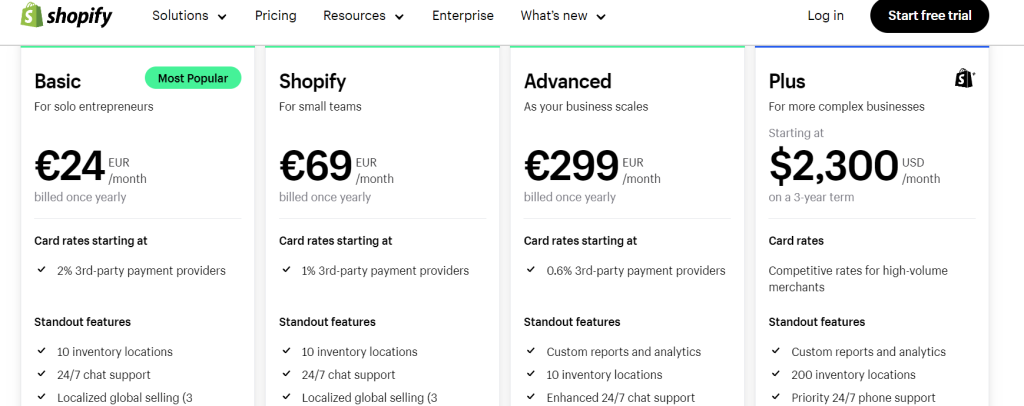
Warning: The promotional prices below require annual billing. Monthly billing costs roughly 25% more. Also, first-time users get a 3-day free trial plus $1/month for the first 3 months, a promotional offer that masks the actual long-term cost.
Core Plans
Starter: $5/month
Not a full store. This gives you a checkout link to sell via social media or existing websites. No standalone storefront. Best for creators selling a few products through Instagram or TikTok.
Basic: $39/month (or $29/month billed annually)
The entry point for a real online store. Includes everything most small stores need: unlimited products, 2 staff accounts, abandoned cart emails, discount codes. Transaction fees are 2.9% + 30 cents per online sale if using Shopify Payments.
Grow: $105/month (or $79/month billed annually)
Formerly called “Shopify.” Adds 5 staff accounts, better reporting, and lower transaction fees (2.6% + 30 cents). Worth it once you’re doing enough volume that the fee reduction pays for the upgrade.
Advanced: $399/month (or $299/month billed annually)
For scaling businesses. Includes 15 staff accounts, advanced reporting, third-party calculated shipping rates, and the lowest transaction fees (2.4% + 30 cents). Customs duty and import tax calculations are only available at this tier.
Plus: Starting at $2,000-$2,500/month
Enterprise tier. Dedicated support, customizable checkout, and no third-party transaction fees. Only makes sense at high volume.
Third-Party Payment Gateway Fees
If you don’t use Shopify Payments (their built-in payment processor), you pay an additional fee on every transaction:
- Starter: 5%
- Basic: 2%
- Grow: 1%
- Advanced: 0.6%
This effectively forces most merchants into using Shopify Payments. Using PayPal, Stripe, or other processors means eating into your margins.
Hidden Costs to Watch
- Premium themes: $150-$400 one-time (free themes are limited)
- Apps: $5-$100+/month each, and most stores need several
- Domain: ~$15/year if purchased through Shopify
- Advanced features: Reports, automation, and international tools require paid apps or higher plans
- Transaction fees: Even with Shopify Payments, you’re paying 2.4-2.9% per sale
Pricing Verdict
Shopify’s entry pricing is competitive, but total cost of ownership is higher than it appears. A realistic budget for a small store running Basic with a few essential apps is $100-150/month, not $29. The value is in the convenience, not the base price.
- Bandwidth Unlimited
- Panel cPanel
- Number of Sites Unlimited
- Bandwidth Unlimited
- Panel cPanel
- Number of Sites Unlimited
- Bandwidth Unlimited
- Panel cPanel
- Number of Sites Unlimited
- Bandwidth Unlimited
- Bandwidth Unlimited
Shopify Transparency Score
How upfront is Shopify about what you’re actually getting?
- Company Information: Excellent. Founded 2006, Ottawa headquarters, publicly traded. Ownership and corporate structure clearly documented.
- Pricing Transparency: Moderate. Base prices are clear, but the app costs that most stores require aren’t obvious upfront. Transaction fee structures are documented but complex. The $1/month promotional offer can mislead new users about actual costs.
- Technical Documentation: Good. Performance metrics, uptime guarantees, and CDN details are published. Developers have extensive documentation.
- Terms and Policies: Limited. The refund policy (no money-back guarantee) is buried in Terms of Service section 5.10. Many users don’t discover this until they need it.
Overall Transparency: Shopify is transparent about what it does well. It’s less forthcoming about total costs and exit options. The lack of a money-back guarantee is notable compared to traditional hosting providers.
Alternatives to Shopify
If Shopify doesn’t fit, these alternatives address specific gaps:
For Lower Ongoing Costs: WooCommerce
WooCommerce is a free WordPress plugin that turns any WordPress site into an online store. You’ll need separate hosting ($15-50/month for quality VPS hosting or $3-10/month for shared hosting), but there are no transaction fees and thousands of free plugins. Better for budget-conscious sellers willing to handle more technical work.
For No Third-Party Transaction Fees: BigCommerce
BigCommerce starts at $39/month like Shopify but doesn’t charge additional fees for using external payment gateways. It includes more built-in features (reducing app dependency) and offers stronger B2B (business-to-business) capabilities. The tradeoff is a smaller app ecosystem and automatic plan upgrades based on revenue thresholds.
For Simpler Needs: Wix
Wix offers ecommerce at lower price points with a drag-and-drop builder that prioritizes design flexibility. Best for small stores that don’t need Shopify’s advanced inventory and channel management. Less powerful, but more affordable.
For hosting your own ecommerce solution, see our cloud hosting comparison.
Conclusion
Shopify earns its reputation as the leading ecommerce platform for a reason. With 4.4/5 ratings across 11,000+ business reviews, it delivers on its core promise: making online selling accessible without technical expertise.
The Bottom Line
Shopify is best for sellers who value simplicity and reliability over absolute cost optimization. The platform handles everything technical, integrates broadly, and scales without migration headaches. But that convenience comes at a price, often higher than the advertised monthly fee once apps and transaction fees accumulate.
If you’re a beginner who doesn’t want to manage hosting, or a growing business that values stability, Shopify is a solid choice. If you’re budget-constrained, need deep customization, or rely heavily on SEO and content marketing, alternatives like WooCommerce will serve you better.
For more ecommerce hosting options, see our eCommerce VPS hosting guide where we compare platforms for online stores at various scales.
Frequently Asked Questions
Is Shopify good for beginners?
Yes. This is where Shopify genuinely excels. The setup wizard walks you through adding products, configuring payments, and launching your store. No coding required. You won’t touch server settings or worry about software updates. For first-time sellers, this removes significant barriers. Just budget realistically for apps you’ll likely need beyond the base plan.
Is Shopify worth the price?
It depends on what you’re comparing it to. Against other hosted platforms, Shopify’s pricing is competitive. Against self-hosted WooCommerce, it’s more expensive long-term. The value proposition is convenience, not savings. If avoiding technical hassles is worth $100-150/month to you (once apps are included), Shopify delivers. If you’d rather invest time to save money, alternatives exist.
What are the main complaints about Shopify?
Three issues appear consistently: (1) App dependency, meaning many essential features require paid apps that increase monthly costs. (2) Limited SEO tools compared to WordPress. (3) Support quality varies, with some users reporting great experiences and others frustrated by offshore teams and slow escalations. The lack of phone support on non-Plus plans also frustrates some businesses.
How does Shopify compare to WooCommerce?
Shopify is hosted and managed. You pay monthly, they handle everything technical. WooCommerce is a free plugin for WordPress. You pay for hosting separately and manage updates yourself. Shopify is easier. WooCommerce is cheaper and more customizable. For non-technical users, Shopify wins. For developers or budget-conscious sellers, WooCommerce often makes more sense.
Is Shopify good for dropshipping?
Shopify is considered the go-to platform for dropshipping. Integrations with suppliers like Oberlo, Spocket, and Printful work smoothly. The ease of testing products and pivoting quickly suits the dropshipping model. That said, marketing costs to drive traffic are entirely your responsibility, which can make dropshipping expensive regardless of platform.
Does Shopify offer refunds?
No money-back guarantee. Section 5.10 of Shopify’s Terms of Service states plans are non-refundable. If you believe you were charged in error, you can contact support for a case-by-case review, but refunds aren’t standard. This differs from traditional hosting providers that often offer 30-day guarantees. Consider the 3-day free trial and $1/month promotional period your testing window.