
On This Page: [hide]
In AI SEO, hosting speed is crucial. Faster servers enable AI bots and search crawlers to crawl your site more efficiently, improving indexing coverage and search visibility. This guide explains how hosting speed, latency, and architecture influence crawl rates—plus practical steps to optimize them.
Key Takeaways
- AI bot crawling is essential for SEO—it drives indexing, discoverability, and organic traffic.
- Hosting speed directly affects crawl efficiency: fast Time to First Byte (TTFB) and low latency improve indexation; slow sites get crawled less.
- Performance audits, smart server placement, and a CDN are cornerstone tactics to keep crawl throughput high.
Understanding AI Bot Crawling
AI-driven web crawlers continuously scan the web to download, parse, and index content. Efficient crawling helps search engines understand your pages, rank them correctly, and surface them to the right users.
- Identifies and indexes content to appear for relevant queries.
- Boosts organic traffic by ensuring fresh content is discoverable.
- Improves visibility & backlinks by making content easy for bots (and users) to find.
Blocking or throttling bots risks making content invisible to AI and search systems. Optimize access rather than restrict it.
The Role of Hosting Speed in AI Bot Crawling
Server speed and responsiveness (especially TTFB) influence how many URLs a crawler can fetch in a session. Faster responses increase crawl frequency and depth; sluggish servers reduce the crawl budget applied to your site.
- Low latency, high throughput → better indexing cadence, more pages discovered.
- Server location matters: hosting near your audience (e.g., EU for EU traffic) cuts round-trip times.
How Latency Impacts AI Bots
Latency—the delay before data transfer starts—adds friction to every request a bot makes.
- Higher latency increases load times and reduces the crawl rate.
- Distance = delay: greater geographic distance raises latency and hampers crawl efficiency.
- Frequent delays can postpone discovery of new content and slow updates to the index.
Data-Driven Insights on Hosting Speed and AI Crawling

- Server proximity and network quality correlate with lower TTFB and faster fetches.
- Faster response times improve both user metrics and bot crawl efficiency—supporting higher rankings.
- Consistent performance (not just occasional speed) sustains reliable crawl coverage.
Optimizing Hosting Speed for Better AI Crawling
Prioritize speed fundamentals and resilience to ensure bots can fetch more pages in less time.
- Target sub-3s fully loaded times and sub-500ms TTFB on core pages where possible.
- Audit bottlenecks: database latency, slow plugins, unoptimized media, chat scripts.
Choosing High-Performance Servers
- Modern hardware (NVMe SSDs, ample RAM/CPU) reduces I/O waits.
- HTTP/2 or HTTP/3 + TLS to accelerate parallel fetching.
- Autoscaling or burst capacity to handle bot surges without timeouts.
Implementing a Content Delivery Network (CDN)
- Edge caching serves assets from locations near bots and users to lower latency.
- Smart caching rules (HTML caching for anon traffic, long-lived static caching) increase crawl efficiency.
- Image optimization (WebP/AVIF, responsive images) cuts payload size.
Regular Performance Audits
- Identify slow templates & endpoints with RUM and synthetic tests.
- Rate-limit abusive traffic to prevent resource exhaustion during bot visits.
- Harden with a WAF to block bad bots while allowing known crawlers.
- Review robots.txt to avoid unintentionally blocking critical crawlers.
Monitoring AI Bot Activity
Visibility into bot behavior helps you validate improvements and diagnose issues.
- Search Console for Googlebot crawl stats, fetch issues, and coverage.
- Server logs to track GPTBot, ClaudeBot, PerplexityBot, Google-Extended, and others.
- Real-time monitoring to alert on spikes, errors (4xx/5xx), and unusual patterns.
Common Mistakes That Harm Crawl Efficiency
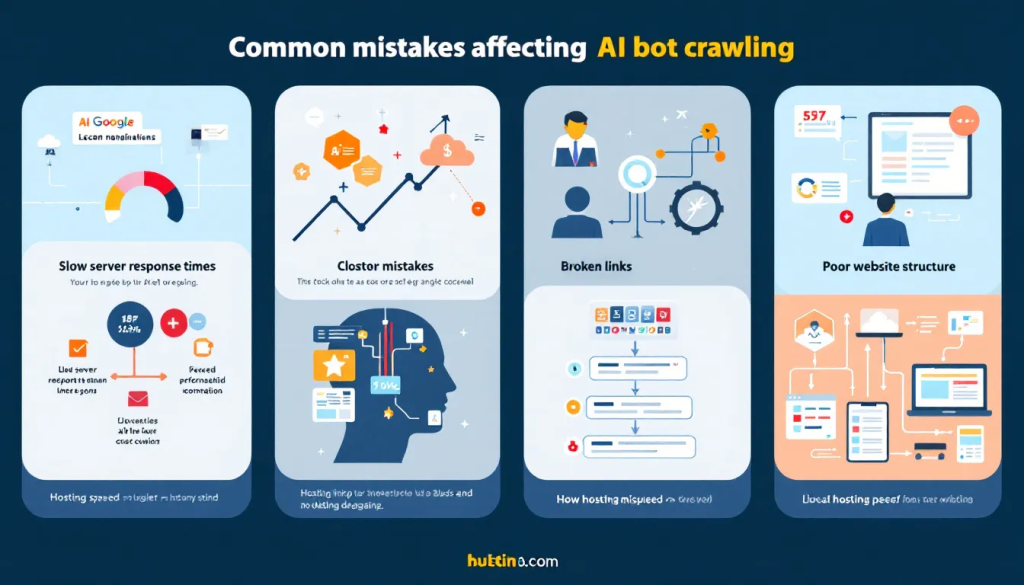
- Over-restrictive robots.txt that blocks important sections or bots.
- Ignoring mobile performance in a mobile-first crawling world.
- Thin pages (300 words) and infrequent updates that reduce crawl interest.
- Slow pages & timeouts causing bots to abandon fetches.
Advanced Strategies for AI SEO Success
- Structured data (schema markup) to clarify entities and relationships.
- Internal linking (≥3 contextual links per important page) to improve discovery depth.
- UX optimization fast, accessible, stable pages support better engagement and crawling cadence.
Summary
Hosting speed and latency directly shape AI bot crawling. By upgrading server performance, using a CDN, auditing regularly, and monitoring bot behavior, you unlock higher crawl frequency, better indexation, and stronger rankings. Avoid restrictive robots rules, slow pages, and stale content—then layer in structured data, internal links, and great UX to maximize AI SEO impact.
Frequently Asked Questions
How does hosting speed affect AI bot crawling?
Faster hosting reduces TTFB and latency, allowing bots to fetch more URLs per visit, which improves indexing coverage and ranking velocity.
Why should I monitor AI bot activity?
Monitoring reveals crawl errors, blocked paths, and server bottlenecks so you can fix issues before they impact indexation and traffic.
What mistakes most often block efficient crawling?
Over-aggressive robots.txt rules, slow mobile pages, thin/rarely updated content, and frequent 5xx errors.
How does structured data help AI SEO?
Schema clarifies entities and context, making content easier for AI systems to understand and prioritize in results.
What’s the role of internal linking?
It guides bots to important pages, increases crawl depth, and consolidates topical relevance across your site.