
On This Page: [hide]
Half the internet runs on software that started as a simple blogging tool in 2003. WordPress now powers 594 million websites, processes 70 million new posts monthly, and supports a $635 billion economy. Those numbers sound almost too large to comprehend, so let’s break them down into something actionable.
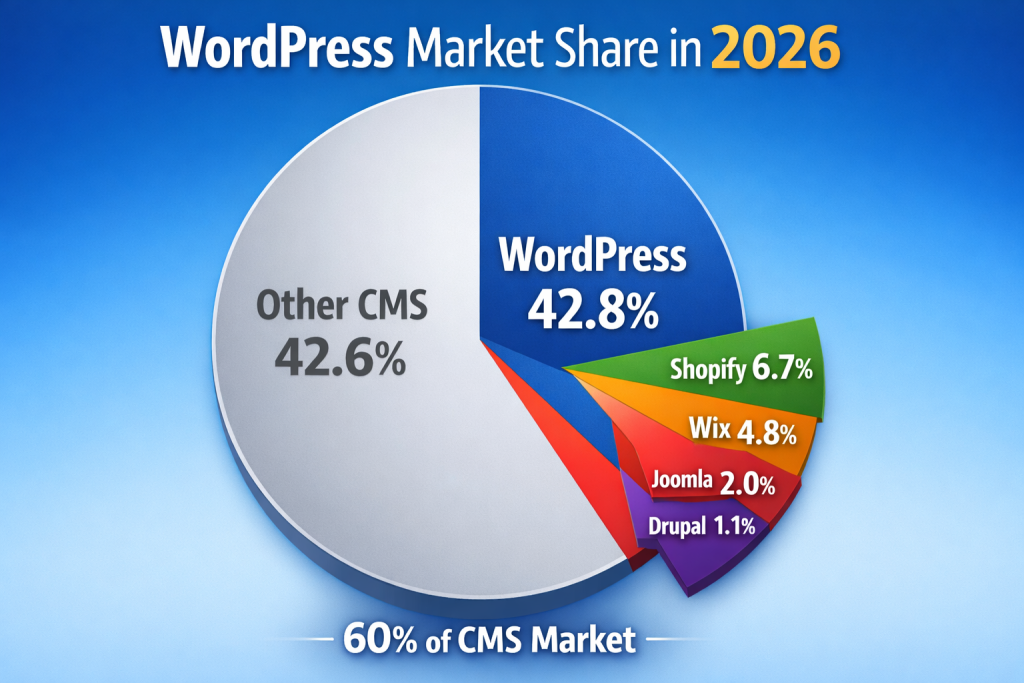
Key numbers for 2026: WordPress holds 42.8% of all websites and 60% of the CMS market. Daily, 35,000 new WordPress sites go live. The plugin repository crossed 60,000 plugins with 2.4 billion total downloads. Security vulnerabilities jumped 34% year-over-year to nearly 8,000 in 2024, with plugins responsible for 96% of them. Enterprise adoption remains strong: 40% of Fortune 500 companies use WordPress somewhere in their digital infrastructure.
Last reviewed: February 2026. Statistics sourced from W3Techs, WordPress.org, Patchstack security reports, and industry research.
Market Share: 42.8% of All Websites
According to W3Techs data from February 2026, WordPress powers 42.8% of all websites on the internet. That percentage represents roughly 594 million websites running on the open-source platform. When you narrow the scope to only sites using a known content management system, WordPress commands 60% market share, making it approximately nine times larger than its nearest competitor.
To put that dominance in perspective: Shopify sits in second place at 6.7%, followed by Wix at 4.8%. Joomla and Drupal, once considered WordPress’s primary open-source competitors, have fallen to 2.0% and 1.1% respectively. The gap between WordPress and everyone else isn’t shrinking.
The growth story has changed, though. WordPress gained just 0.1% market share between January 2021 and early 2026. Compare that to the explosive period between 2014 and 2021 when market share doubled from 21% to 43%. The platform crossed a notable milestone in 2021: it became more common than “no CMS.” Before that year, hand-coded websites without any content management system outnumbered sites using WordPress. That’s no longer true.
February 2026 marks the first meaningful dip, with market share dropping from 43.5% to 42.8%. A fraction of a percentage point matters when you’re talking about millions of websites, but this decline signals maturation rather than collapse. WordPress has saturated the markets it can easily reach. New growth requires competing directly with simpler alternatives like Wix and Squarespace, platforms designed specifically for users who find WordPress’s flexibility intimidating.
Daily and Monthly Usage Statistics
WordPress isn’t just installed on hundreds of millions of sites; people actually use it. The numbers on active engagement paint a picture of a platform that dominates content creation globally.
Approximately 409 million people view over 20 billion WordPress pages every month. That readership figure approaches half a billion humans interacting with WordPress-powered content regularly. Users publish 70 million new posts monthly, averaging 2.33 million posts per day. Break that down further: 27 posts publish every second, including six blog posts specifically.
Comment activity tells another story. WordPress sites receive 77 million new comments monthly. That level of engagement indicates active communities rather than abandoned websites. Not every WordPress installation is a ghost town.
New WordPress websites go live at an impressive pace. Estimates range from 500 to 35,000 new sites daily depending on the source and methodology. The variance comes from how “new site” gets defined. A more conservative figure of 10,000 daily new WordPress sites comes from Hostinger’s platform data alone. If one hosting provider sees that volume, the total across all hosts runs substantially higher.
One statistic puts the pace in memorable terms: a new WordPress website is built every 0.8 seconds. Whether that’s precisely accurate or rounded for impact, the directional point holds. WordPress adoption continues at scale even as overall growth plateaus.
Enterprise Adoption: Fortune 500 and Major Brands
WordPress isn’t just for bloggers and small businesses. Nearly 40% of Fortune 500 companies use WordPress somewhere in their digital presence. Among the top 10,000 websites by traffic, WordPress accounts for 58% of CMS usage. Platforms like Wix and Shopify are nearly absent at that traffic level.
The brand names using WordPress read like a business school case study. Disney runs its corporate site on WordPress, managing press releases, blogs, and investor updates through the platform. Sony Music powers its entire main website with WordPress. Microsoft, a company that built its own content management tools, uses WordPress.org. The White House runs on WordPress VIP.
Other notable WordPress users include:
- Media: Time Magazine, Rolling Stone, CNN Press Room, TechCrunch, The New York Times (sections)
- Technology: Spotify Newsroom, Cisco Blogs, Samsung, IBM
- Entertainment: PlayStation, Star Wars (official blog), James Bond (007.com), Angry Birds
- Sports and celebrities: Rafael Nadal, Usain Bolt, Katy Perry
- Government and research: NASA (blogs and microsites), WhiteHouse.gov
These aren’t small implementations. Disney’s corporate site handles millions of visitors. PlayStation serves one of the most engaged gaming communities online. These organizations chose WordPress over custom solutions despite having the budgets for anything they wanted. The reasons typically include developer availability, ecosystem maturity, and lower total cost of ownership compared to enterprise platforms like Adobe Experience Manager.
Among the Inc. 5000 fastest-growing companies, 54 out of the top 100 run their websites on WordPress. That statistic matters because high-growth companies face scaling challenges. They wouldn’t stick with a platform that couldn’t handle their trajectory.
Plugin Ecosystem: 60,000+ Plugins and 2.4 Billion Downloads
The WordPress plugin directory contains over 60,300 free plugins as of early 2026. These range from simple functionality tweaks to complete e-commerce platforms. The combined download count has crossed 2.4 billion total installs, making the WordPress plugin ecosystem one of the largest software distribution platforms in existence.
The most downloaded plugins reveal what WordPress users actually need:
- Yoast SEO: Over 550 million total downloads, 5+ million active installs. Search optimization remains the top priority.
- WooCommerce: More than 382 million downloads, averaging 50,000 per day. E-commerce drives considerable WordPress adoption.
- Jetpack: Over 120 million downloads. Site management, security, and performance in one package.
- Contact Form 7: Among the most installed plugins globally for basic form functionality.
The download velocity tells its own story. WooCommerce alone sees 50,000 downloads daily. That’s roughly one download every 1.7 seconds for a single plugin. Multiply that across 60,000+ plugins and you understand why plugin developers consider WordPress a serious business opportunity.
Not all plugins are equal. The majority have few active installations. A small percentage drive most of the ecosystem’s value. Security researchers estimate that about 96% of WordPress vulnerabilities originate in plugins rather than core WordPress code. That concentration of risk in third-party code creates challenges we’ll examine in the security section.
Theme Ecosystem: 13,000+ Free Themes
The official WordPress.org theme directory offers approximately 13,000 to 14,000 free themes as of February 2026. Third-party marketplaces like ThemeForest add another 12,000 to 15,000 premium options. Combined, WordPress users can choose from roughly 30,000 themes ranging from minimalist blogs to complex corporate designs.
Theme adoption has shifted toward full site editing (FSE) compatibility. Over 40% of themes now support the Gutenberg block editor natively. That percentage continues climbing as theme developers respond to WordPress’s architectural direction. Legacy themes designed for the classic editor still work but receive fewer updates.
The most popular themes tend to be multipurpose frameworks rather than specialized designs. Themes like Astra, GeneratePress, and OceanWP dominate because they offer flexibility through customization rather than fixed layouts. Users install these foundation themes and build specific designs through page builders or block patterns.
Premium theme pricing typically ranges from $40 to $200 for single-site licenses. Developer licenses covering unlimited sites run higher. The premium theme market generates substantial revenue, though exact figures remain private since most theme shops don’t publish sales data.
Gutenberg Block Editor Adoption
The Gutenberg block editor, introduced in WordPress 5.0 in December 2018, has crossed a critical adoption threshold. Usage now exceeds 60% of WordPress sites, up dramatically from just 37% in 2020. The editor has achieved the scale where it’s become the default experience rather than an alternative.
Gutenberg’s active installations surpass 82.7 million. Users have published over 24 million posts using the block editor according to Jetpack tracking data. That breaks down to approximately 157,000 posts written with Gutenberg daily. The paragraph block is used 60% of the time, which makes sense since most content is text.
Full Site Editing (FSE), which extends Gutenberg beyond post content to entire templates, grew 145% in 2025 alone. This feature allows users to customize headers, footers, and page layouts using the same block-based approach they use for posts. The growth rate suggests FSE is transitioning from early adopter technology to mainstream feature.
WordPress 7.0, with a beta planned for February 2026 and full release in April, proposes raising the minimum PHP version to 7.4 and expanding AI tooling integration with the block editor. The roadmap shows WordPress doubling down on Gutenberg rather than offering alternatives.
WooCommerce and E-commerce Statistics
WooCommerce powers between 20% and 39% of all e-commerce websites depending on the measurement methodology. The most commonly cited figure places WooCommerce at 33.4% market share with 4.53 million stores worldwide. A broader count including all WooCommerce installations reaches 6.5 million websites.
Geographic distribution shows concentration in Western markets. The United States leads with 422,024 stores (9.4% of all WooCommerce installations). The United Kingdom follows at 171,056 stores (3.7%), with India at 135,274 (2.6%). The remaining installations spread across 175+ additional countries.
WooCommerce’s trajectory has become more complicated recently. Stores decreased 0.7% quarter-over-quarter in Q4 2025 and 6% year-over-year. While WooCommerce experienced a 3.2% annual decline, Shopify continued growing at 8.2% and Wix showed 12.1% growth. Merchants are migrating toward hosted solutions that eliminate server management and plugin compatibility concerns.
That said, WooCommerce maintains advantages for users already invested in WordPress. If you’re running WordPress for content and need e-commerce functionality, adding WooCommerce costs nothing for the base plugin. Combining VPS hosting with WooCommerce often undercuts Shopify’s subscription fees for stores processing high transaction volumes.
Security Statistics: 8,000 Vulnerabilities in 2024
WordPress security statistics demand attention. In 2024, researchers discovered 7,966 new vulnerabilities in the WordPress ecosystem, a 34% increase over 2023. Security databases now track 64,782 total vulnerabilities across WordPress core, themes, and plugins. Sites face attacks every 28 minutes on average.
The vulnerability breakdown by type:
- Cross-Site Scripting (XSS): 53.3% of new vulnerabilities. Attackers inject malicious scripts through forms or comments.
- Cross-Site Request Forgery (CSRF): 17% of vulnerabilities. Often paired with phishing attacks.
- SQL Injection, access control, and other issues: Remaining 30%.
Here’s the critical insight: 96% of WordPress vulnerabilities come from plugins, not core WordPress code. Theme vulnerabilities add another small percentage. Core WordPress itself accounts for minimal security issues. The platform isn’t inherently insecure; its extension ecosystem creates the attack surface.
Exploitation characteristics reveal concerning patterns. 43% of WordPress vulnerabilities can be exploited without authentication. That means attackers don’t need valid login credentials. 67% of vulnerabilities have low exploitation complexity, meaning readily available tools can exploit them.
Recent weekly vulnerability reports show ongoing discovery rates. As of early February 2026, 661 new vulnerabilities emerged in a single week: 638 in plugins, 23 in themes. Of those, 164 remained unpatched at the time of reporting. The EU’s Cyber Resilience Act, taking effect September 2026, will require plugin and theme authors to notify authorities about severe vulnerabilities, potentially improving disclosure and patching timelines.
More than 500 WordPress websites get hacked daily according to security researchers. That translates to over 4,500 compromised sites weekly. Most attacks target outdated plugins, weak passwords, or hosting environments without proper security configurations.
Geographic Distribution: Where WordPress Dominates
WordPress adoption varies significantly by country. The United States leads with over 18.7 million WordPress websites, representing approximately 56% of all WordPress sites globally. Germany and the United Kingdom follow, though with substantially smaller totals.
Japan represents an unusually strong WordPress market. According to 2024 data, WordPress powers 58.5% of all Japanese websites and holds 83% CMS market share in the country. That’s roughly 15-20 percentage points higher than global averages. Japanese developers and businesses have embraced WordPress more completely than most markets.
Emerging markets show growing interest. Google Trends data indicates the highest relative search interest in WordPress from Pakistan, China, Bangladesh, Bosnia & Herzegovina, and Kenya. India and the United States lead absolute search volume with approximately 246,000 monthly searches each. These search patterns suggest where future WordPress growth may concentrate.
WordPress is available in 208 languages, enabling global adoption that English-only platforms can’t match. The WordCamp conference series has reached 71 countries across 6 continents with 1,322 events in 407 cities through April 2025. That geographic spread demonstrates a genuinely global community rather than a platform concentrated in a few markets.
Language distribution on WordPress sites shows English dominance at 71%, followed by Spanish (4.7%) and Indonesian (2.4%). The long tail of 200+ supported languages collectively serves the remaining percentage.
PHP Version Distribution
PHP powers WordPress, and version distribution reveals something about the broader ecosystem’s update patterns. According to WordPress.org’s statistics, the majority of WordPress sites (42.91%) still run PHP 7.4. Newer versions show lower adoption: 16.13% use PHP 8.1, 12.31% use PHP 8.0, and 11.93% use PHP 8.2. Only 1.11% run PHP 8.3.
This distribution creates security concerns. PHP 7.4 reached end-of-life in November 2022. About 30% of WordPress sites run EOL PHP versions. These installations don’t receive security patches from PHP developers, leaving sites vulnerable to PHP-level exploits regardless of how current their WordPress installation is.
WordPress.org officially recommends PHP 8.2 or higher for 2026. The forthcoming WordPress 7.0 proposes PHP 7.4 as the minimum version, which would push users off ancient PHP installations. Aligning with Drupal and Joomla, which already mandate PHP 8.1+, WordPress is moving toward requiring modern PHP.
Hosting providers influence these statistics. Many shared hosting environments default to older PHP versions for compatibility. Users who don’t actively select newer versions inherit whatever their host provides. Managed WordPress hosting typically handles PHP updates automatically, resulting in higher adoption of current versions among those users.
WordPress Version Distribution
WordPress core version adoption shows healthier patterns than PHP versions. WordPress Version 6.x powers 85% of all WordPress websites. Version 5.x accounts for 11%, Version 4.x for 3.7%, and Version 3.x for under 0.5%.
These numbers indicate that most WordPress users accept automatic minor updates. The auto-update feature introduced in WordPress 5.6 likely explains the high concentration on Version 6. Sites receive security and maintenance releases without user action, keeping them current within their major version.
Major version upgrades (5.x to 6.x) require more active participation. The 11% still on Version 5 represents sites where administrators haven’t initiated the upgrade process, either due to plugin compatibility concerns or simple neglect. That’s still substantially better than PHP distribution, where nearly half of sites run outdated software.
WordPress 6.6 has been downloaded more than 97 million times. WordPress 6.8 downloads at a rate of one every 0.12 seconds. The download velocity demonstrates ongoing activity even on sites that already have WordPress installed, as administrators update existing installations.
The WordPress Economy: $635 Billion
WP Engine commissioned research in 2021 that estimated the global WordPress economy at $596.7 billion in 2020, projected to reach $635.5 billion by year end 2021. To put that in perspective: if WordPress were a country, its economy would rank 39th globally according to IMF GDP rankings. If it were a company by market capitalization, it would place 10th worldwide.
That figure includes everything WordPress touches: hosting services, theme and plugin sales, development agencies, freelance developers, training and education, and the businesses running on WordPress infrastructure. The ecosystem supports an estimated 50 million developers worldwide with WordPress familiarity.
No comprehensive update to that economic study has been published for 2025-2026. Given WordPress’s market share stability and the growth of adjacent services like WooCommerce-powered stores, the current figure likely exceeds the 2021 projection. Conservative estimates would place the WordPress economy somewhere between $650 billion and $750 billion today.
WooCommerce-based stores alone generate substantial transaction volume. Data suggests stores using WooCommerce produce between $25 million and $50 million in average annual revenue. Multiply that across 4.5+ million active stores and the e-commerce component alone represents a major share of the overall WordPress economy.
Content Publishing Statistics
Global blog publishing volume runs to approximately 7.5 million posts daily across all platforms. WordPress accounts for a sizable chunk of that total. Platform-specific data shows 2.33 million posts published on WordPress daily, adding up to 70 million monthly. That means WordPress hosts roughly 30% of all daily blog content published worldwide.
Breaking down the publishing velocity: 27 WordPress posts go live every second. Specifically, six blog posts from individual bloggers publish each second. That adds up to 1,620 posts per minute, 97,200 per hour, and over 8.5 billion annually.
Comment engagement adds another dimension. WordPress sites receive 77 million comments monthly. That’s roughly 2.5 million comments daily, indicating active readership rather than passive page views.
The search interest in WordPress itself remains substantial. Google sees 37 million monthly searches for “WordPress” globally. That search volume drives traffic to WordPress.org, tutorials, hosting providers, and the broader ecosystem. For context, 37 million monthly searches exceeds many individual company brand searches.
Future Trends and Projections
Market analysts project WordPress reaching 45-47% total market share by late 2026 or 2027. That projection assumes continued digital transformation, small business website adoption, and WordPress expansion in emerging markets. Whether the February 2026 dip to 42.8% represents a temporary fluctuation or the beginning of a longer decline will become clearer over coming quarters.
AI integration leads WordPress development priorities for 2026. The platform’s strategic focus includes intelligent automation, AI-driven content optimization, and collaborative workflows. Gutenberg block development increasingly incorporates AI assistance for content generation and layout suggestions. Third-party plugins already offer AI writing assistants, image generation, and SEO optimization.
Full Site Editing adoption should accelerate as WordPress 7.0 approaches. The block-based approach to entire site design, not just post content, positions WordPress to compete more directly with drag-and-drop builders like Wix and Squarespace. Whether that competition recaptures market share or merely retains existing users remains uncertain.
The European Union’s Cyber Resilience Act creates new obligations for plugin and theme developers starting September 2026. Open-source developers must implement vulnerability notification processes for severe security issues. This regulatory pressure may improve ecosystem security or drive some developers away from WordPress plugin development. The outcome depends on how the community adapts to compliance requirements.
Enterprise adoption should continue. WordPress VIP and similar enterprise-focused services provide the security, scalability, and support that large organizations require. The platform’s existing penetration among Fortune 500 companies creates reference customers that reduce perceived risk for new enterprise adopters.
Frequently Asked Questions
How many websites use WordPress in 2026?
WordPress powers approximately 594 million websites as of February 2026, representing 42.8% of all websites on the internet. Among sites using a known content management system, WordPress holds 60% market share. The next largest competitor, Shopify, sits at 6.7%.
Is WordPress still growing in 2026?
WordPress growth has plateaued. The platform gained just 0.1% market share between January 2021 and early 2026, compared to doubling its share between 2014 and 2021. February 2026 saw a slight decline from 43.5% to 42.8%. WordPress remains dominant but is no longer expanding rapidly.
How secure is WordPress?
WordPress core itself is relatively secure. However, the ecosystem faces challenges: 96% of WordPress vulnerabilities originate in plugins, not core code. In 2024, researchers discovered 7,966 new vulnerabilities across plugins and themes. Keeping plugins updated and choosing reputable extensions significantly reduces risk.
What percentage of Fortune 500 companies use WordPress?
Approximately 40% of Fortune 500 companies use WordPress somewhere in their digital infrastructure. Notable users include Disney, Sony Music, Microsoft, NASA, and the White House. Among the top 10,000 websites by traffic, WordPress accounts for 58% of CMS usage.
Final Thoughts
WordPress’s statistics tell a story of dominance that has reached maturity. 594 million websites, 60% CMS market share, and a $635 billion economy represent a platform that has fundamentally shaped how the web works. The growth rate has slowed, but the installed base creates enormous inertia. Hundreds of thousands of developers, agencies, and businesses depend on WordPress continuing to exist and evolve.
The security statistics warrant attention for anyone running WordPress. Nearly 8,000 new vulnerabilities in a single year demands active security management. Keeping plugins updated, using reputable cloud hosting with security features, and following best practices matters more than ever.
Enterprise adoption provides a counterweight to concerns about consumer-market competition from website builders. Fortune 500 companies, government agencies, and major media organizations continue choosing WordPress. That validation suggests the platform remains viable for serious applications, not just personal blogs.
If you’re building on WordPress, check our managed WordPress hosting comparison for optimized hosting options, or explore VPS hosting if you need more control over your server environment.