
On This Page: [hide]
Hyvä charged EUR 1,000 per production store from its 2020 launch through late 2025. That ended on November 10, 2025, when Hyvä relicensed under OSL 3.0 and became free to install on any Magento 2 build. The move pulled the rug out from the premium-theme hierarchy Magento merchants had accepted since Luma started aging. In 2026, picking a Magento theme is no longer a price-versus-performance tradeoff. It’s a stack decision first, and a visual decision second.
Quick answer: For new stores and teams serious about Core Web Vitals, Hyvä (free since November 2025) is the clearest starting point with 95-100 Mobile PageSpeed on optimized installs. For Luma-compatible storefronts with deep extension libraries, Porto (USD 129) leads by volume at 27,775 sales, Claue (USD 99) wins for fashion, and Fastest (USD 99) is the speed-focused Luma pick when migrating to Hyvä isn’t yet feasible.
Last reviewed: April 2026. Prices and features verified against official theme pages on 2026-04-21.
How We Selected These Themes
The shortlist started with the six themes from the previous version of this guide (Porto, Market, Claue, Infinit, Supro, Fastest). Hyvä was added because its November 2025 relicense to OSL 3.0 + AFL 3.0 reshaped the 2026 decision frame. Every other theme on this page is now competing against a zero-cost baseline that outperforms them on raw frontend metrics.
Exclusion threshold for a Magento 2.4-capable ranking: the theme must have a version compatible with Magento 2.4.8 (PHP 8.3 and OpenSearch 2.19), and must have shipped an update in the last 12 months. Below that line, your storefront breaks on the next upstream Magento security patch. We also cut themes that only supported Magento 1.x or had no native M2 codebase.
Weights reflect where Magento actually hurts. Mobile PageSpeed and Core Web Vitals get the top weight because Magento’s single biggest complaint in 2026 is frontend bloat. Extension compatibility, price-to-value, and marketplace rating (minimum 4.5/5 where sold on public marketplaces) come next. We didn’t run synthetic Lighthouse tests on our own staging environment. Performance numbers come from theme developer benchmarks, public demo sites, and independent Magento community testing. Where a theme couldn’t confirm Magento 2.4.8 compatibility on its current product page, we flagged the gap rather than assume.
Hyvä – Best Overall for Magento 2 in 2026
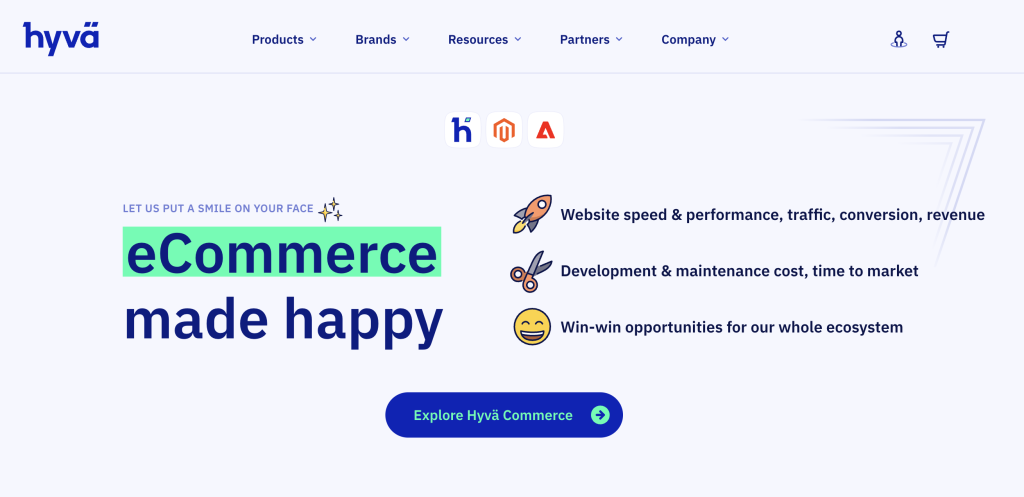
Price: Free (OSL 3.0 + AFL 3.0, the same open-source license Magento ships under) since November 10, 2025 | Stack: Tailwind CSS + Alpine.js (lightweight utility-first CSS and minimal-JS frontend) | Frontend size: ~100-150 KB vs Luma’s ~900 KB
EUR 0. That’s the full Hyvä license price in 2026, same as Magento Open Source itself. Before the relicense, Hyvä sold at EUR 1,000 per production store, and that price alone kept it out of budget conversations for smaller merchants. The November 2025 switch to OSL 3.0 removed the only real objection to it. Hyvä is now available through free Packagist Composer keys and on GitHub, with over 6,700 live production stores running it by early 2026.
What Hyvä actually is: a complete replacement for Luma’s frontend. It throws out the Magento UI library, Knockout.js (the JavaScript framework Luma uses for frontend data binding), RequireJS, and the rendering pipeline that slowed Magento for a decade. Tailwind handles styling. Alpine.js handles the minimal interactivity. The result is pages that weigh 4 to 5 times less than Luma and render in under 2 seconds on mid-range mobile, where Luma-based builds routinely take 5 to 8. Independent benchmarks put 65% of Hyvä-powered stores in the “good” Core Web Vitals band (Google’s page-experience metrics for loading, interactivity, and layout stability), compared to 41% for traditional Magento.
Extension compatibility is where the story gets messier. Magento modules built for Luma use Knockout templates that don’t render inside Hyvä, so every third-party extension needs a Hyvä-compatible “compatibility module” or a rewrite. The Hyvä ecosystem now lists 1,000+ compatible extensions. If your current Magento store runs 20 Luma-only modules, budget for compatibility work before you switch. Agencies quote typical mid-market Hyvä migrations at 4 to 8 weeks and USD 15,000 to USD 70,000, which is the real cost most buyers miss when they read “free.”
Pros:
- Free and open source (OSL 3.0 + AFL 3.0) since November 2025
- 95-100 Mobile PageSpeed on optimized installs
- Frontend 4-5x lighter than Luma (~100 KB vs ~900 KB)
- Tailwind + Alpine means your team can work on it without learning Knockout or React
- Active ecosystem: 1,000+ compatible extensions
Cons:
- Every Luma extension needs a compatibility module or rewrite
- Designed as a developer base, not a pre-styled theme out of the box
- Migration from Luma is a project, not a click
Best for: New Magento 2.4.x stores, teams with Tailwind experience, merchants who failed Core Web Vitals and lost search rankings because of it.
Skip if: You’ve already invested heavily in Luma-only extensions and compatibility work would cost more than you’ll save. In that case, look at Fastest or Porto first.
Verdict: Choose Hyvä if you’re starting a new Magento 2 build in 2026, full stop. It’s free, fastest, and already running on 6,700+ live production stores. Buyers who shouldn’t pick it are teams with 15+ Luma-only extensions and no migration budget. Those teams should look at Fastest or Porto and plan the Hyvä migration for later.
Porto – Best Premium Luma Theme for Multi-Niche Stores
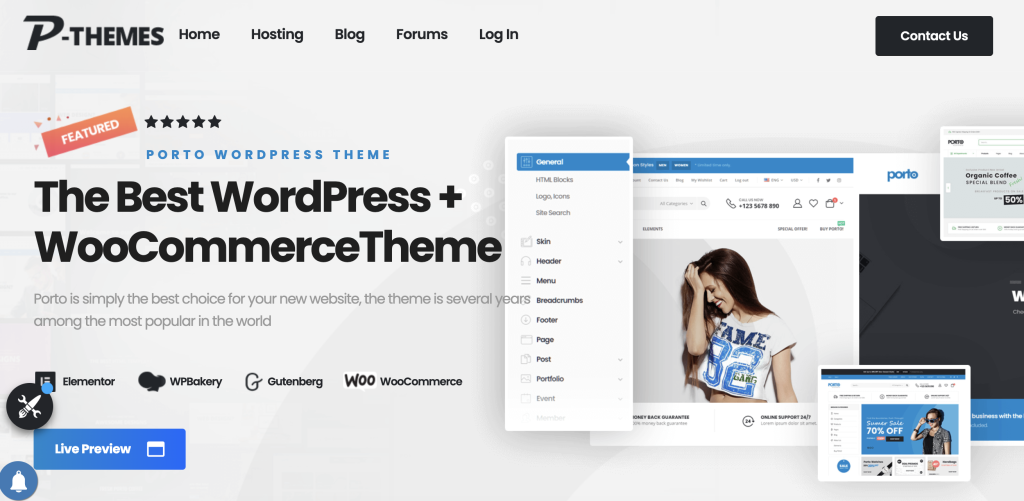
Price: USD 129 Regular License (USD 2,950 Extended) | Sales: 27,775 | Rating: 4.81/5 (1.6K reviews) | Last updated: November 7, 2025
Where Hyvä rewrites the frontend, Porto doubles down on the stack most Magento developers already know. It’s still built on Bootstrap 4.x and the Magento UI library, which means it renders heavier than Hyvä but runs every Luma-compatible extension without a rewrite. Porto is the highest-volume Magento theme on ThemeForest with 27,775 recorded sales, and the November 7, 2025 update confirmed compatibility through Magento 2.4.x and Adobe Commerce. If your extension stack is already built on Luma, that’s the reason to stay.
Porto ships 20 homepage layouts across fashion, electronics, furniture, cosmetics, and auto niches, plus a fluid grid that scales from 2 to 8 product columns. The admin panel exposes 300+ customization controls before you ever touch a template file, which is why agencies reach for Porto when the brief says “non-developers will maintain this.” Ajax navigation, Ajax cart, mega menu, and RTL language support cover what most buyers expect.
Against Hyvä, Porto’s weakness is raw speed. The Bootstrap 4 + jQuery + Knockout footprint costs roughly 700 KB more per page than Hyvä’s Tailwind + Alpine stack. Where Hyvä stores routinely post 95-100 Mobile PageSpeed, Luma-based Porto builds sit in the 50-70 range without aggressive caching and image optimization. At USD 129 one-time, Porto is cheaper upfront than any Hyvä migration, but the Mobile PageSpeed gap is real and measurable.
Pros:
- Largest Magento ThemeForest library: 27,775 sales, 4.81/5 rating
- 20 pre-built homepages covering most major retail niches
- Every Luma extension works out of the box, no compatibility modules
- USD 129 one-time, Extended license at USD 2,950 for SaaS/resale use
Cons:
- Bootstrap 4 + Luma stack measurably slower than Hyvä
- Heavy admin panel can overwhelm small teams
- Refresh cadence is slower than Hyvä’s active GitHub cadence
Best for: Existing Luma-based stores with established extensions, agencies building multi-niche storefronts under tight deadlines, merchants where non-devs update the site.
Skip if: You’re starting fresh and care about mobile speed. Hyvä is free and faster.
Verdict: Pick Porto when your Magento stack is already deeply Luma-based and a rewrite isn’t feasible this year. If you’re building a fresh store in 2026, Hyvä is free and wins on speed. If you want Porto’s visual variety but need better Core Web Vitals, Fastest is a narrower but faster Luma alternative.
Market – Best for Multi-Category Stores with Large Catalogs
Price: USD 84 Regular License | Developer: magentech | Focus: multi-category retail, supermarket, mega-store layouts
If you’re selling 5,000+ SKUs across fashion, electronics, and home goods on a single Magento 2 store, Market is built for that scenario. The theme ships with 40+ pre-built homepage indexes, which means 40+ fully styled home layouts targeting specific retail verticals. You pick the one closest to your niche, swap the demo content, and ship. Market also bundles eight of magentech’s own Magento 2 modules (SM AutoCompleteSearch, SM Filter Products, SM Tab Listing, SM Mega Menu, SM Search Box, SM Cart Quick Pro, SM Categories, SM ShopBy), which together replace roughly USD 250 of separate extensions on the same stack.
At USD 84, Market undercuts Porto by 35% while shipping twice as many homepage layouts. That’s the buyer argument. The honest counter-argument is performance. Market uses the same Luma foundation as Porto, so the Mobile PageSpeed range (50-70 on unoptimized builds) carries over. You’re paying less for more layouts, not for better speed.
The bundled modules are Market’s real edge over Porto. Porto exposes more admin customization (300+ controls) but doesn’t include merchandising modules. Market does the opposite. You get fewer admin knobs but more out-of-the-box features, which suits teams that would rather configure extensions than write custom templates.
Pros:
- 40+ homepage indexes covering supermarket, electronics, fashion, furniture
- 8 bundled magentech merchandising modules included in the price
- USD 84 is the cheapest full Luma theme in this comparison
- Strong mega-menu and advanced filter support for large catalogs
Cons:
- Same Luma-stack speed ceiling as Porto
- Less granular admin customization than Porto
- Homepage layouts skew toward mega-store aesthetics, not boutique
Best for: Multi-vertical catalogs, supermarket and hi-tech storefronts, merchants switching from outdated Magento 1 themes who want a lot of templates included.
Skip if: You sell fewer than 200 SKUs. The layout density is overkill, and Claue or Supro will look cleaner.
Verdict: Market is the right pick when your catalog is broad and your budget is tight. Pick it over Porto when you value bundled modules more than admin-panel depth. Don’t pick it if your store is boutique or fashion-only, where Claue or Supro match the aesthetic far better.
Claue – Best Minimalist Theme for Fashion and Lifestyle
Claue has no multi-vertical ambition, no 40+ homepages, and no sprawling admin panel. What it has is focus: a minimalist theme built specifically for fashion, jewelry, cosmetics, and Instagram-style lifestyle shops. Pricing is USD 99 for 32+ homepage layouts that all share the same clean aesthetic. Built by Arrow-Theme, Claue has recorded 5.1K sales on ThemeForest with a 4.5/5 rating across 243 reviews.
Against Porto’s 20 layouts spread across 8 different retail niches, Claue’s 32 layouts are all variations of the same visual system: generous whitespace, large product imagery, typography-driven hierarchy. That’s what “minimalist” actually means here. If you’re selling apparel or jewelry, that design consistency is an asset. If you’re selling auto parts, it’s a mismatch. Claue includes a front-end page builder, so non-developers can rearrange sections without template edits.
Feature-wise, Claue ships with Mega Menu, Store Locator, Daily Deals, Advanced Reports, Quick View, Color Swatches, Ajax Cart, and a 360-degree image view. Fashion buyers care about the last one: product rotation videos at checkout consistently lift add-to-cart rates on apparel. Against Supro (USD 129, minimalist AJAX theme by the same developer), Claue is USD 30 cheaper but skips Supro’s deeper MageSolution extension bundle.
The speed story is the same as every other Luma-based theme here. Claue runs on Magento’s default frontend stack, so Mobile PageSpeed on unoptimized installs lands in the 50-70 range. The visual simplicity helps somewhat, because there are fewer render-blocking animations than Porto’s heavier layouts, but you still won’t match Hyvä’s 95-100 without switching stacks entirely.
Pros:
- 32+ homepage layouts all sharing a consistent minimalist aesthetic
- 4.5/5 across 243 verified ThemeForest ratings
- Front-end page builder for non-developer edits
- 360-degree image view and Ajax cart ship in the box
Cons:
- Luma-stack speed ceiling
- Visual range is narrow: fashion, jewelry, lifestyle only
- USD 30 cheaper than Supro but ships fewer bundled extensions
Best for: Fashion, jewelry, cosmetics, furniture boutiques under 500 SKUs, stores where product photography drives conversion.
Skip if: Your catalog is mixed-vertical. Market handles that better.
Verdict: Pick Claue if your store is fashion-first and your budget is under USD 100. If you also want a MageSolution extension bundle, Supro is USD 30 more and worth the gap. If you don’t care about Luma compatibility at all, Hyvä is free and faster, and a custom fashion design on Hyvä will outperform Claue on Mobile PageSpeed.
Infinit – Best for AMP Mobile Performance on Luma
AMP (Accelerated Mobile Pages) is the spec-level feature that separates Infinit from everything else in this comparison. By Codazon, priced at USD 129 Regular License, Infinit ships with integrated AMP support, which means your product and category pages can serve a stripped-down mobile variant designed to render in under 1 second. ThemeForest lists it at 4.95/5 across 1,868 sales, the highest rating of any Luma-based theme on this page.
AMP is an older answer to mobile speed than Hyvä, but it’s a workable one for teams that can’t migrate the whole frontend. The tradeoff: AMP pages have restrictions (limited custom JS, enforced component set), and Google has deprioritized AMP in search signals since 2022. In 2026, AMP is no longer a ranking boost, but it still measurably improves Mobile PageSpeed for Luma-based builds that can’t switch stacks. Infinit’s 15+ unique pre-demos cover fashion, electronics, furniture, and mega-store layouts, and the theme bundles drag-and-drop page builder tools so non-developers can edit sections.
Compared to Porto (USD 129, no AMP) and Fastest (USD 99, Luma-speed-optimized but also no AMP), Infinit is the only Luma-based theme here that ships an AMP frontend. Whether that matters depends on your analytics. If Mobile PageSpeed is your top problem and Hyvä migration isn’t on the roadmap, Infinit’s AMP path is the shortest route to double-digit Lighthouse gains.
Pros:
- Built-in AMP support, unique among Luma themes here
- 4.95/5 ThemeForest rating across 1,868 sales
- 15+ homepage demos across multiple niches
- Drag-and-drop page builder included
Cons:
- AMP is no longer a Google ranking signal (as of 2022)
- Same Luma speed ceiling on non-AMP pages
- Codazon’s extension ecosystem is smaller than Porto’s or Claue’s
Best for: Luma-based stores where mobile speed is the top KPI and migrating to Hyvä is at least a year away.
Skip if: You’re starting fresh. Hyvä gets better speed without AMP’s content constraints.
Verdict: Choose Infinit when AMP is specifically valuable for your mobile funnel and you’re locked into Luma. For greenfield builds, Hyvä delivers better Mobile PageSpeed without AMP’s template limitations. If budget is tighter and AMP isn’t essential, Fastest at USD 99 wrings similar Core Web Vitals out of Luma for USD 30 less.
Supro – Best Bundled Value for Small Fashion Stores
USD 799 worth of MageSolution extensions bundled into a USD 129 theme price. That’s Supro’s whole pitch. Built by Arrow-Theme (same developer as Claue), Supro is a minimalist AJAX Magento 2 theme aimed at fashion and accessory shops, and the MageSolution bundle is what separates it from Claue. The included modules cover Ajax Quickview, Ajax Layered Navigation, Ajax Fly Cart, Guest Wishlist, Instant Search, Lookbook, Mega Menu, Store Locator, and GDPR compliance.
Supro ships with 18 minimalist demo layouts, which is fewer than Claue’s 32+ but more focused. Every layout targets fashion-adjacent categories: clothing, accessories, jewelry, lookbooks. The AJAX-heavy design means product filtering, cart updates, and quick views happen without full page reloads, which reduces perceived latency even though underlying Mobile PageSpeed scores sit in the same 50-70 Luma range as Claue.
Against Claue (USD 99, no bundled extensions), Supro is USD 30 more expensive but saves USD 799 on extensions if you’d otherwise buy MageSolution’s modules separately. That math only works if you actually need those specific modules. For small boutiques that don’t plan to buy advanced filtering or AJAX flyout carts separately, Claue is the cheaper and visually cleaner pick. For shops that need those features and would buy them anyway, Supro is the obvious value call.
Pros:
- Bundled extensions worth USD 799 at retail
- AJAX-driven UX reduces perceived latency on filters and cart
- 18 focused fashion layouts, no overlap with generic mega-store templates
- Front-end CMS page builder with 36+ block elements
Cons:
- Same Luma-stack Mobile PageSpeed ceiling
- Extension bundle is only valuable if you’d buy those specific modules anyway
- Narrower visual range than Claue
Best for: Fashion boutiques that need advanced AJAX filtering and wishlists out of the box, stores where GDPR compliance tooling must ship with the theme.
Skip if: You don’t need MageSolution’s specific extension set. Claue is USD 30 cheaper for the same aesthetic.
Verdict: Buy Supro when the MageSolution extension bundle is a genuine need, not a nice-to-have. If you just want the minimalist fashion aesthetic, Claue costs less and delivers the same look. If Mobile PageSpeed is the real goal, Hyvä is free and will outperform both.
Fastest – Best Speed-Optimized Luma Theme Under USD 100
USD 99. That’s Fastest by Codazon, and the name is the whole product argument. Fastest is a Luma-based Magento 2 theme engineered specifically for Core Web Vitals: CSS and JavaScript are minified, lazy-loading is built into product images by default, and unnecessary Luma frontend scripts are stripped from the render path. It’s not going to match Hyvä’s sub-2-second mobile renders, but on a Luma stack it’s the closest you’ll get.
Where Fastest beats its Luma peers is on benchmarked Mobile PageSpeed. Independent Magento community tests put optimized Fastest builds in the 80-85 Mobile PageSpeed range. That’s versus the 50-70 typical of Porto, Market, Claue, Supro, and Infinit without aggressive third-party caching. That’s still well below Hyvä’s 95-100, but it’s a 15-30 point Lighthouse delta you get without a frontend rewrite.
At USD 99, Fastest is the same price as Claue and USD 30 cheaper than Porto, Supro, and Infinit. The 10+ demo layouts target fashion primarily, which narrows the use case against Porto or Market. For merchants whose Magento 2 store is Luma-bound and whose biggest problem is mobile speed, Fastest is the cheapest real solution short of migrating to Hyvä. If you’re considering Magento hosting alongside a theme change, the VPS hosting for ecommerce comparison covers the server-side half of the speed equation.
Pros:
- 80-85 Mobile PageSpeed on optimized Luma builds
- USD 99, cheapest speed-focused Luma theme here
- Minified CSS/JS and lazy-loading out of the box
- Fashion-focused demos suit small-to-mid apparel stores
Cons:
- Still 10-15 points behind Hyvä on Mobile PageSpeed
- Demo range narrow: mostly fashion and lifestyle
- Luma compatibility means Knockout.js overhead remains
Best for: Luma-locked fashion stores where migrating to Hyvä isn’t feasible this quarter but Mobile PageSpeed is bleeding conversions.
Skip if: You can migrate to Hyvä. It’s free and beats Fastest by 10-15 Lighthouse points.
Verdict: Fastest is the right pick when Hyvä isn’t an option and you need to move Mobile PageSpeed numbers this quarter. If you have the runway for a Hyvä migration, don’t buy Fastest. If you’re not migrating but also don’t need maximum speed (because your traffic is mostly desktop B2B), Porto is visually richer at the same price point.
How to Choose the Right Magento 2 Theme
Theme selection in 2026 isn’t a feature-checklist exercise. It’s a stack decision first. Run through these scenarios instead of comparing demo screenshots.
Scenario 1: Greenfield Magento 2.4.8 Build, No Legacy Extensions
Budget under USD 200 one-time, mobile-first audience, Core Web Vitals matter for SEO: Hyvä. Free since November 2025, 95-100 Mobile PageSpeed, and the active extension ecosystem (1,000+ modules) is large enough to cover most common needs. Skip Porto and Market here. The 700 KB frontend-size penalty costs real Lighthouse points you don’t need to eat.
Scenario 2: Existing Luma Store With 10+ Paid Extensions, Migration Not Feasible This Year
Broad catalog (1,000+ SKUs) across multiple retail verticals: Porto (USD 129) or Market (USD 84) depending on whether you need admin depth or more homepage layouts. Porto’s 300+ admin controls make sense when non-developers maintain the store. Market’s 40+ indexes make sense when you want a shipped design for every niche. Skip Hyvä for now. The extension compatibility cost (USD 200-500 per Luma-only module) kills the “free” pitch.
Scenario 3: Small Fashion Boutique Under 200 SKUs, Budget Under USD 150
Single-niche, photography-driven, Instagram audience: Claue (USD 99) or Supro (USD 129). Pick Claue if the aesthetic is the point. Pick Supro if you’d otherwise buy MageSolution’s extension bundle (USD 799 retail value) separately. If you’re willing to commission custom design work on Hyvä, skip both. A custom Hyvä fashion build will outperform either on Mobile PageSpeed.
Scenario 4: Luma-Locked Store Where Mobile PageSpeed Is Bleeding Revenue
Mobile traffic over 60%, can’t migrate to Hyvä in the next 12 months: Fastest (USD 99) for broad Core Web Vitals wins, or Infinit (USD 129) if AMP specifically fits your mobile funnel. Fastest is cheaper and hits 80-85 Mobile PageSpeed on Luma. Infinit’s AMP path wins only if stripped-down mobile templates work for your product. Skip Porto, Market, and Claue here. All three share the 50-70 Mobile PageSpeed ceiling.
Theme Price Is Not the Real Cost
Calculate total first-year cost: theme license + (Luma-to-Hyvä compatibility modules if switching) + (hosting tier that can actually run Magento 2.4.8). A USD 99 theme on underpowered hosting will post worse Core Web Vitals than a USD 129 theme on a properly provisioned VPS. Our cloud hosting comparison and VPS hosting guide cover the infrastructure side of that equation. You can also narrow hosting options through the hosting finder tool.
Frequently Asked Questions
Is Hyvä Theme really free now?
Yes. On November 10, 2025, Hyvä relicensed from a commercial EUR 1,000-per-store license to OSL 3.0 + AFL 3.0, the same dual license Magento Open Source itself ships under. You can install Hyvä on any number of production stores at zero cost via free Packagist Composer keys or directly from the Hyvä GitHub repos. Paid support tiers still exist through Hyvä and third-party agencies, but the theme code itself is free for commercial use.
Which Magento 2 theme is the fastest in 2026?
Hyvä, by a wide margin. Independent benchmarks put optimized Hyvä stores at 95-100 Mobile PageSpeed, with 65% of live Hyvä sites in the “good” Core Web Vitals band versus 41% for traditional Luma-based Magento. Among Luma-based paid themes, Fastest (USD 99) is the closest second at 80-85 Mobile PageSpeed. Porto, Market, Claue, Supro, and Infinit share Luma’s 50-70 Mobile PageSpeed ceiling without third-party caching and image optimization work.
Can I switch from Luma to Hyvä without losing my Magento extensions?
Not directly. Luma-based Magento extensions use Knockout.js templates that don’t render inside Hyvä’s Tailwind + Alpine frontend. Each Luma-only module you rely on needs either an official Hyvä compatibility module (1,000+ are now available) or a custom rewrite. Agencies typically quote mid-market Hyvä migrations at 4 to 8 weeks and USD 15,000 to USD 70,000. Database, products, orders, and customer data all carry over unchanged. It’s the frontend layer that needs work.
How much does a good Magento 2 theme actually cost in 2026?
Expect USD 0 to USD 200 one-time for the theme license itself. Hyvä is free since November 2025. Premium Luma themes like Porto, Infinit, and Supro sit at USD 129. Market is the cheapest Luma option at USD 84. Claue and Fastest land at USD 99. Hyvä’s commercial extensions (sold separately) typically run USD 50-300 per module. The real cost conversation for established stores is the migration and hosting budget, not the license.
Final Verdict
The 2026 Magento theme decision collapses to one question: are you willing to leave the Luma stack? If yes, Hyvä is the right answer, full stop. Free, fastest, and backed by an ecosystem that crossed 6,700 production stores within five months of going open source. Everything else on this list is competing against a zero-cost baseline it can’t match on raw Mobile PageSpeed.
If you’re Luma-locked, the pecking order is clear. Porto (USD 129) remains the safest pick for broad-catalog, multi-niche stores with established extensions. Market (USD 84) is the cheaper alternative when 40+ shipped homepages matter more than admin depth. Claue (USD 99) owns the minimalist fashion niche, and Supro (USD 129) is the Claue variant for shops that need MageSolution’s extension bundle.
Infinit (USD 129) is the right call only when AMP is specifically useful for your mobile funnel, which is a narrower scenario in 2026 than it was in 2022. Fastest (USD 99) is the pragmatic Luma speed pick when Hyvä migration isn’t feasible this year.
Whatever theme you pick, the theme is half the Core Web Vitals equation. Hosting is the other half. For the infrastructure side, the ecommerce VPS hosting guide linked above covers Magento-capable tiers, and the WordPress eCommerce hosting comparison helps if you’re also running a WordPress storefront alongside Magento. A USD 99 theme on under-provisioned hosting will lose to a USD 0 Hyvä build on a properly specced VPS every time.