
On This Page: [hide]
Profit margins between 30% and 80% make reseller hosting one of the more attractive recurring revenue models in web services. Yet most statistics articles bury the numbers that actually matter: how much resellers earn, what market share the segment holds, and whether demand is growing or flattening. This breakdown cuts straight to the data.
Key numbers for 2026: The global reseller hosting market is projected to reach $9.8 billion by 2031, growing at 8.1% annually. Profit margins for small operators can exceed 80% when handling support personally, while established businesses with staff typically see 40-70%. White-label hosting demand has surged 40% as agencies seek branded solutions. North America holds 41% of the overall web hosting market, though Asia-Pacific is growing fastest at 17.3% CAGR.
Last reviewed: February 2026. Statistics sourced from industry market research, provider data, and hosting business analyses.
Market Size: $9.8 Billion by 2031
The global reseller web hosting service market is projected to reach $9.8 billion by 2031, growing at a compound annual growth rate of 8.1% from 2025. This positions reseller hosting as one of the steadier segments within the broader hosting industry. For context, the overall web hosting services market was valued at $149.30 billion in 2025 and is projected to grow to $178.76 billion in 2026, with some projections suggesting $661 billion by 2034 at a 17.80% CAGR.
Reseller hosting sits between shared and VPS in both technical complexity and market value. Shared hosting dominates with 37.64% of global market share and is expected to reach $70.6 billion by 2026. VPS hosting is projected at $6.4 billion by 2026 with 11.9% CAGR growth. Dedicated hosting, serving enterprise clients, should hit $29.6 billion by 2026.
What makes reseller hosting interesting isn’t raw market size but accessibility. Unlike starting a dedicated hosting company (which requires major infrastructure investment) or competing in shared hosting (where established providers dominate), reseller hosting lets individuals and small agencies enter the market with minimal upfront cost. A $30/month reseller plan can support 20+ client accounts, creating a viable business from essentially nothing.
Profit Margins: 30% to 80% Depending on Scale
Profit margins in reseller hosting vary dramatically based on how you operate. Here’s what the data shows across different business models:
Solo operators handling everything: Margins can exceed 80% when you manage a reseller account and provide support yourself. Your only costs are the wholesale hosting fee and your time. A $30/month reseller plan selling 20 packages at $10/month generates $200 revenue with $170 profit.
Small established businesses: Operations with actual support staff typically see 40-70% profit margins. The overhead of contractors or employees eats into raw margins but enables scaling beyond what one person can manage.
New business benchmarks: Landing profit margins of 15-35% is realistic for new entrants still building client bases and learning the operational side. The standard profit margin for any new business hovers around 7-10% net, so even the lower end of reseller margins compares favorably.
Sustainable target model: Industry analysis suggests aiming for 67% gross profit (server costs, payment processing at 33% of revenue), then allocating 15-20% for support overhead, leaving approximately 50% net profit. On $1,000 monthly revenue, that’s $330 to provide service, $170 to support it, and $500 in your pocket.
Revenue Examples: What Resellers Actually Earn
Abstract percentages only tell part of the story. Here’s how the math works with specific numbers:
Starting scenario: Invest in a reseller hosting plan at $30/month and price packages at $10/month per client. With just 20 clients, monthly revenue reaches $200. Subtract your $30 wholesale cost, and you’re left with $170/month profit. Not life-changing, but it covers the hosting and puts money in your pocket with room to grow.
Mid-scale scenario: Charge $20/month for shared hosting while your platform costs $60/month for hosting 100 websites. Just three customers cover your basic costs. With 30 local businesses signed up, you generate $600/month revenue with around $540/month profit.
Agency model: Web designers packaging “Worry-Free Website Care Plans” at $50/month that include hosting, daily backups, and plugin updates can generate significant recurring revenue alongside one-time design work. Ten clients at this rate means $500/month. Fifty clients means $2,500/month from hosting alone, with margins typically ranging 60-80% since care plans involve mostly automated tasks.
The economics favor scaling. Your wholesale hosting cost stays relatively flat while each additional client adds nearly pure margin. This is why reseller hosting appeals to agencies already managing client relationships.
Who Uses Reseller Hosting: Target Demographics
Reseller hosting serves specific market segments rather than general consumers. Understanding who actually buys these services explains the market dynamics.
Digital marketing agencies: Agencies managing multiple client campaigns bundle hosting with other services. They aren’t selling hosting directly; they’re including it as part of retainer packages. The hosting becomes invisible to clients while generating margin for the agency.
Web developers and designers: Freelancers and small studios building sites at scale need somewhere to host client work. Managing dozens of separate hosting accounts creates administrative nightmares. Reseller hosting consolidates everything under one WHM (Web Host Manager) interface while letting each client access only their own cPanel (the user-facing control panel for managing websites).
Entrepreneurs seeking recurring revenue: The subscription model appeals to anyone tired of trading time for money. Once a hosting client is set up, the recurring payment continues with minimal ongoing work, unlike project-based income that resets to zero each month.
Local IT service providers: Computer repair shops, IT consultants, and managed service providers add hosting to their offerings. Clients already trust them with technology, so web hosting becomes a natural extension.
B2B reseller hosting typically offers higher profit margins and stronger customer relationships than consumer-focused models. Business clients prioritize reliability, support quality, and specialized features over finding the absolute lowest price. This makes the reseller hosting market attractive for those with existing business relationships.
White-Label Demand: Up 40% and Growing
White-labeled hosting demand has surged 40% in recent years, driven by agencies and freelancers who want clients to see their brand, not their wholesaler’s. The broader white-label market is projected to reach $99.19 billion by 2026, growing at 12.3% annually across all industries.
Adoption statistics show how mainstream white-labeling has become:
- 73% of agencies have already integrated white-label services into their offerings
- Agencies using white-label services see 42% higher client retention
- Agencies with white-label partnerships grow 2.3 times faster than competitors
- White-label partnerships enable 30-40% higher profit margins through bundled service offerings
The appeal is straightforward. Clients don’t need to know you’re reselling someone else’s infrastructure. Your brand appears on the control panel, the login screen, the nameservers, and the support emails. This creates stickier relationships since clients can’t easily comparison shop when they think you’re the actual provider.
Modern reseller platforms support white-labeling on multiple levels: removing wholesaler branding from cPanel interfaces, uploading custom logos throughout WHM, and configuring private nameservers that resolve to your domain rather than the underlying host’s.
Market Structure: How Reseller Hosting Fits
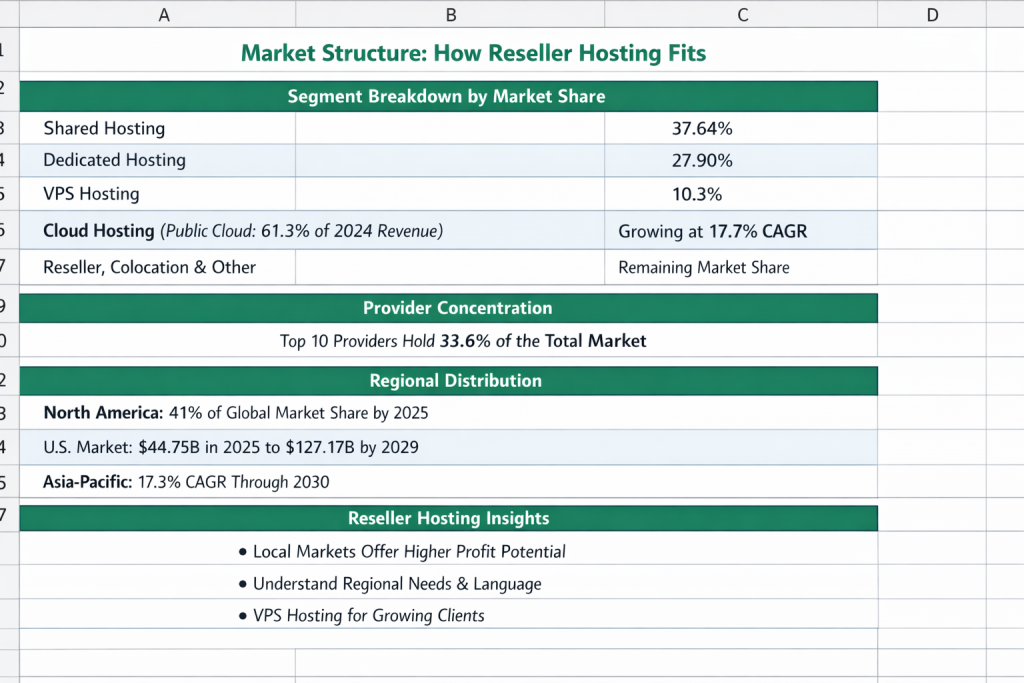
The web hosting industry contains approximately 330,000 companies globally, ranging from solo resellers to hyperscale cloud providers. Understanding how market share distributes helps contextualize the reseller segment.
Segment breakdown by market share:
- Shared hosting: 37.64% of global hosting market
- Dedicated hosting: approximately 27.90% (primarily enterprise)
- VPS hosting: approximately 10.3%
- Cloud hosting: growing at 17.7% CAGR, with public cloud holding 61.3% of 2024 revenue
- Reseller, colocation, and other segments: remaining market share
Provider concentration: The top 10 hosting providers hold just 33.6% of the total market. This fragmentation creates opportunities for smaller operators, including resellers. You’re not competing directly with AWS or GoDaddy; you’re serving niches they don’t address well.
Regional distribution: North America dominates with 41% of global market share in 2025. The U.S. web hosting market alone is forecast to grow from $44.75 billion in 2025 to $127.17 billion by 2029 at 23.5% CAGR. Asia-Pacific shows the fastest growth at 17.3% CAGR through 2030, driven by small business digitization across emerging markets.
For resellers, regional positioning matters. Serving local businesses in underserved markets often proves more profitable than competing for global customers against established brands. Local language support, local payment methods, and understanding of regional business needs create differentiation that price alone can’t match. If you’re exploring VPS hosting options for higher-margin offerings, many successful resellers graduate from shared to VPS as their client base grows.
Uptime Statistics: What Guarantees Actually Mean
Uptime guarantees feature prominently in reseller hosting marketing, but the numbers deserve scrutiny. Here’s what different uptime percentages translate to in practice:
- 99% uptime: 7 hours, 18 minutes of downtime per month (considered poor)
- 99.9% uptime: 43 minutes, 49 seconds of downtime per month (industry standard)
- 99.99% uptime: 4 minutes, 22 seconds of downtime per month (premium tier)
- 99.999% uptime: 26 seconds of downtime per month (enterprise level)
The industry standard sits at 99.9% uptime, which sounds impressive but still allows nearly 9 hours of downtime annually. For business clients, even this level can affect operations significantly.
Performance metrics beyond raw uptime matter too:
- Server response time ideal: under 200ms
- Critical issue SLA response: typically 30 minutes with resolution in 1-2 hours
- Standard support metrics vary by issue severity
Watch for these SLA loopholes: Most cloud and hosting SLAs exclude planned maintenance from uptime calculations. A host could take sites offline regularly for updates while maintaining “perfect” uptime statistics because scheduled downtime doesn’t count. Check frequency also varies: some providers verify uptime every 5 minutes, others every hour. A site could be down for 50 minutes but register as “up” if checks only run hourly.
The Cost of Downtime: Why Reliability Matters
For resellers serving business clients, downtime costs extend beyond technical inconvenience. The financial impact has been measured extensively:
Enterprise scale:
- Global 2000 companies lose $400 billion annually from downtime (9% of total profits)
- Average cost per minute: $14,056 for all organizations, $23,750 for large enterprises
- This represents a 150% increase from the $5,600/minute baseline established in 2014
- 98% of organizations report one hour of downtime costs over $100,000
- 81% face costs exceeding $300,000 per hour
Small business scale:
- SMB downtime cost: approximately $427 per minute
- Annual losses can reach $1 million from combined revenue loss and reputational damage
- 1 in 5 SMBs report inability to survive a breach or outage costing as little as $10,000
Customer trust impact:
- 74% of consumers say reliable websites/apps are key to driving trust
- 64% are less likely to trust a business after experiencing a website crash
- Competitors typically see 30-50% traffic increases during your downtime
- 15-25% of customers who switch during downtime never return
These statistics explain why business clients pay premium prices for reliable hosting. As a reseller, your reputation depends entirely on your upstream provider’s infrastructure. Choosing a reliable cloud hosting or premium reseller platform protects your client relationships and your income.
Growth Drivers: Why Reseller Hosting Remains Viable
Several market forces continue pushing demand for reseller hosting services:
Business digitization: Over 70% of businesses globally have transitioned online, creating sustained demand for hosting services. E-commerce and SaaS sectors consistently require hosting infrastructure, presenting ongoing opportunities for resellers serving these verticals.
Agency consolidation: Marketing agencies increasingly offer full-service packages rather than referring clients elsewhere for hosting. Bundling hosting with design, SEO, and maintenance creates stickier relationships and additional margin on services that would otherwise go to third parties.
Managed services preference: Many small and medium businesses prefer managed hosting solutions over DIY approaches. They’ll pay premium prices for someone else to handle tech support, security patches, and backup management. Resellers who position themselves as managed service providers rather than just hosting resellers capture higher margins.
Regional hosting focus: Businesses increasingly seek hosting solutions close to their target audience for better performance. Resellers can offer localized services with regional expertise that global providers don’t address. Understanding local business practices, languages, and payment preferences creates differentiation.
The counter-trend to watch: direct sign-up portals from major hosting brands squeeze margins for resellers competing purely on price. Successful resellers differentiate through bundled services, local expertise, or niche specialization rather than trying to undercut commodity shared hosting pricing.
Challenges Facing Reseller Hosting in 2026
The statistics aren’t uniformly positive. Several headwinds affect reseller hosting viability:
Margin compression from direct sales: Major hosting providers increasingly target the same small business clients resellers serve. When Hostinger offers $2.99/month shared hosting directly to consumers, resellers can’t compete on price. The response has been moving upmarket toward managed services where direct providers don’t compete as aggressively.
Support burden scaling: Client support doesn’t scale linearly. Ten clients might take two hours monthly. A hundred clients can easily consume 20+ hours, and the support requests tend toward complexity as your client base diversifies. Without automation and clear boundaries, support costs erode margins faster than revenue grows.
Platform dependency risk: Resellers depend entirely on their upstream provider’s infrastructure, pricing, and policies. When a wholesaler raises prices, discontinues features, or experiences outages, resellers absorb the impact with their client relationships. The 2024-2025 cPanel licensing increases hit many resellers hard, forcing painful price increases or margin cuts.
Client acquisition costs: Finding hosting clients isn’t free. Resellers who don’t already have an agency, design business, or IT services operation face real customer acquisition costs. The average cost to acquire a hosting customer ranges from $50-200 depending on channel, which takes months to recover at typical hosting price points.
Technical knowledge requirements: Despite white-label branding, resellers still need enough technical knowledge to troubleshoot issues, explain options to clients, and make informed decisions about their upstream provider. The learning curve creates a barrier that pure business operators underestimate.
Income Projections: From Side Hustle to Six Figures
Realistic income expectations depend heavily on business model and scale:
Solo freelancers: Can earn an extra $500/month treating reseller hosting as supplemental income alongside primary work. This requires minimal time investment once clients are set up, perhaps a few hours monthly for support and maintenance.
Part-time focus: Growing to $2,000-5,000/month is achievable with dedicated effort toward client acquisition. At this level, you’re managing 50-100+ clients depending on pricing.
Full-time agencies: Can scale hosting into six-figure operations when combined with web design, development, or marketing services. The hosting becomes recurring revenue that stabilizes cash flow alongside project-based income.
Key factors affecting income potential:
- Price point: $10/month commodity hosting requires 100 clients for $1,000 monthly revenue. $50/month managed hosting packages reach the same revenue with just 20 clients.
- Service bundling: Hosting alone has thin margins. Hosting bundled with maintenance, security monitoring, and support commands premium pricing.
- Client retention: Hosting churn typically runs 5-15% annually. Lower churn compounds dramatically over time.
- Automation: WHMCS (Web Host Manager Complete Solution, the standard billing and client management software) and similar automation platforms reduce operational overhead, improving margins as you scale.
The math favors treating reseller hosting as one component of a broader service offering rather than a standalone business. Pure hosting resale faces commoditization pressure. Hosting as part of a managed web presence service commands sustainable premiums.
Industry Trends for 2026 and Beyond
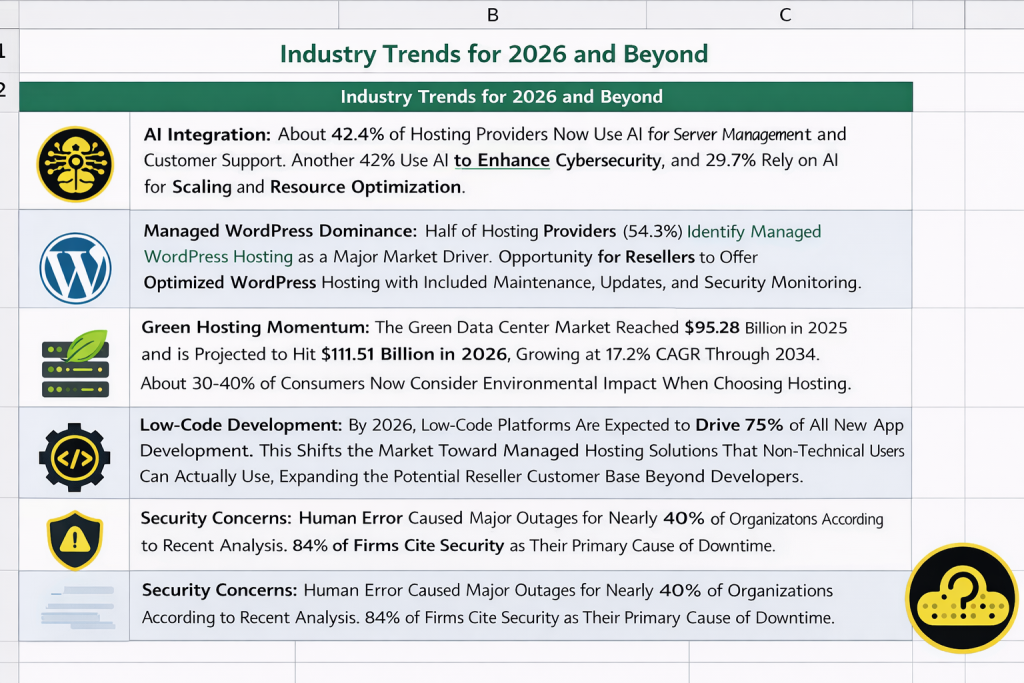
AI integration: About 42.4% of hosting providers now use AI for server management and customer support. Another 42% use AI to enhance cybersecurity, and 29.7% rely on AI for scaling and resource optimization. This technology is filtering into reseller platforms, automating tasks that previously required manual intervention.
Managed WordPress dominance: Half of hosting providers (54.3%) identify managed WordPress hosting as a major market driver. This creates opportunity for resellers who can offer optimized WordPress hosting with included maintenance, updates, and security monitoring. See our managed WordPress hosting comparison for infrastructure options.
Green hosting momentum: The green data center market reached $95.28 billion in 2025 and is projected to hit $111.51 billion in 2026, growing at 17.2% CAGR through 2034. About 30-40% of consumers now consider environmental impact when choosing hosting. Data centers consume 1-1.5% of global electricity, a figure expected to double by 2030. Resellers partnering with carbon-neutral or renewable-powered hosts can differentiate on sustainability while addressing growing client concerns.
Low-code development: By 2026, low-code platforms are expected to drive 75% of all new app development. This shifts the market toward managed hosting solutions that non-technical users can actually use, expanding the potential reseller customer base beyond developers to business owners building their own sites.
Security concerns: Human error caused major outages for nearly 40% of organizations according to recent analysis. 84% of firms cite security as their primary cause of downtime. Resellers who emphasize security monitoring and proactive management address a genuine market concern.
Frequently Asked Questions
How much can you make with reseller hosting?
Income varies dramatically by scale and business model. Solo freelancers typically earn $500/month treating reseller hosting as supplemental income. Part-time operations can reach $2,000-5,000/month with dedicated client acquisition efforts. Full-service agencies scale hosting into six-figure annual revenue when bundled with design, development, and maintenance services. Profit margins range from 30-80% depending on whether you handle support personally or employ staff.
Is reseller hosting still profitable in 2026?
Yes, but profitability depends on positioning. Pure commodity hosting resale faces margin pressure from major providers offering direct sign-ups at aggressive prices. Profitable resellers differentiate through bundled services (hosting plus maintenance plus support), local market expertise, or niche specialization. The agencies seeing 42% higher retention rates are those treating hosting as part of full-service packages rather than standalone products.
What profit margins are realistic for reseller hosting?
Small one-person operations managing their own support can achieve 80%+ gross margins. Established businesses with support staff typically see 40-70% profit margins. A sustainable target model allocates 33% to service costs, 17% to support overhead, leaving approximately 50% net profit. New businesses entering the market should expect 15-35% margins while building client bases and operational efficiency.
How big is the reseller hosting market?
The global reseller web hosting service market is projected to reach $9.8 billion by 2031, growing at 8.1% CAGR from 2025. This sits within the broader web hosting market valued at $149.30 billion in 2025, projected to reach $178.76 billion in 2026. Shared hosting holds 37.64% market share, with reseller hosting representing a smaller but steadily growing segment alongside VPS and dedicated hosting.
Final Thoughts
The reseller hosting market offers genuine opportunity for those approaching it strategically. The $9.8 billion market projection and 8.1% growth rate signal continued demand. Profit margins between 30% and 80% compare favorably to many service businesses. White-label capabilities and automation tools have reduced the operational complexity that once made reselling impractical for small operators.
What separates successful resellers from those who quit isn’t the upstream provider they choose or even their pricing strategy. It’s positioning. Resellers competing on price against commodity shared hosting face a race to the bottom. Resellers bundling hosting with maintenance, security, and support capture sustainable margins and build client relationships that last.
The statistics support a clear conclusion: reseller hosting works best as a component of broader service offerings rather than a standalone business. The 42% higher retention rates agencies see with white-label services come from being essential to clients, not from offering the cheapest hosting available. If you’re considering reseller hosting, start by identifying what additional value you can provide beyond raw server space.
For more hosting market data, see our CMS market share statistics covering WordPress, Shopify, and platform trends, or check our website builder statistics for the broader DIY website landscape.