
On This Page: [hide]
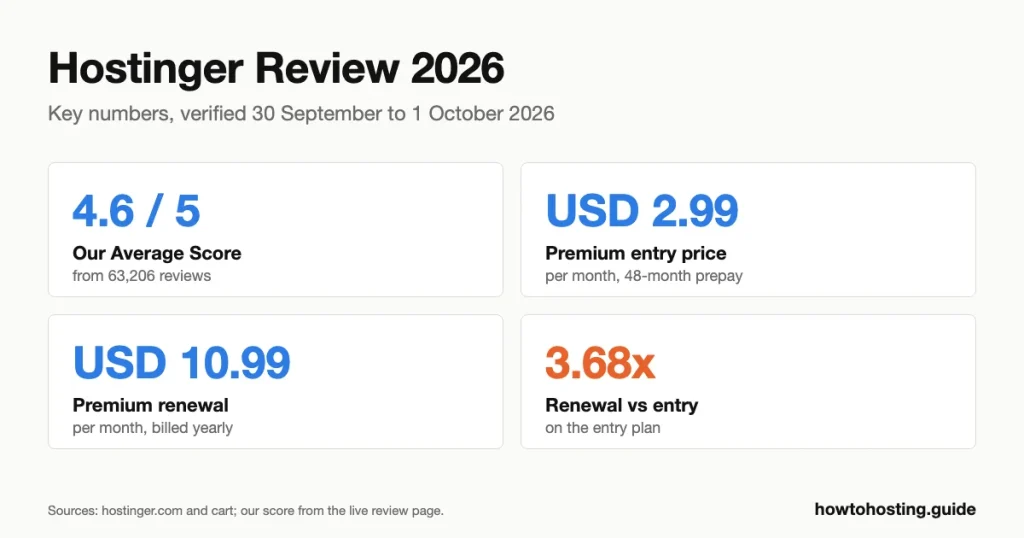
Hostinger sells some of the cheapest entry plans on a hosting network that spans four continents. The trade-off is support that now starts with an AI agent. Our Average Score for Hostinger is 4.6 out of 5, calculated from 63,206 customer reviews. Its Premium plan costs USD 2.99 a month for four years, then USD 10.99.
Every figure below comes from Hostinger’s own site: plan cards, the cart, the legal pages and the help center, checked on 30 September and 1 October 2026. On top of that, we sorted Trustpilot’s 200 newest reviews by who prompted them and read the latest Reddit threads. We also measured network latency to 11 Hostinger data centers from 10 countries. We didn’t buy a plan. Most reviews ranking for Hostinger today still describe Kodee, a support bot Hostinger replaced in September 2026.
Overall: Hostinger scores 4.6/5 across the 63,206 reviews we examined. Its network is fast in Europe, the Americas and Southeast Asia, and its entry prices are hard to beat. Complaints center on AI-first support and the renewal bill. It suits someone launching one to three sites who is happy to get help by chat.
Hostinger’s Premium plan dropped from 100 websites and 100 GB of storage to 3 websites and 20 GB for plans bought from 17 December 2025. Any review promising 100 sites on the entry plan describes accounts bought before 24 April 2025.
Last updated: October 2026. Pricing and review data verified.
 Visit Site
| Name | Hostinger |
| Total Reviews | 63206 |
| Average Score | 4.6 |
| Website | https://hostinger.com |
| Address | 61 Lordou Vironos str. Larnaca 6023 CY |
| CMS Support | WordPress, Drupal, PrestaShop, Joomla, MODX |
| Server Locations |  Lithuania, Lithuania,  Singapore, Singapore,  Netherlands, Netherlands,  United States, United States,  Brazil, Brazil,  United Kingdom, United Kingdom,  India, India,  France, France,  Indonesia Indonesia |
Number of Reviews
Avg. Review Score
Customer Support
Features and Services
Hostinger began in November 2004 in Kaunas, Lithuania, under the name Hosting Media. It is now headquartered in Vilnius. Its About page says it has never been publicly listed. A private equity firm, ConHostinger, holds around 30%, and the founders and team own the rest. Hostinger claims more than 5 million customers in over 150 countries.
What Hostinger Sells
- Web hosting: three plans, Premium, Unlimited and Cloud Startup, sold on four-year terms for the headline price. The WordPress hosting page lists those three plans again, priced identically.
- Cloud hosting: Startup, Professional and Enterprise tiers. Cloud Startup comes with 4 CPU cores, 4 GB of RAM and a dedicated IP address. Its 100 GB of storage is NVMe, a faster type of SSD.
- VPS hosting: four self-managed KVM plans. A VPS (virtual private server) is a private share of one physical machine, isolated from other customers. KVM gives each one its own operating system kernel, so tools like Docker (software that runs apps in isolated containers) work normally.
- Agency hosting: plans for studios that host client sites, with site isolation and unbranded client dashboards.
- AI Builder and email: a drag-and-drop site builder driven by prompts, plus business email and Google Workspace resale.
- No dedicated servers: the hosting menu on hostinger.com lists none.
Plan Limits Worth Checking
Plan names hide most of the detail, so Hostinger’s own limits page is worth reading before you pick. Premium gives you 3 websites and 20 GB of storage, running on one CPU core with 2 GB of memory. The card calls that storage “SSD”, while the two bigger plans get NVMe. Premium allows 400,000 inodes (every file and every folder counts as one) and 40 PHP workers (the processes that build pages on request). It also caps you at 10 databases.
Unlimited lifts the site cap and doubles the CPU to two cores. It adds 3 GB of RAM, 50 GB of NVMe storage, 600,000 inodes and 150 databases. It also gets daily backups, where Premium gets weekly ones. Hostinger’s hosting agreement says the weekly backup overwrites the previous one, and only two weeks are kept.
The limits page shows how fast the entry plan has shrunk. Premium bought until 23 April 2025 came with 100 websites, 100 GB and 300 databases. From 24 April to 16 December 2025, buyers got 25 websites and 25 GB. From 17 December 2025, it’s 3 websites, 20 GB and 10 databases. Older accounts keep their old limits, which is why some long-time customers still talk about 100 sites.
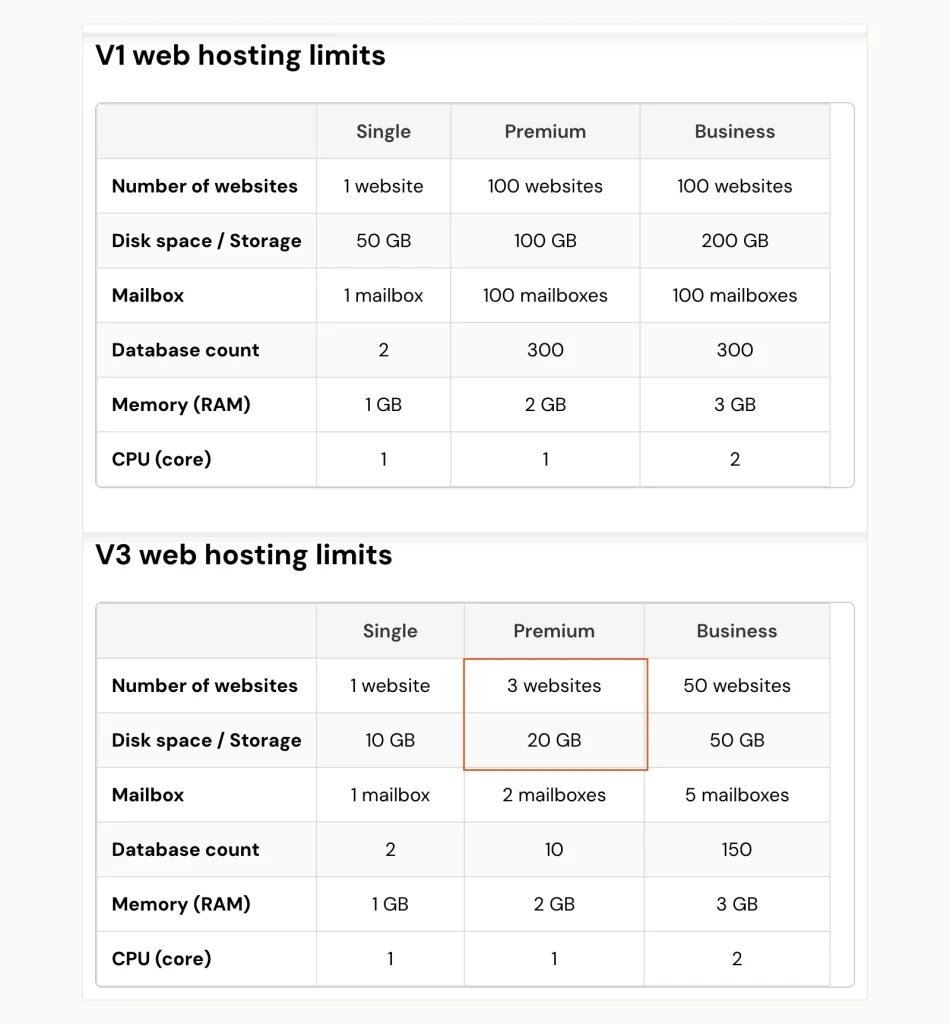
Compare the Premium column in the two tables: the outlined cells show today’s 3 websites and 20 GB. Source: Hostinger help center, “New web and cloud hosting limits”, captured 1 October 2026.
Data Center Locations
Hostinger’s About page lists data centers in France, Germany, Lithuania, the Netherlands and the UK. In North America it names Phoenix, Boston and Asheville. In Asia it lists India, Indonesia and Malaysia, and in South America, Brazil. The page leaves out Singapore. Even so, a Singapore server answers on Hostinger’s own network and appears on its status page. Its CDN (a network that caches pages near visitors) adds points in Japan, Sydney and Johannesburg.
You pick the location when you set up a site. That choice matters more than any plan feature, because a server near your visitors answers faster. The gap to watch is Oceania: there is no Australian origin server, only CDN caching. Pages that can’t be cached, like a checkout or a login, still travel to a data center in Asia or the US.
Performance Expectations
This test covers network reach, meaning how quickly Hostinger’s servers reply. It says nothing about page load time. On 30 September 2026 we pinged servers in 11 Hostinger data centers from home internet connections in 10 countries. We sent 10 packets per test through Globalping, a public network of measurement probes. Every server we tested sits on Hostinger’s own network, not a CDN. Not one packet was lost across all 110 tests.
The table shows the fastest Hostinger data center for each country, as an average round trip in milliseconds (ms).
| Probe (city, provider) | Fastest Hostinger data center | Average ping |
|---|---|---|
| Vilnius, Lithuania (Telia) | Vilnius | 1.0 ms |
| Sao Paulo, Brazil (Telefonica) | Sao Paulo | 3.4 ms |
| Amsterdam, Netherlands (KPN) | Meppel, Netherlands | 4.3 ms |
| Jakarta, Indonesia (Jaringanku) | Jakarta | 4.3 ms |
| Singapore (MyRepublic) | Singapore | 5.9 ms |
| Hamburg, Germany (Deutsche Telekom) | Frankfurt | 8.9 ms |
| London, UK (BT) | Paris | 9.9 ms |
| Philadelphia, US (Verizon) | Boston | 10.6 ms |
| Jaipur, India (Airtel) | Mumbai | 26.7 ms |
| Brisbane, Australia (Aussie Fibre) | Phoenix, US | 165.9 ms |
Nine of the ten countries reach a Hostinger data center in under 27 ms. Australia is the outlier. From Brisbane, the fastest answer came from Phoenix at 165.9 ms. Kuala Lumpur took 213.6 ms, and Singapore took 302.4 ms over that probe’s route. London had no server to test: we found no UK server name on Hostinger’s status page, so the UK probe’s best result came from Paris.
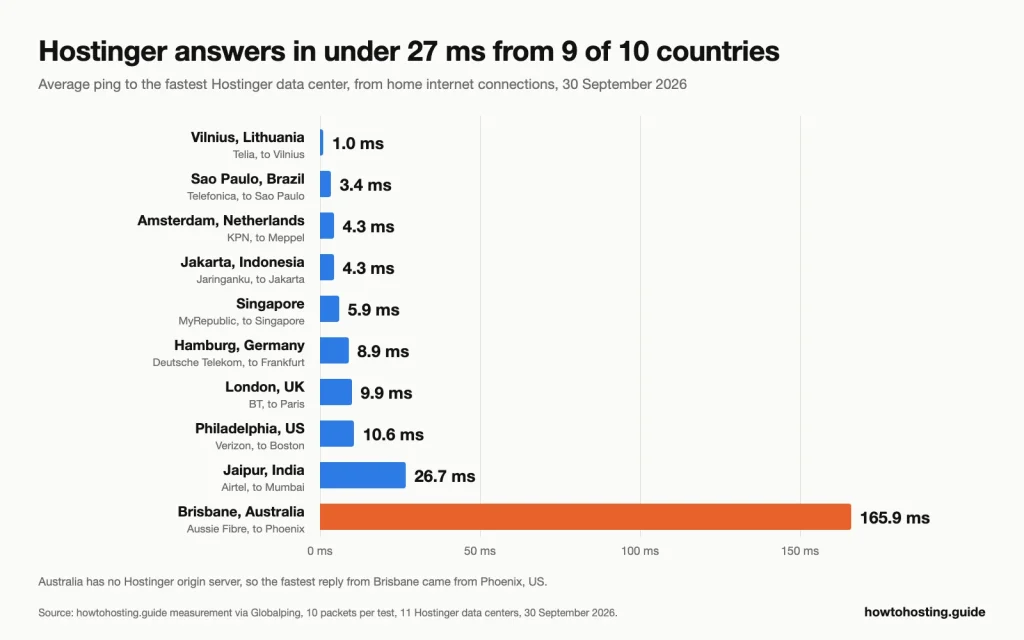
Brisbane is the only probe without a nearby Hostinger data center. Source: our Globalping measurement from home internet connections, 30 September 2026.
Latency is only the first step of a page load. Server load, caching and your own site’s code decide the rest. Our search turned up no recent third-party benchmark of Hostinger’s speed or uptime that we could cite. Hostinger promises 99.9% uptime a month, and the Transparency section below explains what that promise pays out.
Customer Experience
Trustpilot score: 4.6 from 72,718 reviews, 19,973 of them from the past year. Across the full 72,718, 63,426 are five-star (87.2%) and 4,990 are one-star (6.9%). The middle is thin: 3,118 four-star, 638 three-star and 546 two-star reviews. Hostinger invites customers to review it, pays for a Trustpilot subscription and replies to 99% of negative reviews. Trustpilot notes those replies may use AI assistance.
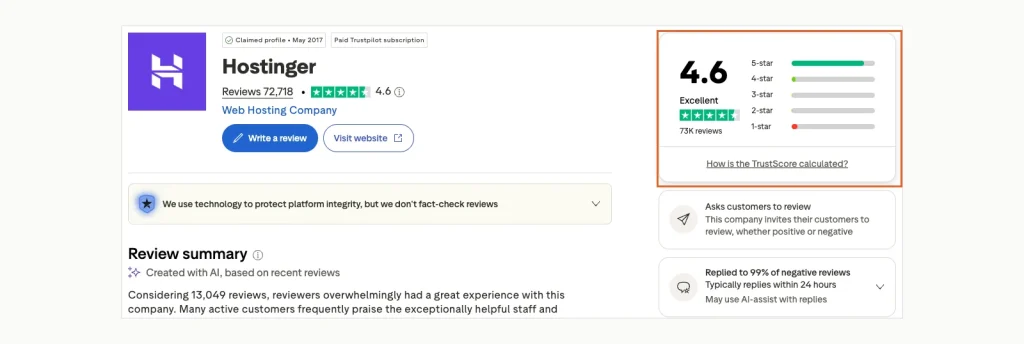
Look at the outlined rating card, then the two boxes under it: Hostinger invites reviews and may use AI to reply. Source: Trustpilot, captured 1 October 2026.
Why is the middle so empty? The split makes more sense once you ask who prompted each review. Trustpilot tags every review with its source. Of the 200 newest, posted from 25 to 30 September 2026, 166 came through Hostinger’s invitations. They averaged 4.92 stars, with 156 five-star reviews and not a single one-star. The other 34 were written unprompted. Those averaged 1.56 stars, and 27 of them were one-star.
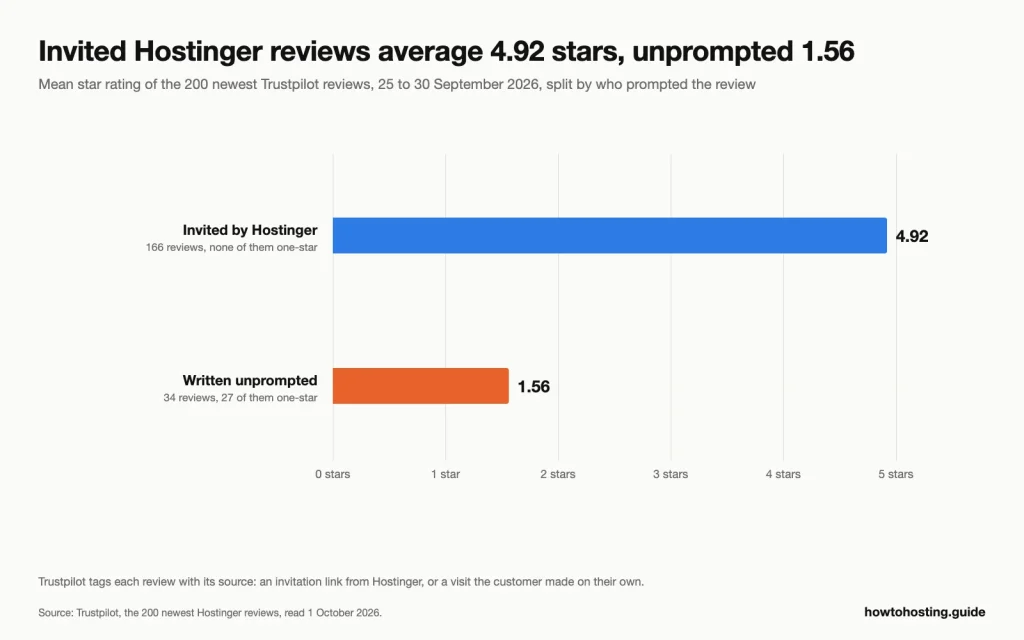
Same company, same week, very different scores depending on who asked for the review. Source: Trustpilot, 200 newest reviews dated 25 to 30 September 2026, counted 1 October 2026.
Neither group is fake. Invitations usually follow a solved ticket, so they catch Hostinger on a good day. Unprompted reviews tend to come after a problem, from customers who went looking for a place to say so. Both are real, and which one you’ll write depends on whether you ever hit a problem.
Where Customers Are Happy
Among the 60 newest English five-star reviews, 24 mention support or help. Several thank an agent for patience during a migration, an SSL fix or a tricky deployment. An SSL certificate is what makes the browser show a padlock. Twelve call the service easy or simple to use. Most of these reviews are short: 40 of the 60 run under 120 characters.
Price and value come up too, though less often than you might expect for a budget host. One long review praises the AI agent for walking its author through a complex job. Two others say they got real help only once a human joined the chat.
What Goes Wrong
We read the 100 newest English one- and two-star reviews, from 7 to 30 September 2026. Ninety-seven of them were unprompted. By our keyword count, 52 complain about AI support, and 35 ask to reach a human. Twenty-two describe downtime and 17 involve refunds. Fifteen describe a suspended or locked account, and 7 complain about the renewal price.
The AI complaints follow a pattern. Customers describe loops where the bot repeats the same fix, and escalations that take days. Two VPS buyers describe refund requests that were refused at first, even though they cancelled inside 30 days. Hostinger replied to 95 of those 100 reviews.
What Reddit Shows That Trustpilot Doesn’t
Reddit’s search returned 63 posts mentioning Hostinger from 25 to 30 September 2026. Eighteen were referral-code or coupon posts, which are marketing rather than feedback. The rest are more useful, because long threads show how problems unfold.
One customer of nearly ten years had a site and its email suspended after an abuse complaint. The poster was less upset about the suspension than about support not reading their replies. Commenters split between “follow the terms” and “fix the process”. In another thread, a customer since 2021 spent four days trying to get a human to run server-level tests. A reply that reads as coming from Hostinger staff said the case was now a priority.
A third thread describes an AI-built store that vanished. The AI suggested the owner’s wording might have told it to delete the store. A later reply said the store was fully restored and safeguards were added. On the positive side, several replies in r/VPS and r/smallbusiness recommend Hostinger’s KVM 2 or its cheap shared plans. A German thread offered harsher opinions about privacy and spam, but it gave no evidence.
Support Quality
Support now starts with Hostinger Agent, an AI assistant inside the dashboard. A Customer Success specialist can join the chat when the agent is unsure. You can also continue a conversation on WhatsApp. There is no phone number, and email is only offered for account recovery.
Hostinger dates the change itself. Its blog says the model changed “at the end of June” 2026. Since then, AI resolution with a specialist’s help rose from 41% to 72%, and live chat demand fell from 10% to 4.5%. The blog says customers “can still ask for a specialist at any time, on any plan”.
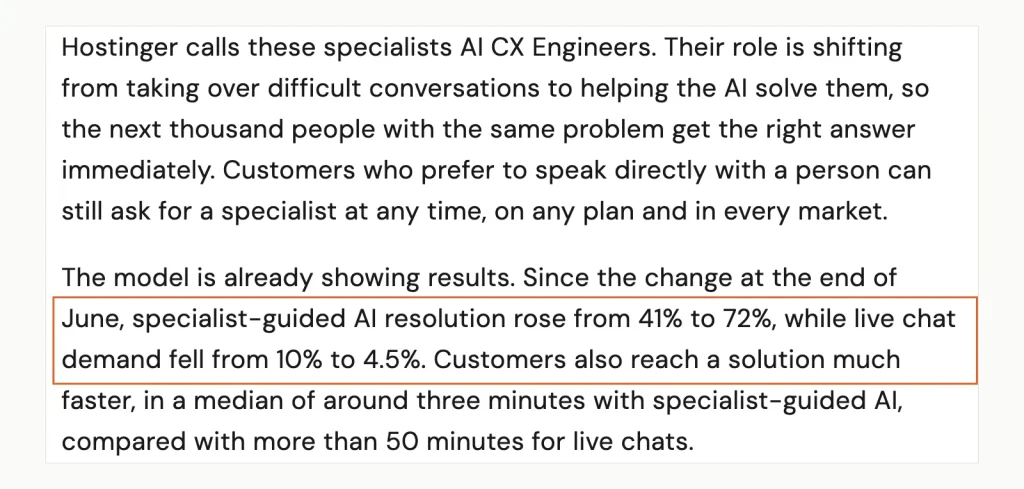
The outlined sentence dates the switch to AI-first support. Source: Hostinger blog post on the Hostinger Agent launch, published 2 September 2026, captured 1 October 2026.
By Hostinger’s own measure, AI help reaches a solution in a median of about three minutes. Live chats took more than 50. For common questions, that’s a real gain. The recent reviews above suggest the cost falls on customers with unusual problems, who now have to argue their way to a person.
When to Use Hostinger
So who is Hostinger actually for? Mostly for buyers whose needs fit its plans exactly and who rarely need a human.
Who It Suits
First-time site owners: the dashboard earns steady praise from beginners. The AI agent handles routine setup like domains, email and DNS records, which point a domain at a server. USD 143.52 covers four years, including a free domain for the first year.
Small businesses with visitors near a data center: our pings stayed under 27 ms from nine countries in Europe, the Americas and Asia. If your customers are in one of those regions, your site starts close to them.
Developers who want cheap RAM: KVM 2 gives 8 GB for USD 8.99 a month and renews at USD 14.99. That’s a gentler renewal than any of Hostinger’s shared plans.
It Makes Sense If
- You run three sites or fewer, because Premium covers exactly three.
- You can prepay four years, because the USD 2.99 rate only exists on the 48-month term.
- You solve most problems yourself, because first-line support is an AI agent.
- You want Docker or AI tools on a VPS, because every plan runs on KVM with root access.
When NOT to Use Hostinger
Most of Hostinger’s weak points show up after you’ve paid, when something breaks or the first term ends.
Skip It If
You want to phone someone: Hostinger has no phone line. Its support is AI-first, with specialists behind it. That is the most common theme in recent one- and two-star reviews.
Your audience is in Australia or New Zealand: there is no origin server in Oceania. From Brisbane, our fastest result was 165.9 ms to Phoenix. A host with a Sydney data center will answer much faster.
You’re buying a VPS and might want a refund: Hostinger’s refund policy contradicts itself on VPS plans. One line excludes “all VPS hosting plans” from standard refunds. The same list then includes “KVM VPS (except upgrades)”. A separate rule allows a VPS refund only if 180 days have passed since your last one.
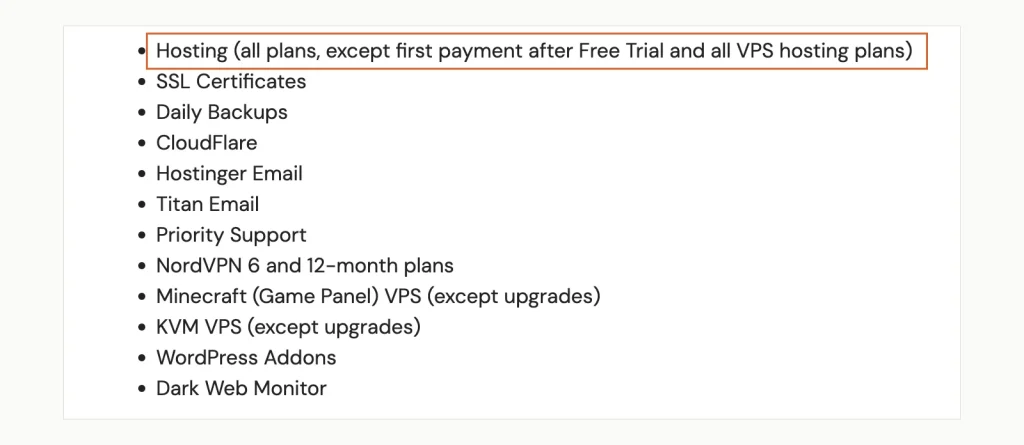
Read the outlined first line, then the tenth: the same list both excludes and includes KVM VPS plans. Source: Hostinger refund policy, last revised 8 September 2026, captured 1 October 2026.
You still run an old Hostinger VPS: any VPS bought before 18 April 2023 uses OpenVZ, an older container technology. Those plans haven’t been renewable since 1 March 2026. Hostinger’s migration guide gives two shutdown dates, 30 November and 14 December 2026. Treat 30 November as your deadline, because the servers and their data are deleted.
Check These Before Paying
- Sending email from WordPress: every Web plan caps server-based sending at 10 a minute and 100 a day. Contact forms are fine, but newsletters need an SMTP service (an external mail server).
- More than three sites: Premium stops at three, and Unlimited renews at USD 16.99.
- Backups: Premium keeps weekly backups for two weeks. Keep your own copies, as our WordPress backup guide explains.
- A short trial: the monthly price is USD 11.99, four times the headline rate.
Worried most about the year-two price? UltaHost keeps its price flat. If phone support matters most, InMotion Hosting offers it from its Power plan. Both are covered below.
Hostinger Transparency Score
Hostinger publishes more technical detail than most budget hosts. Its policies, though, contradict each other in places that matter to buyers.
- Company Information: Excellent – the About page gives the founding date and city, the headquarters, and the roughly 30% private equity stake. The terms name the group companies behind the service.
- Pricing Transparency: Good – renewal rates appear on every plan card. The 12-month renewal term only shows in the cart, and the terms allow Hostinger to change the renewal fee you saw at purchase.
- Technical Documentation: Good – the limits page lists inodes, PHP workers, I/O (disk read and write speed) and mail caps per plan. It clashes with the plan cards in places: the Unlimited card promises “Unlimited mailboxes per website”, while the limits page says 5. The About page also omits the Singapore data center.
- Terms & Policies: Limited – the refund policy contradicts itself on VPS plans, and the OpenVZ guide gives two shutdown dates. The uptime clause is clear but thin.
That uptime clause promises 99.9% a month. If Hostinger misses it, “as solely determined by us”, you can ask for a credit of 5% of that month’s hosting fee. The credit only buys more Hostinger services. On Premium at USD 2.99, that’s about 15 cents.
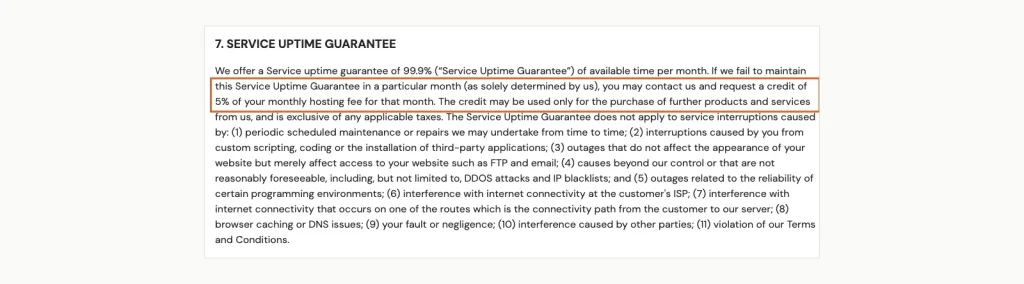
The outlined sentences show who judges a breach and what it pays. Source: Hostinger hosting agreement, last revised 28 August 2026, captured 1 October 2026.
Overall Transparency: Good. Prices and specs are easy to find. The refund and shutdown terms need a second read, and on VPS plans you should get a written answer before you buy.
Alternatives to Hostinger
The three hosts below each fix a different Hostinger weakness: the renewal jump, the missing phone line and thin backups.
For a Price That Doesn’t Jump: UltaHost
UltaHost’s Starter plan renews at the price you paid: USD 3.44 a month on its default two-year term, or USD 2.88 on three years. The catch is its refund policy, which excludes two- and three-year plans. Our Hostinger vs UltaHost comparison works through the six-year cost of both.
For Phone Support and a Longer Refund: InMotion Hosting
InMotion’s Power plan lists phone support from human staff, and InMotion advertises a 90-day money-back guarantee on its shared plans. It costs more. Launch is USD 4.79 a month on a one-year term and renews at USD 14.99, while Power is USD 5.79 and renews at USD 18.99. Phone support only starts on Power, though, because the Launch card lists live chat alone.
For Daily Backups on Every Plan: SiteGround
SiteGround includes daily backups on all plans, with 30 days of history. That’s the premium pick: StartUp is USD 2.99 a month, prepaid for a year, on its international storefront. After that it renews at USD 17.99. That’s steeper than Hostinger’s USD 10.99, but you get daily backups on the entry plan.
- Hostinger reviews from Brazil
| Average score | 4.85 |
| Number of reviews | 9239 reviews |
- Hostinger reviews from United States
| Average score | 4.62 |
| Number of reviews | 6089 reviews |
- Hostinger reviews from India
| Average score | 4.55 |
| Number of reviews | 4783 reviews |
- Hostinger reviews from France
| Average score | 4.47 |
| Number of reviews | 2700 reviews |
- Hostinger reviews from Spain
| Average score | 4.61 |
| Number of reviews | 2455 reviews |
- Hostinger reviews from United Kingdom
| Average score | 4.11 |
| Number of reviews | 2433 reviews |
- Hostinger reviews from Pakistan
| Average score | 4.64 |
| Number of reviews | 2340 reviews |
- Hostinger reviews from Mexico
| Average score | 4.79 |
| Number of reviews | 2183 reviews |
- Hostinger reviews from Argentina
| Average score | 4.77 |
| Number of reviews | 1905 reviews |
- Hostinger reviews from Colombia
| Average score | 4.74 |
| Number of reviews | 1465 reviews |
- Hostinger reviews from Canada
| Average score | 4.62 |
| Number of reviews | 1151 reviews |
- Hostinger reviews from Indonesia
| Average score | 4.85 |
| Number of reviews | 1084 reviews |
- Hostinger reviews from Turkey
| Average score | 4.67 |
| Number of reviews | 948 reviews |
- Hostinger reviews from Morocco
| Average score | 4.58 |
| Number of reviews | 909 reviews |
- Hostinger reviews from Egypt
| Average score | 4.71 |
| Number of reviews | 892 reviews |
- Hostinger reviews from Germany
| Average score | 4.12 |
| Number of reviews | 735 reviews |
- Hostinger reviews from Nigeria
| Average score | 4.82 |
| Number of reviews | 655 reviews |
- Hostinger reviews from Australia
| Average score | 4.56 |
| Number of reviews | 613 reviews |
- Hostinger reviews from Italy
| Average score | 4.39 |
| Number of reviews | 613 reviews |
- Hostinger reviews from Saudi Arabia
| Average score | 4.73 |
| Number of reviews | 546 reviews |
- Hostinger reviews from United Arab Emirates
| Average score | 4.51 |
| Number of reviews | 535 reviews |
- Hostinger reviews from Bangladesh
| Average score | 4.48 |
| Number of reviews | 506 reviews |
- Hostinger reviews from Netherlands
| Average score | 4.29 |
| Number of reviews | 500 reviews |
- Hostinger reviews from Philippines
| Average score | 4.79 |
| Number of reviews | 471 reviews |
- Hostinger reviews from Peru
| Average score | 4.69 |
| Number of reviews | 460 reviews |
- Hostinger reviews from Portugal
| Average score | 4.52 |
| Number of reviews | 406 reviews |
- Hostinger reviews from Belgium
| Average score | 4.61 |
| Number of reviews | 365 reviews |
- Hostinger reviews from Ukraine
| Average score | 4.45 |
| Number of reviews | 316 reviews |
- Hostinger reviews from Chile
| Average score | 4.69 |
| Number of reviews | 300 reviews |
- Hostinger reviews from Ecuador
| Average score | 4.86 |
| Number of reviews | 278 reviews |
Hostinger Plans and Pricing
Hostinger puts the renewal rate in grey text under each buy button, so it isn’t hidden. What the plan card leaves out is the length of that renewal. The checkout says it: after the first term, Premium renews for 12 months at a time.
Renewal warning: Premium starts at USD 2.99/mo and renews at USD 10.99/mo, a 268% increase. You pay USD 143.52 upfront for the first 48 months. The first renewal year then costs USD 131.88, which is 92% of what the first four years cost.
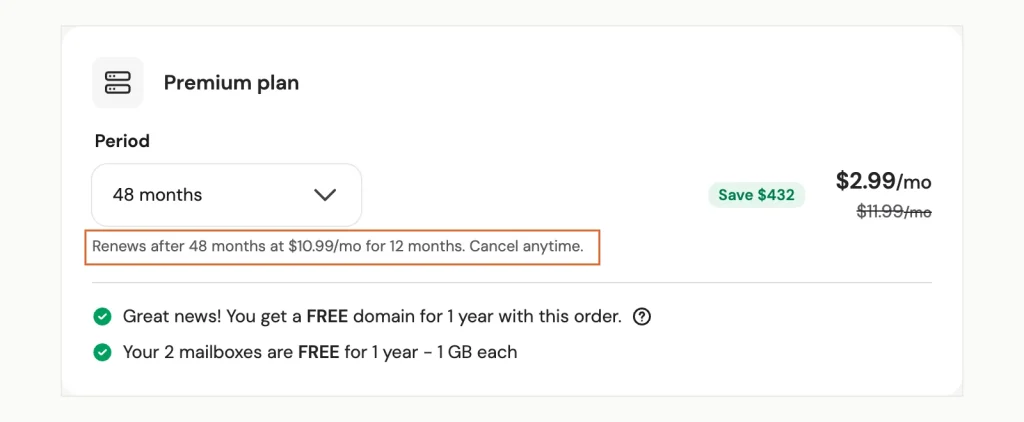
The outlined line gives the renewal price and the 12-month renewal term the plan card leaves out. Source: Hostinger cart, captured 30 September 2026.
All prices below are hostinger.com’s USD prices, shown without VAT. Checkout adds tax by country.
| Plan | Term for entry price | Entry price | Renewal price | Renewal vs entry |
|---|---|---|---|---|
| Premium | 48 months | USD 2.99/mo | USD 10.99/mo | 3.68x |
| Unlimited | 48 months | USD 3.99/mo | USD 16.99/mo | 4.26x |
| Cloud Startup | 48 months | USD 7.99/mo | USD 25.99/mo | 3.25x |
| KVM 1 VPS | 24 months | USD 6.49/mo | USD 11.99/mo | 1.85x |
| KVM 2 VPS | 24 months | USD 8.99/mo | USD 14.99/mo | 1.67x |
| KVM 4 VPS | 24 months | USD 12.99/mo | USD 28.99/mo | 2.23x |
| KVM 8 VPS | 24 months | USD 25.99/mo | USD 49.99/mo | 1.92x |
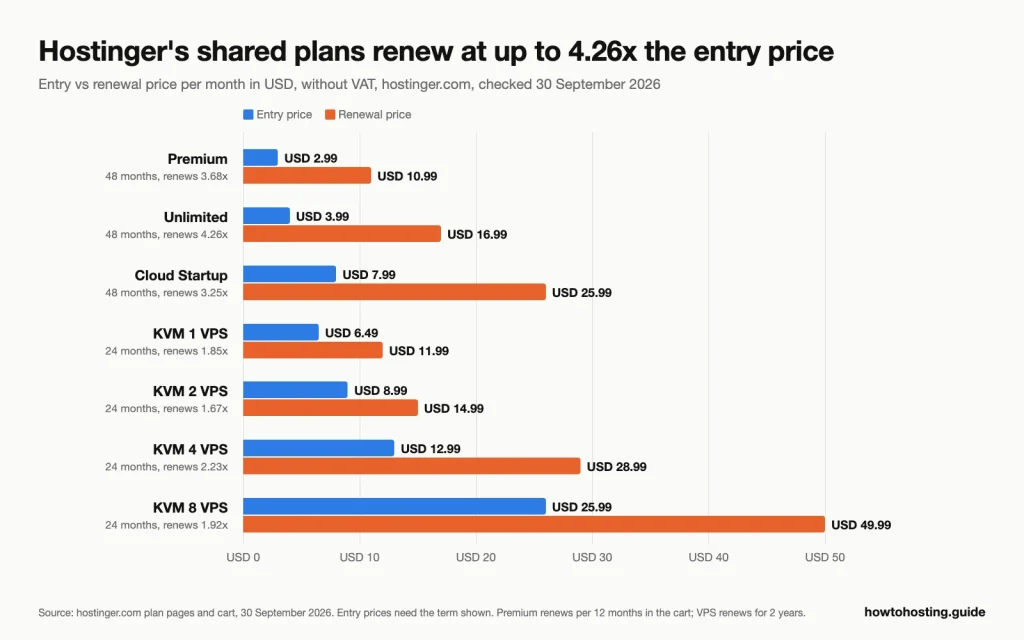
The orange bars show what each plan costs after its first term. Source: hostinger.com plan pages and cart, prices without VAT, checked 30 September 2026.
Web and WordPress Hosting
Entry price: USD 2.99/mo for Premium (promotional, requires a 48-month prepayment of USD 143.52)
Renews at: USD 10.99/mo, billed 12 months at a time
Shorter terms cost more per month, but they renew at the same rate. In the cart, Premium costs USD 3.49 on a 24-month term and USD 3.99 on a 12-month term. Month to month it’s USD 11.99, with no free domain. The crossed-out USD 11.99 on the plan card is that monthly price, not the renewal rate. Unlimited (USD 3.99, renewing at USD 16.99) is the plan to pick if you need more than three sites or daily backups.
VPS Hosting
Starting at: USD 6.49/mo | Renews at: USD 11.99/mo
The VPS line renews far more gently, at 1.67x to 2.23x the entry price, on 24-month terms. KVM 2 is the best value in the range. For USD 8.99, renewing at USD 14.99, it pairs 2 vCPU cores (virtual processor cores) with 8 GB of memory and 100 GB of NVMe. All four plans are self-managed: root access (full administrator control) is yours, and so is every update and security patch. If that sounds like a chore, read what a managed VPS includes before you choose.
Cloud and Agency Hosting
Starting at: USD 7.99/mo | Renews at: USD 25.99/mo
Cloud Startup is managed hosting with more headroom: 2,000,000 inodes, 100 PHP workers and daily plus on-demand backups. Agency Startup is USD 29 a month if you prepay 24 months, then USD 49 a month after that.
Dedicated Servers
Hostinger doesn’t sell dedicated servers. Its biggest single-customer option is the KVM 8 VPS, with 8 vCPU cores and 32 GB of RAM.
Costs That Arrive Later
- Email: mailboxes are free for the first year, then USD 0.59 a month each on a 12-month term.
- Domain: free for a year on 12-, 24- and 48-month plans. The cart lists its regular price as USD 13.99. If you ask for a refund, Hostinger may keep the domain’s price.
- Daily backups: included from Unlimited up. Premium gets weekly backups only.
- Ecommerce add-on: USD 1 for three months, then USD 8.99 a month. It’s offered in the cart but not ticked, and WooCommerce, the free WordPress store plugin, needs no add-on.
- Future renewals: Hostinger’s terms reserve the right to change fees, “including Services’ renewal fees displayed at this Site at the time of your first purchase”.
Is the Price Fair?
For the first four years, yes. Here’s the thing: USD 143.52 for 48 months of hosting on a fast network is hard to beat. The deal gets worse from year five, when USD 10.99 a month buys a 3-site, 20 GB plan. If you plan to stay longer than four years, compare the renewal rate, not the promo. Hostinger’s VPS plans are the better long-term buy for anyone comfortable running a server.
- Bandwidth Unlimited
- Panel cPanel
- Number of Sites Unlimited
- Bandwidth Unlimited
- Panel cPanel
- Number of Sites 100
- Bandwidth Unlimited
- Panel cPanel
- Number of Sites 1
- Bandwidth Unlimited
- Panel cPanel
- Number of Sites 100
- Bandwidth Unlimited
- Panel cPanel
- Number of Sites 100
- Bandwidth 1 TB
- Panel Plesk
- Number of Sites Unlimited
Conclusion
Hostinger earns its 4.6 from 63,206 reviews on price and network reach, not on support. It’s the right buy for a small site whose owner can prepay four years and rarely needs a person.
So, Is It Worth It?
For the first four years, it’s one of the best-value hosts you can buy. The first renewal year costs USD 131.88, almost as much as those four years together. The Trustpilot split tells you what to expect from support: invited reviewers average 4.92, unprompted ones 1.56.
Buy Hostinger Premium if you run up to three sites for visitors in Europe, the Americas or Southeast Asia. Buy KVM 2 if you can manage a server. Pick UltaHost if the renewal bill decides it, or InMotion if you want a phone number. SiteGround suits anyone who wants daily backups on the cheapest plan.
Outgrowing Premium but not ready to run a server? Our guide to cloud hosting vs shared hosting explains what the step up to a plan like Cloud Startup buys you.
Frequently Asked Questions
Can Hostinger Premium host more than three websites?
Not if you buy it today. Premium plans bought from 17 December 2025 allow 3 websites and 20 GB. Older accounts keep higher limits, which is why some users mention 100 sites. For more sites, you need Unlimited at USD 3.99 a month, renewing at USD 16.99.
What will Hostinger Premium cost after the first four years?
It renews at USD 10.99 a month, billed for 12 months at a time, which comes to USD 131.88 for year five. The first 48 months cost USD 143.52 upfront. So the renewal year costs 92% as much as the first four years together.
Why do so many recent Hostinger reviews mention AI support?
Hostinger moved to AI-first support at the end of June 2026. In 100 recent one- and two-star reviews, 52 complained about it. You can still ask for a human specialist in the chat, but expect that to take longer than the AI’s first reply.
Is Hostinger cheaper than UltaHost in the long run?
Only for the first few years, because Hostinger Premium costs USD 2.99 a month for four years and then USD 10.99. UltaHost Starter stays at USD 3.44 on its two-year term. UltaHost’s two- and three-year plans can’t be refunded, though, while Hostinger’s 30-day refund covers every web hosting plan.
Is Hostinger fast outside Europe and the US?
In most of the places we tested, yes. Our pings reached a nearby Hostinger data center in 26.7 ms or less from India, Indonesia, Singapore and Brazil. Australia is the exception: from Brisbane, the best result was 165.9 ms, because there’s no Australian server.
Can I get a refund after Hostinger renews my plan?
Yes, within 30 days, because Hostinger’s refund policy counts a renewal charge as a new transaction and restarts the window. Domain renewals and payments in cryptocurrency can’t be refunded. On VPS plans, the policy contradicts itself, so ask support to confirm in writing.
