
On This Page: [hide]
OVHcloud signed up 12% more new bare metal (whole physical server) customers in the six months to February 2026 than a year earlier. Over the same period, its new VPS customers grew 116%. So at one of Europe’s largest hosts, dedicated demand is still rising, just far slower than for the virtual servers sold beside it. Meanwhile a memory shortage has pushed server prices up since spring. This page collects the numbers that hold up, each traced to whoever published it, and flags the popular ones that don’t.
Quick answer: There’s no single figure. Published 2026 estimates put the dedicated server market between USD 15.8 billion (MarkWide Research) and USD 23.94 billion (The Business Research Company). These are the other numbers that hold up:
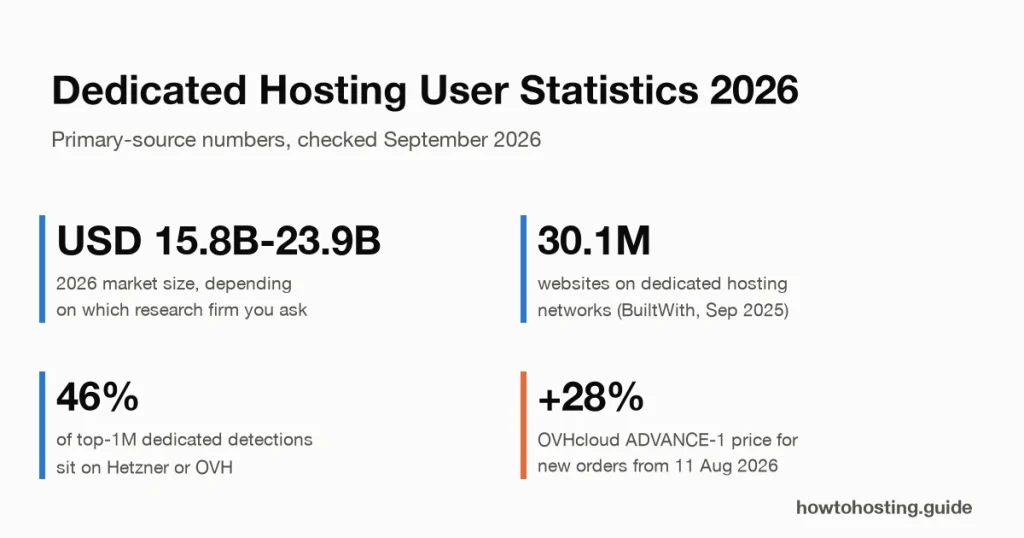
- BuiltWith counted 30,149,148 websites on dedicated hosting networks in its 26 September 2025 update, 44.9% of them in the US.
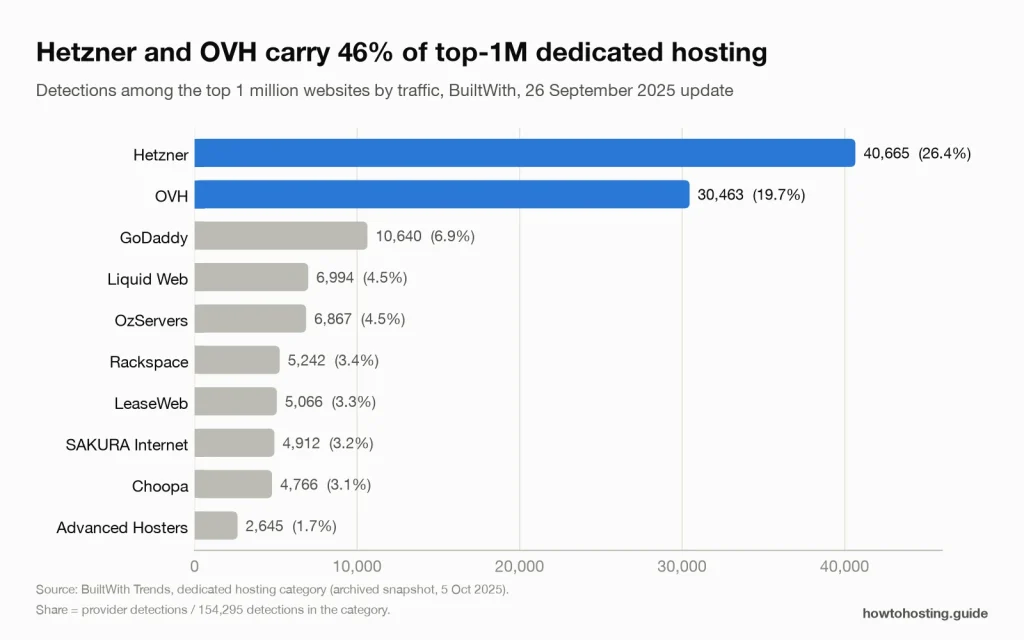
- Hetzner and OVH carry 46.1% of dedicated hosting detections among the top 1 million websites, per BuiltWith.
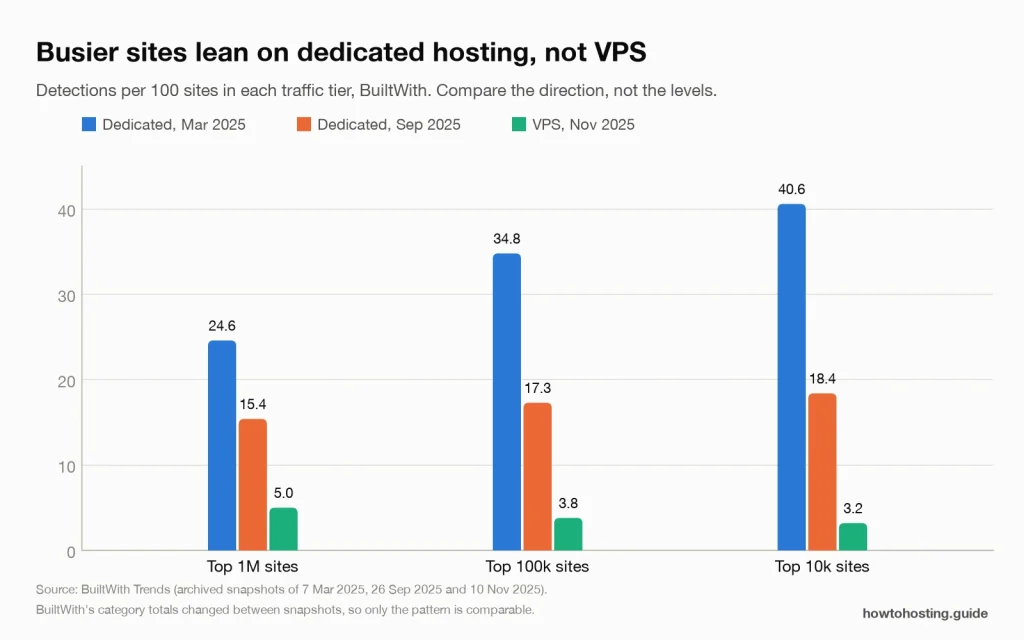
- In BuiltWith’s data, busier sites use dedicated hosting more: 18.4 detections per 100 sites in the top 10,000, against 15.4 in the top 1 million.
- Conventional DRAM contract prices rose 93% to 98% in Q1 2026, according to memory analyst TrendForce.
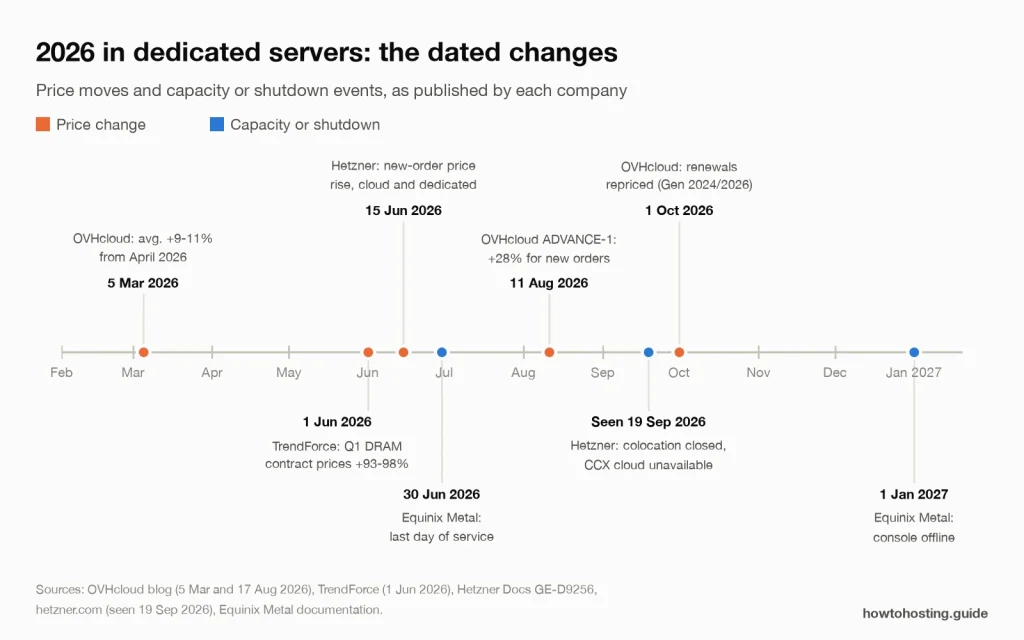
- OVHcloud raised its ADVANCE-1 dedicated server 28% for new orders on 11 August 2026.
- Hetzner raised new-order prices on all its dedicated servers and cloud plans on 15 June 2026.
- On 19 September 2026, the cheapest in-stock OVHcloud dedicated server cost USD 20 a month plus a USD 20 setup fee.
Last reviewed: September 2026. Prices and features verified.
How We Sourced These Numbers
Every figure below had to pass one test: we could trace it to the organization that produced it. Market-size numbers come from the research firms’ own report pages or press releases, with each edition date shown. We dropped any figure that only appears on hosting blogs quoting each other. That cut one widely repeated market-size number (more on that below).
Usage counts come from BuiltWith, a web technology tracker. Its live pages block automated reading, so we used archived snapshots and give each one’s “last updated” date.
Prices were read on 19 September 2026 from provider price lists, pricing APIs and official price-change notices. Where a provider publishes only euros, as with OVHcloud’s ADVANCE-1, we converted at the European Central Bank reference rate of 1.1460 from 18 September 2026. A price change only made the list if the provider published its date and its size.
Limitations, honestly stated: we didn’t buy the paid market reports, so segment shares behind their paywalls aren’t here. We ran no benchmarks. BuiltWith’s newest snapshot we could read is a year old, and its categories count provider networks rather than confirmed dedicated plans.
Market Size: USD 15.8 Billion or USD 23.94 Billion, Depending on Who You Ask
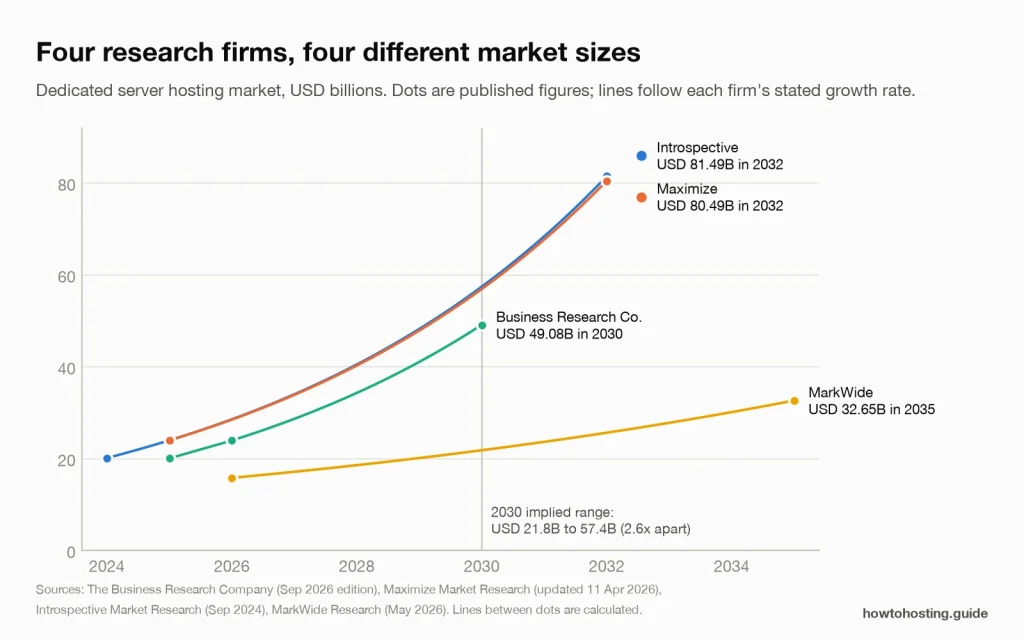
We found four research firms whose dedicated server hosting forecasts we could read on their own pages. One of those editions dates from 2024. They don’t agree on much beyond “growing”.
- The Business Research Company (September 2026 edition): USD 20.04 billion in 2025 and USD 23.94 billion in 2026. It forecasts USD 49.08 billion by 2030, growing 19.7% a year. North America was the largest region in 2025; Asia-Pacific grows fastest.
- MarkWide Research (May 2026): USD 15.8 billion in 2026, rising to USD 32.65 billion by 2035 at 8.40% a year.
- Maximize Market Research (updated 11 April 2026): USD 23.96 billion in 2025, reaching USD 80.49 billion by 2032 at 18.9% a year.
- Introspective Market Research (September 2024): USD 20.13 billion in 2024, reaching USD 81.49 billion by 2032 at 19.1% a year.
Why the spread? The firms define the market differently. MarkWide counts colocation as a segment, meaning rack space rented for your own hardware. The Business Research Company and Maximize both count on-premises deployments. That probably explains most of the gap, though the free summaries don’t give enough detail to prove it.
We ran each firm’s stated growth rate forward to 2030, a year three of the four don’t publish. The implied 2030 market lands anywhere from about USD 21.8 billion (MarkWide) to USD 57.4 billion (Introspective). That’s a 2.6x gap for the same market, four years out. If you’re quoting a single number in a pitch deck, name the firm and the edition next to it.
The USD 29.6 Billion Figure Doesn’t Hold Up
Several hosting statistics pages repeat one market figure: USD 29.6 billion by 2026, up from USD 16.95 billion in 2023. It comes with a claimed 18.9% annual growth rate. Our own 2025 version of this page used it (not our finest research moment).
We couldn’t trace it to any named report. Its arithmetic fails too: USD 16.95 billion growing 18.9% a year for three years gives USD 28.49 billion. Treat it as unsourced.
How Many Websites Run on Dedicated Hosting?
BuiltWith’s 26 September 2025 update counted 30,149,148 detections of dedicated hosting across the whole web. Among the top 1 million sites by traffic, it found 154,295. The top 100,000 held 17,283, the top 10,000 held 1,836, and the top 1,000 held 142.
Read those numbers with one caveat. BuiltWith assigns whole provider networks to a category, not individual plans. GoDaddy’s 10,640 top-1M sites appear in BuiltWith’s dedicated list and, with the identical count, in its VPS list.
So “dedicated hosting” here means “hosted on a network BuiltWith files under dedicated”. That counts shared and VPS sites on those networks, and misses dedicated servers on networks filed elsewhere. Treat it as a rough gauge, not a census.
Watch the totals, too, because they move in ways real usage doesn’t. BuiltWith’s 7 March 2025 update showed 43,176,112 detections, so the count fell 30% in six months. Over the same period, the US count rose 16%, from 11.70 million to 13.53 million. A swing that size, in opposite directions, looks like BuiltWith re-tagging networks rather than 13 million sites moving. BuiltWith doesn’t publish a changelog, so we can’t confirm the cause.
One pattern survives both snapshots, though. The busier the site, the more likely it sits on a dedicated hosting network:
- September 2025: 15.4 detections per 100 sites in the top 1M, 17.3 in the top 100k, 18.4 in the top 10k
- March 2025: 24.6, 34.8 and 40.6 for the same three tiers
- VPS hosting (10 November 2025) runs the other way: 5.0, 3.8 and 3.2
Only the very top breaks the pattern. In September 2025, the top 1,000 sites dropped back to 14.2 per 100 (March’s snapshot has no top-1,000 figure). BuiltWith’s data doesn’t say why.
Dedicated Hosting Statistics by Country
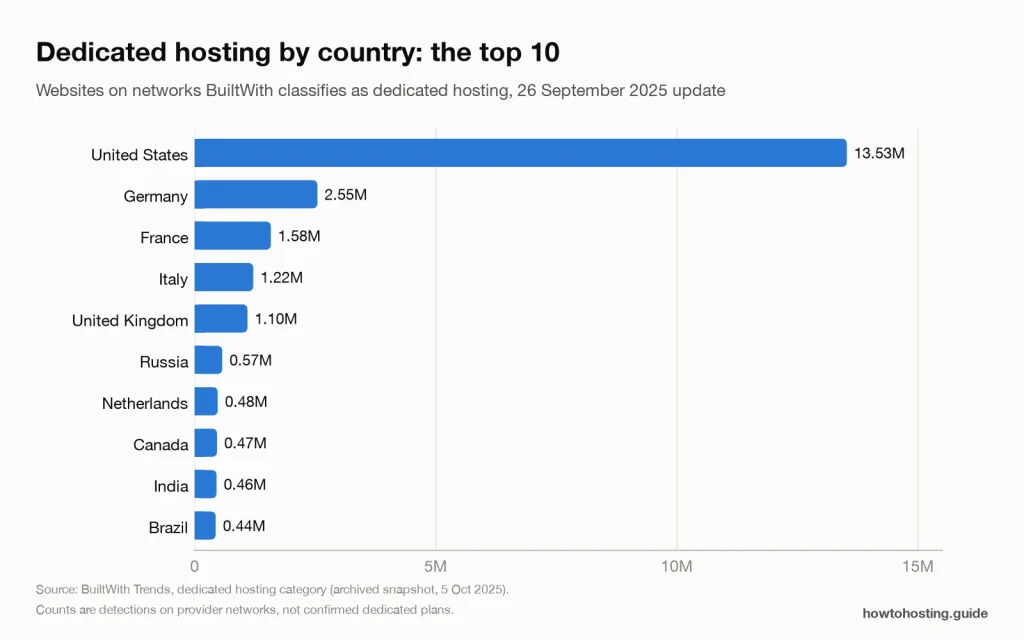
With 13,525,606 detections in BuiltWith’s September 2025 update, the United States leads by a wide margin. That’s 44.9% of the global total. Europe fills the next four places:
- Germany: 2,547,711
- France: 1,581,440
- Italy: 1,217,398
- United Kingdom: 1,097,708
- Then Russia (574,620), the Netherlands (480,568), Canada (465,315), India (455,571) and Brazil (437,549)
March 2025 showed the same top five in the same order, so trust the ranking more than the raw counts. Together, Germany, France, Italy and the UK account for 6.44 million detections, or 21.4% of the world total.
Here’s the odd part. France has 69 dedicated hosting detections for every VPS detection (1,581,440 against 22,790). Germany’s ratio is 4.4 to 1, and the US sits at 2.0 to 1.
The likeliest explanation is BuiltWith’s tagging, not French taste. OVH, based in France, runs a huge network that BuiltWith files under dedicated hosting, and that network alone would inflate the national count. Hetzner would do the same for Germany, its home market, and it also rents servers from a data center in Helsinki, Finland. If you’re shortlisting providers in the region, our guide to dedicated hosting in Europe compares them on price and location.
Who Hosts Them: Hetzner and OVH Lead
Two European companies dominate the category among busy sites. In the top 1 million, Hetzner accounts for 40,665 dedicated hosting detections (26.4%) and OVH for 30,463 (19.7%). Together that’s 46.1% of the category. In March 2025 the pair held 44.5%, so their lead isn’t an artifact of one snapshot.
Everyone else in the top 10 is far smaller. GoDaddy has 10,640, Liquid Web 6,994 and OzServers 6,867. Rackspace (5,242), LeaseWeb (5,066), SAKURA Internet (4,912), Choopa (4,766) and Advanced Hosters (2,645) follow. GoDaddy’s number, again, is the same one BuiltWith lists under VPS.
Their size helps explain the gap. OVHcloud says it runs over 500,000 servers in 46 data centers across four continents, according to its April 2026 half-year results. Hetzner’s cloud page claims more than 400,000 customers.
Hetzner’s colocation page says it is “unable to provide data center space for colocation until further notice.” It blames “high growth in the cloud and bare metal server sectors.” In plain terms, Hetzner is turning away rack-space customers to keep room for its own servers.
Not every big name stayed in. Equinix shut down its Equinix Metal bare metal service on 30 June 2026. It had announced the end of sale on 7 November 2024, almost 20 months earlier. Its console goes offline on 1 January 2027.
Who Uses Dedicated Servers in 2026
Research firms’ free summaries agree on one thing: Linux holds the largest share of dedicated servers. Both Maximize Market Research and Introspective Market Research say so. Maximize adds that managed hosting took the largest share of 2025 demand. Only Introspective names a leader by company size. It says small and medium businesses hold the largest share, without publishing the number.
The same industries recur across the reports: banking and finance, IT and telecom, e-commerce or retail, healthcare and government. Two of them also name gaming, and The Business Research Company gives online gaming its own end-user segment.
Provider data is more concrete than any of that. OVHcloud’s half-year results (1 September 2025 to 28 February 2026) show three things about its customers:
- New customers grew 116% on VPS but 12% on bare metal, after it repositioned its entry-level offers
- Existing customers spent more: net revenue retention, their spending against a year earlier, reached 104%
- Blockchain companies are a real buyer group. Alchemy, a Web3 infrastructure firm, now runs on over 2,000 OVHcloud bare metal servers
OVHcloud also said it’s copying the sales approach that won blockchain customers into other technical sectors. That hints at where OVHcloud expects bare metal growth: specialist workloads rather than ordinary websites.
And the cloud users these providers court? Flexera’s 2026 State of the Cloud survey of 753 decision-makers found 85% name managing cloud spend as a top challenge. Estimated wasted cloud spend rose to 29%, the first increase in five years. Nearly three in four organizations (73%) run hybrid setups, mixing public cloud with private or on-premises servers. That’s the audience a fixed monthly server bill is pitched at.
What a Dedicated Server Costs in September 2026
“How much does a dedicated server cost?” is one of the questions Google lists under “People also ask” for this topic. Here are eight price points we checked on 19 September 2026, cheapest first:
- OVHcloud Kimsufi KS-4: USD 20 a month plus a USD 20 installation fee, so the first month costs USD 40. The cheaper KS-B (USD 10) and KS-C (USD 12) showed “Coming Soon”.
- InMotion Aspire: USD 35.00 a month on a 12-month term, renewing at USD 49.99 (1.43x). It runs a Xeon E3-1246 v3.
- Hetzner Server Auction: from USD 68.90 (EUR 61.70) a month, no setup fee. Auction servers were exempt from Hetzner’s June price rise.
- InMotion Essential: USD 99.99 a month, and it renews at the same price.
- Hetzner AX42: USD 119.00 (EUR 99.00) a month plus a USD 59 (EUR 49) setup fee. That buys an 8-core Ryzen 7 PRO 8700GE with 64 GB of DDR5 memory.
- Contabo AMD Ryzen 12 Cores (Ryzen 9 7900, 64 GB): USD 131.75 a month on a 12-month term. Month to month, it’s USD 155 (EUR 129).
- OVHcloud ADVANCE-1 (Gen 2024): USD 131.78 (EUR 114.99) a month for new orders since 11 August.
- Liquid Web, fully managed: from USD 205.70 a month on a two-year term with 15% off. The undiscounted price isn’t published.
Two costs hide in that list. The first is setup fees, which double the first-month bill on OVHcloud’s Kimsufi range and add half a month on Hetzner’s AX42.
The second is management. InMotion sells the same Essential tier, on a Xeon E-2134, for USD 99.99 unmanaged or USD 218.98 with Premier Care. That’s 2.19x, and InMotion’s own card values the bundled cPanel license alone at USD 58.99 a month. Our cheap dedicated server comparison covers the sub-USD 100 end in more depth.
The 2026 Memory Shock Behind Higher Prices
A dedicated server bills you for all of its memory, so RAM prices hit this product harder than shared hosting. And RAM got much dearer, fast. TrendForce, a memory market analyst, reported that conventional DRAM (standard memory chips) contract prices rose about 93% to 98% in Q1 2026 alone. It forecast another 58% to 63% for Q2.
The climb is slowing, not reversing. On 9 July 2026, TrendForce forecast server DRAM contract prices would rise a further 13% to 18% in Q3. Several US cloud giants have locked in multi-year supply deals that cap their increases. TrendForce expects price pressure to shift to buyers without those deals. It also projects server memory supply growing only 15% to 20% in 2027.
Providers passed it on in stages:
- On 5 March 2026, OVHcloud’s founder Octave Klaba wrote that he expected RAM to cost 250% to 300% more by end-2026 than in September 2025. From April, OVHcloud raised prices on services deployed from 2026 by 9% to 11% on average. It doesn’t expect a return to normal before 2029.
- Hetzner raised monthly prices for all new dedicated server and cloud orders on 15 June 2026, while cutting most setup fees. Running contracts and Server Auction machines kept their old rates.
- OVHcloud’s August update said “DDR5 RAM now costs six times as much as it did a year ago.” RAM options for new orders rose between 68% and 652%.
Hetzner’s published before-and-after table shows the split ran by processor, not by plan type. Intel-based shared cloud plans rose 31% to 38%, and Arm plans 30% to 33%. AMD plans jumped far more. Shared CPX plans rose 144% to 175%, and CCX plans with dedicated vCPUs (processor threads reserved for you) rose 113% to 173%.
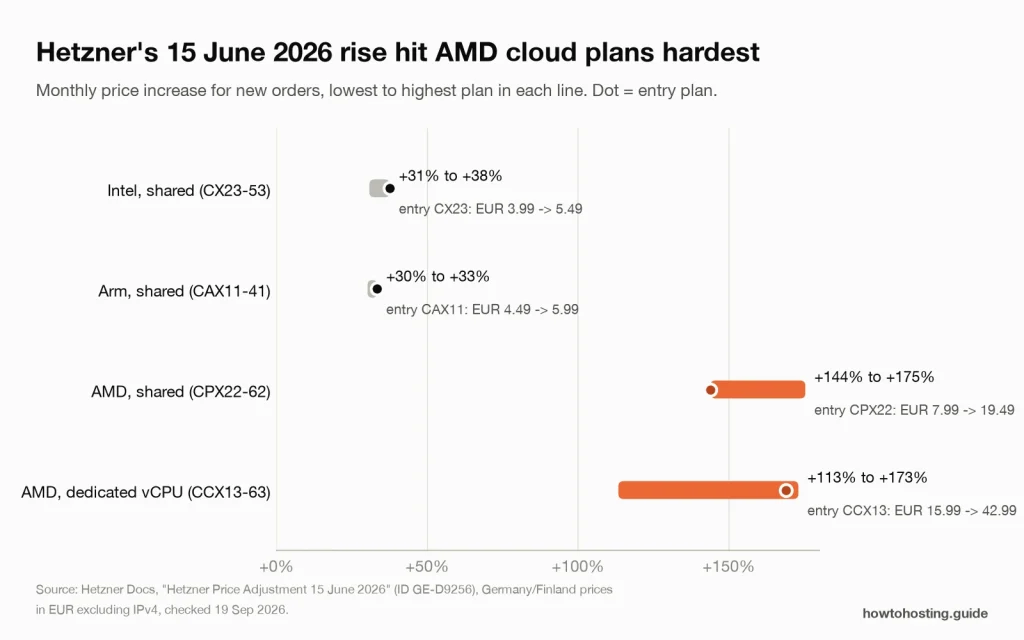
On 15 June 2026, Hetzner raised its CCX13 dedicated-vCPU cloud plan from USD 18.49 to USD 50.49 a month for new orders. In euros, that’s EUR 15.99 to EUR 42.99, a 169% rise.
OVHcloud raised its ADVANCE-1 bare metal server from USD 103.13 to USD 131.78 (EUR 89.99 to EUR 114.99) for new orders on 11 August 2026. Existing OVHcloud Advance, Game, Scale and High Grade servers get repriced at renewal from 1 October 2026. The Kimsufi, So you Start and Rise ranges are unaffected.
Bare Metal vs Cloud: Where the Numbers Point
Hetzner’s June repricing produced a result worth knowing before you buy. In Hetzner’s own table (both prices exclude IPv4), the AX42-1 bare metal server costs USD 117.10 (EUR 97.30) a month. The CCX33 cloud server, with 8 dedicated vCPUs and 32 GB of RAM, now costs USD 162.99 (EUR 138.49). The physical machine is 28% cheaper and carries twice the memory, with 8 full cores rather than 8 vCPUs.
Before 15 June, that same CCX33 cost EUR 62.49, so its price more than doubled. There’s a second problem today: on 19 September 2026, every CCX plan from CCX13 to CCX63 showed “This product is currently unavailable” on Hetzner’s site. For steady, always-on workloads at this provider, bare metal is now both the cheaper option and the one you can order today. Our dedicated server vs VDS comparison runs the same test across other providers.
Our read of the wider market (an opinion, not a measurement): bare metal is consolidating around specialist hosts, not disappearing. Equinix left, but Hetzner is short of floor space and OVHcloud signed up more new bare metal customers than a year earlier. We’d expect the buyers who stay to be those with sustained load, where hourly cloud billing stops paying off.
How to Use These Numbers Before You Buy
Statistics only help if they change a decision. Four situations where they should:
Budget under USD 50 a month, and you run Linux yourself? Order OVHcloud’s Kimsufi KS-4 at USD 20 a month, and budget USD 40 for month one because of the installation fee. Expect a Xeon E3-1230 v6 and a 300 to 500 Mbps port. InMotion’s Aspire costs USD 35 but renews at USD 49.99, so over a second year it costs 2.5x the KS-4. Skip the USD 10 KS-B unless it’s actually in stock; a “Coming Soon” price isn’t a price.
Workload: steady 8-core load on a dedicated-vCPU cloud plan. Move to Hetzner’s AX42. Going by Hetzner’s price table, the AX42-1 costs USD 117.10 before IPv4, against USD 162.99 for the CCX33. That’s USD 45.89 a month less with twice the RAM, so the USD 59 setup fee pays for itself in the second month. Stay on cloud only if you use hourly scaling, and check that CCX capacity exists first.
Team: no Linux admin, and nobody who knows cPanel. At InMotion, paying for management costs about 2.2x the bare server: USD 218.98 for Premier Care Essential, against USD 99.99 unmanaged. If one person on your team can patch a server, unmanaged saves USD 118.99 a month, or USD 1,427.88 a year. Keep cPanel, though, and about half that saving goes on the license, which InMotion values at USD 58.99 a month.
Renewal due after 1 October on an OVHcloud Advance, Game, Scale or High Grade server. Expect the new rate: the base ADVANCE-1 renews at USD 131.78 (EUR 114.99), the same as a new order. RAM you already have installed renews 20% higher on Gen 2024 servers and 40% higher on Gen 2026. Before renewing, price Hetzner’s Server Auction: it starts at USD 68.90 and skipped the June rise, but hardware varies, so match the specs. If you need OVHcloud’s network specifically, look at the Rise range, which the August update left out.
Frequently Asked Questions
How much does a dedicated server cost per month in 2026?
Entry servers start around USD 20 a month, like OVHcloud’s Kimsufi KS-4, plus a matching setup fee. Mid-range unmanaged servers in our list run USD 100 to USD 135, such as Hetzner’s AX42 at USD 119.00. Fully managed servers with cPanel start near USD 200, such as InMotion’s Premier Care at USD 218.98.
Who is the largest dedicated server provider?
By websites hosted, Hetzner leads. BuiltWith counted 40,665 Hetzner detections among the top 1 million sites in September 2025, ahead of OVH’s 30,463. OVHcloud reports over 500,000 servers across 46 data centers, and we found no comparable server count from Hetzner.
How many websites use dedicated hosting?
BuiltWith counted 30,149,148 detections on dedicated hosting networks in its 26 September 2025 update, including 154,295 among the top 1 million sites. Treat it as a rough gauge. BuiltWith counts websites on provider networks it tags as dedicated, not confirmed dedicated plans.
Are dedicated server prices going up in 2026?
Yes. Hetzner raised prices on all new dedicated and cloud orders on 15 June 2026. OVHcloud raised its ADVANCE-1 by 28% for new orders on 11 August and reprices renewals from 1 October. Both blame rising hardware costs, and TrendForce still expects server DRAM to rise 13% to 18% in Q3.
Is a Hetzner dedicated server cheaper than a Hetzner cloud server?
Yes, for 8 cores. Hetzner’s own table prices the AX42-1 bare metal server, with 64 GB of RAM, at USD 117.10 a month. The 32 GB CCX33 cloud plan with 8 dedicated vCPUs costs USD 162.99. Cloud still suits short, bursty jobs, but every CCX plan showed as unavailable on 19 September 2026.
Final Verdict
The dedicated hosting market is growing, but nobody agrees how big it is. Published 2026 estimates run from USD 15.8 billion to USD 23.94 billion, and the forecasts sit 2.6x apart by 2030. The steadier facts come from usage data. Hetzner and OVHcloud carry nearly half of the dedicated hosting detections among the top 1 million sites. In BuiltWith’s data, busier sites also lean on dedicated hosting more than smaller ones do.
2026’s real story is cost. Memory prices roughly doubled in a single quarter, and both OVHcloud and Hetzner repriced new orders. Yet at Hetzner, the bare metal box came out of it looking better, not worse, against cloud servers with dedicated vCPUs. If your workload runs around the clock, the numbers we checked favor renting the whole machine.
For provider picks built on these numbers, start with our list of the best dedicated hosting providers. Since the US holds 45% of dedicated hosting detections, our dedicated server USA guide is the natural next read for American buyers.