
Su questa pagina: [nascondere]
Il server cloud CPX52 di Hetzner costa EUR 36.49 un mese dopo 14 giugno 2026. La mattina dopo costava EUR 100.49. I prezzi di listino del cloud hanno trascorso due decenni andando in una direzione, giù. Quest'anno hanno voltato pagina. Di seguito sono riportati i numeri di hosting cloud che potremmo risalire a chi li ha pubblicati. Dimensione del mercato, chi effettivamente ospita il web, quanto costa un server oggi. Una cifra popolare si è rivelata essere una previsione di cinque anni fa.
Risposta rapida: La spesa per il cloud sta crescendo più velocemente che in qualsiasi momento degli ultimi otto anni, ma il denaro e i siti web si stanno spostando verso posti diversi. Queste sono le cifre che reggono:
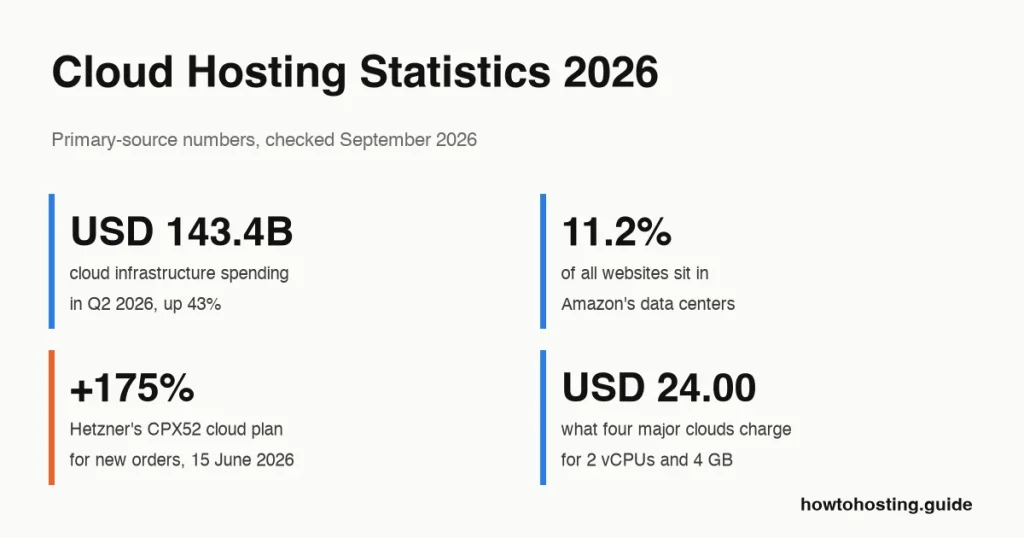
- Le imprese hanno speso USD 143.4 miliardi di dollari in servizi di infrastruttura cloud nel secondo trimestre 2026, su 43% un anno prima, secondo il gruppo di ricerca Synergy.
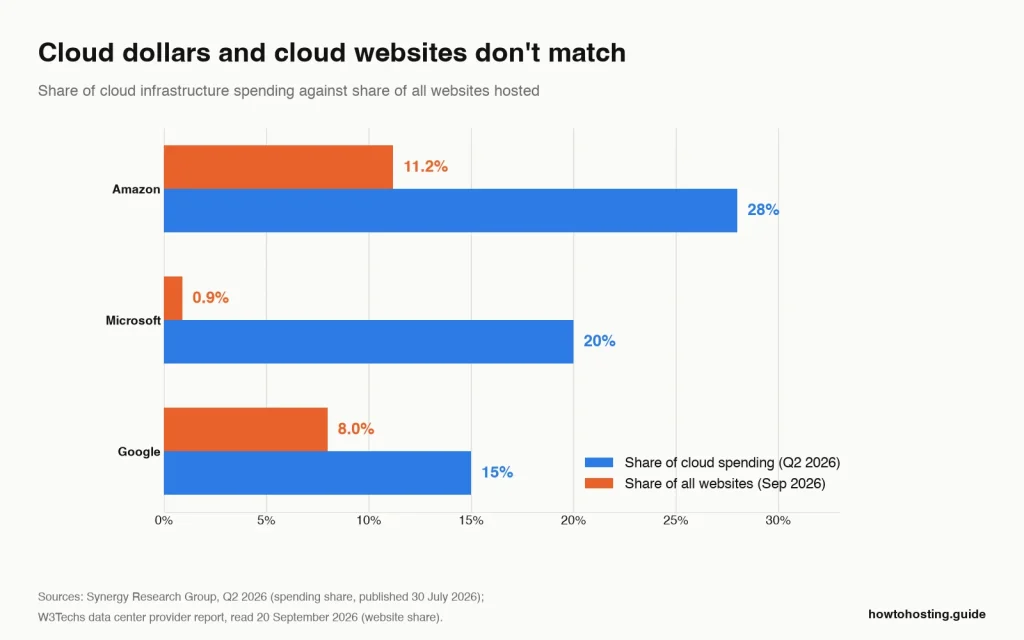
- Amazon prende 28% di quella spesa, Microsoft 20% e Google 15%.
- Amazon è il fornitore di data center per 11.2% di tutti i siti web, Google per 8.0% e Microsoft per 0.9%, per W3Techs su 20 settembre 2026.
- Hetzner ha aumentato i prezzi su ogni piano cloud per i nuovi ordini 15 giugno 2026. Il suo CPX52 è salito 175% in euro.
- A partire dal 1 ottobre 2026, OVHcloud fattura lo storage locale e l'IPv4 pubblico come linee separate nella sua Generazione 3 istanze.
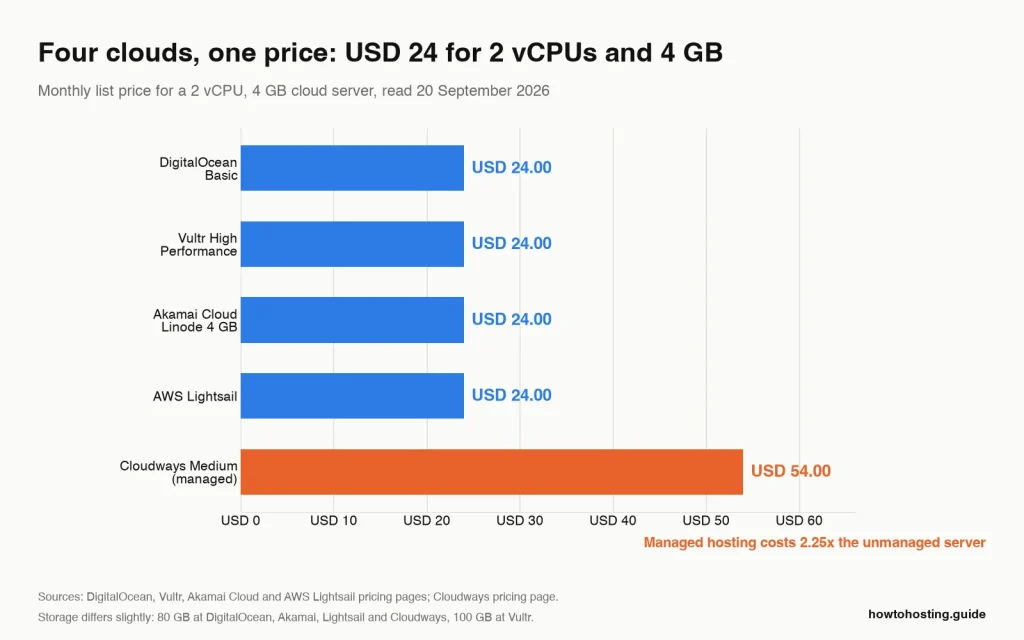
- Quattro grandi nuvole si caricano esattamente Dollaro statunitense 24.00 un mese per un 2 vCPU, 4 serverGB: DigitalOcean, Vultr, Akamai Cloud e AWS Lightsail.
- La marcia di Flexera 2026 sondaggio di oltre 750 i decisori del cloud attribuiscono la spesa sprecata al cloud 29%, il primo aumento in cinque anni.
Ultima revisione: settembre 2026. Prezzi e caratteristiche verificate.
Da dove vengono i numeri
Una regola ha deciso cosa ha reso questa pagina: dovevamo raggiungere l'organizzazione che ha prodotto la figura, non c'è un blog che lo cita. I dati di mercato provengono dai comunicati trimestrali di Synergy Research Group e dai comunicati stampa di Gartner, ciascuno con indicata la data di pubblicazione. Tutto ciò che potevamo trovare solo nei riepiloghi statistici è stato tagliato, inclusa una figura utilizzata dalla nostra versione precedente di questa pagina.
I conteggi a livello di sito Web provengono da W3Tech, che sondaggi più di 20 milioni di siti estratti dal report sull'esperienza utente di Chrome e da un elenco Tranco personalizzato. I suoi report si aggiornano quotidianamente, quindi ogni figura W3Techs qui riportata porta la data in cui l'abbiamo letta: 20 settembre 2026.
I prezzi sono stati letti lo stesso giorno dalle pagine dei prezzi del fornitore, avvisi di variazione dei prezzi e un'API per i prezzi dei fornitori. Dove un fornitore pubblica solo euro, diamo la cifra in euro invece di convertirla. Una data di conversione diventa obsoleta più velocemente del prezzo.
Ora i limiti. Non abbiamo acquistato alcun rapporto di mercato a pagamento, quindi le divisioni dei segmenti dietro i paywall non sono qui. Non abbiamo eseguito benchmark né monitoraggio dei tempi di attività. W3Techs conta la rete a cui si risolve un sito. Acquista da un rivenditore che funziona su Amazon, e il tuo sito conta come Amazon in una tabella. Nell'altro, conta come rivenditore. Quella stranezza si rivela utile, e c'è un'intera sezione sull'argomento qui sotto.
Quanto è grande il mercato del cloud in? 2026?
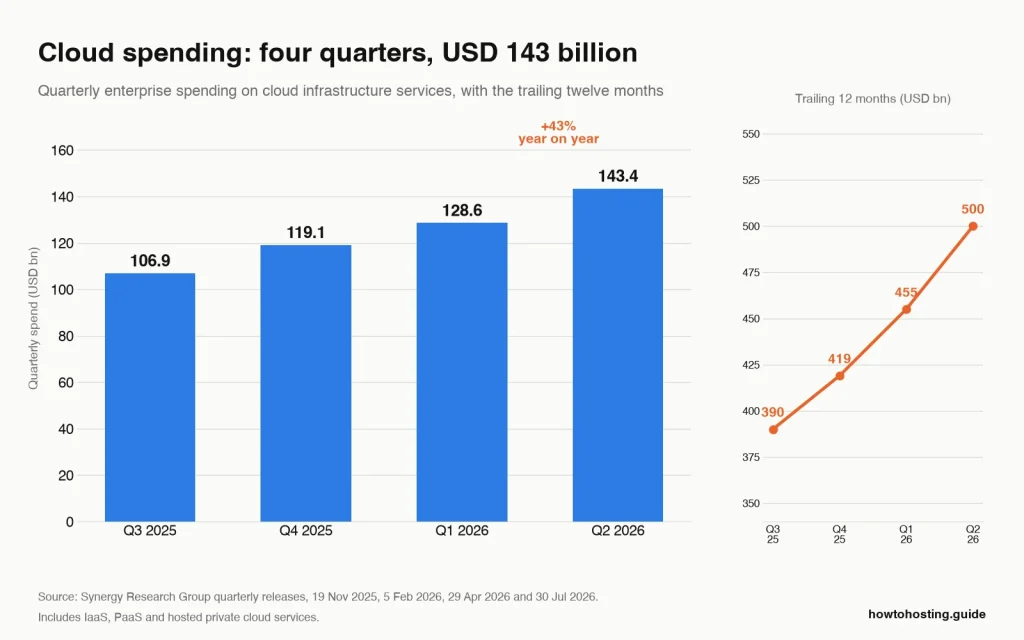
Gruppo di ricerca sulla sinergia, ora parte di TechInsights, metti Q2 2026 spesa aziendale per servizi di infrastruttura cloud a Dollaro statunitense 143.4 miliardo. Si tratta di un balzo superiore a quello dell’USD 43 miliardi dal secondo trimestre 2025, e un tasso di crescita anno su anno di 43%. È stato l'undicesimo trimestre consecutivo in cui il tasso di crescita è aumentato. Nel corso di quegli undici trimestri il mercato è raddoppiato.
Ecco la corsa trimestrale, tutto dalle versioni di Synergy:
- Q3 2025: Dollaro statunitense 106.9 miliardo, ultimi dodici mesi USD 390 miliardo
- Q4 2025: Dollaro statunitense 119.1 miliardo, su 30%, chiusura 2025 a USD 419 miliardo
- Q1 2026: Dollaro statunitense 128.6 miliardo, su 35%, ultimi dodici mesi USD 455 miliardo
- Q2 2026: Dollaro statunitense 143.4 miliardo, su 43%, ultimi dodici mesi Dollaro statunitense 500 miliardo
Gartner conta una fetta più stretta e ottiene una risposta più piccola. Suo 27 luglio 2026 previsione stima la spesa mondiale per le infrastrutture come servizi in USD 287 miliardi di 2026. Questo è tutto 29.3% da USD 222 miliardi di 2025. USD di Synergy 500 miliardi comprende anche servizi di piattaforma e cloud privato ospitato, che Gartner archivia altrove. Entrambi hanno ragione. Stanno misurando cose diverse, quindi nomina l'azienda ogni volta che ne citi uno.
Qualcosa in quella versione di Gartner è facile da perdere. Nel mese di aprile 2026 previsione, IaaS era ancora raggruppato in un'unica linea di servizi IT del valore di USD 1.87 trilioni. A luglio aveva la sua fila. Quindi, se hai in mano un 2026 previsione delle nuvole accanto a una precedente, controlla dove si trovava IaaS in ciascuno.
Hardware, non servizi cloud, è la linea Gartner in più rapida crescita. La spesa per i sistemi di data center è prevista in USD 822 miliardi di 2026, su 62.5%. Si tratta di più del doppio del tasso di crescita dei servizi cloud venduti in aggiunta. In questi dati, questo è il segnale più chiaro che il 2026 Il problema dei costi inizia nella catena di fornitura.
L'USD 947.3 La cifra di un miliardo è a 2021 Previsione
Le pagine delle statistiche del cloud adorano un numero: Dollaro statunitense 947.3 miliardi di 2026, crescente 16.3% un anno. La nostra versione precedente di questa pagina lo conteneva, senza data allegata.
Fa risalire a un comunicato stampa di MarketsandMarkets pubblicato su 28 ottobre 2021, prevedendo il 2021-2026 finestra da una base di USD 445.3 miliardo. L'aritmetica va bene. Il problema è l'annata. È stato scritto prima che l’intelligenza artificiale generativa rimodellasse la domanda del cloud. Il 16.3% la crescita ipotizzata è inferiore alla metà 43% Sinergia misurata nel secondo trimestre 2026. Se vedi USD 947.3 miliardi quotati 2026, controlla se la pagina ti dice che è a 2021 previsione. La maggior parte no.
Quota di mercato: Amazon 28%, Microsoft 20%, Google 15%
La sinergia 30 luglio 2026 pubblicazione dà il secondo trimestre in tutto il mondo 2026 azioni di 28% per Amazon, 20% per Microsoft e 15% per Google. Insieme, questo è 63% di tutti i servizi di infrastruttura cloud. Restringi la definizione a IaaS e PaaS pubblici e prendiamo gli stessi tre 67%. PaaS è una piattaforma come servizio: i database gestiti e i runtime delle app venduti su server grezzi.
Tieni traccia della tendenza e Google è quello che si muove. La sua quota è andata avanti in quattro trimestri di Synergy 13%, 14%, 14%, 15%. Amazon è andato 29%, 28%, 28%, 28%. Microsoft si è seduta a 20% o 21% per tutto. Amazon non si sta restringendo. Sta crescendo più lentamente di un mercato in espansione 43% un anno.
Di seguito i primi tre, i nuovi arrivati sono la storia. Nove società neocloud, i fornitori GPU-first creati per la formazione sull'intelligenza artificiale, ora siediti tra i primi 40 fornitori di servizi cloud in base ai ricavi dell'infrastruttura. La sinergia nomina CoreWeave, OpenAI, Oracolo, Crusoe, Non lo farò, Anthropic e Nscale tra i coltivatori più rapidi. Nel primo trimestre 2026 ha messo i neoclouds all'incirca 5% del mercato totale. I servizi cloud specifici di GenAI sono cresciuti 165% anno su anno nel secondo trimestre.
I fornitori europei detengono una fetta molto più piccola in patria. La sinergia 24 luglio 2025 analisi mettono i fornitori europei a circa 15% del mercato cloud europeo, giù da 29% in 2017. Amazon, Microsoft e Google prendono 70% tra loro.
Quanti siti web vengono eseguiti su cloud hosting?
La spesa ti informa sui carichi di lavoro aziendali. Dice molto poco sui siti web. Per questo, W3Techs è la misura migliore, perché controlla dove si trova effettivamente il server di un sito.
Su 20 settembre 2026, la tabella dei fornitori del data center è letta così:
- Amazon: 11.2% di tutti i siti web
- Google: 8.0%
- Hostinger: 5.2%
- OVH: 2.7%, Internet unita: 2.7%, Squarespace: 2.5%
- Hetzner: 2.4%, team.blue: 2.1%, Gruppo GoDaddy: 1.9%
- DigitalOcean: 1.5%, Oracolo: 1.4%, Microsoft: 0.9%
Aggiungi insieme i quattro hyperscaler, Amazon, Google, Oracle e Microsoft, e tu ottieni 21.5% di siti web. Si tratta di circa un sito su cinque su infrastrutture di proprietà di un’azienda che vende anche sistemi di intelligenza artificiale. Gli altri quattro su cinque lavorano con società di hosting, costruttori di siti e fornitori regionali.
Microsoft è l’anomalia che vale la pena guardare. Azure guadagna un dollaro cloud su cinque e appare sotto 1% di siti web. È una piattaforma per carichi di lavoro aziendali, non una piattaforma web. Per chiunque acquisti per l'hosting, la sua quota di mercato è il numero sbagliato di cui preoccuparsi.
I dollari cloud e i siti Web cloud sono due mercati diversi
Metti i due tavoli fianco a fianco e il divario sarà difficile da nascondere. W3Techs ne pubblica due. Uno registra in quale struttura si trova il server. Gli altri record che hanno venduto l'hosting. Lo stesso giorno, stesso campione.
- Amazon: 11.2% come fornitore di data center, 4.5% come fornitore di hosting
- Google: 8.0% come fornitore di data center, 1.7% come fornitore di hosting
- Hetzner: 2.4% e 2.1%, quasi identico
- Hostinger: 5.2% e 5.2%, identico
Fai la divisione e 60% dei siti ospitati su Amazon hanno acquistato il loro hosting da qualcun altro. Per Google lo è 79%. Hetzner e Hostinger possiedono i loro scaffali e vendono direttamente, quindi i loro due numeri corrispondono.
I rivenditori compaiono dall'altra parte del registro. Shopify è il più grande provider di web hosting singolo su 5.4% dei siti Web e non appare da nessuna parte nella tabella del data center. Vercel tiene 2.1% come fornitore di hosting e inoltre non ha accesso al data center. Entrambi funzionano sull’infrastruttura di altre persone. Una piattaforma gestita come Cloudways fa apertamente la stessa cosa. Rivende DigitalOcean, Vultr, Akamai, Capacità di AWS e Google Cloud con un pannello di controllo in alto. I nostri confronto tra hosting cloud gestito copre quello strato in dettaglio.
E allora? Due cose pratiche. Primo, “funziona su AWS” è una linea di marketing, non un elemento di differenziazione, perché più di un sito su dieci lo fa già. Secondo, acquistare da un rivenditore significa ereditare due società’ storie di interruzioni e due società’ decisioni sui prezzi. Solo uno di loro ti invia una fattura.
Cinque anni di condivisione del sito web: Chi ha guadagnato e chi è scivolato
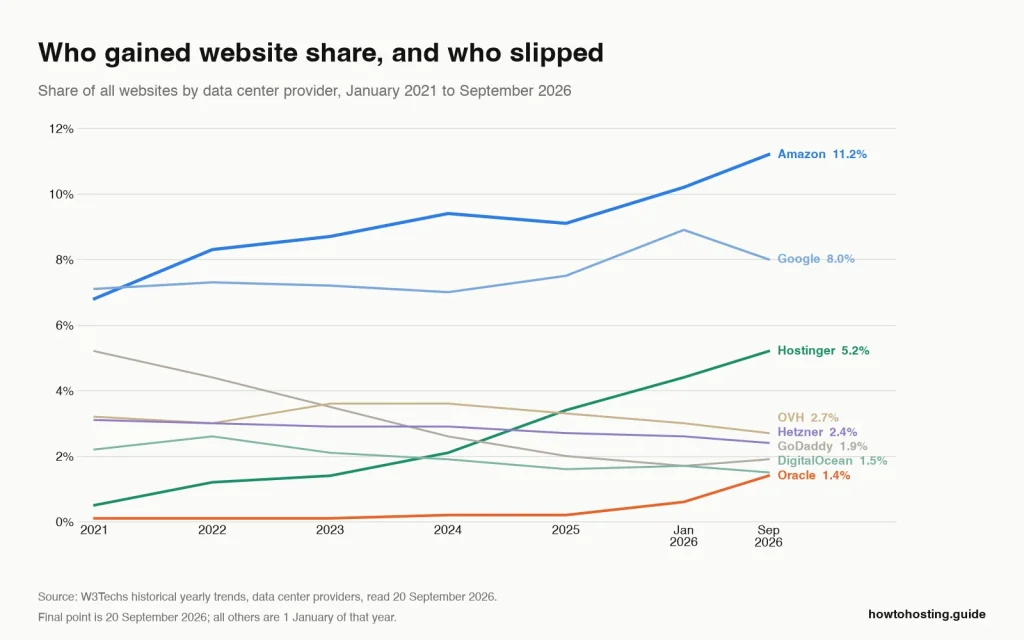
W3Techs mantiene una cronologia annuale fino a gennaio 2021, che trasforma un'istantanea in una direzione. Quota del fornitore di data center, gennaio 2021 contro 20 settembre 2026:
- Amazon: 6.8% per 11.2%
- Google: 7.1% per 8.0%
- Hostinger: 0.5% per 5.2%
- Oracolo: 0.1% per 1.4%
- Hetzner: 3.1% per 2.4%
- OVH: 3.2% per 2.7%
- DigitalOcean: 2.2% per 1.5%
- Gruppo GoDaddy: 5.2% per 1.9%
Oracle è la mossa più acuta sul tabellone. Si è seduto a 0.1% per tre gennaio consecutivi, raggiunto 0.2% a gennaio 2025, poi colpisci 1.4% entro settembre 2026. È sette volte più grande in venti mesi. Il livello gratuito di Oracle e le sue offerte di hosting AI rientrano entrambi in quella finestra, e i dati W3Techs da soli non possono separarli (abbiamo provato).
Nel frattempo i tre nomi che uno sviluppatore chiamerebbe “hosting cloud” tutto è andato indietro. Hetzner, OVH e DigitalOcean hanno perso quote di siti web mentre il mercato del cloud è raddoppiato in dollari. Le loro entrate potrebbero essere in aumento. La loro fetta del web non lo è.
Hosting cloud per paese: Dove siedono i server
W3Techs registra anche la posizione del server per i siti in cui può determinarne una. Su 20 settembre 2026 hanno tenuto gli Stati Uniti 33.0%, con la Germania seconda 15.4%.
- stati Uniti: 33.0%
- Germania: 15.4%
- Giappone: 6.0%
- Francia: 5.2%
- Olanda: 3.7%
- Russia: 3.5%, Regno Unito: 2.7%, Brasile: 2.6%, Italia: 2.2%, India: 2.0%
quello della Germania 15.4% è il numero su cui vale la pena soffermarsi. È quasi tre volte la cifra francese e più di cinque volte quella britannica. Per un paese con un’economia più piccola rispetto agli Stati Uniti o al Giappone, sono molti server. Hetzner, IONOS e un fitto campo di host regionali gestiscono tutti la capacità tedesca. Le norme tedesche sulla protezione dei dati danno agli acquirenti locali un motivo per restare. La stessa logica guida la domanda in Austria, Svizzera e il più ampio mercato dell’Europa centrale. Là, un data center dell'UE è spesso il primo filtro applicato da un acquirente.
Nuvola sovrana: La spesa europea triplica 2027
Gartner ha dato a quell'istinto un prezzo. Suo 9 febbraio 2026 previsione stima la spesa IaaS nel cloud sovrano mondiale a USD 80.4 miliardi di 2026. Questo è tutto 35.6% da USD 59.3 miliardi di 2025, e raggiunge i USD 110.6 miliardi di 2027.
L’Europa è la grande regione che si muove più velocemente. La tabella di Gartner prende la spesa IaaS nel cloud sovrano europeo dal dollaro statunitense 6.87 miliardi di 2025 a USD 12.59 miliardi di 2026. In 2027 raggiunge l'USD 23.12 miliardo. Questo è 3.4 volte in due anni, e pone l’Europa davanti al Nord America 2027, previsione in USD 21.13 miliardo. La Cina è leader in tutto, a USD 47.4 miliardi di 2026.
C’è una seconda scoperta nella stessa versione. Gartner stima che la domanda di cloud sovrano cambierà 20% dei carichi di lavoro attuali dai provider cloud globali a quelli locali, una mossa che chiama geopatriazione. Per un host regionale, questo è il numero più incoraggiante in questa pagina. Per un acquirente, significa che il fornitore locale che hai liquidato come piccolo sta per avere più clienti, ed eventualmente una lista d'attesa.

Spesa IaaS nel cloud sovrano per regione. L’Europa supera il Nord America 2027. fonte: Gartner, febbraio 2026.
Quanto costa il cloud hosting a settembre 2026
Inizia con il numero per cui le persone effettivamente vengono. La risposta onesta inizia intorno ai USD 3 al mese e non ha massimale. Prima un po' di gergo, poiché è in ogni riga sottostante. Una vCPU è un core del processore virtuale, condiviso con altri clienti a meno che il piano non lo dica. Ecco i prezzi di ingresso di cui leggiamo 20 settembre 2026, prima il più economico:
- Prestazioni regolari di Vultr, Solo IPv6: Dollaro statunitense 2.50 un mese per 1 vCPU, 0.5 GB e 10 GB di memoria. Con un indirizzo IPv4 è USD 3.50.
- DigitalOcean Basic: Dollaro statunitense 4.00 un mese per 1 vCPU, 512 MiB e 10 GiB.
- AWS Lightsail: Dollaro statunitense 5 un mese per 2 CPU virtuali, 0.5 GB, 20 GB e 1 TBC di trasferimento.
- Akamai Cloud Nanode 1 GB: Dollaro statunitense 5.00 un mese per 1 vCPU, 1 GB e 25 GB.
- HetznerCAX11: euro 5.99 un mese, in aumento rispetto all'EUR 4.49 prima 15 giugno 2026. La tabella di Hetzner lo colloca in USD 6.99, e i suoi server cloud vengono forniti senza un IPv4 pubblico, che aggiunge EUR 0.50 (Dollaro statunitense 0.60).
- Contabo Cloud VPS 4: euro 6.55 al mese IVA esclusa per un periodo di 24 mesi, per 4 Core vCPU, 8 GB e 100 GB. La pagina mostra EUR 9.41 colpito.
- Micro flessibile Cloudways: Dollaro statunitense 14 un mese per 1 vCPU, 1 GB e 25 GB di NVMe, con gestione inclusa.
Due cose si nascondono in quella lista. Il primo è l'indirizzo IPv4, che diversi fornitori ora fissano i prezzi separatamente, quindi una cifra principale che lo esclude non è il conto. La seconda è la gestione. Cloudways addebita USD 14 per un 1 serverGB. DigitalOcean vende la stessa cosa direttamente in cambio di USD 6, quindi il livello gestito costa 2.3 volte il server grezzo.
Ora confronta il simile con il simile. Chiedi quattro grandi nuvole 2 vCPU e 4 GB di RAM e citano lo stesso numero:
- DigitalOcean Basic, 4 GiB, 80 SSD GiB: Dollaro statunitense 24.00
- Vultr ad alte prestazioni, 4 GB, 100 GB NVMe: Dollaro statunitense 24.00
- Akamai Cloud Linode 4 GB, 80 GB: Dollaro statunitense 24.00
- AWS Lightsail 4 GB, 80 GB SSD: Dollaro statunitense 24
- Cloudways medio, 4 GB, 80 GB NVMe, gestito: Dollaro statunitense 54.00
Quattro cloud non gestiti, un prezzo, al centesimo. La versione gestita della specifica identica costa 2.25 volte tanto. Questo è il numero più pulito che abbiamo su quanto vale la gestione del server 2026.
Anche lo sconto europeo di queste dimensioni si è ridotto. CPX22 di Hetzner, un piano condiviso a due core, costa USD 9.49 un mese prima 15 giugno 2026 e costa USD 22.99 adesso. Un piano che si collocava ben al di sotto dell’USD 24 il cluster ora si trova proprio sotto di esso. Per la fascia di mercato inferiore a 10 USD, Nostro Confronto di hosting cloud economico lo mappa.
Il 2026 Il prezzo aumenta, Con le date
I server cloud ti fatturano tutta la loro memoria, e la memoria è diventata costosa rapidamente. OVHcloud progetta e assembla le proprie macchine, quindi vede prima quella fattura. Nel mese di agosto porre il problema in modo chiaro: “Acquistare memoria oggi ci costa sei volte di più rispetto a un anno fa.” Tre fornitori si sono trasferiti, ognuno a modo suo.
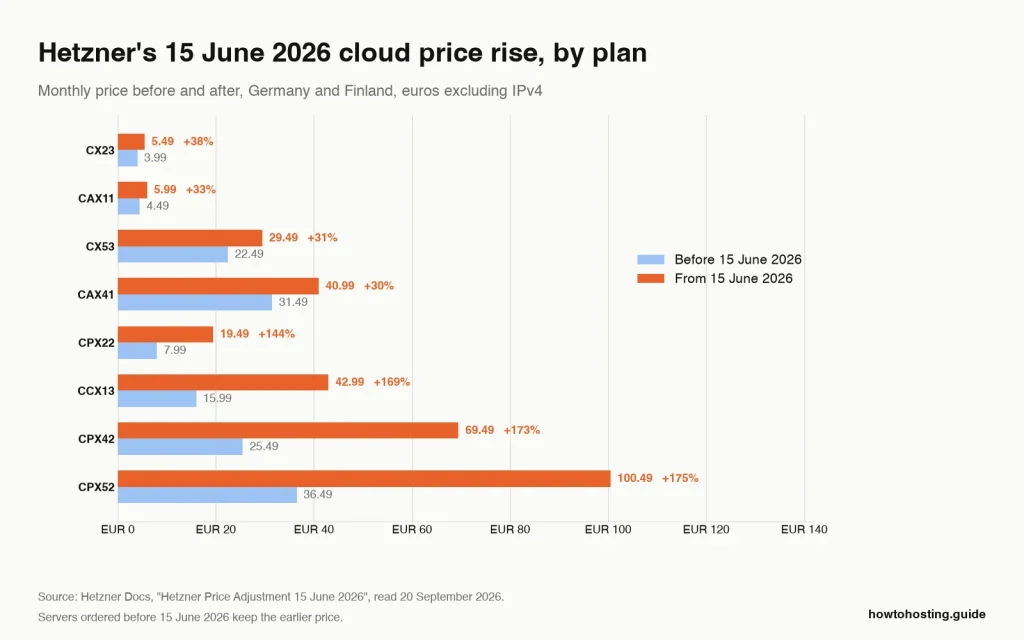
Hetzner, 15 giugno 2026. Ogni piano cloud e server dedicato è stato rivalutato per i nuovi ordini a 8 IO CEST. L'aumento suddiviso per piano famiglia, non in base alle dimensioni del piano, e lo spread è enorme. Nella tabella euro di Hetzner per Germania e Finlandia, la linea CX di ingresso è aumentata 31% per 38%. La linea CAX ottimizzata in termini di costi è cresciuta 30% per 33%. La linea CPX con vCPU condivisa è aumentata 144% per 175%, e la linea CCX con vCPU dedicata 113% per 173%. Gli ordini effettuati prima di quella mattina mantengono la vecchia tariffa, sebbene il ridimensionamento di un server esistente possa spostarlo su quello nuovo.
Alcune mosse individuali sono brutali. CPX22 è passato da EUR 7.99 è l'EUR 19.49 un mese, e CCX13 da EUR 15.99 è l'EUR 42.99. Il CPX52 di Hetzner è passato da EUR 36.49 è l'EUR 100.49 un mese dopo 15 giugno 2026, un aumento di 175%. La colpa è di Hetzner “il massiccio aumento dei costi di approvvigionamento” e allo stesso tempo riduci i costi di installazione della maggior parte dei server dedicati.
OVH cloud, Aprile e ottobre 2026. Fondatore Octave Klaba ha scritto 5 marzo 2026 che i prezzi della RAM potrebbero aumentare 250% per 300% entro il 2026, contro settembre 2025. Ha aggiunto che i fornitori devono ora ordinare la memoria fino a dodici mesi in anticipo, senza conoscere il prezzo finale. OVHcloud ha limitato l'incremento di aprile sul Public Cloud, Cloud privato e bare metal su 9% per 11% in media. Le implementazioni più vecchie sono aumentate 2% per 6%.
Si verifica un cambiamento più grande 1 ottobre 2026. L'archiviazione locale e l'IPv4 pubblico non vengono più inclusi nella generazione 3 istanze, il B3, Famiglie C3 e R3. L'archiviazione locale diventa una classe fatturabile in EUR 0.0001458 per GB all'ora, circa euro 0.11 per GB al mese, o EUR 109 per TB. Un indirizzo IPv4 pubblico costa EUR 0.0027 un'ora, circa euro 1.97 un mese, fatturato anche se non collegato. Quindi un indirizzo che hai dimenticato ti costa ancora. Il prezzo di calcolo orario non cambia. OVHcloud stima il conseguente aumento della bolletta 1.4% per 21.9%, e più piccola è la tua istanza, più duro atterra.
I Piani di Risparmio cambiano nella stessa data. Il 1, 6 e scompaiono i termini di 24 mesi, in partenza 12 mesi a 15% spento e 36 mesi a 30% spento, entrambi sconti inferiori rispetto a prima. Tali sconti si applicano solo al calcolo, pertanto il nuovo storage e le linee IP vengono addebitati a tariffa intera anche all'interno di un impegno in corso. La B2, C2, R2 e le istanze precedenti mantengono lo spazio di archiviazione incluso.
AWS, in corso. Amazon Pagina dei prezzi dei blocchi di capacità EC2 ora lo afferma “i prezzi di prenotazione vengono aggiornati regolarmente in base all'andamento della domanda e dell'offerta.” Lo aggiunge “i prezzi attuali dovrebbero essere aggiornati il prossimo ottobre, 2026.” Una prenotazione p5e.48xlarge quotata in USD 47.76 un'ora dopo 20 settembre 2026. Pubblicazione di una data di revisione dei prezzi programmata, piuttosto che una riduzione dei prezzi, è un cambiamento di postura. Questa è l’azienda che ha insegnato al settore ad aspettarsi il contrario.
Presi insieme, questo è il 2026 modello, e non è quello ovvio. Gli aumenti non hanno tenuto conto delle dimensioni del piano, e non hanno nemmeno tenuto traccia della memoria. Gli aumenti di Hetzner ordinati per famiglia di processori. OVHcloud è particolarmente sensibile alle istanze più piccole. Ciò che tutti e tre condividono è una direzione: il prezzo tutto compreso sta venendo a pezzi.
Uno sguardo al futuro, e questa è l'opinione piuttosto che la misurazione. Aspettatevi che una parte maggiore della vostra fattura arrivi come componenti separati che potete disattivare, e aspettarsi che il confronto su base comparabile diventi più difficile in questo modo. Questa è la nostra lettura delle modifiche di cui sopra, non è una cifra pubblicata da nessuno.
Cosa fanno gli acquirenti con i soldi: 29% di È sprecato
Quello di Flexera 2026 Il rapporto sullo stato del cloud ha intervistato più di 750 decisori del cloud. pubblicato su 18 marzo 2026, ha stimato la spesa cloud sprecata stimata 29%. Si tratta del primo aumento in cinque anni, e Flexera lo attribuisce ai carichi di lavoro dell’intelligenza artificiale e alla complessità dei costi che ne derivano.
Analizza il resto del sondaggio e il quadro si completa. La gestione della spesa per il cloud è la sfida principale per 85% degli intervistati. Tra le grandi imprese, 76% spendere più di USD 5 milioni al mese sul cloud. Raggiunto l'utilizzo dell'IA generativa 81%, dal 72% un anno prima, e 45% ora utilizzano ampiamente l’intelligenza artificiale in produzione. Nel frattempo 63% avere un team FinOps e 73% eseguire configurazioni ibride, mantenendo alcuni carichi di lavoro sull'hardware che controllano.
Leggili insieme e apparirà uno schema. Le organizzazioni sono migliorate nella disciplina dei costi e hanno comunque perso terreno, perché la cosa che stavano disciplinando cambiò forma sotto di loro. Se quasi un terzo della spesa cloud aziendale non produce nulla, una fattura mensile fissa del server sembra migliore di qualsiasi tabella comparativa dei fornitori.
Mettere questi numeri al lavoro
Un numero che non cambia nulla è una curiosità. Ecco quattro decisioni di acquisto che dovrebbero essere prese in considerazione.
Budget inferiore a USD 10 un mese, eseguendo un sito WordPress o una piccola app che gestisci tu stesso. Prendi gli USD di DigitalOcean 6.00 Gocciolina di base a 1 GiB, o Nanode di Akamai Cloud a USD 5.00 per la stessa memoria e 25 GB di memoria. Il CAX11 di Hetzner non è più la risposta automatica a queste dimensioni. All'EUR 5.99 più euro 0.50 per un indirizzo IPv4, I dati forniti da Hetzner in USD lo collocano vicino all’USD 7.59, sopra entrambi. Controlla le specifiche prima di dare per scontato che abbia un valore migliore, perché la pagina di Hetzner non mostrava le specifiche del piano quando abbiamo guardato. Salta Cloudways qui: Dollaro statunitense 14 per 1 GB ripaga solo se nessuno nel tuo team può applicare patch a un server.
Carico di lavoro: costante 4 Sito produttivo GB, e stai confrontando le citazioni. Smetti di considerare la colonna del prezzo come quella decisiva. A 2 vCPU e 4 GB, DigitalOcean, Vultr, Akamai Cloud e AWS Lightsail addebitano tutti USD 24.00. La scelta dipende dall'ubicazione del data center, rete e supporto. Vultr include 5 TB di trasferimento contro DigitalOcean 4,000 GiB, il che conta se servi i media. Paga i dollari 54 per Cloudways solo quando un pannello di controllo gestito ti fa risparmiare di più 30 dollari di lavoro al mese.
Pubblico: 80% Visitatori dell'UE, con i dati personali nel database. La Germania ospita 15.4% dei siti web del mondo, seconda solo agli Stati Uniti, quindi la capacità locale è abbondante piuttosto che esotica. Gartner prevede che la spesa per IaaS nel cloud sovrano in Europa raggiungerà l'USD 12.59 miliardi di 2026 e USD 23.12 miliardi di 2027. Seleziona i fornitori con una regione UE denominata anziché vaga “Conforme all'UE” reclamo, e chiedi anche dove vivono i backup.
Rinnovo previsto dopo 1 ottobre su un OVHcloud B3, Istanza C3 o R3. Il prezzo calcolato rimane valido e vengono visualizzate due nuove righe. Budget intorno agli euro 0.11 per GB al mese per l'archiviazione locale, più euro 1.97 per ciascun indirizzo IPv4 pubblico. Quindi rilascia qualsiasi indirizzo che non stai utilizzando. UN 100 L'istanza GB con un IP raccoglie circa EUR 13 un mese. Su un piano di risparmio, tieni presente che lo sconto copre solo il calcolo, quindi le nuove linee arrivano a prezzo pieno a metà impegno.
Domande frequenti
Quanto costa il cloud hosting al mese in 2026?
I server cloud iniziali partono da USD 2.50 un mese, che è il piano solo IPv6 di Vultr, o USD 4.00 per la gocciolina Basic più piccola di DigitalOcean. Una dimensione di produzione 2 vCPU, 4 Il server GB costa USD 24.00 presso DigitalOcean, Vultr, Akamai Cloud e AWS Lightsail. L’hosting cloud gestito lo raddoppia all’incirca: Cloudways addebita USD 54 per lo stesso 4 GB.
Quale fornitore di servizi cloud ospita il maggior numero di siti Web?
Amazon, con un netto margine. W3Techs ha registrato Amazon come fornitore di data center per 11.2% di tutti i siti web su 20 settembre 2026. Google prosegue 8.0% e Hostinger su 5.2%. Microsoft, nonostante tenga 20% della spesa per le infrastrutture cloud, appare sotto just 0.9% di siti web.
Il cloud hosting sta diventando sempre più costoso 2026?
sì, e gli aumenti sono documentati. Hetzner ha aumentato i prezzi su tutti i nuovi ordini cloud in poi 15 giugno 2026, con la sua linea CPX 144% per 175% in euro. OVHcloud aumenta i prezzi del Public Cloud 9% per 11% in media ad aprile, e separa lo storage e IPv4 da 1 ottobre 2026. Entrambi citano come motivo l'aumento dei costi di memoria.
Hetzner è ancora l'host cloud più economico?
Non sul prezzo adesivo, no. Il CAX11 di Hetzner è passato dall’EUR 4.49 è l'EUR 5.99 sopra 15 giugno 2026. La tabella di Hetzner pone il nuovo prezzo in USD 6.99, prima dell'EUR 0.50 Indirizzo IPv4. Vultr inizia da USD 2.50 e DigitalOcean a USD 4.00. Più in alto nella gamma, Il CPX22 di Hetzner è passato da USD 9.49 a USD 22.99 lo stesso giorno. Questo si colloca appena sotto l’USD 24.00 quattro grandi nuvole fanno pagare 2 vCPU e 4 GB.
Quanti siti Web utilizzano l'hosting cloud?
Dipende da dove tracci la linea. Contando solo i quattro hyperscaler, Amazon, Google, Oracle e Microsoft rappresentano 21.5% di tutti i siti Web nei dati W3Techs per 20 settembre 2026. Aggiungi fornitori cloud indipendenti come OVH, Hetzner e DigitalOcean e la cifra raggiunge 28.1%. La maggior parte del resto si trova presso società di hosting condiviso e costruttori di siti.
Quale fornitore di servizi cloud sta crescendo più rapidamente?
Tra i tre grandi, Google. La sua quota di spesa per l'infrastruttura cloud è diminuita 13% nel terzo trimestre 2025 per 15% nel secondo trimestre 2026, mentre Amazon è scivolata via 29% per 28%. Fuori dai tre grandi, le neonuvole crescono ancora più velocemente. Nove di loro ora sono tra i primi 40 fornitori di servizi cloud, e i servizi specifici di GenAI sono cresciuti 165% anno su anno nel secondo trimestre 2026.
Verdetto finale
Il mercato del cloud sta registrando la crescita più rapida degli ultimi otto anni, e quasi nulla riguarda l'hosting di siti Web. Amazon, Microsoft e Google Prendere 63% di un mercato che corre a USD 500 miliardi all'anno. Sotto ci sono gli stessi tre 21% dei siti web del mondo, e Microsoft sotto 1%. Se stai scegliendo dove posizionare un sito, i titoli dei giornali sulle quote di mercato del cloud sono lo strumento sbagliato. Dove si trovano i server e cosa dice la fattura sono quelli giusti.
La fattura è cambiata quest'anno. Hetzner rivalutato ogni piano cloud 15 giugno 2026, e la sua linea di vCPU condivisa è più che raddoppiata. OVH cloud rimuove lo spazio di archiviazione e IPv4 dal pacchetto 1 ottobre 2026. Nel frattempo DigitalOcean, Vultr, Akamai Cloud e AWS Lightsail sono tutti sbarcati in USD 24.00 per lo stesso 2 vCPU, 4 serverGB. Quando quattro società indipendenti quotano lo stesso centesimo, il prezzo ha smesso di fare il lavoro. Acquista sulla regione, rete e supporto invece.
Vuoi nomi piuttosto che numeri? La nostra carrellata di i migliori provider di cloud hosting applica tutto questo a piani specifici. I lettori che servono visitatori dell"UE dovrebbero abbinare questa pagina alla nostra guida al il miglior cloud hosting in Europa. Gartner prevede che la spesa per il cloud sovrano europeo triplicherà 2027. E se il tuo carico funziona 24 ore su 24, la stessa compressione della memoria ha rimodellato il nudo metallo, che tracciamo nel nostro statistiche di hosting dedicato.