
Sur cette page: [cacher]
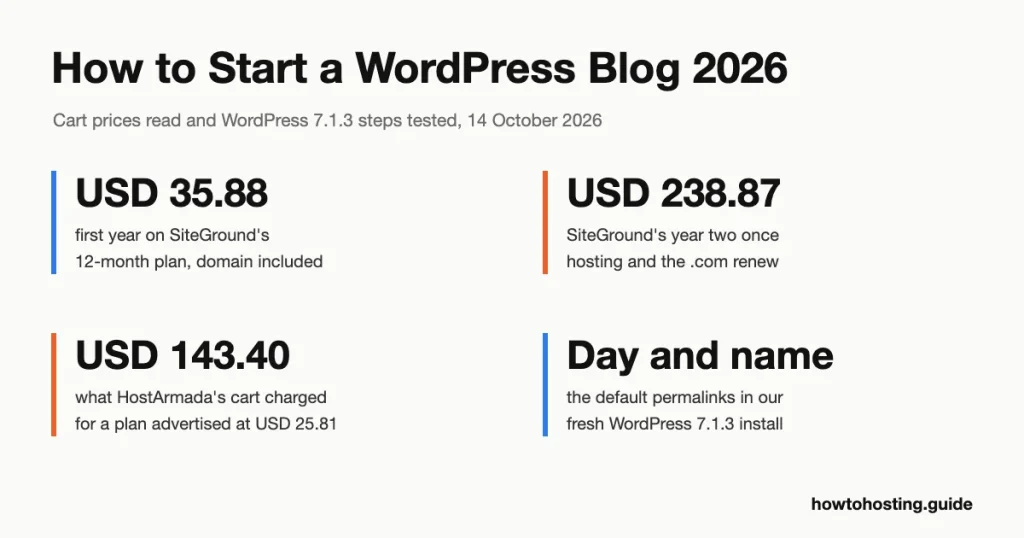
A self-hosted WordPress blog costs USD 35.88 en USD 47.88 for its first year on a 12-month hosting plan, with the domain included. Year two is where budgets break: USD 151.87 en USD 238.87, once hosting and the .com renew at full price.
Réponse rapide: the setup fits in one sitting. Hostinger’s documentation says its WordPress installer usually finishes in under a minute, and everything after that is a few screens in the dashboard. Here are the seven steps:
- Pick a hosting plan and read the renewal line in the cart, not on the plan card.
- Claim the free domain and untick the paid extras.
- Install WordPress with your host’s installer, then log in.
- Change four settings: Titre, fuseau horaire, permalinks and pingbacks.
- Keep the default theme or install a new one.
- Add an anti-spam plugin and switch on its auto-updates.
- Écrire, categorize and publish your first post.
Dernière révision: octobre 2026. Prices were checked in each host’s cart on 14 octobre 2026. That same day, we ran every WordPress step in WordPress Playground, sur WordPress 7.1.3.
WordPress.org or WordPress.com: Decide Before You Pay
Two products share the name. WordPress.org is free software that runs on hosting you pay for. WordPress.com is Automattic’s hosted service, where you rent a finished site.
Self-hosting gives you any plugin, any theme and your own ads, and you can move to another host whenever prices change. On WordPress.com you trade that control for convenience. Either way you’re on the most-used website software there is: W3Techs counts WordPress on 40.0% de tous les sites Web (lis 14 octobre 2026).
Voici la comparaison honnête. WordPress.com Personal costs USD 4/month billed yearly, qui est en USD 48 une année (ou USD 9 paying monthly, excluding taxes). It includes a free domain for one year and 6 Go de stockage. That’s less than any year-two hosting bill in this guide. So if you only want to write, and you’ll never install a plugin, WordPress.com is the cheaper path.
Everyone else should self-host. The rest of this guide covers that route.
Étape 1: Choose a Hosting Plan by Its Renewal Price
We checked the entry plan of three hosts in their carts: Hébergement Premium, SiteGround StartUp and HostArmada Start Dock. Each fits one new blog. The plan card shows the promotional price; the cart shows the term you’re committing to and what comes after it.
| Plan | Prix le plus bas (terme) | 12-durée du mois | Renouvelle à | Stockage et emplacements | Remboursement |
|---|---|---|---|---|---|
| Hébergement Premium | 2,99 USD/mois (48 mois, USD 143.52) | USD 47.88 (3,99 USD/mois) | 10,99 USD/mois | 20 GB SSD, 3 des sites | 30 journées |
| Démarrage de SiteGround | 2,99 USD/mois (12 mois, USD 35.88) | USD 35.88 | 17,99 USD/mois | 10 GB, 1 site | 30 journées |
| Station de démarrage HostArmada | USD 2.15/mo advertised (12 mois, USD 25.81) | USD 25.81 annoncé; the cart charged USD 143.40 | 11,95 USD/mois (USD 9.95 sur 36 mois) | 15 GB NVMe, 1 site | 45 journées |
Prices are each host’s US-dollar storefront, hors taxe. Hostinger and SiteGround added a tax line for our location; HostArmada’s cart showed no tax line.
Hébergement Premium: the lowest cost over four years
Hostinger’s USD 2.99 isn’t a monthly bill. C'est en USD 143.52 paid upfront for 48 mois, ce qui équivaut à USD 35.88 une année. The cart then states the renewal plainly: USD 10.99/mo for 12 mois, ou USD 131.88 une année.
Prefer one year to test the idea? The 12-month term costs USD 47.88 et renouvelle au même USD 10.99, un saut de 2,75x. Year two then comes to USD 151.87 once the .com renews. That’s still USD 87.00 less than SiteGround’s year two.
For a new blog, Premium covers what you need: 3 sites Internet, 20 GB of SSD storage and weekly backups. The domain and two mailboxes are free for the first year. Hostinger is also one of three hosts on WordPress.org’s recommended list, next to Bluehost and Pressable. Skip the 1-month term: ça coûte USD 11.99 and comes with no free domain.
Démarrage de SiteGround: the cheapest first year, the steepest renewal
SiteGround facture des USD 35.88 pour le premier 12 mois, puis 17,99 USD/mois. That’s a 6.02x multiplier, so hosting alone costs USD 215.88 en deuxième année. Ajouter l'USD 22.99 domain renewal and you reach USD 238.87.
The 24-month term softens it. USD 179.76 covers two years (7,49 USD/mois), ce qui permet d'économiser des dollars 72.00 against paying 12 months and then renewing once. The renewal after that is still USD 17.99.
What you get is narrower than Hostinger’s plan: 1 site Web et 10 GB, half Hostinger’s storage. En retour, SiteGround keeps daily backups for up to 30 days and includes a free .com, .org or .net for the first year. Our cart came from SiteGround’s “World” storefront in US dollars; European visitors see EUR 2.99, renouvellement en EUR 15.99, hors TVA.
Station de démarrage HostArmada: cheap on paper, check the cart total
HostArmada advertises Start Dock at USD 2.15/mo for 12 mois (USD 25.81). Sur 14 octobre 2026 we opened its own “Commencer” link three times. Each time the order summary showed the full USD 143.40. Typing the code from its pricing page returned “The promotion code entered does not exist”.

The code from HostArmada’s own pricing page fails at checkout, so the advertised USD 25.81 year becomes USD 143.40, plus pre-ticked privacy. La source: my.hostarmada.com cart, capturé 14 octobre 2026.
The longer terms did work. The 36-month link applied its 74% discount automatically, pour USD 93.13 upfront and a Renouvellement à 9,95 USD/mois. The 24-month link gave USD 57.82, renouvellement en USD 10.95. So if you choose HostArmada, use a multi-year term and confirm the discount line before you pay.
Entre 28 septembre et 14 octobre 2026, HostArmada raised its three-year Start Dock price from USD 1.99 en USD 2.59 un mois. The renewal stayed at USD 9.95, so guides quoting USD 1.99 understate the first bill by USD 21.49.
Start Dock includes 15 Go de stockage NVMe, 1 site Internet, free SSL and 7 sauvegardes quotidiennes. Its 45-day money-back window is the longest of the three, with a catch covered in Step 2.
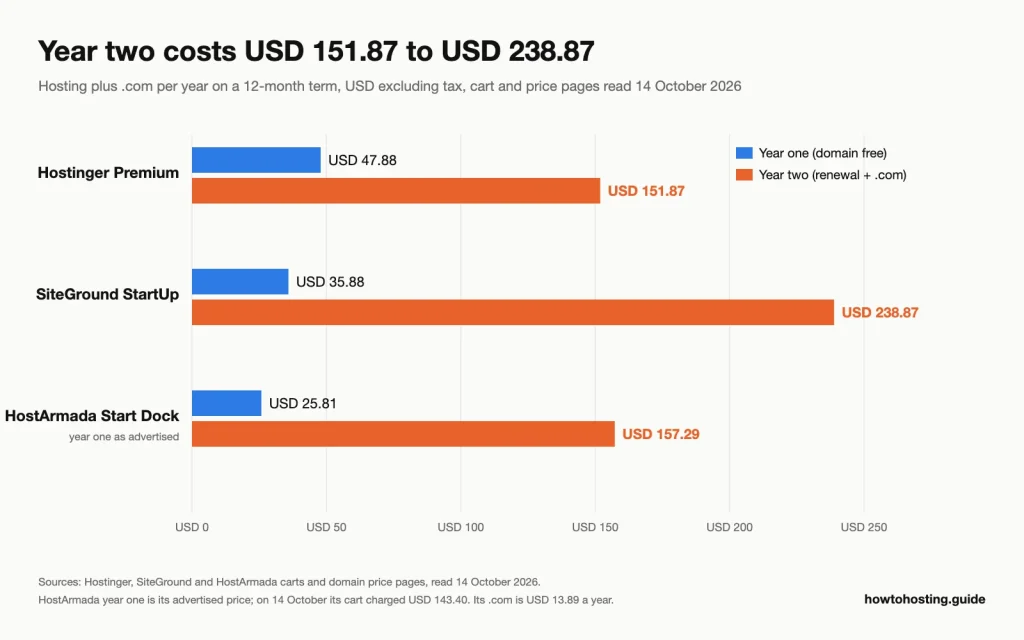
Year two includes the hosting renewal and the .com renewal. La source: each host’s cart and domain price page, lis 14 octobre 2026.
Put the 12-month terms side by side and the gap is plain. La première année coûte USD 47.88 chez Hostinger, USD 35.88 at SiteGround and USD 25.81 at HostArmada as advertised. Deuxième année, with the .com renewal added, coûte USD 151.87, USD 238.87 et USD 157.29. If none of these fits, notre cheap shared hosting comparison by renewal price covers more hosts.
Étape 2: Register the Domain and Untick the Extras
Your domain is the address readers type, so pick it with care: changing it later means moving every link. Keep it short and easy to say aloud. Skip hyphens and numbers, and take the .com if it’s free.
All three hosts include a free .com for the first year on terms of 12 mois ou plus. The renewal is where they differ:
- Hostinger: its domain price table lists .com renewals at 19,99 USD/an. Its cart values the same free domain at USD 13.99, so budget for the table price.
- SiteGround: .com renews at USD 22.99/yr. Domain privacy is an optional USD 12.00 pour la première année, puis USD 24.00, and the box isn’t ticked for you.
- HostArmada: a .com costs USD 13.89 a year when bought on its own in the cart; no separate renewal rate is printed. Its Privacy Protection add-on (USD 4.65) arrive pre-ticked, so untick it if you don’t want it.
The free domain also changes the refund maths. Hostinger’s refund policy calls free domains non-refundable and lets it keep the domain’s price from your refund. SiteGround’s terms say it may deduct the domain’s standard fee. HostArmada withholds USD 13.95. Donc un “full refund” within the money-back window is really the hosting minus the domain. At Hostinger and HostArmada you keep using the domain until it expires.
Étape 3: Install WordPress and Log In
Each host installs WordPress from its own panel. We couldn’t test these panels without buying, so the routes below come from each host’s documentation, continuer à lire 14 octobre 2026:
- Hostinger: open the website dashboard in hPanel, Cliquez sur Auto Installer sous Site Internet, et choisissez WordPress. Leave the install path blank for the main domain, then set the admin username, password and email.
- SiteGround: aller à Sites Internet > New Website, pick the domain, choisir Start New Website et alors WordPress, and enter your login details.
- HostArmada: open cPanel from the client area, aller à Logiciel > Programme d'installation des applications Softaculous, sélectionner WordPress et cliquez Installer maintenant.
Pick an admin username that isn’t “administrateur”, since that’s the default name login bots try first. Then open yourdomain.com/wp-login.php and sign in.
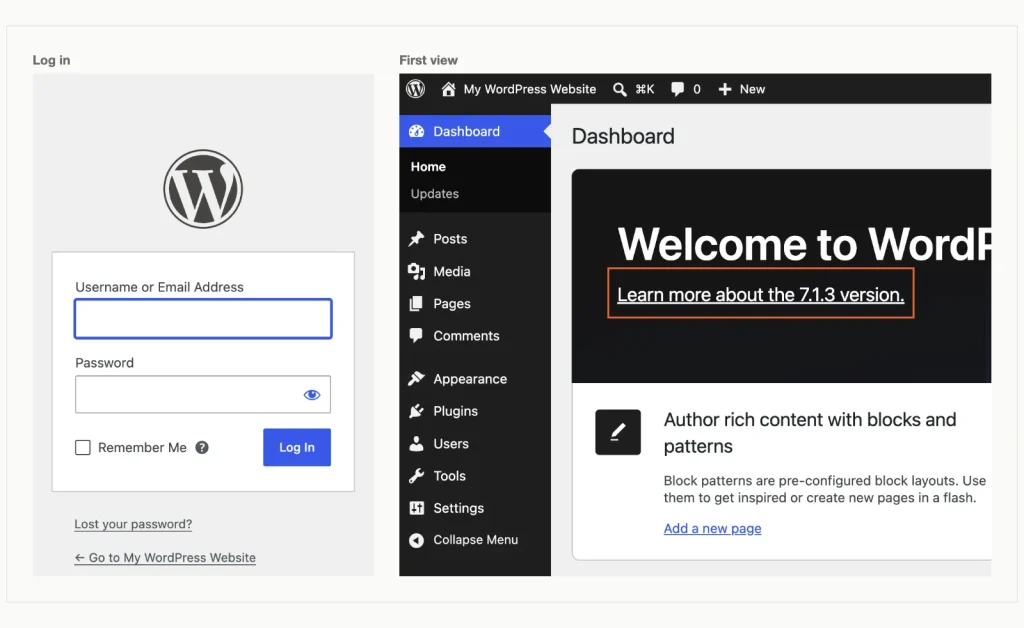
The login screen at /wp-login.php, then the first dashboard view, with the version link outlined. WordPress 7.1.3, tested in WordPress Playground (run locally with the Playground CLI), 14 octobre 2026.
The dashboard opens with a Welcome to WordPress! panneau. Dans 7.1.3 the menus read Add Post, Add Plugin et Add Theme, so older guides that say “Ajouter un nouveau” no longer match the screen.
A fresh install also ships with sample content. Ours held one published post, “Hello world!”, and one published page. Delete the post before readers find it: aller à Des postes > Tous les messages, hover over the title and click Déchets.
Étape 4: Change These Settings Before Your First Post
Four settings are worth changing on day one. Each takes a minute, and one of them, permaliens, is painful to change once posts exist.
Titre du site, tagline and timezone
Aller à Réglages > Général. Our install arrived with the title “My WordPress Website”, an empty tagline and the timezone set to UTC+0. Type your blog’s name and a one-line tagline.
For the timezone, pick a city rather than a UTC offset. A city follows daylight saving time, so a post scheduled for 9 un m. still goes out at 9 un m. in summer. Cliquez sur Sauvegarder les modifications and wait for “Settings saved.”
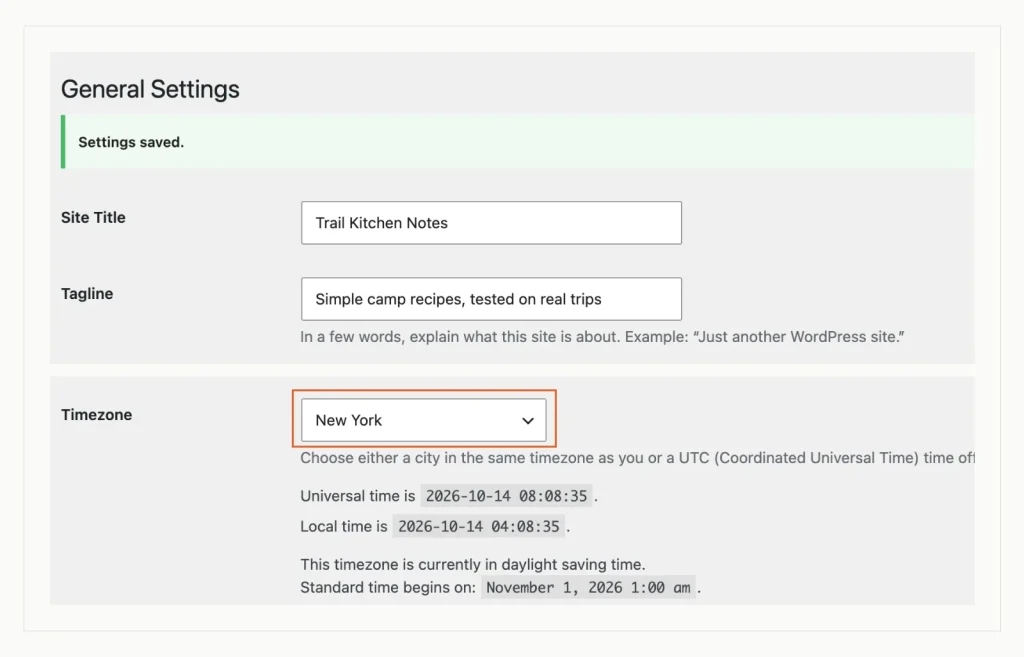
Titre, tagline and a city timezone saved under Settings, Général; the city setting tracks daylight saving time. WordPress 7.1.3, tested in WordPress Playground (run locally with the Playground CLI), 14 octobre 2026.
Permaliens: don’t assume they’re “Plaine”
Most guides tell you to switch from “Plaine” links to “Nom de la publication”. Our fresh 7.1.3 install wasn’t on Plain at all. It used Day and name, which puts the date in every address, like /2026/10/14/sample-post/.
That’s WordPress’s own installer at work. It tries the date-based structure first and falls back to Plain only when the server can’t rewrite web addresses. Your host’s installer may choose differently, so open Réglages > Permaliens and look.
Sélectionner Nom de la publication et cliquez Sauvegarder les modifications. The confirmation reads “Permalink structure updated.” Do this before you publish anything, because changing it later changes every post’s address.
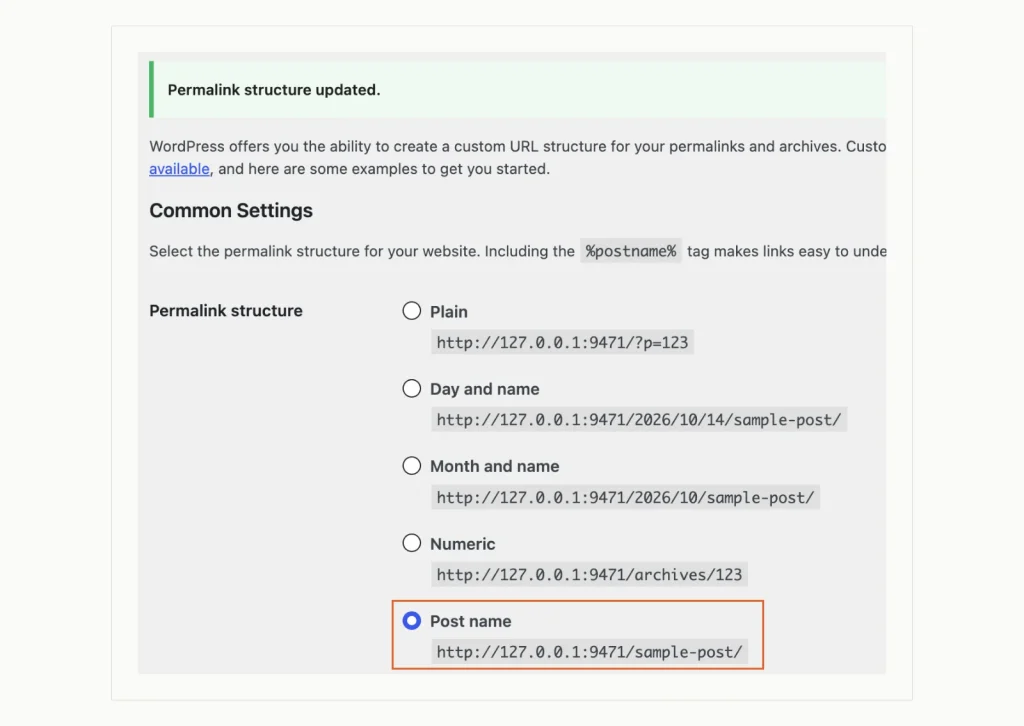
Post name selected after the install defaulted to Day and name. WordPress 7.1.3, tested in WordPress Playground (run locally with the Playground CLI), 14 octobre 2026.
Pingbacks off, search engines on
Pingbacks (automatic notices sent between blogs when one links to another) were switched on in our install. Today they mostly bring spam. Aller à Réglages > Discussion and untick the first two boxes. They read Attempt to notify any blogs linked to from the post et Allow link notifications from other blogs (pingbacks and trackbacks) on new posts. Then save.
Prochain, ouvert Réglages > En lisant. Sous Search engine visibility, make sure Discourage search engines from indexing this site is unticked. It was unticked in our test, but a ticked box asks search engines not to index the site, so check rather than assume.
You’ll also see a Connectors screen under Settings. It stores API keys for AI services and Akismet. A new blog can ignore it.
Étape 5: Keep the Default Theme or Install One
WordPress 7.1.3 activates Twenty Twenty-Five, a block theme with more than 1,000,000 active installs on WordPress.org. Keeping it is a fine choice for a first blog. You can change colors and fonts in Apparence > Éditeur.
Want a different look? Aller à Apparence > Thèmes > Add Theme and search the free directory. We tested with Ollie, a block theme last updated on 8 octobre 2026. Il a 6,000+ installations actives et un 5 hors de 5 moyenne de 36 notes.
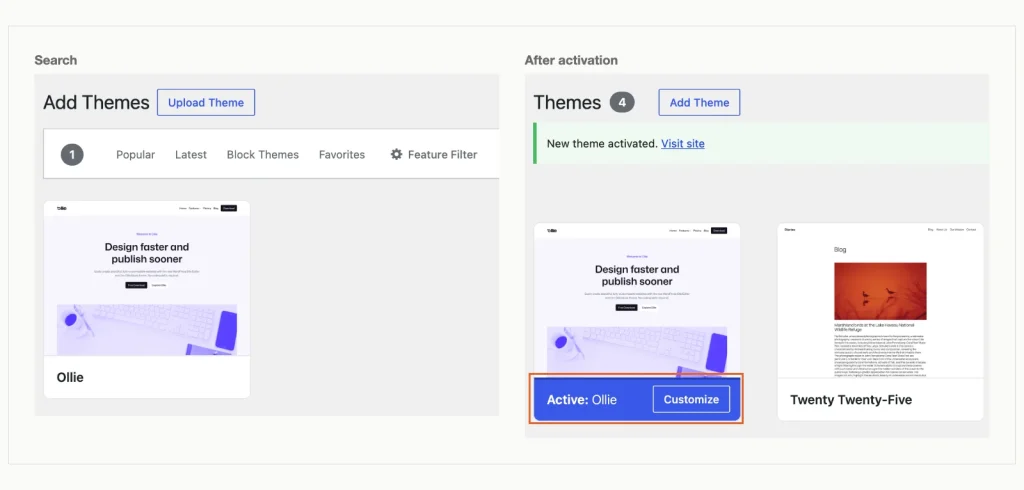
Searching the free theme directory, then the theme active after installation. WordPress 7.1.3, tested in WordPress Playground (run locally with the Playground CLI), 14 octobre 2026.
Cliquez sur Installer, puis Activer. The screen confirms “New theme activated.” and the theme moves to the front of your Themes list.
Before choosing, check two things on the theme’s directory page: the last update date and the WordPress version it’s tested with. A free theme that’s still maintained beats a paid one you don’t need yet.
Étape 6: Install One Plugin First: Protection contre les spams
Every plugin is code you’ll need to keep updated, so start with the one problem every blog with comments has: courrier indésirable. WordPress already includes Akismet, inactive. Its own description says API keys are free for personal blogs, but businesses and commercial sites need a paid subscription.
We installed Antispam Bee instead. C'est gratuit, and its description says it doesn’t send commenters’ personal information to third-party services. Il a 700,000+ active installs and is tested up to WordPress 7.1.3.
Aller à Plugins > Add Plugin, search for the name, Cliquez sur Installer maintenant et alors Activer.
One detail surprised us. Après activation, the plugin’s row still showed Enable auto-updates, which means auto-updates were off. Click it so security fixes install without you; after a reload the link read Disable auto-updates, which confirms they’re on.
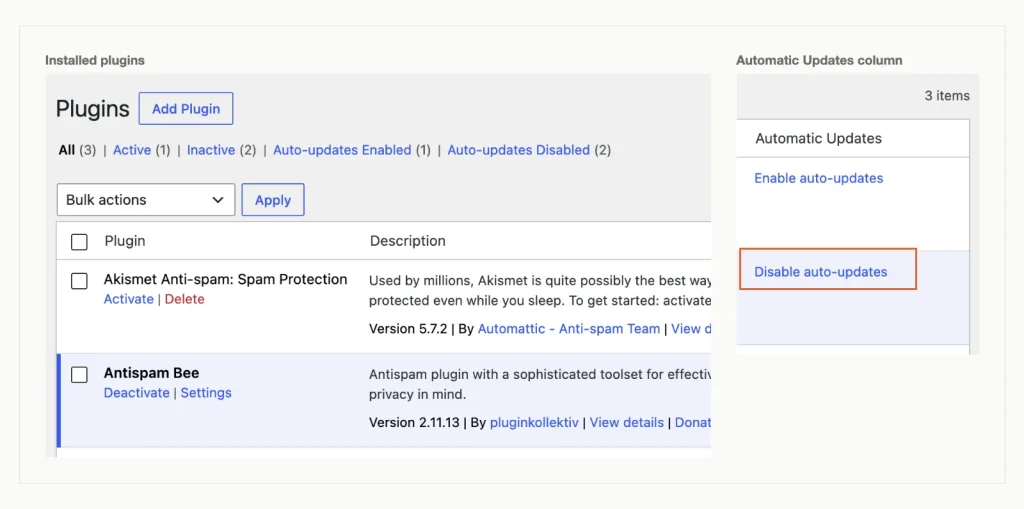
Antispam Bee active with auto-updates switched on; Akismet ships with WordPress but stays inactive. WordPress 7.1.3, tested in WordPress Playground (run locally with the Playground CLI), 14 octobre 2026.
Add more plugins only when a real need appears. Our list of must-have WordPress plugins with their renewal prices helps you tell which paid tiers are worth it.
Étape 7: Rédigez et publiez votre premier article
Aller à Des postes > Add Post. The first visit opens a “Welcome to the editor” guider; read it or close it.
- Cliquez sur Add title and type the headline.
- Press Enter to start a paragraph and write.
- For a subheading, type
/headingon a new line and press Enter. The slash command works for any block, tel que/imageou/list. - Switch to the Publier tab on the right. WordPress fills in the Slug from your title; shorten it if it’s long.
- Sous Les catégories, Cliquez sur Add Category, type a name and confirm. The new category is ticked for you.
Our test post got a “Recipes” Catégorie, et “Uncategorized” was unticked automatically. Cela compte, because posts left in Uncategorized pile up in a category nobody chose.
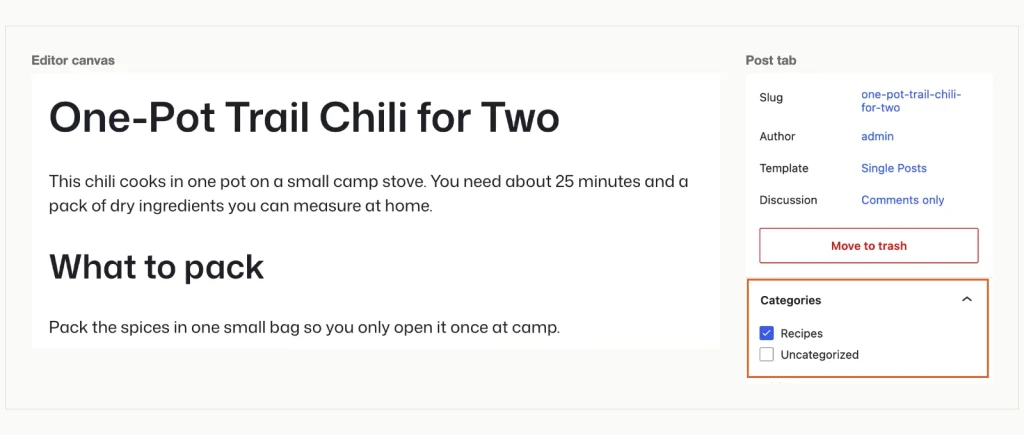
A first post with a heading added through the /heading slash command, and its new category ticked. WordPress 7.1.3, tested in WordPress Playground (run locally with the Playground CLI), 14 octobre 2026.
Cliquez sur Publier. WordPress shows a check first: Visibilité: Publique et Publier: Immediately. Cliquez sur Publier again and the panel confirms the post is live, with its address ready to copy.
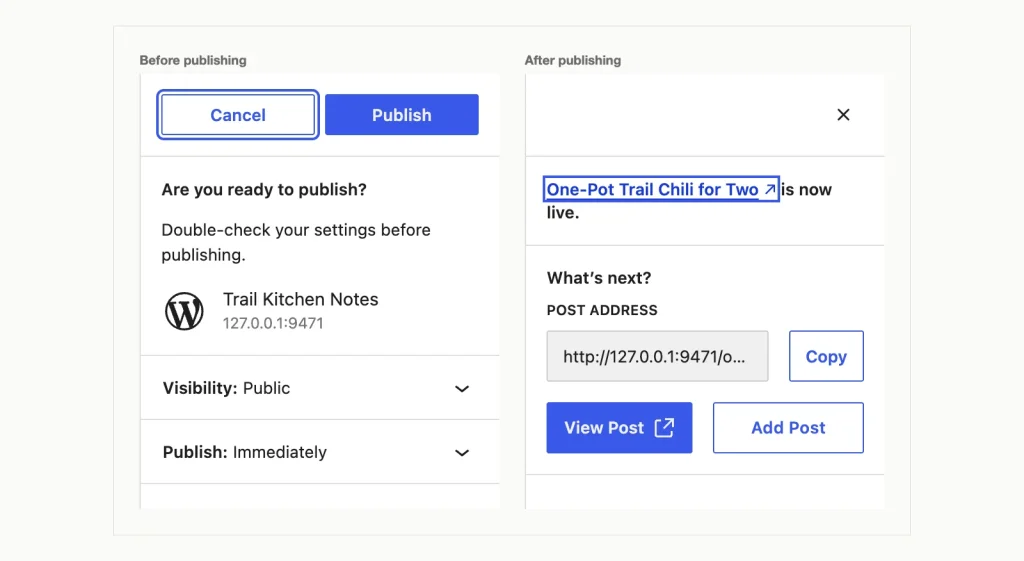
The check before publishing and the confirmation after. WordPress 7.1.3, tested in WordPress Playground (run locally with the Playground CLI), 14 octobre 2026.
Open that address in a new tab. Ours loaded at /one-pot-trail-chili-for-two/, which confirms the Post name setting from Step 4 worked.
Prochain, build your About and Contact pages. Those belong on pages rather than posts, et notre guide pour WordPress posts vs pages shows which content goes where.
Questions fréquemment posées
Combien coûte la création d'un blog WordPress?
On a 12-month plan with the free domain, the first year costs USD 35.88 at SiteGround or USD 47.88 chez Hostinger, avant impôt. The free theme and plugin used here cost nothing. Plan for year two, bien que: USD 151.87 at Hostinger and USD 238.87 at SiteGround.
Is Hostinger or SiteGround better for a new WordPress blog?
Hostinger, for most new bloggers. SiteGround’s first year is USD 12.00 moins cher, but its year two costs USD 87.00 plus. Hostinger’s Premium plan also gives twice the storage and three sites instead of one.
Should I pay for one year or several years upfront?
Pay for one year if you’re unsure you’ll keep blogging. Once you’re committed, longer terms cost less. Hostinger’s 24-month term is USD 83.76, tandis que 12 months plus one renewal costs USD 179.76. SiteGround’s 24-month term saves USD 72.00 de la même façon.
Combien de temps faut-il pour créer un blog WordPress?
Most of the time goes on choosing a host and a name. Hostinger says its WordPress installer usually finishes in under a minute. Après ça, the settings, thème, plugin and first post in this guide are a handful of screens.
Conclusion
For a blog you plan to keep, Hébergement Premium est le choix. Its 48-month prepay costs USD 35.88 une année, and on 12-month terms its year-two bill of USD 151.87 is the lowest of the three.
Want the cheapest single test year? Démarrage de SiteGround coûte USD 35.88. Plan to move before the USD 17.99 renouvellement, or year two costs USD 238.87.
Choisir Station de démarrage HostArmada only on its 24- ou durée de 36 mois, and only after the cart shows the discount line. Whichever host you choose, set Post name permalinks and switch off pingbacks before your first post.
Once a few posts are up, give them a home of their own. Notre guide sur adding a post to a page in WordPress shows how to set up a Blog page and add it to your menu.
Merci beaucoup pour ce tutoriel! Je suis un débutant, et ici j'ai trouvé tous les détails essentiels qui m'aideront à commencer à créer mon blog personnel de la bonne façon.
Bon travail les gars, l'aime parce qu'il montre de purs conseils et suggestions sans pousser les produits et services. J'utilise un fournisseur d'hébergement local en Grèce et je vous ai trouvé votre examen d'installation wordpress pour Papaki.
Existe-t-il un moyen de créer une réunion sur la page d'accueil du blog wordpress. J'utilise un thème gratuit. Veuillez conseiller?
salut! Merci beaucoup pour le tutoriel. Puis-je vous demander quelque chose en plus? Existe-t-il un moyen de créer une adresse e-mail liée à un blog? Je ne souhaite pas que mon blog soit associé à un compte Gmail personnel. J'ai donc besoin de créer une adresse email dédiée au blog. Merci :)
Salut l'équipe Howtohosting,
tu as écrit tellement de contenu! Alors merci, pour commencer.
Je ne savais pas par où commencer, mais ensuite j'ai continué à lire de plus en plus et j'ai compris l'essentiel, je pense. Heureusement que vous avez des images et des parties de tutoriel et ce genre de choses. J'ai particulièrement aimé le conseil NE CLIQUEZ PAS sur le “Découragez les moteurs de recherche d'indexer” partie – Je riais de la façon dont c'était formulé, mais je me suis demandé ce que ça ferait exactement – tu m'as fait vérifier.
Vous en avez fait une sorte d'encyclopédie, que j'aime, mais pour être honnête, Je n'ai pas tout suivi… trop long, MDR, mais pouvez-vous donner plus d'exemples sur ce qu'est un contenu de qualité, mis à part les guides pratiques et les actualités? Maintenant, J'ai un site presque entièrement fonctionnel, c'est donc ma question – le peu de bon contenu. Qu'est-ce qui fait du bien? Les backlinks sont-ils si importants et si je paie pour cela, c'est une mauvaise stratégie?
En attente de réponse,
Votre tout nouveau fan,
Robert
Hey, Robert!
Heureux que nous ayons été utiles!
À vos points:
Un contenu de qualité doit être rédigé avec des phrases significatives, qui aident le mieux votre public. Par exemple, vous vendez des voitures – n'écrivez pas seulement les spécifications des voitures, mais un historique plus détaillé de chaque véhicule.
Ce qui rend le contenu intéressant, c'est quand vous le rendez attrayant. Fais-le, afin que vos utilisateurs souhaitent et aient certainement besoin de voir ce contenu sur votre site et que cela les aide. Donc, il s'applique à tout type de site, ceux ci-dessus ne sont que quelques exemples.
Backlinks, les liens internes et autres liens d'information utiles sont importants, mais ne payez pas pour eux. En tant que débutant, vous avez beaucoup à construire et avec un site rapide et un bon contenu (regarde ce que j'ai fait là, haha), les liens viendront éventuellement.
Payer pour des liens peut être bon et mauvais. Si vous payez quelqu'un pour être sur sa page, qui peut être bénéfique et éthique. Mais comme payer des milliers de liens pour accéder à votre site Web comme un faux coup de pouce dans un court laps de temps est mauvais et vous ne devriez certainement pas le faire.
Meilleures salutations de l'équipe HowToHosting.guide!
Oui, BenEC, vous devez créer un autre compte de messagerie pour le blog.
Vous pouvez toujours modifier les e-mails, donc pas de soucis là-bas.
Est-il vraiment obligatoire d'utiliser Email Outreach, cela aidera-t-il les utilisateurs qui reviennent régulièrement?
Je me demande quelque chose.. est-il possible d'utiliser wordpress juste pour la création d'un blog puis de transférer le blog sur mon site wix? J'essaie juste de trouver la meilleure option pour combiner wordpress et wix… Merci d'avance!!
Je vous remercie! Un article tellement génial!
C'est formidable que des guides comme ceux-ci existent pour aider les utilisateurs à atteindre leurs objectifs et WordPress est certainement la plate-forme que j'utiliserais
Je viens de créer un site Web WP pour mon entreprise. La prochaine étape consiste à ajouter un plugin SEO. En premier, Je pensais que Yoast serait le meilleur choix mais alors l'outil Rank Math que j'ai vu dans un article que vous avez lié – les meilleurs outils de référencement, attiré mon attention. Maintenant, j'essaie d'identifier celui qui fonctionnera le mieux.
Merci! Excellent article qui m'a aidé à rendre mon premier site de blog si facile!