
Nesta página: [ocultar]
Resposta curta: use uma postagem para qualquer coisa com uma data que pertença ao fluxo do seu blog: notícia, tutoriais, anúncios, receitas. Use uma página para conteúdo que deve sempre ficar no mesmo lugar: Casa, Sobre, Serviços, Contact and your privacy policy.
A quick test helps. Would a reader expect it in your RSS feed or a category list? Postar. Does it belong in the main menu for years? Página.
The old rules need an update, Apesar. WordPress’s own default theme, Vinte e vinte e cinco, doesn’t print the date on a single post. And a page with comments switched on still shows no comment box in it. Every difference below was checked on 9 Outubro 2026 no WordPress 7.1.3, running in WordPress Playground, with one block theme and one classic theme.
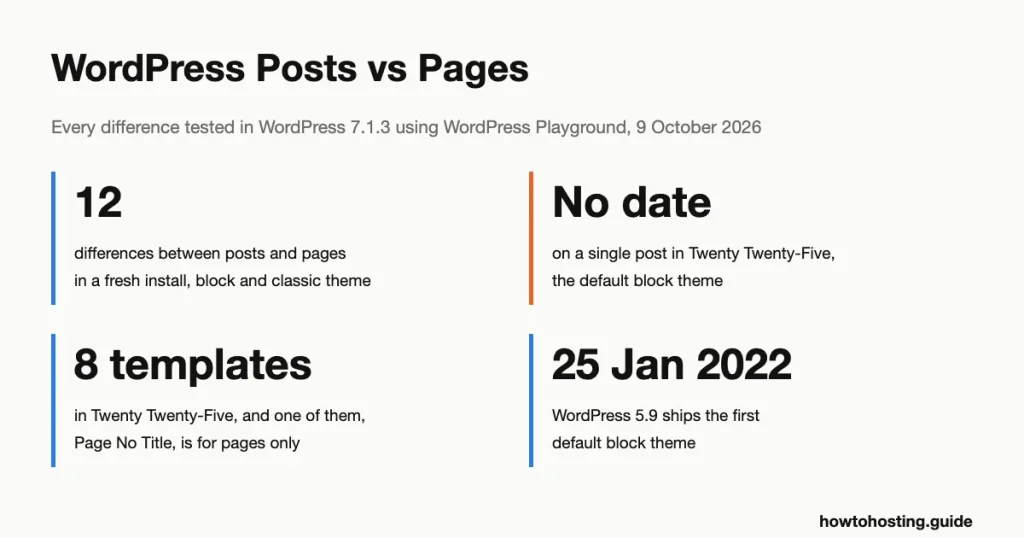
Posts vs Pages: 12 Differences at a Glance
Here’s what differs in a fresh WordPress 7.1.3 instalar. “Block theme” means Twenty Twenty-Five, o padrão. “Classic theme” means Twenty Twenty-One, which builds pages from PHP files instead of blocks.
| Attribute | Postagens | Páginas |
|---|---|---|
| Date in the web address | sim, with a date-based permalink setting (/2026/10/05/autumn-soup/) | Nunca (/about/team/) |
| Monthly date archive (/2026/10/) | Listed | Not listed, even when published that month |
| Date and author shown to visitors | Up to the theme: classic showed both, block showed the author only | Nenhum, in both themes |
| Categories and tags | sim | No panel for either |
| Main RSS feed (/feed/) | Incluído | Left out |
| Categoria, tag and author archives | Incluído | Left out |
| Parent and child items | Não | sim, and the child’s address nests under the parent |
| Manual order | Não, mais novo primeiro (sticky posts can be pinned) | Order field, in Quick Edit only |
| Comments on a new item | Abrir | Closed |
| Templates in Twenty Twenty-Five | Single Posts; “Change template” greyed out | Páginas, plus Page No Title |
| Excerpt and post format | sim | Não |
| Can be the homepage | Não, only as part of the post list | sim, under Settings, então lendo |
The rest is shared. Both use the same block editor, take a featured image, keep revisions and show up in the XML sitemap WordPress builds at /wp-sitemap.xml. Site search covers both, também. Our search for “Receitas” returned a page and a post side by side.
The editor shows the split clearly. Open a post and the right-hand sidebar offers an excerpt, a format, Categories and Tags. Open a page and those four are gone, replaced by a single Parent setting.
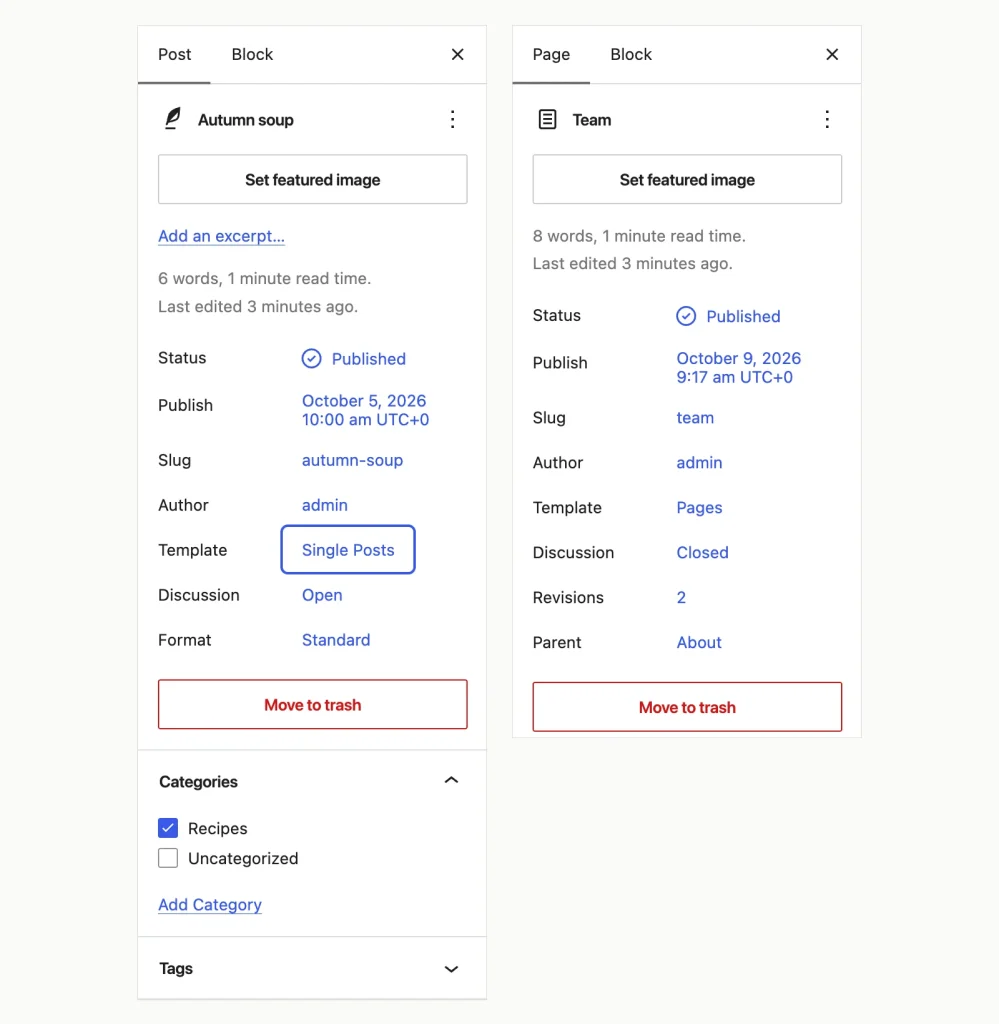
Deixou, a post; direita, uma página. Only the post offers an excerpt, a format, Categories and Tags, while only the page has a Parent setting. WordPress 7.1.3, testado no WordPress Playground, 9 Outubro 2026.
When a Post Is the Right Choice
Posts are built to be found by time and by topic. Every post lands in the main feed, the monthly archive, its category and tag archives and its author’s archive. You don’t set any of that up. It just happens when you click Publish.
Em nosso teste, the main feed at /feed/ carried our four posts and none of our pages. We also tried adding ?post_type=page to the feed address. It returned the same four posts. So if a newsletter tool or a feed reader should pick something up, it has to be a post.
Pick a post when the content:
- has a date that matters to the reader, such as a price change, an event or a release;
- belongs to a topic you’ll keep writing about, so a category archive can collect it;
- should show up in “latest posts” listas, which only ever pull posts;
- will be one of dozens, where a flat list of pages would turn into clutter.
Aqueles “latest posts” lists can sit almost anywhere. Nosso guia para showing recent posts in a sidebar or footer cobre as opções.
Posts can’t nest, Apesar. Não há “sub-post”. If you want structure, use categories, which can have parent categories of their own. Tags can’t.
When a Page Is the Right Choice
Pages are built to be found by place. They sit outside the date system: no date archive, no feed, nothing in the address that ages. Our About page was published on 9 Outubro 2026, and the October archive still skipped it.
Their one real superpower is hierarchy. Give the Team page a parent of About, and its address becomes /about/team/. The editor’s Parent setting spells out a second effect: páginas infantis “show up as sub-items in the default navigation menu.” That’s exactly what a Services section with five service pages needs.
Pages are also the only type that can become your homepage. The Homepage menu under Settings, then Reading listed About, Team and Sample Page. Nenhuma postagem.
Pages also carry an Order number for sorting. Don’t look for it in the editor, Apesar. No 7.1.3 we found it only in Quick Edit, on the Pages list (hover a page, then click Quick Edit).
Dates and Authors Are the Theme’s Call
“Posts show a date and author, pages don’t” is the line most guides repeat. Both types store a date and an author in the database. Whether visitors see them depends on the theme.
Twenty Twenty-One, the classic theme, printed “Published October 5, 2026”, “By admin”, the category and the tag on our post. The page got none of that. Vinte e vinte e cinco, the block default, printed “Written by admin in Recipes” on the post. Its own date was missing. The only dates on that screen belonged to the “More posts” list at the bottom.
Does that matter? For news and price posts, sim. A reader can’t tell a 2026 post from a 2019 1. The fix belongs in Single Posts, the template every post uses, found in the Site Editor’s Templates list. Twenty Twenty-Five already uses the Post Date block in its More posts list, so the block is ready to add. We didn’t make that edit in our test.
Comments on Pages: Off by Default, Sometimes Off for Good
WordPress opens comments on new posts and closes them on new pages. Our site setting said “abrir”, and new posts followed it. New pages stayed “Closed” in the Discussion setting regardless.
You can switch a single page to open. What happens next depends on the theme again. Em vinte e vinte e um, the comment form appeared under the page. Em vinte e vinte e cinco, nothing appeared. Its Pages template simply has no Comments block in it, so there’s nowhere for comments to print.
Want feedback on an About page in a block theme? You’d add a Comments block to the Pages template, which then affects every page using it. We didn’t test that step. A contact form is usually the better tool for a page anyway.
What Changed With Block Themes and Site Templates
Templates used to be the clearest difference. A theme developer wrote PHP files, e um “page template” was something only pages could pick. WordPress 4.7, lançado em 6 dezembro 2016, opened page templates to every post type. The idea that templates belong to pages stuck around anyway.
WordPress 5.9, lançado em 25 janeiro 2022, shipped Twenty Twenty-Two, the first default block theme, and put its templates in the Site Editor. Em um tema de bloco, templates are made of blocks, and you edit them in the dashboard with no code. WordPress 6.3, lançado em 8 agosto 2023, added pages to the Site Editor too.
Here’s how that looks today. Twenty Twenty-Five ships 8 modelos. A post uses Single Posts, a page uses Pages, and the theme adds one extra choice, Page No Title, that only pages can pick. On our post, the Template menu showed “Change template” greyed out, because the theme offered posts nothing else.
Then we clicked “Create new template” on a post and called it “Recipe post”. WordPress’s own dialog warned what would happen: “A custom template can be manually applied to any post or page.” Sure enough, the page’s template picker then listed Recipe post next to Page No Title. Templates you create yourself aren’t tied to one type.
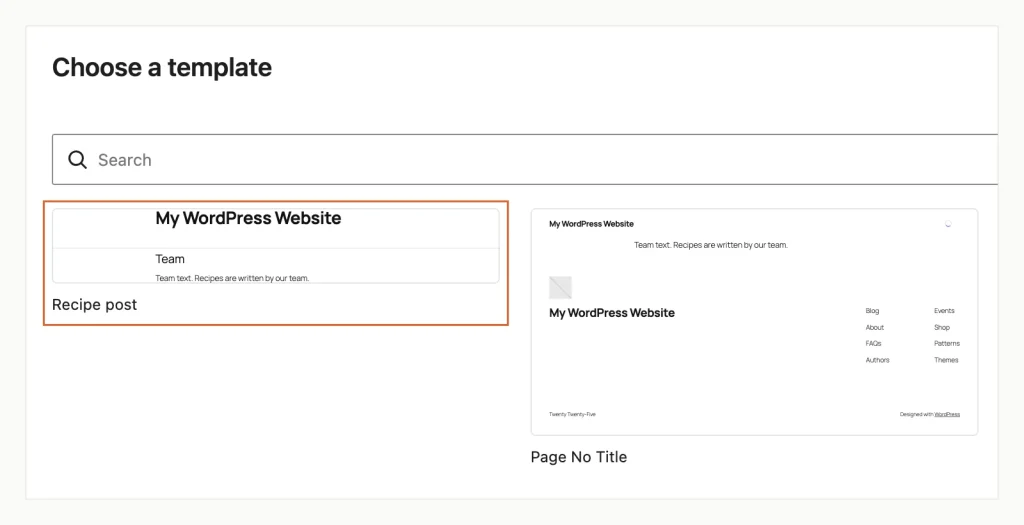
The template picker on a page, after we created “Recipe post” from a post. The outlined card shows it is offered to pages too. WordPress 7.1.3, testado no WordPress Playground, 9 Outubro 2026.
The Site Editor itself still treats the two differently. Under Appearance, então Editor, the menu lists Identity, Estilos, Páginas, Navegação, Patterns and Templates. Pages get their own entry there. Posts don’t, so you still write and manage them under Posts in the dashboard.
On a classic theme, nada disso se aplica. Templates stay as PHP files, and Twenty Twenty-One ships no extra page templates at all. Planning a jump from classic to block? Ler how to switch WordPress themes safely primeiro, because headers, menus and widgets all get rebuilt.
Three Mistakes People Make With Posts and Pages
Making pages named after categories. Picture pages called News, Opinion and Video in the menu, plus categories with the same names. A user on Reddit described exactly this setup in June 2026. Their posts showed on the homepage but never “debaixo” the matching page. A page and a category don’t connect just because they share a name. Link the menu to the category archive instead (such as /category/news/), or add a filtered post list to the page. Nosso guide to adding posts to a page in WordPress walks through the post list options step by step.
Building a growing library out of pages. Tutoriais, help articles and product notes feel “timeless”, so people make them pages. Fifty pages later there are no categories, no tags and no feed. Use posts for anything you’ll keep adding to. Save pages for the handful of sections that define the site.
Putting dates in the address of evergreen posts. Our test site used a date-based permalink setting, so a post lived at /2026/10/05/autumn-soup/. That’s fine for news. For a guide you’ll update for years, the date ages the address. Choose a format such as “Nome do post” under Settings, then Permalinks before you publish much. Changing it later changes every post’s address.
Changing a Page Into a Post (or Back)
WordPress has no built-in switch for this. A free plugin, Post Type Switcher, adds one. Its directory listing showed version 4.0.1, last updated on 24 marcha 2026, Com mais 200,000 instalações ativas. It’s marked as tested up to WordPress 6.9.10, not 7.x.
We installed it anyway and converted a page called Opening hours. The plugin added a Post Type setting to the sidebar and asked for confirmation first. Three things changed after we accepted:
- The address moved from /opening-hours/ to /2026/10/09/opening-hours/, following the date-based permalink setting.
- The old address redirected to the new one when we opened it in the browser.
- The new post appeared in the main RSS feed, with no category attached.
So after a switch, give the post a category and check that the old address still lands on it. Rather not depend on that redirect? Copy the content into a new post, then point the old address at it with a redirect plugin.
perguntas frequentes
Is a post or a page better for SEO?
Neither type ranks better on its own. Search engines see a web page, not a WordPress content type, and both types appear in the sitemap WordPress builds. What differs is the extras: posts get category archives, feeds and dates. Pick by how readers will find the content, not by rankings.
Can I add categories to a WordPress page?
Not out of the box. Pages have no Categories or Tags panel, and WordPress doesn’t register either for pages. A plugin or a few lines of code can add them, but we didn’t test that. If content needs categories, it usually should be a post.
Why doesn’t my WordPress post show the date?
Your theme leaves it out. Twenty Twenty-Five shows the author and category on a single post, but not the post’s date. Open Appearance, então Editor, então Modelos, and add a Post Date block to Single Posts. That edit wasn’t part of our test, so rehearse it on a staging site.
Can a post have sub-posts like pages have subpages?
Não. Posts can’t have a parent post, only pages can. Group related posts with a parent category and child categories instead, since categories nest and tags don’t.
Which One Should You Use?
Default to posts for anything you publish regularly. Keep pages for the few fixed sections that hold the site together, and use parent pages when a section has subsections. On a block theme, check two things your theme may hide: the date on single posts and the comment form on pages.
Curious to see these differences for yourself? Parque WordPress, where we ran all of this, gives you a throwaway WordPress in a browser tab for free. We cover it, with other no-cost setups, in our guide to creating a WordPress blog without a domain. Building the blog side next? Our guides on putting a post list on a page and on recent-posts lists, both linked above, take it from here.