
On This Page: [hide]
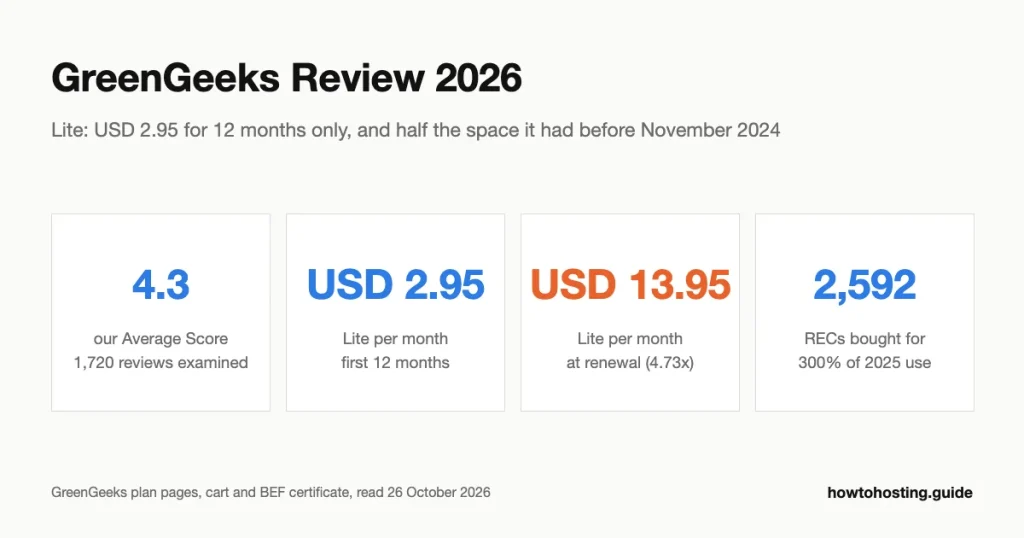
GreenGeeks sells cPanel hosting with one unusual promise: it buys renewable energy certificates covering three times the electricity it estimates it uses. That promise is backed by a dated, numbered certificate, and its support staff earn steady praise. The price is where buyers get caught. Our Average Score for GreenGeeks is 4.3 out of 5, based on 1,720 reviews examined.
We read GreenGeeks’ plan pages, checkout, terms of service, acceptable use policy and energy certificates on 26 October 2026. On Trustpilot, we split its newest 200 reviews by whether GreenGeeks invited them, and read every one- and two-star review from the past year. Reddit threads came next. Then we timed the network route to each of its four data centers from home internet lines in 10 countries. The reviews that rank for GreenGeeks still quote renewals of USD 11.95 or 12.95, and some promise unlimited storage. All of that is out of date. The unlimited space and the USD 11.95 rate ended in November 2024, and the USD 12.95 renewal in December 2025. None of those reviews quotes the certificate numbers or what the uptime clause actually promises.
Quick verdict: GreenGeeks holds a 4.3 from 1,720 reviews for fast, friendly support and a green claim backed by a dated certificate. Its weak points are a first-year price that renews at 4.73 times the rate, storage cut in 2024 and billing disputes at cancellation. It suits small North American and European sites whose owners want documented green hosting and will budget for year two.
GreenGeeks halved its Lite plan from 50 GB to 25 GB between 6 and 9 November 2024, archived copies of its plan pages show. Pro and Premium lost unlimited space that same week, so reviews promising unlimited storage describe plans you can no longer buy.
Last updated: October 2026. Pricing and review data verified.
 Visit Site

| Name | GreenGeeks Web Hosting |
| Total Reviews | 1720 |
| Average Score | 4.3 |
| Website | https://www.greengeeks.com |
| Address | 3411 Silverside Rd. Tatnall Building #104 Wilmington , DE 19810 US |
| Server Locations |  United States,  Canada,  Netherlands |
Number of Reviews
Avg. Review Score
Customer Support
Features and Services
GreenGeeks, LLC has sold hosting since 2008, when Trey Gardner founded it. Kaumil Patel is co-founder and COO. The company says it serves more than 55,000 customers and 600,000 websites. Its range is narrow. There are three shared plans, sold a second time as WordPress hosting, plus three reseller plans, three managed VPS plans and dedicated servers by quote.
What the Shared Plans Include
Every shared plan comes with cPanel (the most common hosting control panel), free Let’s Encrypt SSL and a free domain for year one. It also includes LSCache, LiteSpeed’s cache, which keeps ready-made copies of pages to serve faster. You also get one-click Cloudflare CDN (a network that serves copies of your files from servers near each visitor). Staging (a private test copy of your site), Git, SSH and WP-CLI are included on all three tiers. Pro and Premium add on-demand backups, priority support and Node.js and Python apps. Premium adds Redis object caching (database results kept in memory), a dedicated IP address and a paid AlphaSSL certificate.
The real limits sit in a help article, not on the plan cards. It gives Lite, Pro and Premium 2, 3 and 4 CPU cores and 1, 2 and 3 GB of memory. Disk speed is capped at 10, 15 and 20 MB per second. Inodes (one for every file or folder) are capped at 200,000, 400,000 and 600,000. Outgoing email is limited to 100, 300 and 500 messages an hour.
That article says it was last updated in March 2021, yet it shows the prices GreenGeeks set in December 2025. A 150,000-file cap for Lite circulates online, but we found that number on no GreenGeeks page. The terms add one more rule: an account that uses 100% of its allocation is slowed down automatically until usage drops.
The 300% Green Claim, Read From the Certificate
GreenGeeks says it matches its energy use three times over. The mechanism is renewable energy certificates (RECs), bought through the Bonneville Environmental Foundation (BEF) in Portland, Oregon. One REC represents the environmental benefit of 1,000 kWh of renewable electricity fed into the grid. The certificates are Green-e Energy Certified, a third-party certification for renewable energy sales.
Its latest certificate, number 15341, is dated 23 January 2026. It covers 300% of GreenGeeks’ estimated 2025 electricity use with 2,592 RECs. The certificate before it, dated 28 March 2025, covered 2024 with 3,768 RECs. That’s 31.2% fewer certificates in a year. It implies estimated use fell from about 1,256 MWh (megawatt-hours) to 864 MWh.
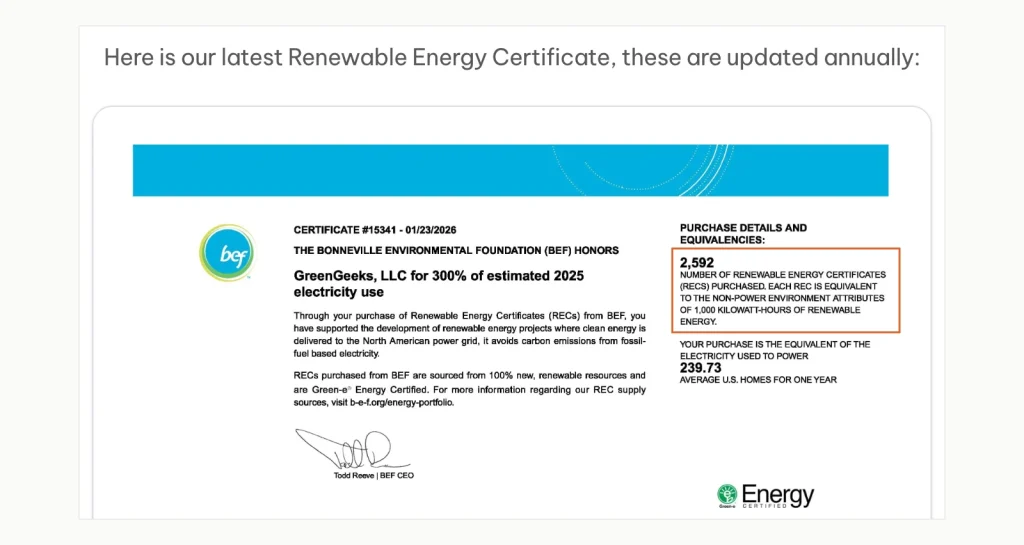
Look at the boxed figure: 2,592 certificates, each standing for the green attributes of 1,000 kWh, bought for 2025. Source: GreenGeeks Going Green page, captured 26 October 2026.
So what does 300% actually buy? Three details matter. First, GreenGeeks supplies the inputs: its own page says it tells BEF how many servers and staff it has, and BEF estimates the rest. Second, the certificate names projects on the North American grid, while two of the four data centers are in the Netherlands and Singapore. Third, RECs don’t change the electricity a given server uses. They pay for renewable generation added somewhere on that grid.
The US EPA lists GreenGeeks as a Green Power Partner since 3 September 2009. Its profile rests on self-reported data, and the latest report covers March 2023 to February 2024, collected in June 2024. GreenGeeks also plants one tree per new account through One Tree Planted and claims more than 50,000 so far.
The Green Web Foundation’s checker passes greengeeks.com, but only because Cloudflare serves the website. So we tested the server addresses GreenGeeks publishes for its data centers. All four pass under GreenGeeks’ own name. One inconsistency remains: the dedicated server page says those machines run on 100% renewable energy, while its other plan pages say 300%.
Where Your Site Can Live
GreenGeeks lists four data centers: Chicago, Montreal, Amsterdam and Singapore. You pick one at checkout, and moving later costs a one-time USD 29.95. Network records show the Chicago and Amsterdam addresses belong to Internap’s network, and the Montreal and Singapore ones to Leaseweb’s.
One detail is out of date. The Montreal test address on GreenGeeks’ data center page didn’t answer at all on 26 October 2026. The server name behind it, mtl200, now points to a different address that works. Older reviews also list Phoenix and Toronto, but neither appears on GreenGeeks’ data center page today.
Network Latency From 10 Countries
On 26 October 2026 we pinged each data center from one home internet connection in each of 10 countries, using the free Globalping network. Each test sent 10 packets. Latency is the round-trip time of a small packet, in milliseconds (ms). It shows how far your visitors are from the server, not how fast a page loads or how busy the server is.
| Probe city | Chicago | Montreal | Amsterdam | Singapore |
|---|---|---|---|---|
| Philadelphia, US | 22.2 | 16.2 | 81.2 | 247.6 |
| Toronto, Canada | 13.0 | 8.6 | 95.6 | 236.8 |
| Morelia, Mexico | 44.5 | 62.9 | 133.2 | 224.6 |
| London, UK | 101.1 | 91.8 | 21.3 | 172.3 |
| Barcelona, Spain | 118.6 | 98.1 | 37.1 | 246.5 |
| Hamburg, Germany | 116.5 | 102.0 | 17.6 | 258.8 |
| Rotterdam, Netherlands | 95.4 | 85.7 | 4.9 | 254.5 |
| Prayagraj, India | 269.6 | 231.1 | 177.9 | 103.9 |
| Singapore | 215.1 | 231.6 | 158.8 | 4.9 |
| Brisbane, Australia | 219.9 | 241.7 | 320.6 | 248.8 |
North America splits cleanly. Montreal was fastest from Philadelphia (16.2 ms) and Toronto (8.6 ms), and Chicago from Mexico (44.5 ms). Amsterdam served Europe well, from 4.9 ms in Rotterdam to 37.1 ms in Barcelona. Singapore answered India in 103.9 ms.
Australia is the gap. From Brisbane, Chicago (219.9 ms) beat Singapore (248.8 ms), so no GreenGeeks location serves Australian visitors well. One probe per country is a small sample, so read these numbers as distances, not rankings.
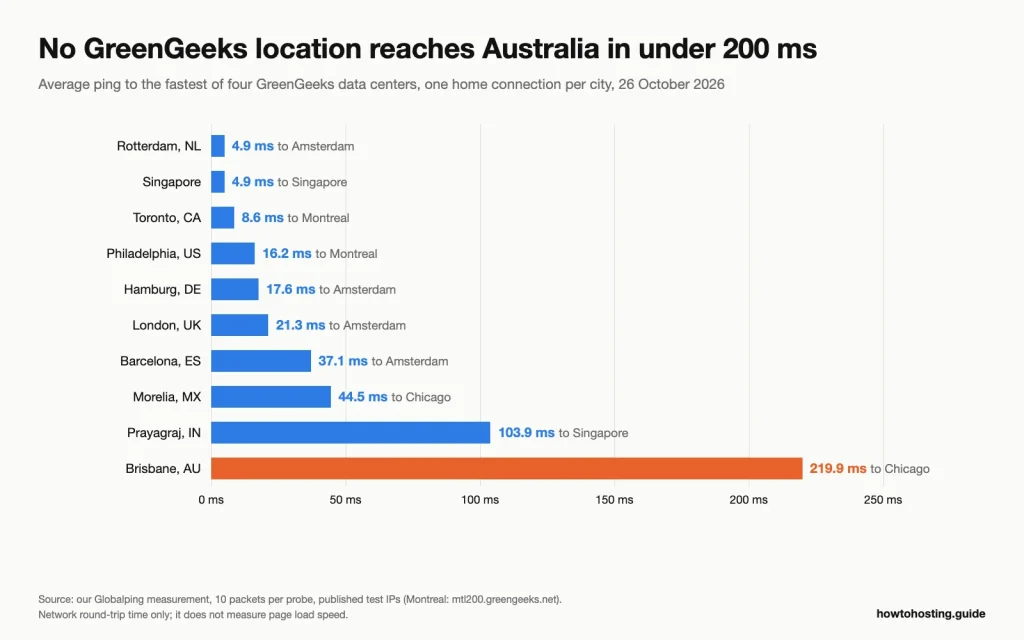
Brisbane’s best result, reached via Chicago, is the only one above 200 ms. Source: our Globalping measurement, 26 October 2026.
We found no independent benchmark of GreenGeeks that we could check. Its shared hosting page claims a “2.8x” performance boost and “100% faster” page loads without saying how either was measured. Customers mention speed mostly in passing. The outage reports we found follow malware cleanups, a forced server move in 2025 and a hardware failure in 2022.
Customer Experience
On Trustpilot, GreenGeeks has a TrustScore of 4.6 from 1,747 reviews, 295 of them from the past 12 months. Five-star reviews make up 83.4% and one-star 11.6%, with little in between. That split hides two different groups of reviewers.
Invited and Unprompted Reviews Tell Different Stories
Trustpilot records how each review arrived. Of the newest 200, posted between 24 February and 24 October 2026, 169 came through a review link GreenGeeks sends. They average 4.88. The other 31 were written unprompted and average 2.77. Fifteen of those 31 gave one star, against two of the 169 invited reviews. By stars, invited reviews run 160, 4, 1, 2 and 2 from five down to one; unprompted ones run 13, 0, 0, 3 and 15.
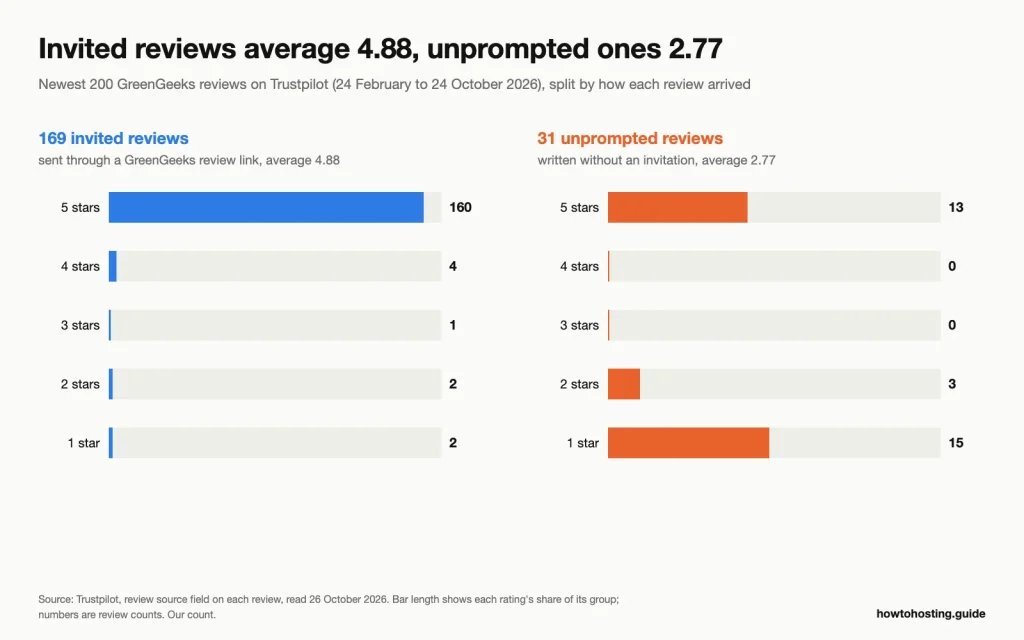
Almost every invited review is five stars; nearly half the unprompted ones are one star. Source: Trustpilot, newest 200 reviews, read 26 October 2026, our count.
Neither group is fake. They capture different moments. Most five-star reviews in our sample praise a support chat or agent. Of the 22 unprompted negative reviews from the past year, 11 describe a billing or account problem. GreenGeeks replied to all 27 negative reviews from the past year, in 0.63 days on average.
What Keeps Customers Around
The praise is consistent and specific: fast chat replies, agents who explain the fix, and hands-on help with migrations. Many five-star reviewers say they’ve stayed for years, some for more than a decade. A smaller group says it chose GreenGeeks for the tree planting or the renewable energy commitment.
Where Complaints Cluster
We read all 27 one- and two-star reviews posted between 26 October 2025 and 24 October 2026. Seven describe charges at renewal or cancellation. Six describe slow or unhelpful support, and four describe sites shut down after malware or a legal complaint.
The billing stories share a pattern. One customer cancelled 11 days before renewal and was charged USD 235 anyway. Another says no renewal notice arrived before a USD 279 charge. A third was billed USD 370 for an old shared plan that kept renewing after a move to VPS.
The rest are smaller groups. Two customers were locked out by two-factor authentication, and two complained about lost files or awkward backup restores. Two more had new orders refused without a reason. One customer of about a year writes that support moved to AI and human replies turned rude.
Reddit Threads From 2024 to 2026
Reddit discussion of GreenGeeks is thin but matches Trustpilot. The USD 235 cancellation charge appeared there too, on 21 September 2026. In March 2025, two reseller customers described a forced server move with a week’s notice. Sites pointing straight at the old IP address went down, and SSL took hours to recover.
In August 2024, a customer who had transferred a domain away was still charged for its renewal and privacy add-on. The poster says GreenGeeks refunded it only after a chargeback threat. Older threads cover a January 2022 outage of about a day and the June 2023 breach notice.
Two identical “is GreenGeeks really green?” posts appeared in different subreddits about two hours apart on 6 March 2026. Both carried an affiliate discount line, so we treat them as marketing.
How to Reach Support
Live chat runs 24/7, tickets go through the dashboard, and the phone number is 1-877-326-7483. GreenGeeks no longer publishes phone hours. Its contact page listed 9 a.m. to midnight Eastern time, seven days a week, until at least 5 May 2026. The redesigned page shows only the number.
Pro and Premium customers get priority support. Policy cases work differently: the acceptable use policy handles them by ticket only, with no phone or chat. A customer who doesn’t answer a policy email within 48 hours can be suspended.
When to Use GreenGeeks
GreenGeeks makes the most sense when the energy paperwork matters to you and your visitors are in North America or Europe.
A business that reports on its footprint: GreenGeeks can show a dated, numbered BEF certificate and an EPA partner listing. That’s proof you can cite in a green report, with the limits explained above.
A one-year project: USD 35.40 buys 12 months of LiteSpeed hosting with a free domain, and the 30-day refund covers a bad start. Plan the exit before the USD 167.40 renewal arrives.
Several small sites for North American visitors: Pro hosts unlimited sites on 50 GB with on-demand backups. From Philadelphia, Toronto and Mexico, the nearer of Chicago and Montreal answered in 8.6 to 44.5 ms.
- cPanel and LiteSpeed caching on every shared plan.
- 24/7 live chat that reviewers praise for speed.
- A data center in the Netherlands for European visitors.
- Managed VPS plans that don’t jump at renewal.
When NOT to Use GreenGeeks
Several limits only show up in the terms, after you’ve paid.
Long-term email storage: The acceptable use policy defines any message older than 30 days, or mail totalling 10 GB, as archived mail. Archived mail is banned, and GreenGeeks may remove it without notice.
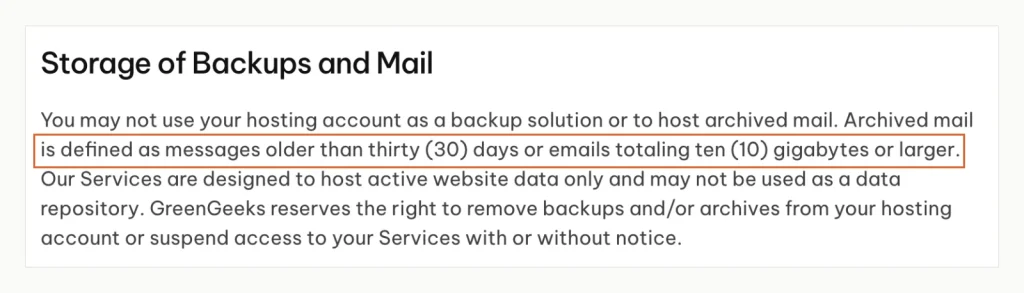
The boxed line is the definition that turns old mail into a policy breach. Source: GreenGeeks Acceptable Use Policy, captured 26 October 2026.
The same policy forbids automatic forwarding to Gmail, Yahoo or Outlook. A long-lived mailbox belongs with a dedicated email host instead.
Paid compensation for downtime: The 99.9% SLA (service level agreement) in GreenGeeks’ terms says only that GreenGeeks “will try to maintain maximum uptime.” It offers no credit or refund when it misses.
Backups on a VPS: VPS plan cards list daily backups, but the terms and the backup policy both say GreenGeeks doesn’t back up VPS servers. Arrange your own.
A discount for prepaying: There isn’t one. Two- and three-year terms cost close to the renewal rate from day one.
An Australian audience: Our Brisbane probe reached Chicago faster than Singapore, and both took more than 200 ms.
Renewable certificates for your region: GreenGeeks’ RECs fund projects on the North American grid. They don’t fund projects on the grids in the Netherlands or Singapore, where two of its data centers sit.
Cancelling close to renewal: Customers report charges even after cancelling early. The terms require auto-renewal to be off five business days ahead, and GreenGeeks bills 24 hours before the renewal date.
InterServer cuts the renewal bill and drops the storage cap. Kualo adds the uptime credits GreenGeeks doesn’t offer.
- GreenGeeks Web Hosting reviews from United States
| Average score | 4.62 |
| Number of reviews | 749 reviews |
- GreenGeeks Web Hosting reviews from Canada
| Average score | 4.49 |
| Number of reviews | 329 reviews |
- GreenGeeks Web Hosting reviews from United Kingdom
| Average score | 3.84 |
| Number of reviews | 96 reviews |
- GreenGeeks Web Hosting reviews from Spain
| Average score | 4.28 |
| Number of reviews | 48 reviews |
- GreenGeeks Web Hosting reviews from Australia
| Average score | 3.57 |
| Number of reviews | 35 reviews |
- GreenGeeks Web Hosting reviews from Mexico
| Average score | 4.79 |
| Number of reviews | 25 reviews |
- GreenGeeks Web Hosting reviews from France
| Average score | 3.62 |
| Number of reviews | 25 reviews |
- GreenGeeks Web Hosting reviews from Germany
| Average score | 3.70 |
| Number of reviews | 21 reviews |
- GreenGeeks Web Hosting reviews from India
| Average score | 3.68 |
| Number of reviews | 19 reviews |
- GreenGeeks Web Hosting reviews from Italy
| Average score | 4.61 |
| Number of reviews | 18 reviews |
- GreenGeeks Web Hosting reviews from New Zealand
| Average score | 4.69 |
| Number of reviews | 16 reviews |
- GreenGeeks Web Hosting reviews from South Africa
| Average score | 4.40 |
| Number of reviews | 15 reviews |
- GreenGeeks Web Hosting reviews from Pakistan
| Average score | 3.87 |
| Number of reviews | 15 reviews |
- GreenGeeks Web Hosting reviews from Denmark
| Average score | 3.67 |
| Number of reviews | 15 reviews |
- GreenGeeks Web Hosting reviews from Belgium
| Average score | 3.93 |
| Number of reviews | 15 reviews |
- GreenGeeks Web Hosting reviews from Egypt
| Average score | 3.46 |
| Number of reviews | 14 reviews |
- GreenGeeks Web Hosting reviews from Peru
| Average score | 4.88 |
| Number of reviews | 12 reviews |
- GreenGeeks Web Hosting reviews from Sweden
| Average score | 4.67 |
| Number of reviews | 12 reviews |
- GreenGeeks Web Hosting reviews from Portugal
| Average score | 4.67 |
| Number of reviews | 12 reviews |
- GreenGeeks Web Hosting reviews from Netherlands
| Average score | 4.09 |
| Number of reviews | 11 reviews |
- GreenGeeks Web Hosting reviews from Chile
| Average score | 5.00 |
| Number of reviews | 10 reviews |
- GreenGeeks Web Hosting reviews from Israel
| Average score | 3.40 |
| Number of reviews | 10 reviews |
- GreenGeeks Web Hosting reviews from Romania
| Average score | 4.11 |
| Number of reviews | 9 reviews |
- GreenGeeks Web Hosting reviews from Greece
| Average score | 4.88 |
| Number of reviews | 8 reviews |
- GreenGeeks Web Hosting reviews from Ireland
| Average score | 4.00 |
| Number of reviews | 8 reviews |
- GreenGeeks Web Hosting reviews from Colombia
| Average score | 5.00 |
| Number of reviews | 8 reviews |
- GreenGeeks Web Hosting reviews from Brazil
| Average score | 5.00 |
| Number of reviews | 8 reviews |
- GreenGeeks Web Hosting reviews from Kenya
| Average score | 4.88 |
| Number of reviews | 8 reviews |
- GreenGeeks Web Hosting reviews from Croatia
| Average score | 3.50 |
| Number of reviews | 8 reviews |
- GreenGeeks Web Hosting reviews from Algeria
| Average score | 3.31 |
| Number of reviews | 7 reviews |
GreenGeeks Plans and Pricing
Entry price: USD 2.95/mo for Lite, prepaid for 12 months. Renews at: USD 13.95/mo, 4.73 times as much. Prices are GreenGeeks’ USD prices as listed, with no tax line shown, checked in the cart on 26 October 2026. That renewal sits well above InterServer’s USD 7 a month and HostPapa’s USD 10.99 before tax on a one-year term.
| Plan | Sites and storage | First term | Renews at | Increase |
|---|---|---|---|---|
| Lite | 1 site, 25 GB | USD 2.95/mo, 12 months (USD 35.40) | USD 13.95/mo | 4.73x |
| Pro | Unlimited sites, 50 GB | USD 4.95/mo, 12 months (USD 59.40) | USD 18.95/mo | 3.83x |
| Premium | Unlimited sites, 100 GB | USD 8.95/mo, 12 months (USD 107.40) | USD 30.95/mo | 3.46x |
| Reseller RH-25 | 25 cPanel accounts, 60 GB | USD 19.95/mo, 12 months | USD 34.95/mo | 1.75x |
| Reseller RH-50 | 50 cPanel accounts, 80 GB | USD 24.95/mo, 12 months | USD 49.95/mo | 2.00x |
| Reseller RH-80 | 80 cPanel accounts, 160 GB | USD 34.95/mo, 12 months | USD 69.95/mo | 2.00x |
| VPS 4 GB | 4 vCPU, 75 GB SSD | USD 69.95/mo, monthly or yearly | USD 69.95/mo | 1.00x |
| VPS 8 GB | 6 vCPU, 150 GB SSD | USD 129.95/mo, monthly or yearly | USD 129.95/mo | 1.00x |
| VPS 16 GB | 6 vCPU, 250 GB SSD | USD 179.95/mo, monthly or yearly | USD 179.95/mo | 1.00x |
Renewal warning: Lite’s first 12 months cost USD 2.95/mo, and the price then becomes USD 13.95/mo, a 372.9% increase. Pro rises 282.8% and Premium 245.8% at their first renewal.
Why the Three-Year Term Costs More
Most hosts reward longer prepayment. GreenGeeks does the opposite, because the discount exists only on the 12-month term. In the cart, Lite costs USD 13.95/mo on two-year billing and USD 13.45/mo on three-year billing, from day one. Monthly billing is USD 13.95.
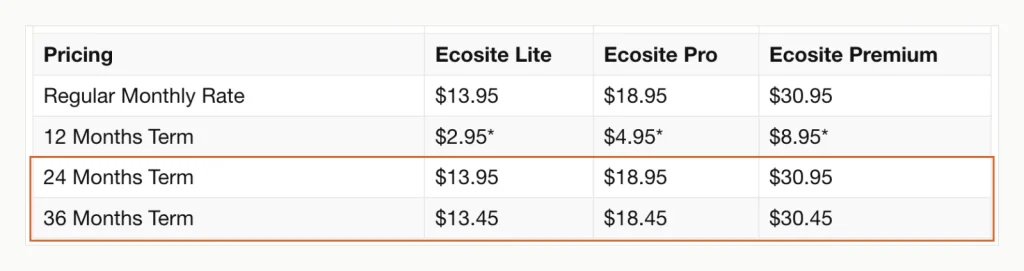
The boxed rows show the two- and three-year terms priced near the regular rate. Source: GreenGeeks Shared Hosting Features and Pricing help article, captured 26 October 2026.
We count three-year totals the cheapest way to pay for all 36 months, renewals included. On Lite, that route is one promotional year, then two yearly renewals: USD 35.40 + 167.40 + 167.40 = USD 370.20. Prepaying 36 months costs USD 484.20, and paying monthly costs USD 502.20. Pro follows the same pattern at USD 514.20, 664.20 and 682.20. Premium comes to USD 850.20, 1,096.20 and 1,114.20.
Prepay warning: GreenGeeks’ 36-month term costs USD 114.00 more than the 12-month route on Lite, USD 150.00 more on Pro and USD 246.00 more on Premium.
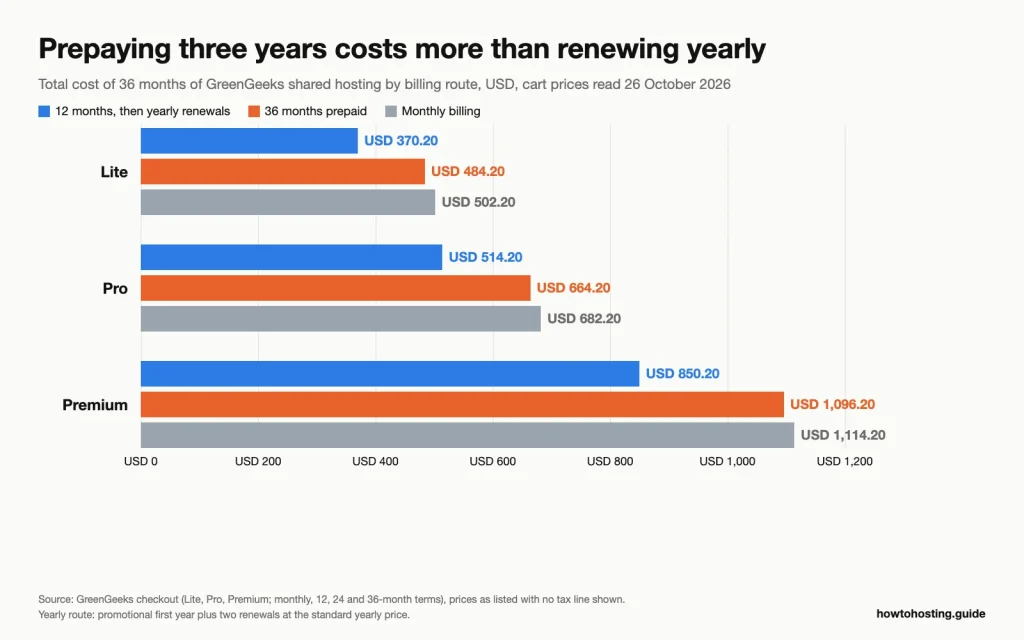
The orange 36-month bars sit above the blue yearly route on every plan. Source: GreenGeeks checkout, 26 October 2026.
Less Space for More Money Since 2024
Archived copies of GreenGeeks’ plan pages show two changes. Between 6 and 9 November 2024, Lite dropped from 50 GB to 25 GB. Pro and Premium swapped unlimited space for 50 GB and 100 GB. The regular rates rose that week from USD 11.95, 16.95 and 26.95 to USD 12.95, 17.95 and 29.95.
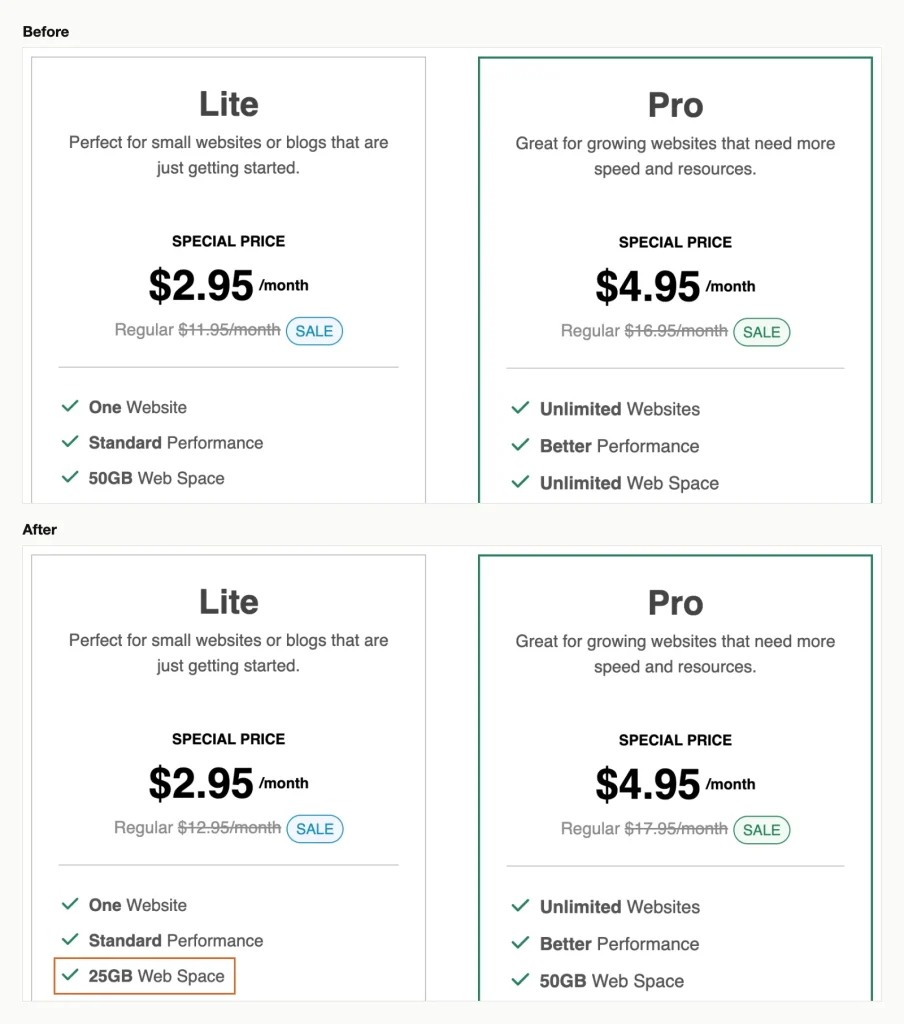
Compare the Web Space lines and the struck-through regular prices in the two copies. Source: Wayback Machine captures of GreenGeeks’ WordPress hosting page, 6 and 9 November 2024.
A second rise followed between 12 and 19 December 2025, when each renewal went up by USD 1. Across both changes, Lite’s regular rate rose 16.7%, from USD 11.95 to 13.95, while its space halved. Pro’s is up 11.8% and Premium’s 14.8%.
GreenGeeks also ran a sale last winter. Lite cost USD 1.95 a month for the first year from early November 2025 until at least 23 January 2026. That sale changed only year one, and the renewal stayed at the standard rate.
Reseller, VPS and Dedicated Servers
Reseller plans rise sharply at renewal. RH-25 goes from USD 19.95 to 34.95, and RH-50 and RH-80 roughly double, to USD 49.95 and 69.95. They include WHM (cPanel’s reseller console), an eNom domain reseller account and a WHMCS Starter billing license at no charge. GreenGeeks deducts that license cost from any refund, though. Our reseller hosting comparison ranks GreenGeeks against 11 other wholesalers.
The managed VPS line has no promotion at all. It costs USD 69.95, 129.95 or 179.95 a month, the same on monthly or yearly billing and at renewal. Each plan includes cPanel, a dedicated IP and 10 TB of data transfer. Dedicated servers start from USD 169 a month through sales, with no published specs, and the terms exclude them from the money-back guarantee.
Charges That Arrive Later
- Backup restores: Lite gets one free restore a month, then USD 25 each.
- Changing data center: a one-time USD 29.95.
- Extra migrations: shared plans include one free site move within 30 days of signup, then USD 15 per site.
- Dedicated IP and AlphaSSL: USD 48 a year and USD 99.95 a year below Premium.
- Free domain: if you claim a refund in the first 30 days, GreenGeeks keeps the registration fee.
- Cancelling: you’re billed for the full month you cancel in, and auto-renewal must be off at least five business days before the renewal date.
Is the Price Fair?
For one year, yes. USD 35.40 buys LiteSpeed caching, 25 GB and a free domain, with a 30-day refund window. From year two, USD 167.40 a year is expensive for 25 GB, and the missing multi-year discount removes the usual way to soften it. GreenGeeks is priced for buyers who value the energy certificates enough to pay full rate, or who plan to move after twelve months.
- Bandwidth Unlimited
- Panel cPanel
- Number of Sites 1
- Bandwidth Unlimited
- Panel cPanel
- Number of Sites Unlimited
- Bandwidth Unlimited
- Panel cPanel
- Number of Sites Unlimited
- CPU 4 cores
- RAM 2 GB
- CPU 4 cores
- RAM 4 GB
- CPU 6 cores
- RAM 8 GB
GreenGeeks Transparency Score
These grades measure how easy each fact is to find and read. A harsh term written plainly can still earn a good grade.
Company information: Good. GreenGeeks names its founders, its LLC and a Wilmington, Delaware mailing address. Its June 2023 breach notice is on the California Attorney General’s website. We found no company registration number on its site, though, and its About page says 2008 while its shared hosting page says 2009.
Pricing transparency: Good. Plan cards print the renewal price and the 12-month term, and the cart repeats both. The undiscounted two- and three-year prices appear only in the cart and a help article.
Technical documentation: Limited. Resource limits live in a help article labelled March 2021. The Montreal test address is dead, and dedicated server specs aren’t published.
Terms and policies: Limited. The terms, dated 9 November 2022, contradict the plan cards on backups. They keep platform copies 24 hours “for disaster recovery purposes only.” The SLA names a percentage but no remedy.
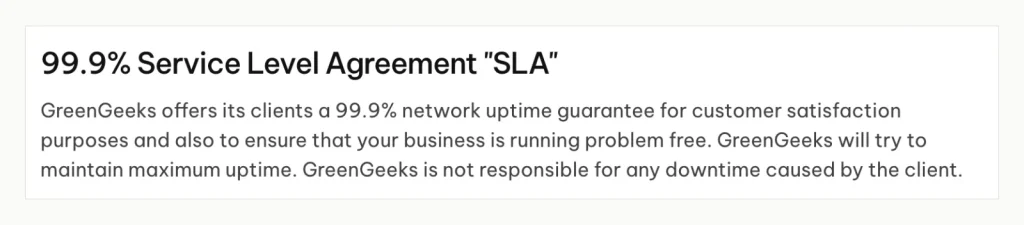
Read past the 99.9% heading: the clause promises only that GreenGeeks will try. Source: GreenGeeks Terms of Service, captured 26 October 2026.
Overall Transparency: Limited. GreenGeeks is clear about what you pay. It is far less clear about what you get after paying: backups, uptime and storage limits are scattered across documents that disagree.
Alternatives to GreenGeeks
Each pick below fixes one weakness named above. That means the renewal jump, the uptime promise with no credits, or certificates bought for another continent. Prices are as each provider lists them, with no tax line shown, checked on 26 October 2026.
For a Smaller Renewal Bill: InterServer
InterServer charges USD 2.50 for the first month and USD 7 a month after. On yearly billing, that’s USD 30 for the first year and USD 84 for each year after. Three years cost USD 198.00 against USD 370.20 on GreenGeeks Lite, and storage isn’t capped for normal website and email use.
For Uptime Credits and a 60-Day Refund: Kualo
Kualo’s Solo plan costs USD 9.99 a month for one site and 10 GB, or USD 99.90 a year. Its 99.9% guarantee pays a 10% to 100% account credit depending on downtime, and the refund window is 60 days. It hosts in the UK or the US at the same price and says its power is 100% renewable, certified by Green-e.
For European Sites on Renewable Power: Infomaniak
Infomaniak runs its own data centers in Switzerland and says they use 100% renewable energy without air conditioning. Shared hosting includes 250 GB and 20 websites, with a 30-day free trial and a 30-day refund. Our Infomaniak review covers its prices and contract terms.
Conclusion
Our Average Score for GreenGeeks is 4.3 from 1,720 reviews, and the evidence supports it. Support is fast, the energy certificate is real and dated, and the servers cover North America and Europe well. The cost is year two. Lite renews at 4.73 times its first-year rate, holds half its pre-November 2024 space, and longer terms carry no discount.
Buy GreenGeeks for a North American or European site if documented renewable matching is part of the brief. Take the 12-month term, note the renewal date, and switch off auto-renewal well before the five-business-day deadline if you plan to leave. Keep your own backups, and keep old mail somewhere else.
If the second-year bill matters more than the certificate, InterServer costs USD 172.20 less over three years. If you need uptime credits or a 60-day trial, choose Kualo. UK readers can compare GreenGeeks with London-hosted options in our UK eco hosting comparison.
Frequently Asked Questions
Is GreenGeeks really green, or is the 300% claim marketing?
It’s documented, within limits. GreenGeeks’ latest BEF certificate, dated 23 January 2026, covers 300% of its estimated 2025 use with 2,592 RECs. Those certificates fund renewable projects on the North American grid rather than powering your server directly.
Are GreenGeeks’ prices only for the first year?
Yes. Lite costs USD 2.95/mo for 12 months, then USD 13.95/mo. Two- and three-year terms don’t get the promotional price, so the cheapest route is one promotional year followed by yearly renewals.
Why do GreenGeeks customers get charged after cancelling?
The terms require auto-renewal to be switched off at least five business days before the renewal date, for each service separately. GreenGeeks charges 24 hours early and doesn’t refund renewals. Seven of the 27 negative Trustpilot reviews in the past year describe this kind of charge.
GreenGeeks or HostPapa for a small site?
HostPapa Essentials is USD 2.95/mo if you prepay three years. Its renewal is USD 8.99 for another three years or USD 10.99 for one, before tax. GreenGeeks Lite renews at USD 13.95. HostPapa’s homepage and plan page make no renewable energy claim, so pick it for price and GreenGeeks for the certificate.
Is GreenGeeks a good fit for a nonprofit or small business with a green policy?
Often, yes. It gives you a citable REC certificate and an EPA partner listing, with US, Canadian and European servers. Budget USD 167.40 a year for Lite from year two, and keep your own backups.
What can I get back if I cancel GreenGeeks in the first 30 days?
Hosting fees on shared, reseller and VPS plans. Domains, add-ons, setup fees and dedicated servers are excluded, and a free domain’s registration fee is deducted. Nothing is refundable after 30 days or on renewals.
